
Women in Ancient Egypt: Rights, Roles, and a Social Standing That Surprised the Ancient World
Ancient Egyptian women held a social and legal status that would not be matched in Europe for another 3,000 years.
They could own and sell property. They could initiate a divorce. They could run businesses, work as scribes, serve as priests, and — in at least four documented cases — rule as pharaoh. In a world where most ancient civilizations treated women as the legal property of their fathers or husbands, Egypt stood apart.
This is not a modern reinterpretation. The evidence is carved into temple walls, written on papyrus scrolls, and buried in tombs you can still visit today.
Legal Rights That Preceded the Modern World by Millennia
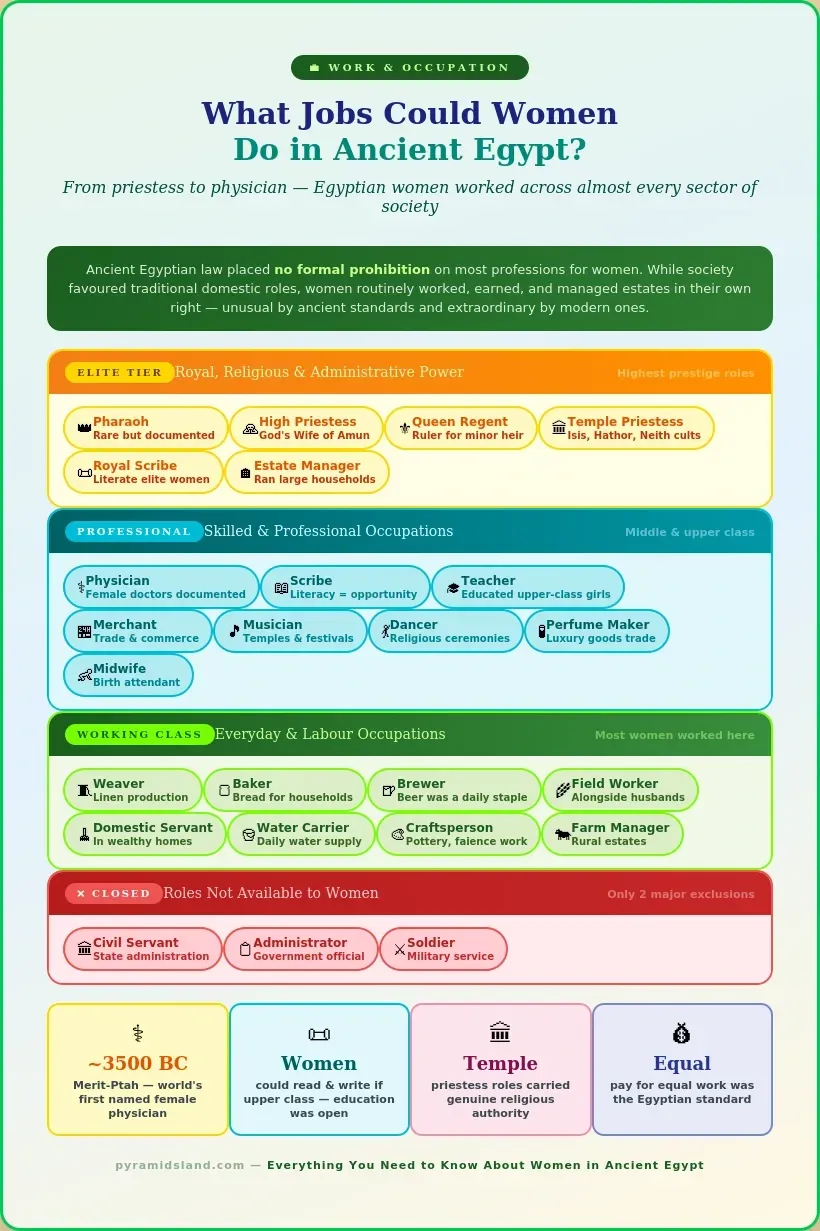
Egyptian women of equivalent social class had the same legal rights as men. This was codified — not informal, not dependent on a kind husband, but embedded in the legal system.
A woman could own land, houses, and livestock in her own name. She could sell, lease, or will her property to whomever she chose. She could enter into contracts, appear in court as a witness or plaintiff, and conduct business independently.
Marriage contracts — the ancient equivalent of prenuptial agreements — typically favored the wife. If the husband initiated divorce, he forfeited claims to jointly held property and was required to pay maintenance for his former wife and children. Regardless of who initiated the separation, the wife retained her original dowry, any assets earned or inherited during the marriage, and full custody of the children. In most cases, she also kept the marital home.
Adultery was illegal for both partners — but it was the woman's punishment that was more severe and more public: nose-slitting, a disfigurement chosen because it was both humiliating and impossible to hide. The double standard was real, even in a society that offered women more legal protection than most.
For context: in contemporary Athens — often celebrated as the birthplace of democracy — women could not own property, could not appear in court, and required a male guardian (father, husband, or son) to conduct any legal business. Egyptian women had full legal personhood more than 2,000 years before European women gained comparable rights.
Marriage and Family Life
Girls typically married between the ages of 12 and 14. Families usually arranged marriages, though a woman could refuse a proposal — forced marriage was not legally sanctioned.
While pharaohs commonly practiced polygamy (for both political and dynastic reasons), the vast majority of Egyptian marriages were monogamous. Marriage was expensive, and most men could not afford to maintain multiple households.
The primary purpose of marriage, in legal and cultural terms, was the production of an heir. Infertility was one of the most common grounds for divorce. This pragmatism extended to family planning: a papyrus dating to approximately 1600 BC contains what appears to be an early description of contraceptive methods and pregnancy termination — suggesting that women had at least some degree of reproductive choice, though the extent of its practice remains debated.
Within the household, women managed domestic operations: preparing meals, brewing beer (a dietary staple, since Nile water was often unsafe to drink), raising children, maintaining the home, and laundering clothes. Wealthier women supervised these tasks rather than performing them, directing household servants or slaves.
Work and Public Life
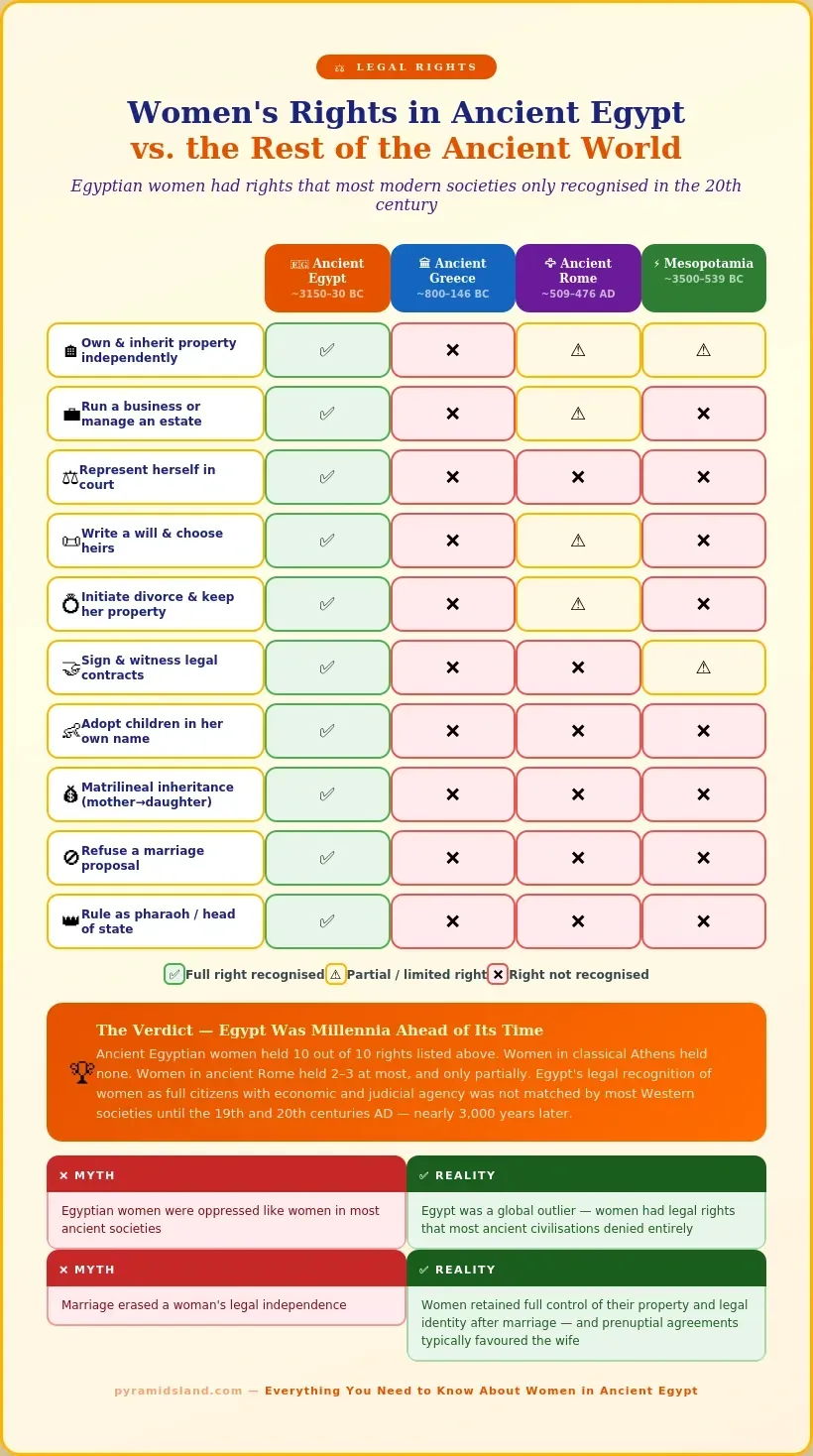
Egyptian women were not confined to the household. The evidence shows women working across a range of professions:
Priestesses served in temples dedicated to female deities. The role of "God's Wife of Amun" — held by Hatshepsut before she became pharaoh — was one of the most politically powerful religious positions in Egypt.
Scribes — while most scribes were male, evidence of female scribes exists, particularly in later periods.
Doctors — the physician Merit-Ptah, who lived around 2700 BC, is one of the earliest named female physicians in recorded history.
Businesswomen ran textile workshops, breweries, and trade operations. Records from the workers' village at Deir el-Medina (Luxor's West Bank) show women managing financial transactions, lending goods, and engaging in commercial disputes.
Entertainers — female musicians, dancers, and singers held valued social roles, particularly in religious ceremonies and royal court events.
The role of "God's Wife of Amun" deserves special attention. This was not a ceremonial title. By the Third Intermediate Period, the God's Wife controlled the temple economy of Karnak — one of the wealthiest institutions in the ancient world. She had independent wealth, a personal estate, and political authority that sometimes rivaled the pharaoh's. At Karnak, your guide can show you the chapels built by God's Wives — women who administered more resources than most kings.
Beauty and Self-Presentation
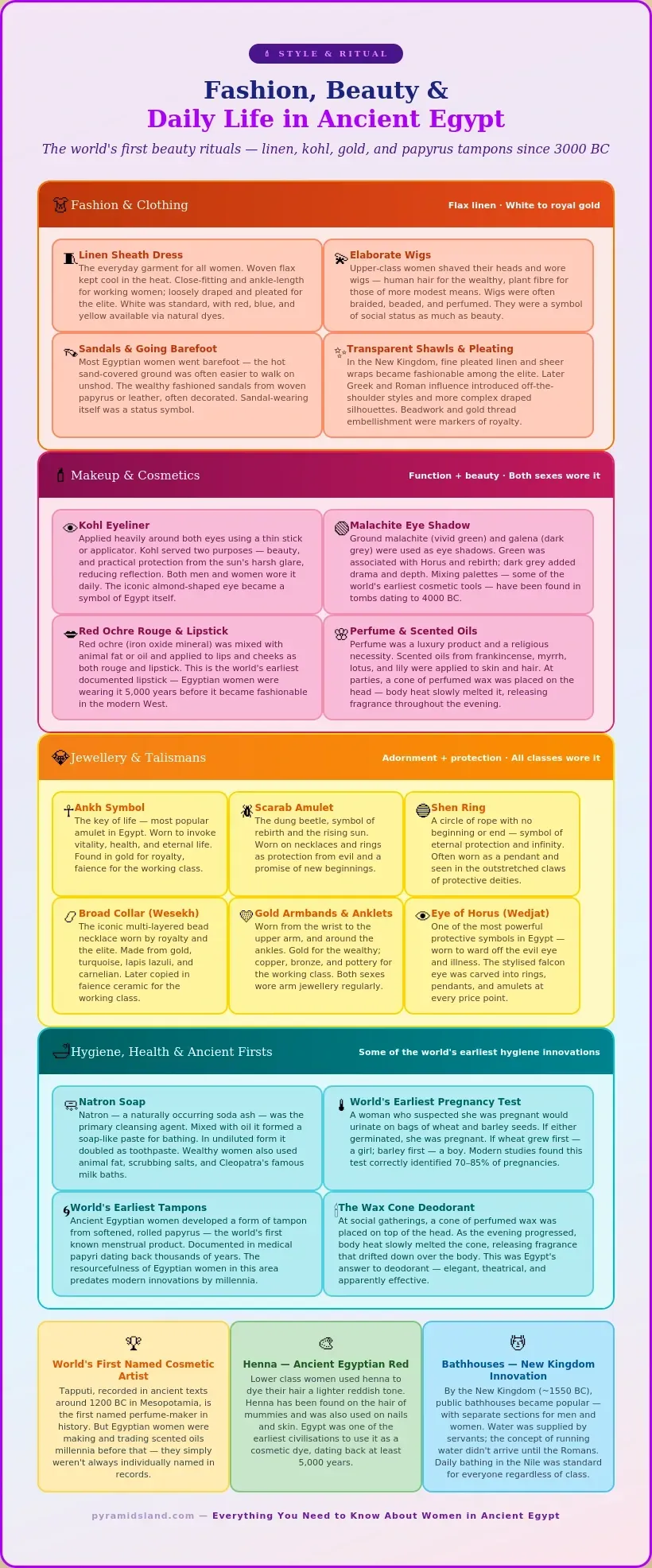
Cosmetics were universal across all classes. Kohl (ground galena) was applied heavily around the eyes — both for beauty and for protection against the harsh desert sun glare. Green malachite served as eye shadow. Red ochre, mixed with oil or fat, was used as rouge and lip color. Makeup applicators, mirrors, and perfume containers appear frequently in tomb assemblages — suggesting that personal appearance mattered enough to bring into the afterlife. At the GEM, your guide can point out cosmetic sets in the burial goods: palettes, applicator sticks, and mirror discs polished to a reflective finish.
Hair practices varied by class. Working-class women wore their hair long and loose, sometimes tinted with henna. Elite women often shaved their heads and wore elaborate wigs — the finest made from human hair, more affordable versions padded with plant fibers. Examples of both survive in museum collections.
Female Pharaohs
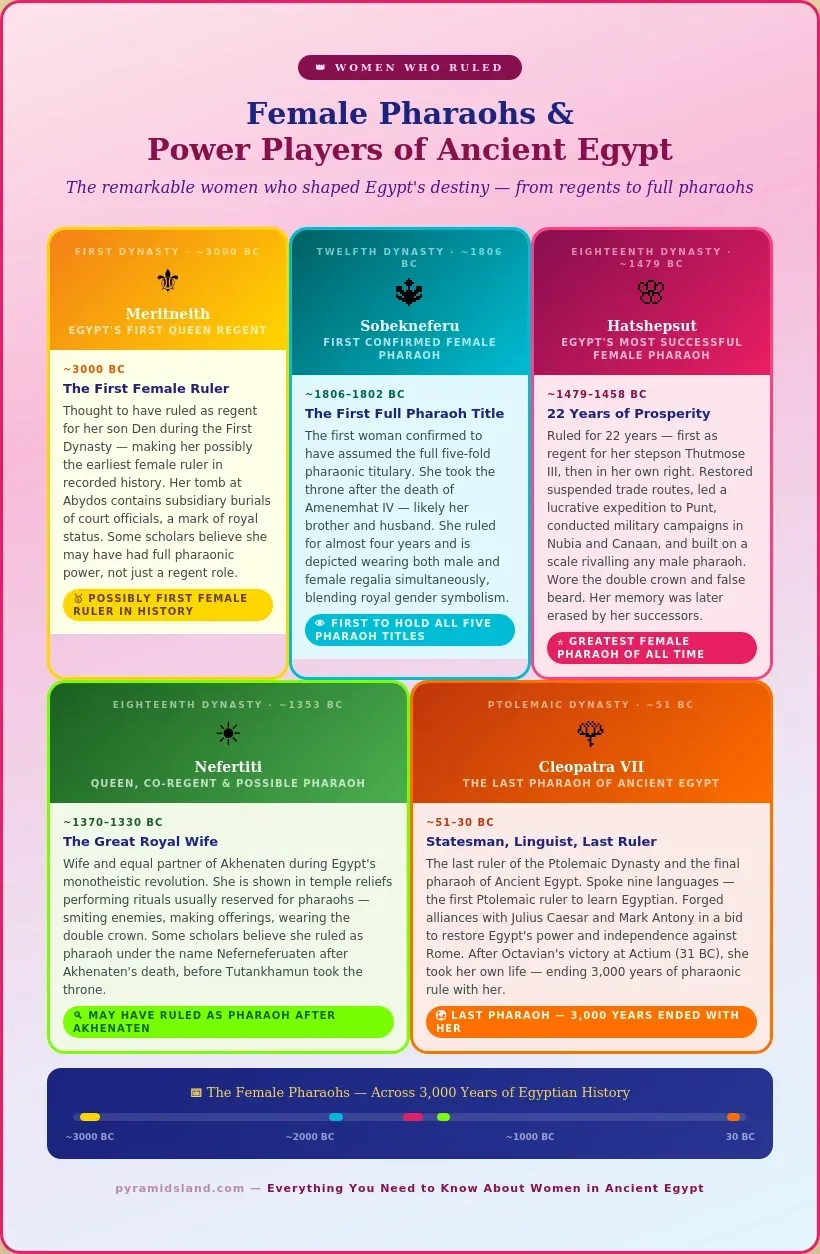
At least four women held the full title of pharaoh during Egypt's dynastic period:
Sobekneferu (c. 1806–1802 BC) — the first confirmed female pharaoh, ruling at the end of the 12th Dynasty.
Hatshepsut (c. 1479–1458 BC) — the most successful and best-documented female pharaoh, ruling for approximately 21 years during the 18th Dynasty. Her mortuary temple at Deir el-Bahri on Luxor's West Bank is one of the most architecturally significant structures in Egypt. → Read her full story
Neferneferuaten (c. 1334–1332 BC) — possibly Nefertiti ruling under a different name, though her identity remains debated among Egyptologists.
Twosret (c. 1191–1189 BC) — the last pharaoh of the 19th Dynasty, who ruled briefly at the end of a chaotic succession period.
Cleopatra VII (51–30 BC) — the most famous name associated with female Egyptian power, though she was ethnically Macedonian Greek and ruled during the Ptolemaic period, not the pharaonic era. She was, however, the only Ptolemaic ruler who bothered to learn Egyptian.
The Queens Who Didn't Need the Throne
Not every powerful woman in ancient Egypt held the title of pharaoh. Some wielded influence through other channels — and their monuments are among the most impressive you will see.
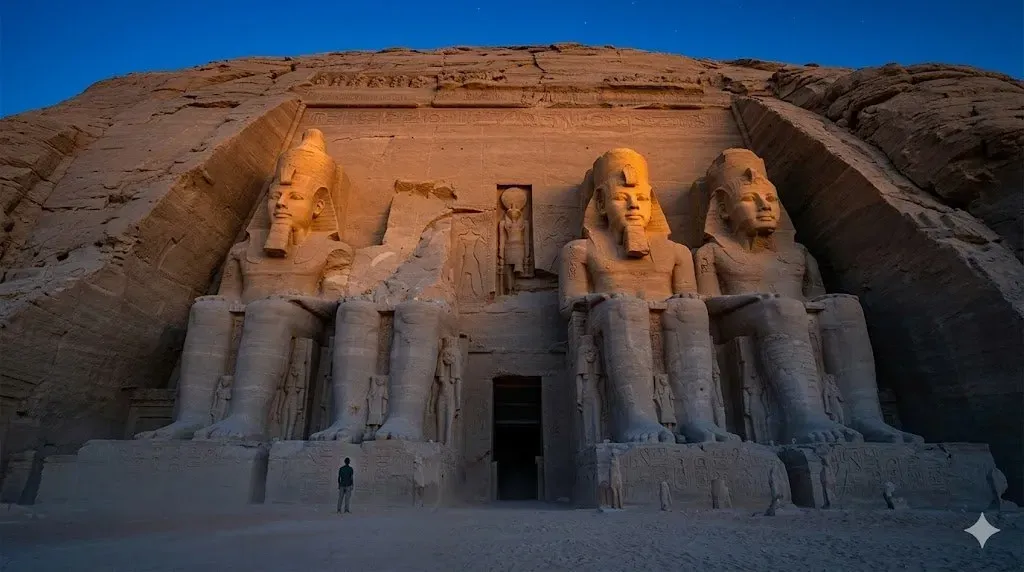
Nefertari — principal wife of Ramesses II and arguably the most honored queen in Egyptian history. At Abu Simbel, her temple stands beside the pharaoh's — and on its façade, her statues are carved the same height as his. In 3,000 years of Egyptian royal art, this is virtually unprecedented. It was a public declaration that she stood as his equal.
Her tomb in the Valley of the Queens (QV66) is considered the finest painted tomb in Egypt — and one of the finest in the world. The paintings are not faded. They blaze. Vivid reds, cobalt blues, and burnished golds on white plaster, depicting Nefertari being led by Isis through the afterlife, playing senet (a board game believed to represent the journey of the soul), and standing before Osiris. The quality of the brushwork is extraordinary — individual eyelashes are visible, the folds of her white linen dress catch light, and the colors look as if they were applied last year, not 3,200 years ago.
Access to QV66 is currently closed for conservation. The tomb opens and closes periodically to protect the fragile painted plaster — when it reopens, access requires a premium ticket (previously 1,400 EGP), with a daily limit of 150 visitors. Your guide can check the current access status and arrange tickets in advance if it has reopened by the time of your visit. Even when closed, the tomb's paintings are reproduced in high-quality displays at the Valley of the Queens visitor center and in the GEM's educational galleries — and Nefertari's story is visible at Abu Simbel, where her temple stands beside Ramesses II's.
Nefertiti — wife of Akhenaten and co-ruler during the Amarna revolution, when the entire Egyptian pantheon was replaced by a single god (the Aten). Her painted limestone bust — now in Berlin's Neues Museum — is the most recognized image of ancient Egyptian art in the world. But Nefertiti was not merely decorative. Contemporary depictions show her smiting enemies (a role previously reserved exclusively for the pharaoh), and some Egyptologists believe she ruled briefly as pharaoh under the name Neferneferuaten after Akhenaten's death. She disappears from the record — her fate remains one of Egyptology's great unsolved mysteries.
The Amarna galleries at the GEM contain artifacts from Nefertiti and Akhenaten's household — a guide can walk you through the artistic revolution they launched and the theological crisis that followed.
→ Ancient Egyptian Religion — the Akhenaten revolution and Tutankhamun's restoration
Where to See the Evidence
The lives of ancient Egyptian women are not just found in textbooks. They are visible at the sites you visit on a standard Egypt itinerary — and with a guide who knows where to look, these sites transform from monuments to stories.
Deir el-Medina — Luxor West Bank
The workers' village where the artisans who built the royal tombs lived with their families. This is the most intimate window into ordinary life in ancient Egypt — and the best site in Egypt for understanding women's daily reality.
Tomb paintings here depict everyday domestic scenes: women baking, brewing beer, nursing children, and managing household affairs. But the real treasure is the documentary evidence. Ostraca (pottery fragments used as notepaper) found at the site record women managing financial transactions, lending goods, and engaging in commercial disputes — running their households as economic units.
The most remarkable document is the will of Naunakhte, a wealthy woman of Deir el-Medina who, in the 12th century BC, disinherited several of her children because they had not cared for her in her old age. She named each child and stated exactly who would receive what — and who would receive nothing. The document survives. The law was on her side. Three thousand years old, and it reads like a modern inheritance dispute.
Your guide at Deir el-Medina reads the names to you. The village stops being ruins and becomes a neighborhood — with families, grudges, and legal rights that work.
Tomb of Nefertari (QV66) — Valley of the Queens, Luxor
Described in the section above. Currently closed for conservation, the tomb opens and closes periodically to protect the paintings. When accessible, it requires a premium ticket (previously 1,400 EGP) with a daily limit of 150 visitors. Your guide checks the current status and arranges access if available. Even when the tomb is closed, Nefertari's story is told at Abu Simbel and through reproductions at the Valley of the Queens visitor center.
Abu Simbel — Aswan
Nefertari's temple stands beside Ramesses II's — and her façade statues are the same height as his. Your guide points this out as you approach: in the entire history of Egyptian royal art, this is almost unheard of. It is a carved declaration of equality, 3,200 years old and 20 meters tall.
→ Aswan Day Tours — Abu Simbel included
Hathor Temple at Dendera — Near Luxor
Dedicated to the goddess of love, music, and fertility — one of the Eye of Ra's benevolent manifestations. The temple ceiling (the sky goddess Nut, the 36 decans) is the most visually stunning interior in Egypt. On the exterior rear wall, you can see one of the only surviving large-scale depictions of Cleopatra VII — your guide points her out.
→ The Eye of Ra — Hathor as the Eye's benevolent form → Egyptian Astrology — the Dendera Zodiac ceiling
Deir el-Bahri — Luxor West Bank
Hatshepsut's mortuary temple. Three terraces, Punt reliefs, and the erasure scars. The full story is in our dedicated guide.
→ Queen Hatshepsut — her reign, her temple, and her erasure
NMEC — Cairo (Fustat)
The Royal Mummies Hall includes Hatshepsut and other female royals. Your guide walks you through the cases and explains who each woman was — not just their name, but their role, their power, and what the CT scans revealed about their lives and deaths.
→ Luxor Day Tours — Deir el-Medina, Valley of Queens, Hatshepsut's temple → Cairo Day Tours — GEM, NMEC, Saqqara
Why This Matters When You Visit
Understanding the status of women in ancient Egypt changes how you experience the sites. When the tomb of Nefertari is open — and it reopens periodically — you are not just looking at beautiful art. You are looking at the burial chamber of a woman who wielded real political influence, whose marriage contract likely guaranteed her significant independent wealth, and whose tomb was designed to ensure her passage into the afterlife on equal terms with any king. Even when the tomb is closed, her statues at Abu Simbel tell the same story in stone.
When your guide reads you Naunakhte's will at Deir el-Medina, you are hearing the voice of an ordinary woman who used the legal system to enforce her wishes — and won. When your guide points to Nefertari's statue at Abu Simbel and says, "same height as the pharaoh," you are seeing an equality carved in stone that many modern societies have yet to achieve.
Egypt's ancient past is not just about pharaohs and pyramids. It is about a civilization that, in certain fundamental ways, was more progressive than the societies that came after it. And that is something a guide can show you — at specific walls, in specific tombs, on specific statues — in ways no textbook can replicate.
→ Luxor Day Tours — Deir el-Medina, Valley of Queens, Karnak, Dendera → Aswan Day Tours — Abu Simbel, Philae → Tell us your dates and we'll build the itinerary
Myth vs Reality
Myth: women in ancient Egypt were oppressed like in most ancient societies
Reality: Compared to other ancient civilizations, Egyptian women had unusually strong legal rights, including owning property, managing wealth, and appearing in court independently.
Myth: Women had no political power
Reality: While politics was male-dominated, women could act as regents, influence policy, and in rare cases rule as pharaohs—most famously Hatshepsut.
Myth: Women were confined to the home
Reality: Women worked as merchants, musicians, weavers, healers, priestesses, and estate managers. Their labor was essential to Egypt’s economy and religious life.
Myth: Marriage erased woman's independence
Reality: Marriage did not cancel a woman’s legal identity. Women retained control of their personal property and could initiate divorce.
Myth: Female power was symbolic, not real
Reality: Women exercised real economic, legal, and religious authority. Records show women managing estates, writing wills, and directing inheritance decisions.
Myth: Powerful women were rare exceptions
Reality: While ruling queens were uncommon, everyday women routinely exercised rights that were exceptional by ancient standards.
FAQ
What rights did women have in ancient Egypt?
Women could own and sell property, enter into contracts, appear in court, initiate divorce, run businesses, and will their assets to whomever they chose. These rights were codified in law and applied to women of all social classes. Marriage contracts typically favoured the wife, guaranteeing her the marital home and custody of children in the event of divorce.
Could women be pharaohs in ancient Egypt?
Yes. At least four women held the full title of pharaoh: Sobekneferu (12th Dynasty), Hatshepsut (18th Dynasty, the most successful), possibly Nefertiti as Neferneferuaten (18th Dynasty), and Twosret (19th Dynasty). Cleopatra VII ruled during the later Ptolemaic period. Hatshepsut's 21-year reign was one of the most prosperous in Egyptian history.
Were Egyptian women equal to men?
Legally, yes — women had the same property rights, court access, and contractual capacity as men of the same social class. Socially, Egypt was still patriarchal: men dominated government, the military, and most public offices. But the gap between legal equality and social practice was far narrower in Egypt than in any other ancient civilisation, including Greece and Rome.
Where can I see evidence of women's lives in Egypt?
The best sites are: Deir el-Medina (Luxor West Bank) for ordinary women's daily lives; Abu Simbel for Nefertari's temple alongside Ramesses II's; the Tomb of Nefertari (Valley of the Queens) when it reopens from conservation; Dendera for the Hathor temple; and Deir el-Bahri for Hatshepsut's mortuary temple. All are accessible on standard Luxor and Aswan itineraries.
Who was Nefertari?
he principal wife of Ramesses II (19th Dynasty) and arguably the most honoured queen in Egyptian history. Her temple at Abu Simbel features her statues at the same height as the pharaoh's — virtually unprecedented in Egyptian art. Her tomb (QV66) in the Valley of the Queens is considered the finest painted tomb in Egypt, with vivid colours intact after 3,200 years. The tomb is currently closed for conservation but reopens periodically — your guide can check status and arrange access.
Why is ancient Egypt important in women's history?
Because it recognized women as legal individuals with economic agency thousands of years before similar rights appeared in many other cultures.
Related Guides
- Queen Hatshepsut — her reign, her temple, and her erasure
- Ancient Egyptian Religion — goddesses, priestesses, and the divine feminine
- The Eye of Ra — Hathor, Sekhmet, and the goddesses of the Eye
- Egyptian Astrology — Senenmut's astronomical ceiling
- Karnak Temple Guide
- Valley of the Kings Guide
- One Day in Luxor Itinerary
- 2 Days in Luxor Itinerary

Ashraf Fares