
Egypt's Royal Mummies: Where to See Them & Who They Are
***Edited April 26, 2026
You can stand face-to-face with Ramesses II.
Not a statue. Not a relief. The actual preserved remains of the man who ruled Egypt for 67 years, built Abu Simbel, and fought the Battle of Kadesh — his hair, his teeth, the shape of his face, all visible under museum lighting 3,200 years after his death.
He is one of 20 royal mummies now displayed at the National Museum of Egyptian Civilization (NMEC) in Old Cairo — 18 kings and 2 queens, spanning the 17th to 20th Dynasties — each in a climate-controlled case inside a hall designed to replicate the darkness and silence of the Valley of the Kings. They were transferred there in April 2021 during the Pharaohs' Golden Parade — a nationally televised procession that moved 22 mummies through the streets of Cairo in nitrogen-filled capsules on custom-built vehicles, accompanied by a 21-gun salute and a performance by the Egyptian United Philharmonic Orchestra.
In this guide:
- Where to See the Royal Mummies — Visiting NMEC
- What a Pyramids Land NMEC Visit Looks Like
- What to Expect in the Royal Mummies Hall
- Which Pharaohs Are on Display
- Where Is Tutankhamun?
- How the Mummies Were Found
- How Mummification Worked
- NMEC vs GEM vs the Old Egyptian Museum
- Frequently Asked Questions
Where to See the Royal Mummies — Visiting NMEC
The royal mummies are at the National Museum of Egyptian Civilization (NMEC), located in Fustat (Old Cairo), overlooking Ain el-Sira Lake. This is not the Grand Egyptian Museum (GEM) near the Pyramids, nor the old Egyptian Museum in Tahrir Square. The mummies were moved to NMEC specifically — a point that causes confusion for many visitors planning their Cairo itineraries.
Address: El-Fustat Road, Ein Elsira, Old Cairo Opening hours: Daily 9 AM – 5 PM (last entry 3 PM). Fridays also open 6 PM – 9 PM (last entry 8 PM). Ramadan hours may be reduced. Getting there: Metro to Mar Girgis station, then a short taxi or Uber ride. Approximately 20–30 minutes from downtown Cairo, depending on traffic. On-site parking is available.
Ticket price (2026): EGP 550 for foreign adults, EGP 300 for students with a valid international ID. Children under 6 are free. The Royal Mummies Hall is fully included in the main ticket — no separate fee. Buy online the night before to skip the queue at the ticket window.
Time needed: a minimum of 90 minutes for the Royal Mummies Hall and the main chronological gallery. Allow 2–3 hours to see the entire museum. The mummies hall alone takes 30–45 minutes without a guide, but a guide transforms the visit — the most common review note is that the plaques alone don't provide enough context.
Combine with: NMEC is in the same neighborhood as Coptic Cairo (the Hanging Church, Abu Serga Church, Ben Ezra Synagogue). The two are a natural half-day pairing.
Facilities: Modern, fully air-conditioned, wheelchair accessible (elevators, designated parking). Restaurant and café on site. Gift shop with books on the mummies collection. Garden and lake views outside.
What a Pyramids Land NMEC Visit Looks Like
We arrive at NMEC at 9:00 AM opening — or as close as Cairo traffic allows. The museum opens daily at 9:00 AM (last entry 3:00 PM), and we aim to be inside by 9:15.
The route we follow with every group:
We start on the main ground floor (15–20 minutes) — a quick orientation to the timeline of Egyptian civilization from pre-dynastic to modern times, featuring the giant statues and a panoramic view of Fustat from the upper terrace. Then the upper galleries (30 minutes) — daily life, crafts, the evolution of writing and religion. This builds context for what comes next.
Then the descent to the Royal Mummies Hall. The ramp down feels like entering a tomb — and this is where we stop. Before anyone walks in, the briefing: "Inside, you will see real people who once ruled the world. No photos, no flash, no touching the glass. Speak quietly. Some of you may feel awe, some unease — both are normal. This is a sacred space for millions of Egyptians. Stay with me, and I'll tell you who each one was."
We move through the Mummies Hall slowly (45–60 minutes), in chronological order, from Seqenenre Tao to Ramesses VI. Each pharaoh gets a 60-second story — who they were, what their mummy tells us about their life and death.
We go directly to NMEC. No shopping detours, no papyrus factory stops. Because NMEC sits next door to Coptic Cairo (Old Cairo/Fustat), we almost always combine the two on the same morning. After the museum, we either walk or take a 5-minute golf-cart shuttle to the Hanging Church, the Ben Ezra Synagogue, and the Coptic Museum. It flows perfectly: ancient Egypt → early Christian Egypt. Total half-day, back to the hotel by 1:30 PM for lunch and rest before the afternoon.
What to Expect in the Royal Mummies Hall
The Royal Mummies Hall occupies the lower floor of NMEC, accessed by a descending ramp from the ground level. The design is intentional: you walk downward, as if entering a tomb.
The hall is dark, climate-controlled, and arranged as a serpentine path. Each mummy lies in its own room-like space, inside an individual glass case with controlled temperature and humidity. The lighting is subdued. Staff is stationed throughout to enforce a strict no-photography rule — and it is consistently enforced. The result is that visitors move through quietly, at a pace that feels respectful rather than rushed.
Next to each mummy is a plaque detailing their reign, significant events, and the circumstances of their discovery. The signage is in English and Arabic, and the quality of the explanatory text is among the best in any Egyptian museum.
What you will see: The preservation varies. Some mummies — Ramesses II and Seti I in particular — are extraordinarily well-preserved, with hair, teeth, and facial features clearly distinguishable. Others show more damage from age, tomb-robbing, or ancient rewrapping by 21st Dynasty priests. Seqenenre Tao's skull shows severe head wounds — a 2021 CT study suggested these may have been inflicted during a ceremonial execution rather than battlefield combat, though the exact circumstances remain debated. He is the most visceral reminder that these are not artifacts but people.
A note on the experience: Visitors consistently describe an unexpected emotional weight in the hall. Some feel initial discomfort at viewing human remains as museum exhibits, but find that the darkness, the silence, and the solemnity treat the mummies with dignity. This is not a spectacle. It is closer to a vigil.
Without fail, the mummy that stops people is Ramesses II. Clients freeze in front of him. The red hair still visible, the strong jaw, the sheer size — even after 3,200 years, he looks like a king who could stand up and give orders. Hatshepsut comes second, especially if we have just visited her temple in Luxor. The most common reaction is a deep, respectful silence. Groups that were chatty upstairs go completely quiet. You hear the occasional soft "wow" or "he looks peaceful." A few people feel a quiet unease — the very human faces make the distance of time collapse. It is always the most emotional stop of the entire Cairo visit.
Which Pharaohs Are on Display
The NMEC Royal Mummies Hall displays kings and queens spanning the 17th through 20th Dynasties of the New Kingdom. The most significant include:
Ramesses II (19th Dynasty, r. 1279–1213 BC) — Egypt's longest-reigning and most prolific pharaoh. Builder of Abu Simbel, Karnak's Great Hypostyle Hall, and the Ramesseum. His mummy is among the best preserved — visitors can see the red-tinted hair (from the embalming process), the strong jaw, and the tall frame. After 3,200 years, he still looks like a king who could stand up and give orders. He is the mummy that stops every group.
→ Abu Simbel Temples — history, engineering, and how to visit
Seti I (19th Dynasty, r. 1294–1279 BC) — Father of Ramesses II. His tomb (KV17) in the Valley of the Kings is the longest and most elaborately decorated. His mummy is exceptionally well preserved — often cited as the finest example of royal mummification.
Thutmose III (18th Dynasty, r. 1479–1425 BC) — Often called the "Napoleon of Egypt" for his military campaigns across 17 major expeditions. He expanded the empire to its greatest territorial extent.
Hatshepsut (18th Dynasty, r. 1479–1458 BC) — Egypt's most successful female pharaoh. Her mummy was unidentified for over a century; confirmation came in 2007 through CT scanning when a loose tooth matched her canopic jar.
→ Queen Hatshepsut — her reign, her temple, and her erasure
Amenhotep III (18th Dynasty, r. 1390–1352 BC) — Grandfather of Tutankhamun. His reign marked the peak of Egyptian wealth and international prestige.
Seqenenre Tao (17th Dynasty, r. c. 1558–1553 BC) — His skull shows severe head wounds. He is the earliest king in the collection and the most confronting — the injuries are clearly visible.
Ahmose Nefertari (18th Dynasty) — Wife of Ahmose I, the founder of the New Kingdom. One of the most revered queens in Egyptian history, worshipped as a patron deity for centuries after her death.
Merenptah (19th Dynasty, r. 1213–1203 BC) — Son and successor of Ramesses II. His Victory Stele (now at GEM) contains the earliest known reference to "Israel" in any ancient text — not as a powerful nation, but in the phrase "Israel is laid waste, her seed is naught." A fascinating historical footnote that adds depth to his case in the mummies hall.
The full list also includes Thutmose I, II, and IV; Amenhotep I and II; Ramesses III, IV, V, VI, and IX; Siptah; and Seti II.
→ Ancient Egyptian History — the full timeline from the Old Kingdom to the Greco-Roman period
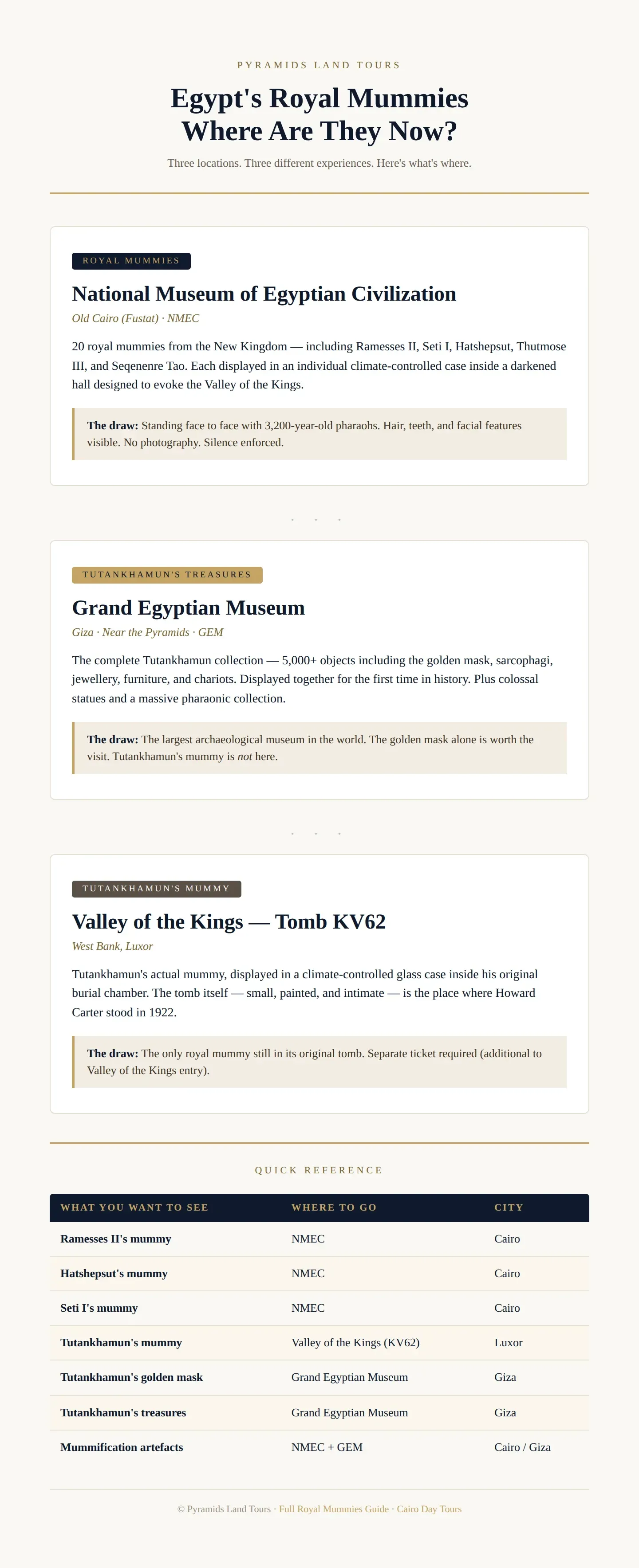
Where Is Tutankhamun?
Tutankhamun's mummy is not at NMEC. It remains in his original tomb, KV62, in the Valley of the Kings in Luxor, where it is displayed inside a climate-controlled glass case in the burial chamber.
His treasures — including the golden mask, sarcophagi, jewelry, and over 5,000 funerary objects — are at the Grand Egyptian Museum (GEM) near the Pyramids of Giza. GEM displays the complete Tutankhamun collection for the first time in one location.
This separation confuses many travelers. The simple version:
- Tutankhamun's body: Valley of the Kings, Luxor
- Tutankhamun's treasures: Grand Egyptian Museum, Giza
- Other royal mummies (Ramesses II, Seti I, Hatshepsut, etc.): NMEC, Old Cairo
If your itinerary includes Cairo and Luxor, you can see all three.
→ Grand Egyptian Museum — what to expect → Luxor Guide — including the Valley of the Kings
How the Mummies Were Found
Almost none of the royal mummies were found in their original tombs. Tomb robbing was so widespread in antiquity that priests of the 21st Dynasty (c. 1070–945 BC) conducted a massive rescue operation: they unwrapped, rewrapped, and relocated the royal mummies to secret caches to protect them from further desecration.
The Deir el-Bahri Cache (TT320): In the mid-1870s, the Abd el-Rassul family of Luxor discovered a hidden tomb shaft near Deir el-Bahri containing dozens of royal mummies. The family sold artifacts quietly for over a decade before authorities traced the items back to them. In 1881, the cache was officially excavated — 45 mummies were recovered, including Ramesses I, II, III, and IX, Thutmose I, II, and III, and Amenhotep I.
The Tomb of Amenhotep II (KV35): In 1898, French Egyptologist Victor Loret discovered a second cache — the tomb had been reused to store additional royal mummies, including Thutmose IV, Amenhotep III, and Ramesses IV, V, and VI. This cache also contained "The Younger Lady," later identified through DNA testing as the biological mother of Tutankhamun.
After excavation, the mummies spent over a century at the Egyptian Museum in Tahrir Square before their 2021 transfer to NMEC. Modern CT scanning and DNA analysis have since revealed details invisible to earlier researchers — diseases, injuries, family relationships, and causes of death that rewrite what we thought we knew about these rulers.
How Mummification Worked
Understanding the basics of mummification changes how you see things at NMEC. The process took approximately 70 days and was carried out by specialized priests. The brain was extracted through the nostrils with a metal hook. The major organs — lungs, liver, stomach, intestines — were removed and stored in canopic jars, each protected by one of the four sons of Horus. The heart was always left in place: the Egyptians believed it would be weighed against the Feather of Ma'at in the Hall of Judgment. The body was then packed in natron (a natural salt) for 40 days to dehydrate, washed with oils, wrapped tightly in hundreds of meters of linen with protective amulets placed between layers, sealed with resin, and placed inside a wooden sarcophagus — often nested inside two or three layers of coffins for royal burials.
When you see the varying states of preservation at NMEC — Seti I's near-perfect condition versus the damage visible on others — you are seeing the results of this process over 3,000 years, as well as the effects of ancient tomb-robbing, rewrapping by 21st Dynasty priests, and the different embalming techniques used across dynasties.
→ Ancient Egyptian Religion — the belief system behind the burial → Ancient Egyptian Symbols — the amulets placed in the wrappings
NMEC vs GEM vs the Old Egyptian Museum
Cairo now has three major museums, which creates planning confusion. Here is what each one holds:
National Museum of Egyptian Civilization (NMEC) — Old Cairo, Fustat. Royal mummies, chronological history of Egyptian civilization from prehistory to the modern era, textile gallery, Coptic and Islamic collections. The mummies are the primary draw.
Grand Egyptian Museum (GEM) — Giza, near the Pyramids. The complete Tutankhamun collection (5,000+ objects), colossal statues, and a massive pharaonic collection. The largest archaeological museum in the world.
Egyptian Museum of Antiquities (Tahrir Square) — Downtown Cairo. The historic museum where the mummies were previously displayed. Still open with a significant collection, though major pieces have been transferred to GEM and NMEC.
If you have one day in Cairo for museums: GEM for Tutankhamun and the Pyramids. Add NMEC if you want to see the royal mummies — they are not at GEM.
If you have two days: Day 1 for GEM + Pyramids. Day 2 for NMEC + Coptic Cairo.
Our standard museum sequencing for a 3-day Cairo itinerary: GEM on Day 1 morning, NMEC on Day 2 morning. GEM is enormous and contains the full Tutankhamun collection — it is the "wow" opener. NMEC is more intimate and emotionally intense; putting it on Day 2 lets the wonder of GEM settle first, and the mummies hit harder. Day 3 is typically the Pyramids, Sphinx, and Saqqara, so the two museums are nicely spaced. If you are visiting only one museum, we recommend GEM. But if you want both, this order never fails.
→ Contact us to build your Cairo museum itinerary → → Cairo Travel Guide — full city itinerary → Our Cairo Day Tours — private, guided, door-to-door
Frequently Asked Questions
Where are Egypt's royal mummies?
At the National Museum of Egyptian Civilization (NMEC) in Old Cairo. Tutankhamun's mummy is a separate case — it remains in his tomb (KV62) in the Valley of the Kings, Luxor.
Are the royal mummies at the Grand Egyptian Museum (GEM)?
No. The royal mummies are at NMEC, not GEM. GEM houses the Tutankhamun treasure collection. This is the most common source of confusion for Cairo visitors.
Do I need a separate ticket for the Royal Mummies Hall?
No. Entry to the Royal Mummies Hall is included in the main NMEC admission ticket (EGP 550 for foreign adults as of 2026). One ticket covers the entire museum.
Can I take photos in the Royal Mummies Hall?
No. Photography is strictly prohibited in the mummies hall. Staff enforce this consistently. You can photograph the rest of the museum.
How long does NMEC take to visit?
90 minutes minimum for the mummies hall and main gallery. 2–3 hours for the full museum including the garden. The mummies hall alone takes 30–45 minutes without a guide.
Is NMEC worth visiting if I'm already going to GEM?
Yes. They serve completely different purposes. GEM is about Tutankhamun and pharaonic grandeur. NMEC covers all of Egyptian civilization and houses the actual royal mummies. Two different experiences — both worth your time.
Is NMEC suitable for children?
Yes, though parents should prepare children for the mummies hall. The preserved remains — with visible hair, teeth, and facial features — can be confronting. Several families report their children found it fascinating rather than frightening, but it depends on the child.
Can I combine NMEC with other Cairo sights?
NMEC pairs naturally with Coptic Cairo, which is in the same neighbourhood. The Hanging Church, Abu Serga Church, and Ben Ezra Synagogue are all nearby.
Where is Tutankhamun's mummy?
In his tomb (KV62) in the Valley of the Kings, Luxor — not in Cairo. His treasures, including the golden mask, are at GEM in Giza.
What is the Pharaohs' Golden Parade?
A nationally televised event on 3 April 2021 in which 22 royal mummies were transported from the old Egyptian Museum in Tahrir Square to NMEC. Each mummy travelled in a nitrogen-filled capsule on a decorated vehicle. The event marked NMEC's inauguration as the mummies' permanent home.
Sources
- National Museum of Egyptian Civilization official site — nmec.gov.eg
- UNESCO, "Pharaohs' Golden Parade" coverage, April 2021
- Wikipedia, "National Museum of Egyptian Civilization" — en.wikipedia.org
- Ikram, S., Death and Burial in Ancient Egypt, Longman, 2003
- Saleem, S. & Hawass, Z., "The Royal Mummies of the New Kingdom," Frontiers in Medicine, 2021
Ashraf Fares