
Trust Is the Real Currency of Travel in Egypt
***Edited June 4, 2026
In London, you trust the Tube map. In Tokyo, you trust the train schedule. In New York, you trust the grid system. These are systemic trust environments — the infrastructure is reliable, the rules are clear, and personal relationships are optional.
Egypt operates on a different system. The infrastructure is less predictable. The rules are less visible. And the trust that makes everything work is relational — built through people, not through systems.
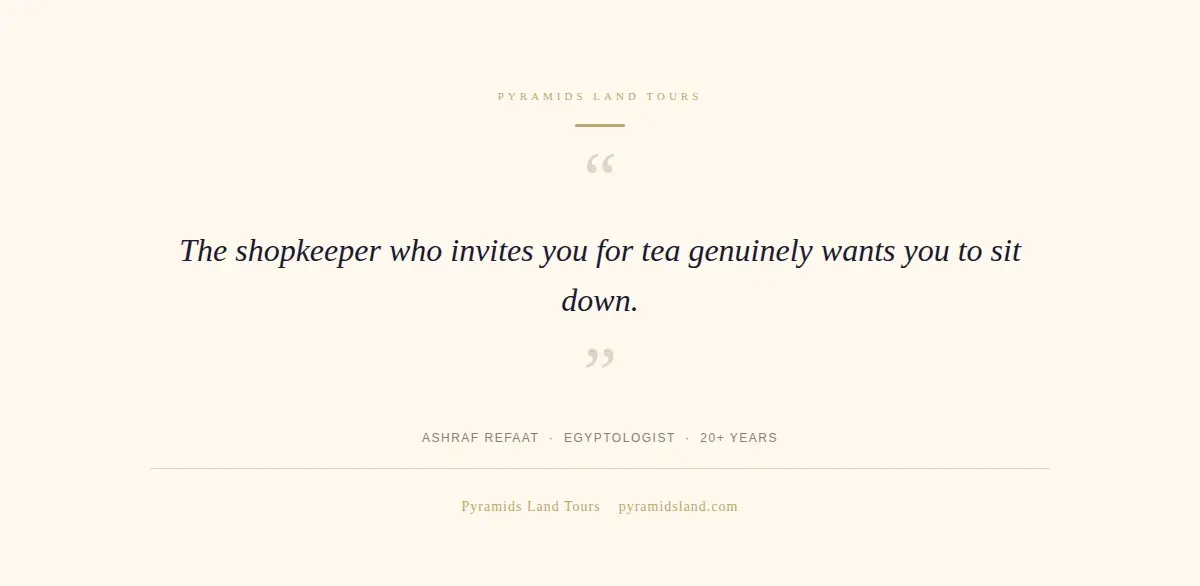
This is not a deficiency. It is a different operating system. And when trust is relational, the moments it produces are warmer than anything a system can deliver. The shopkeeper in Khan El Khalili who invites you for tea genuinely wants you to sit down. The guide who remembers you mentioned your daughter's interest in astronomy and points out the astronomical ceiling at Senenmut's tomb — that is relational trust creating a moment no algorithm would have produced. The driver who stops at a roadside sugarcane juice stand because he noticed you were curious about it yesterday — that is a person paying attention to another person, not a system executing a workflow.
The question travelers should ask is not "Can I trust Egypt?" It is "how does trust work here, and how do I build it?"
Why First-Time Visitors Feel the Gap
In systemic trust environments, you do not need to trust any individual person. You trust the system. The bus arrives because the schedule says it will. The restaurant charges what the menu states. The taxi meter runs because the law requires it. Personal trust is unnecessary because institutional trust handles everything.
In Egypt, you need to trust specific people — your guide, your driver, the hotel concierge, the vendor who says this price is fair. This is not harder. It is different. And for travelers who have spent their lives in systemic environments, the adjustment feels like a risk even when it is not.
The result is what I call the defensive baseline. Every interaction is filtered through uncertainty. Is this person trustworthy? Is this price fair? Is this route correct? Is that person offering genuine help or positioning for a tip? The mental energy required to process these questions — for every vendor, every taxi, every recommendation — is exhausting. A TripAdvisor forum thread titled "Are Tours in Egypt a Scam?" captures this anxiety precisely. The poster was not asking about a specific operator. They were asking whether the entire system could be trusted. The answer is yes — but not the way they were used to trusting systems back home.
This cognitive overhead is the real reason first-time visitors describe Egypt as overwhelming. It is not the heat, the crowds, or the vendors. It is the relentless processing required to evaluate every interaction in a trust system that they have yet to learn to read.
The Scams That Do Exist — Named Honestly
Honesty about Egypt's challenges is not optional for a guide who wants to be trusted. At the Giza Plateau and other major tourist sites, several recurring patterns are evident. I am going to name them specifically because vague warnings are useless and pretending they do not exist — as many operators do — erodes the trust we are trying to build.
The "museum is closed" redirect. Someone near the entrance to a site or museum tells you it is closed today and offers to take you somewhere "better." The site is not closed. This person has no affiliation with the site. They are redirecting you to a shop or a friend's business where they earn commission.
The "free" photograph. A person at the pyramids places a headdress or scarf on you, takes a photo with your camera, and then demands payment. Variations include placing you on a camel "just for a photo" and then demanding a fee to let you off.
The camel ride price switch. A price is agreed for a camel ride. After the ride, the operator claims the agreed price was per person, not per ride, or per minute, not for the full excursion. Without a witness or a guide present, the negotiation is one-sided.
The perfume or papyrus "demonstration." You are taken to a shop for what is presented as a cultural demonstration — "see how real papyrus is made." The demonstration lasts three minutes. The sales pitch lasts thirty minutes. The prices are several times higher than at non-tourist shops. Your guide receives a commission on anything you buy.
These are not representative of Egypt or Egyptians. They are specific, known patterns at specific high-traffic locations — versions of which exist at tourist sites worldwide, from the Colosseum to the Taj Mahal. They are entirely avoidable with basic awareness or with a guide who manages the dynamic before you encounter it.
With Mahmoud at Giza, these interactions simply do not happen. Vendors see a guided group and give a quick nod. The camel operators stay back. The "museum is closed" approach does not start because the social signal that this group is accompanied and purposeful changes the dynamic entirely. You do not need to process each interaction individually because someone you trust has already processed the environment for you.
How Trust Builds — Hour by Hour
Trust in Egypt does not arrive in a single moment. It compounds through small, consistent acts of reliability that accumulate across hours and days.
It begins before the trip starts. My coordinator or I will send a WhatsApp message the evening before your first day — between 8 and 10pm — with the exact pickup time, the driver's name and phone number, and a short morning plan. This is not logistics. It is the first act of accountability. The traveler now has a named person who is responsible for tomorrow. Across our reviews, this single five-minute touchpoint is one of the most frequently praised elements. Travelers describe it as the moment their anxiety about Egypt disappeared.
We track every flight in real time via the airport website and flight apps. If a flight is delayed by two hours, the driver adjusts, and we keep the client updated via WhatsApp. The traveler walks out of the arrivals hall at 2 am after a delay, and their name is on a sign. That moment — expected reliability delivered under imperfect conditions — is where trust compounds. It says: these people do what they said they would do, even when it is inconvenient.
The next morning, the guide arrives on time. The car is clean. The itinerary matches what was promised. At the Giza Plateau, the guide handles the vendor dynamic without you noticing. At Karnak, the guide adjusts the pace when your energy flags. At lunch, the restaurant is genuine — not a commission arrangement. Each successful interaction reinforces the one before it.
You had been in Egypt for four days. Zenab met you in the lobby each morning at 5:15. By now, you had stopped checking the schedule — you knew she would be there, that the car would be ready, that the day was planned. You trusted her. Not because someone told you to, but because she had been reliable every single day. This morning, she suggested a small detour to a Nubian village near Aswan that was not on the itinerary. A month ago, you would have been suspicious — is this a shop? A commission stop? But after four days of clean, transparent scheduling, you said yes without hesitation. The village was extraordinary. The family who hosted you served tea with fresh mint and showed you their home. Fatma translated the conversation — she is from a Nubian family herself, and the exchange was warm and genuine in a way that no pre-arranged "cultural experience" could replicate. You would never have found it independently. You would never have trusted the suggestion on day one.
That is what relational trust produces when it has been earned. Not just safety. Discovery.
The Day-Three Transformation
The shift usually starts by day three. Travelers who arrived tense and watchful begin to relax. They stop clutching bags tightly, start smiling back at vendors, and by day four or five, they are the ones accepting tea invitations and chatting with shopkeepers. Egypt becomes warm rather than threatening — not because Egypt changed, but because the traveler's framework changed.
This transformation is not automatic. It requires that the first 24 hours went well, that the guide has been consistently reliable, and that no commission-based detour has broken the chain of trust. When the chain holds, the transformation is remarkably consistent across cultures, ages, and levels of travel experience.
Across nearly 6,000 reviews, the word "safe" appears as a spontaneous, unprompted descriptor — not in response to a safety question, but as something travelers felt compelled to volunteer. Solo female travelers, families, older couples — they all use the same word, and they almost always attribute it to the guide's presence, not to gates or guards. One reviewer wrote that Ahmed Maged "made us feel like family." Another described Fatma's presence as "the reason I felt completely secure as a solo woman in Egypt." These are not marketing phrases. They are unprompted descriptions of what relational trust feels like when it works.
How to Shop in Egypt Without the Anxiety
One of the most common trust-related anxieties is shopping. Travelers want to buy gifts — papyrus, spices, cotton, jewelry — but fear being overcharged or taken to commission shops. The result is often avoidance: they buy nothing or buy at the airport, where the selection is poor and prices are higher.
The honest advice: ask your guide to recommend shops where prices are posted and where there is no commission relationship. Every city has them. In Cairo, the streets behind Khan El Khalili are lined with family-run spice shops with fixed prices. In Luxor, the alabaster workshops near the West Bank vary enormously in quality and pricing — your guide knows which ones are genuine and which are tourist traps. In Aswan, the Nubian market near the corniche offers handmade crafts at reasonable prices if you are willing to negotiate gently.
The key distinction is between shopping you choose and shopping that is chosen for you. When your guide takes you to a shop as a scheduled stop on the tour, the shop is almost certainly paying commission. When you ask your guide to recommend a shop after seeing something you like, the dynamic is different — your guide is serving your interest, not a commercial arrangement. Direct-booking tours make this distinction possible because their schedules have no mandatory shopping stops to protect.
Trust as the Foundation
Egypt does not require suspicion. It requires informed trust — the kind built through transparency, reliability, and named people who are accountable for your experience.
The planning, the structure, the early departures and crowd-avoidance strategies, the realistic pacing — these are all mechanisms of trust. They say: someone has thought about your day before you woke up. Someone knows the timing. Someone is responsible.
When that trust is in place, Egypt opens up. Not just the sites — the people, the hospitality, the warmth that makes travelers describe it as the most welcoming country they have ever visited. The conversations over tea. The laughter with the felucca captain. The moment the vendor who has been calling you all morning finally gets a smile back and says "welcome to Egypt" with genuine warmth. The experience Egypt gives when trust is present is unlike anything else in travel.
The travelers who arrive with a complete planning checklist and a guide they can verify are not being paranoid. They are building the foundation for the kind of trust that turns Egypt from a destination into a relationship — one that most travelers describe as the most rewarding of their lives.
Tell us what concerns you most. We will address it directly, with no obligation.
Ashraf Fares