
Why Your Guide Matters More Than Your Hotel In Egypt
***Edited June 3, 2026
Inside the tomb of Ramesses VI in the Valley of the Kings, the ceiling is painted with the sun's complete journey through the underworld. It is one of the most extraordinary artworks in human history. It is also completely invisible without someone to explain it.
A traveler without a guide sees a decorated ceiling and moves on. A traveler with an Egyptologist guide sees a three-thousand-year-old map of the cosmos — the sun swallowed by the sky goddess at dusk, traveling through twelve hours of darkness, and reborn at dawn. Same ceiling. Same tomb. Completely different experience.
That difference — between looking and understanding — is why the guide matters more than anything else about your Egypt trip.
Do You Even Need a Guide?
This is the real question. Before we discuss private versus group formats or hotel recommendations, the honest question is whether a guide is necessary at all.
You can visit Egypt's sites independently. Many travelers do. Cairo is navigable — Uber works throughout the city, the Metro connects major neighborhoods, and the Giza Plateau has clear signage. The Valley of the Kings sells tickets at egymonuments.com or at the gate. Karnak does not require a reservation.
But "navigable" and "meaningful" are different things. The pattern in our review data and in travel forums is consistent: experienced independent travelers who visited Egypt without a guide say they wish they had one. Not because they could not manage the logistics — but because they spent their energy figuring out where to go and how to get there, leaving nothing for understanding what they were looking at.
On the Rick Steves travel forum, a seasoned independent traveler — someone who has navigated Europe and the Middle East solo — wrote that Egypt was the one country where she would hire a personal guide for a significant portion of her time. Not because she needed hand-holding, but because the density of history at Egyptian sites requires interpretation to become meaningful.
What an Egyptologist Guide Actually Does
At the Valley of the Kings, the difference between a guided and unguided visit is the difference between seeing and understanding.
Without a guide, you arrive and choose three tombs from a list. The Valley opens at 6:00 am in summer and 6:30–7:00 am in winter. Your standard ticket lets you enter any three of the roughly eight to ten tombs open that day — they rotate monthly for conservation. Without advance knowledge of the rotation, you may choose poorly. You enter a tomb, see extraordinary paintings, take photos, and leave. You are not sure what the paintings depicted or why this tomb matters more than the one next door. After ninety minutes in the exposed valley, you are hot and ready to leave.
With an Egyptologist guide, the experience transforms entirely. Before entering the valley, your guide has checked the rotation board and selected three tombs for maximum impact — one with extraordinary color, one with the astronomical ceiling, and one that tells a strong narrative. Tutankhamun, Ramesses V/VI, and Seti I require extra tickets — your guide advises whether they are worth it for your interests. Inside each tomb, the guide reads the walls. You notice what you would have walked past. You leave two and a half hours later, physically tired but intellectually energized.
The distinction travelers describe again and again is this: a weak guide recites dates and names; a real Egyptologist tells a story. They do not list the dynasties — they make a dead king into a person, an empty corridor into a funeral, a wall of symbols into a sentence. That is the entire difference between a tour you tolerate and one you remember.
I was inside the tomb of Ramesses III on a quiet morning with a couple from London. I pointed out a small, almost hidden scene on the wall where the pharaoh is shown playing senet — the ancient Egyptian board game — with his queen in the afterlife. The wife, who had been quiet most of the morning, suddenly laughed and said, "He's just a man playing games with his wife, exactly like us." Then she went completely silent for a long minute, staring at the painting. She turned to me with tears in her eyes and whispered, "I never understood until now that they were real people." That is what Egypt does to people — and it only happens with interpretation.
This is the difference a guide makes, and it is the easiest thing to plan for. Tell us your dates and your biggest concern → and we'll match you with the guide who does exactly this.
What Else a Guide Quietly Does
Interpretation is why you book a guide. But read enough reviews, and you notice that travelers praise something else just as often — the things the guide handles so quietly you barely register them.
The first is logistics under pressure. Travelers single out the guide or driver who met them at immigration and walked them through Cairo airport — which one visitor accurately called "pure organized chaos" — who managed the domestic-flight transfers, and who ran a luggage-check routine so nothing went missing over a week of hotels, cruise boats, and planes. The history is why you relax into the day; the logistics are why you are calm enough to.
The second is the vendor buffer. At the Giza Plateau, the Sphinx, and Khan El Khalili, a good guide absorbs the interaction you find tiring — negotiating when you genuinely want to buy, declining politely when you do not, turning a gauntlet into an ordinary afternoon. Travelers also describe guides who forewarn them about the small things that can derail a day: closed-toe shoes for the rubble at some sites, enough water, modest cover for the mosques.
The third is pacing. The single phrase that recurs most in five-star reviews is "never felt rushed." A good guide reads the group's energy and adjusts — a rest in the shade, cold hibiscus tea, time to simply sit and ask questions instead of being marched to the next stop. The fourth is calibration: the best guides hold the attention of a history-obsessed adult and a bored fifteen-year-old in the same family, adjusting the depth without losing either. And the fifth is flexibility — the guides travelers remember are the ones who absorbed a flight delay, a stomach bug, or a last-minute change of plan and kept the day intact.
There is one more, harder to name. For solo female travelers especially, the right guide is the difference between bracing and exploring — Zenab turns anxious navigation into confidence. For nervous first-timers, the security a crowd seems to promise actually comes from this: a person beside you who manages every interaction, and logistics handled before you arrive. The guide is not a luxury layered on top of the trip. The guide is the trip's nervous system.
The Timing Knowledge You Cannot Google
A guide's value extends beyond interpretation. It includes operational knowledge that transforms the quality of every site visit.
Cruise ship buses start arriving in the Valley of the Kings around 8:45am, with the real flood at 9:30–10:30. I depart Luxor hotels at 5:00–5:30am and reach the ticket office at opening time. By the time the bus wave arrives, we are finishing our third tomb. Karnak's Hypostyle Hall light is most magical between 7:00 and 8:30 am — the low-angle morning sun entering through the clerestory windows between the twelve taller central columns, creating the effect the ancient architects designed three thousand years ago. By midday, when the sun is overhead, the effect disappears entirely. The Giza panoramic viewpoint is quietest before 9 am and again from about 3:00–4:30 pm when the golden light returns and most groups have left.
These are not secrets. They are experience — the kind of operational knowledge that accumulates over years and cannot be replicated by a blog post or a guidebook.
How to Evaluate Guide Quality
Not all guides are equal, and the term "experienced local guide" in a tour listing means nothing. The credentials that matter are specific.
A licensed Egyptologist guide in Egypt holds a university degree in archaeology, history, or ancient languages, plus a government license from the Ministry of Tourism — verifiable through the Egyptian Travel Agents Association at etaa-egypt.org. This is not the same as a "tourism school graduate" or a "local guide." The academic depth is what produces the interpretation that transforms a site visit.
It is worth knowing what the absence of that depth looks like, because the contrast is sharp. A guide paid on commission from the shop steers the day toward perfume and papyrus showrooms; a guide on a fixed daily rate has no reason to take you anywhere you did not ask to go. A guide assigned to 40 people on a bus cannot answer your specific question; a private guide can build the day around it. One traveler recounted that a guide quietly avoided any site he was unfamiliar with and, at one point, ended up in a heated argument with local officials over permissions, while the travelers sat baffled, unsure of what was happening. A properly licensed, experienced Egyptologist is the opposite of that — confident across sites, fluent in the bureaucracy, and accountable to a real company.
At Pyramids Land, we share the guide's name, a short bio, and, when possible, a photo four to six weeks before arrival. Mahmoud Hoka specializes in the Giza Plateau and knows the pyramid complex so well that a morning visit becomes a masterclass in Old Kingdom engineering. Zenab leads Luxor tours and works extensively with solo female travelers, bringing both archaeological knowledge and the warmth that makes women traveling alone feel welcome. Nour works with families — adjusting the pace, language, and storytelling for children who need active engagement rather than an academic lecture. Fatma specializes in Nubian culture and leads Abu Simbel and Aswan tours with a perspective rooted in her own heritage.
These are not interchangeable. They are specialists assigned based on fit — which is only possible because we know both our guides and, by the time you arrive, a little about you.
The Real Budget Question
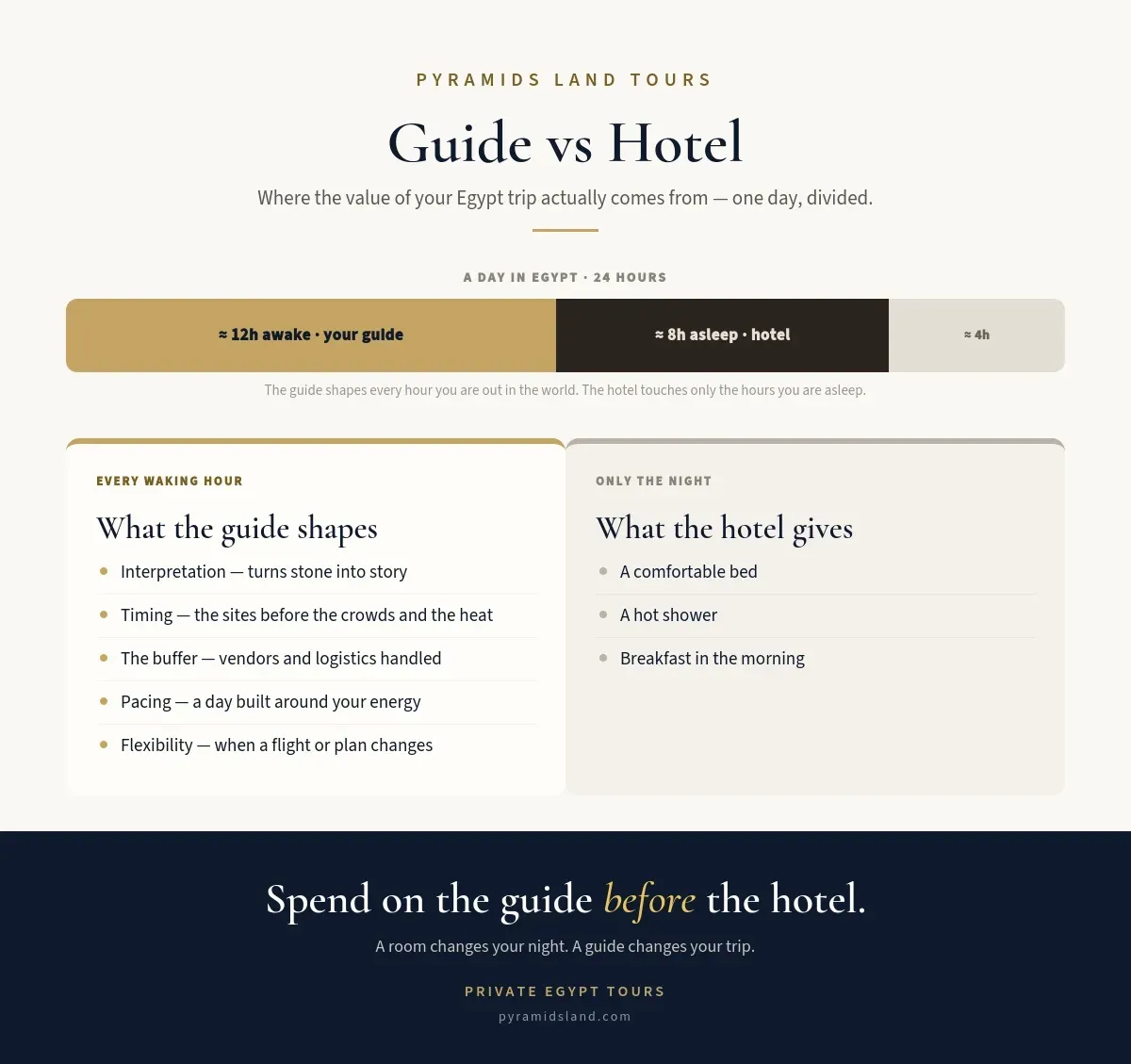
I tell travelers who ask about budget allocation: if the budget is tight, spend it on a really good private guide and driver rather than a fancier hotel room. The guide shapes the entire day. The hotel is just where you sleep.
You woke at 5:00 a.m. in a clean, simple three-star hotel on the West Bank of Luxor. By 6:10, you were standing in the Valley of the Kings with Zenab, the air still cool, the tombs empty. She explained that this valley was chosen because the mountain above it is shaped like a natural pyramid, it sits on the west bank where the sun sets — the symbol of death — and it is close to the workers' village at Deir el-Medina. Inside the tomb of Ramesses VI, she pointed up at the astronomical ceiling and walked you through the twelve hours of the night. The colors were vivid. The silence was extraordinary. By 8:30, when the bus crowds arrived, you were already sitting in the shade with cold hibiscus tea, processing what you had seen. The hotel room was forgettable. The morning was not.
A grander hotel would have changed the eight hours you spent asleep. The guide changed the twelve hours you spent awake — and the memory you brought home. That is the trade-off. Every time.
Tell us your dates and interests, and we'll match you with the right guide — no obligation. Message us on WhatsApp and tell us your dates and your biggest concern →, or browse our guided Egypt tours.
Ashraf Fares