
Private vs Group Tours in Egypt: Which Is Better for First-Time Travelers?
***Edited June 4, 2026
There is a moment at the Valley of the Kings, about two hours after opening, when the day splits in two. Before the cruise ship buses arrive, the valley is quiet — your footsteps echo in the corridors, the painted walls glow in the overhead lighting, and the guide's voice is the only sound. After the buses arrive, the same corridors have queues. The same tombs feel rushed. The same guide must shout.
Which version of the Valley of the Kings you experience depends entirely on one decision: whether your day was designed around you or around a bus schedule.
Guided or Independent?
Before comparing private and group, there is a more fundamental question. Do I need any professional help at all?
The short answer: you can travel to Egypt independently. Cairo's Uber works. The Metro connects major neighborhoods. Sites sell tickets at the gate, and you can pre-purchase at egymonuments.com. A Cairo Pass (currently $130, valid for five days) covers unlimited entry to most major Cairo and Giza sites — though not the Grand Egyptian Museum, which is ticketed separately — and pays off mainly if you plan to re-enter Giza multiple times; for a single pass through the sites, individual tickets often cost less.
The honest answer: for a first visit, professional support produces dramatically better outcomes. The distances, the heat, the crowd patterns, and the social dynamics around tourism are unfamiliar to most Western visitors and consume cognitive energy that could be spent on the experience. Independent travelers consistently say they wish they had a guide — not because they could not manage, but because the guide freed their attention to what Egypt actually offers.
What's Actually Different
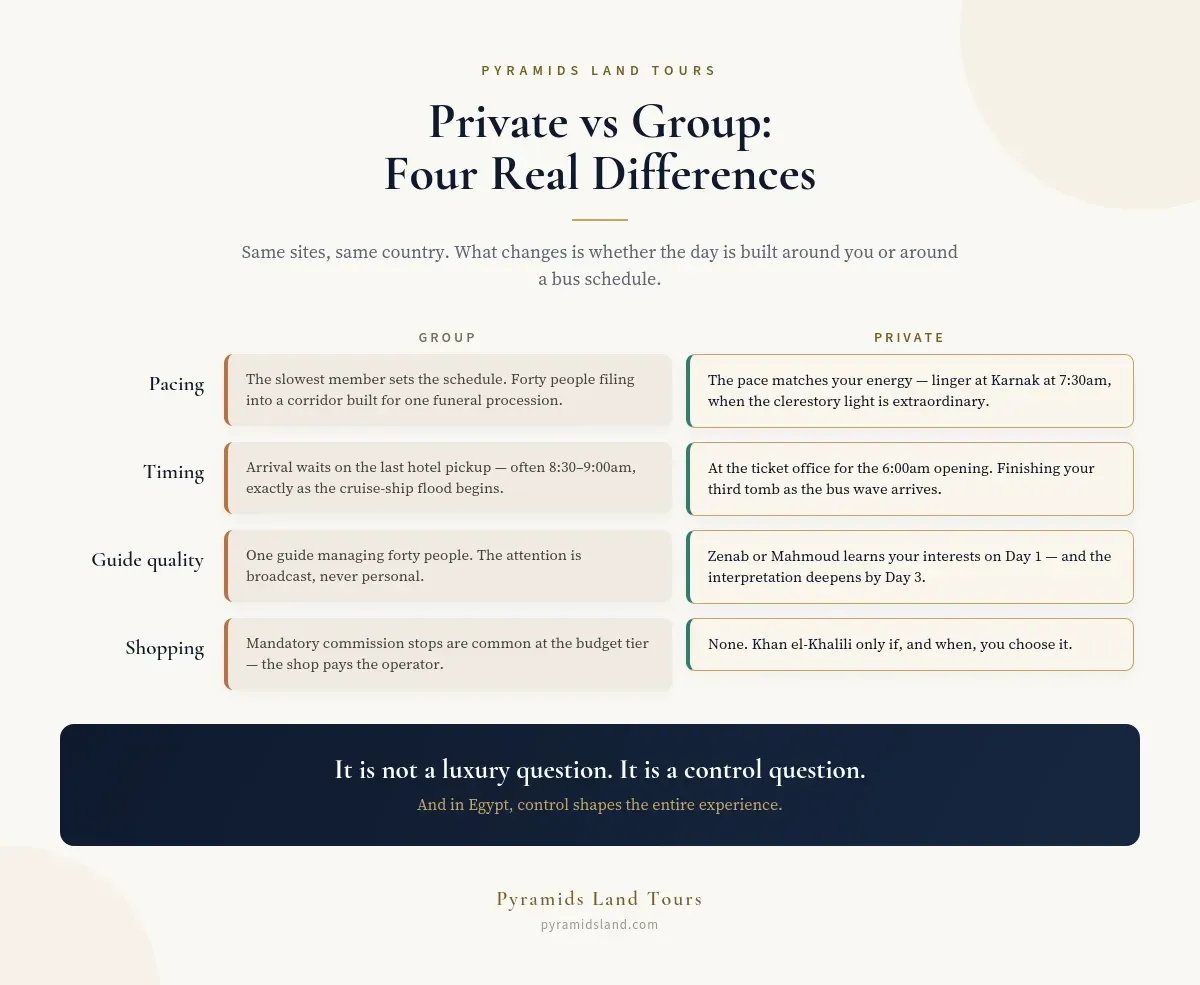
This is not a luxury question. It is a control question — and across the travel forums, control is the single word travelers use most when they explain why they wished they had gone private.
A private tour means a dedicated guide and driver for your group only — whether two people or ten. A group tour means joining a bus of fifteen to forty strangers on a fixed schedule designed for the average.
Pacing. On a group tour, the schedule is fixed, and the slowest member sets it. One traveler recounted paying a substantial sum for a group bus tour to Luxor and then losing roughly four hours waiting for latecomers in 41°C heat — reaching the Valley of the Kings too late and too rushed to absorb the quiet they had come for. Even when no one is late, you feel the herd: forty people entering a tomb corridor designed for a pharaoh's funeral procession, multiple buses converging on the same temple at the same hour. On a private tour, the pace matches your energy. If you want to spend extra time at Karnak because the light through the clerestory windows is extraordinary at 7:30 am, then do so.
Timing. On a group tour, arrival at the Valley of the Kings depends on when the last hotel pickup was completed — often 8:30 or 9:00 am, precisely when the cruise ship flood begins. On a private tour, we reach the ticket office right at opening — 6:00 a.m. in summer. By the time the bus wave arrives around 8:45, we are finishing our second or third tomb.
Guide quality. On a group tour, even an excellent guide cannot provide personal attention while managing forty people. On a private tour, Zenab, Mahmoud, or Nour speaks to you specifically. They learn your interests on Day 1 and calibrate every subsequent explanation. By Day 3, the interpretation deepens because the relationship deepens — and you can ask the question you were too shy to ask in front of thirty-nine strangers.
Shopping. Mandatory shopping stops are common in budget group tours — the shop pays the operator commission on tourist purchases. On a well-structured private tour, there are none. If you want to visit Khan El Khalili — and it is worth visiting — that is your decision, not the operator's revenue model.
"But Isn't a Group Easier — and Safer — for a First-Timer?"
This is the fear underneath most group bookings, and it deserves an honest answer rather than a sales pitch. First-time visitors often choose a group because a crowd feels like a safety net — a buffer against a country they have been told is overwhelming.
Here is the thing: the security a nervous first-timer actually wants does not come from being in a crowd. It comes from two things — a guide who manages every interaction, and logistics that are handled before you arrive. A private tour gives you more of both, not less. You get airport-to-airport support, a dedicated guide who never splits attention with thirty-nine other people, and a driver who is yours. In a large group, the guide is managing a headcount; if something goes sideways for you specifically — a stomach bug, a missed connection, a change of plan — you are one of forty, not the priority. The crowd feels safe. The dedicated guide is safe. Those are not the same thing, and travelers consistently discover the difference around Day 2.
The Honest Case for Group Tours
I run a private tour company, so let me make the case for the competition.
Group tours remove all decision-making. For travelers who find planning stressful — who do not want to research timing, evaluate guides, or manage logistics — a group tour provides complete relief. You show up. Someone tells you where to go. You follow. They also offer genuine social pleasure: for solo travelers especially, a group is a built-in set of companions and a shared adventure, and many people value that more than flexibility. A Rick Steves forum poster described choosing a group tour through Gate 1 Travel for their first Egypt visit — roughly $3,500 per person including airfare from NYC, with five-star hotels, university-educated guides, and all transport — and being genuinely happy with the experience.
Group tours also cost less per person. For a full-day Cairo experience, budget group tours charge $45–$85 per person. A private tour is meaningfully more. That is real money.
I would rather someone see Egypt on a group tour than not see it at all. The pyramids are extraordinary regardless of how you arrive. What Egypt does to people transcends the format.
Who Each Format Serves
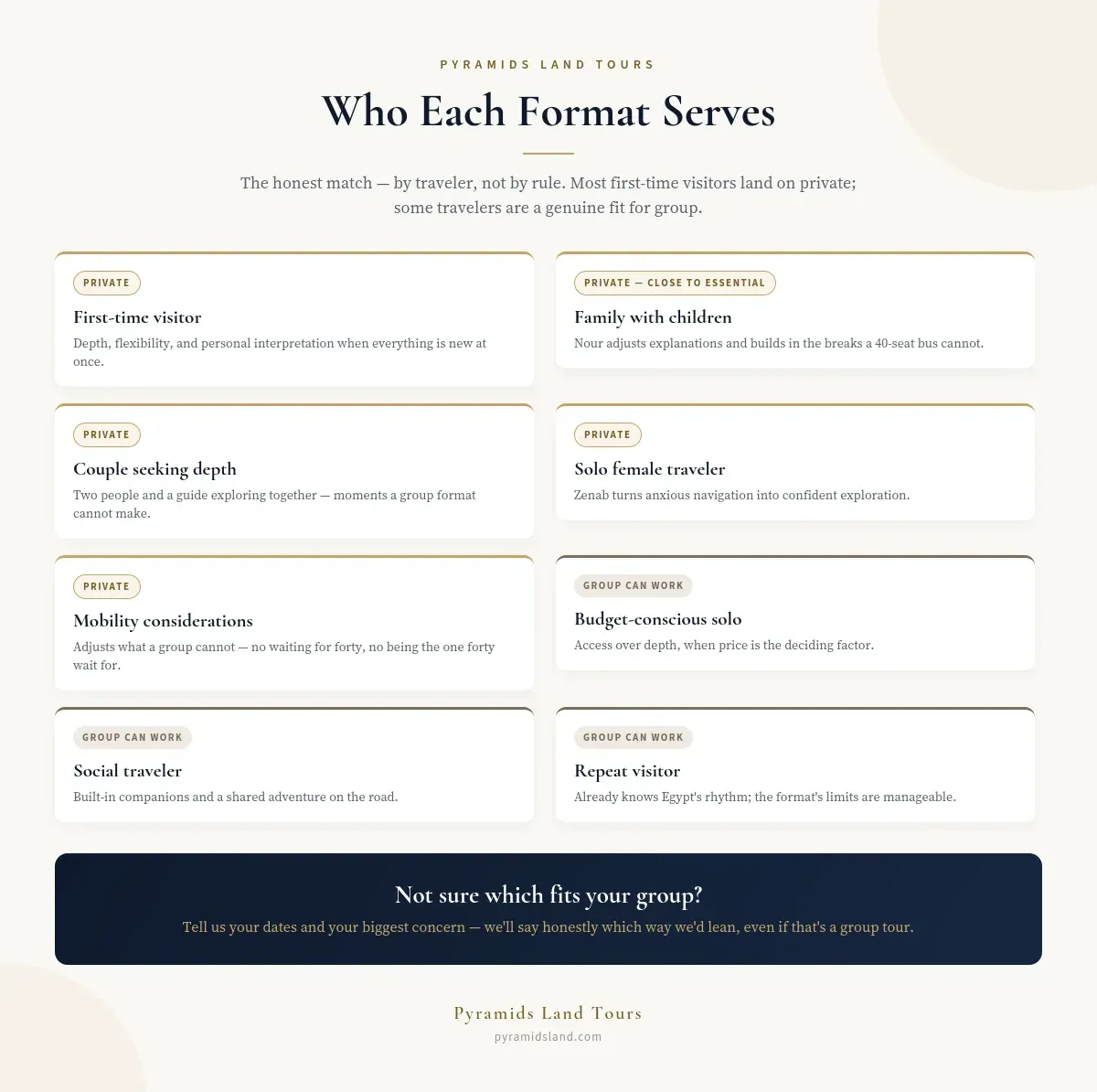
For budget-conscious solo travelers who prioritize access over depth, a group can work. For social travelers who enjoy meeting others, the group provides a shared experience. For repeat visitors who already know Egypt's rhythm, the group's limitations are manageable.
For first-time visitors who want depth, flexibility, and personal interpretation, private consistently produces better outcomes. For families with children, private is close to essential: Nour adjusts explanations, builds in bathroom breaks, and manages pacing that a forty-person bus schedule cannot accommodate. For couples seeking depth, the intimacy of two people and a guide exploring ancient history together creates moments a group format cannot. For solo female travelers, Zenab's presence turns anxious navigation into confident exploration. For travelers with mobility considerations, private adjusts what group cannot — no waiting for forty people, and no being the person forty people wait for.
You sat in the back of the minivan as Rasha drove you between the West Bank sites. The morning had been intense — three tombs, Hatshepsut's temple, the workers' village at Deir el-Medina — and you were quiet. Rasha noticed. She told the driver to stop at a small café overlooking the sugar cane fields. You sat in the shade for twenty minutes, drinking tea, watching a farmer lead a donkey along an irrigation canal. Nobody was waiting. No bus was leaving. The break was not on the schedule because there was no schedule — only a guide who read your energy and responded. That stop became one of the memories you took home.
Not sure which format fits your group? That is the easiest thing to talk through. Tell us your dates and your biggest concern → and we'll tell you honestly which way we'd lean — even if that is a group tour.
Cost Context
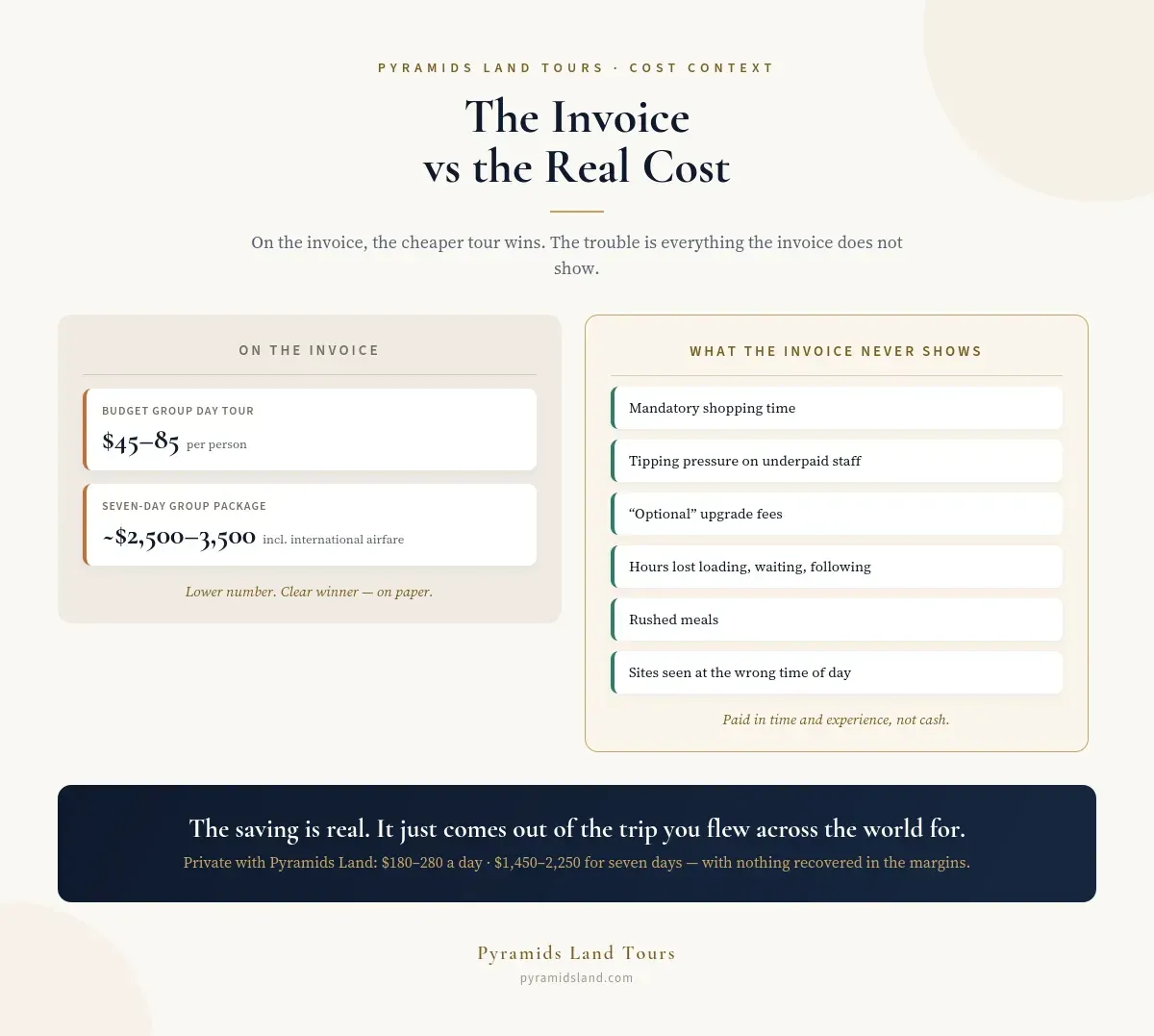
A full-day private Cairo tour with Pyramids Land — guide, transport, and all entrance fees — falls in the range of $180–$280 per person for two sharing. A budget group tour charges $45–$85. On the invoice, the group tour wins. The trouble is that the invoice does not show everything.
The lower price is recovered in ways you pay for in time and experience rather than cash: the mandatory shopping time, the tipping pressure on underpaid staff, the upgrade fees, the hours lost loading and waiting and following a fixed rhythm, the rushed meals, the sites visited at the wrong time of day because forty people could not move faster. Travelers who have done both describe the same realization — that the "saving" was real but came out of the part of the trip they had flown across the world for. A seven-day private package runs $1,450–$2,250 per person. A comparable group package through a major operator like Gate 1: roughly $2,500–$3,500 including international airfare — but with a large bus, a fixed schedule, and commission stops.
We have never offered group tours. Private has always been our only model — because after twenty years, it is the format that produces the experiences our travelers describe in their reviews. The question is not which format is cheaper. Which format helps you enjoy Egypt more?
Tell us your dates and your biggest concern, and we'll answer honestly — no obligation. Message us on WhatsApp and tell us your dates and your biggest concern →, or browse our private Egypt tours.
Ashraf Fares