
The Eye of Horus: Meaning, Myth, and the Symbol You'll See Across Egypt
The Eye of Horus is the stylized falcon eye that the ancient Egyptians called the wedjat — "the whole one," or "the sound one." It was a symbol of protection, healing, and restoration, and it became among the most widely worn amulets in all of Egyptian history: painted on coffins, tucked into mummy wrappings, carved into rings, and set on the prows of boats so the vessel could "see" its way and turn back evil.
It comes from one of the oldest stories Egypt ever told: the god Horus loses his eye in a violent struggle, and the eye is made whole again. That single idea, something broken being restored to wholeness, is why Egyptians reached for the wedjat for three thousand years whenever they wanted health, safety, or a safe passage into the next life.
You will see it more often than you expect on a trip to Egypt. It watches from the granite of Edfu, surfaces in the gold of Tutankhamun's burial, and stares out of half the souvenir stalls in Khan el-Khalili. This guide explains what it actually means, separates it cleanly from the Eye of Ra, with which it is so often confused, tells you honestly which of the popular "facts" hold up and which do not — and shows you exactly where to find it when you are standing on Egyptian ground.
What Is the Eye of Horus?
The Eye of Horus is an ancient Egyptian symbol of protection, royal power, and good health, drawn as a human eye combined with the facial markings of a falcon. Its Egyptian name, wedjat (also written udjat or wadjet), means roughly "the sound one" or "the one that is made whole" — a direct reference to the myth in which the eye is damaged and then healed.
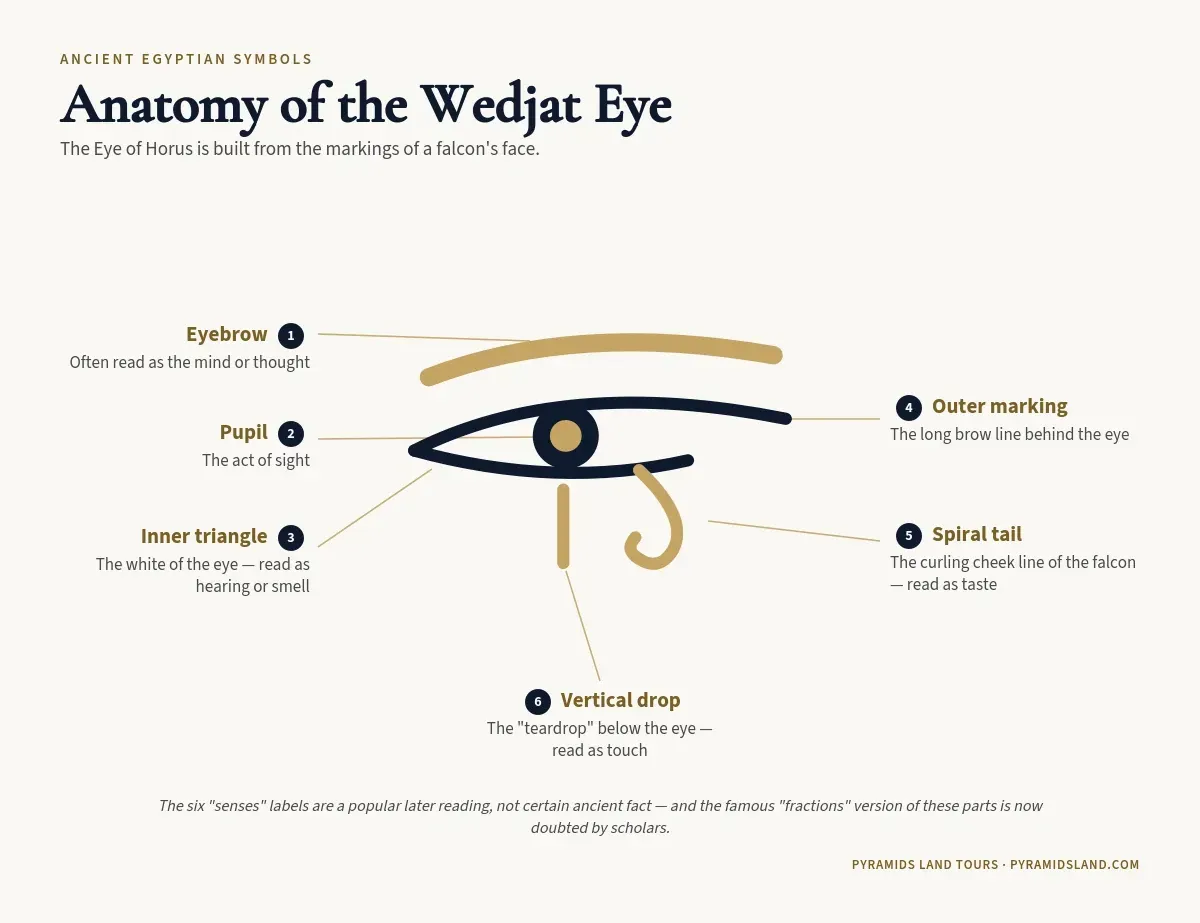
Look closely at the shape, and you are looking at a falcon's face. Horus was a sky god usually depicted as a falcon or a falcon-headed man, and the symbol bears his features: the long brow, the rounded eye, and, beneath it, two distinctive markings — a straight vertical line and a curling spiral tail. Those are not decorative inventions. They mirror the cheek and eye markings of the lanner falcon, the bird most associated with Horus, including the "teardrop" that falls below the eye.
For the Egyptians, the wedjat meant three linked things: protection (it guarded the living and the dead against harm and evil), healing and wholeness (a damaged thing restored to soundness), and royal authority (Horus was the god of kingship, and the living pharaoh was his earthly embodiment). When later associations linked the eye to the moon, which wanes to nothingness and is restored to fullness each month, the wedjat gained a fourth layer: the rhythm of loss and return.
The Myth: How Horus Lost His Eye — and Got It Back
The Eye of Horus cannot be understood apart from the most important story in Egyptian religion: the murder of Osiris and the war for his throne.
Osiris, the good king, was killed by his jealous brother Set. Osiris's wife, Isis, recovered and revived him long enough to conceive a son, Horus, who was raised in secret in the Delta marshes to one day avenge his father and reclaim the kingship. When Horus came of age, he and Set fought a long and brutal contest, part battle and part lawsuit, before the council of the gods. In the course of that struggle, Set seized Horus's eye and destroyed it — gouged out, torn into pieces, or hurled away, depending on which version you read.
The eye was then restored. In most tellings, the god Thoth, lord of wisdom, magic, writing, and the moon, found the eye and made it whole again; in some versions, the goddess Hathor heals it. The healed eye was the wedjat, "the made-whole one." And in the story's most resonant moment, Horus did not keep the restored eye for himself. He offered it to his dead father, Osiris, helping to revive him in the underworld. From that act the eye became permanently bound up with offerings, regeneration, and the passage to eternal life, which is precisely why it ends up on so many things buried with the dead.
This is the detail that matters most, and the one that separates the Eye of Horus from its solar cousin: at its heart, the wedjat is a healing symbol. It is the emblem of damage repaired, of order restored after violence, of a wound made whole. → Ancient Egyptian Religion — the Osiris myth and the cosmos it built
Eye of Horus vs Eye of Ra: The Difference, Honestly
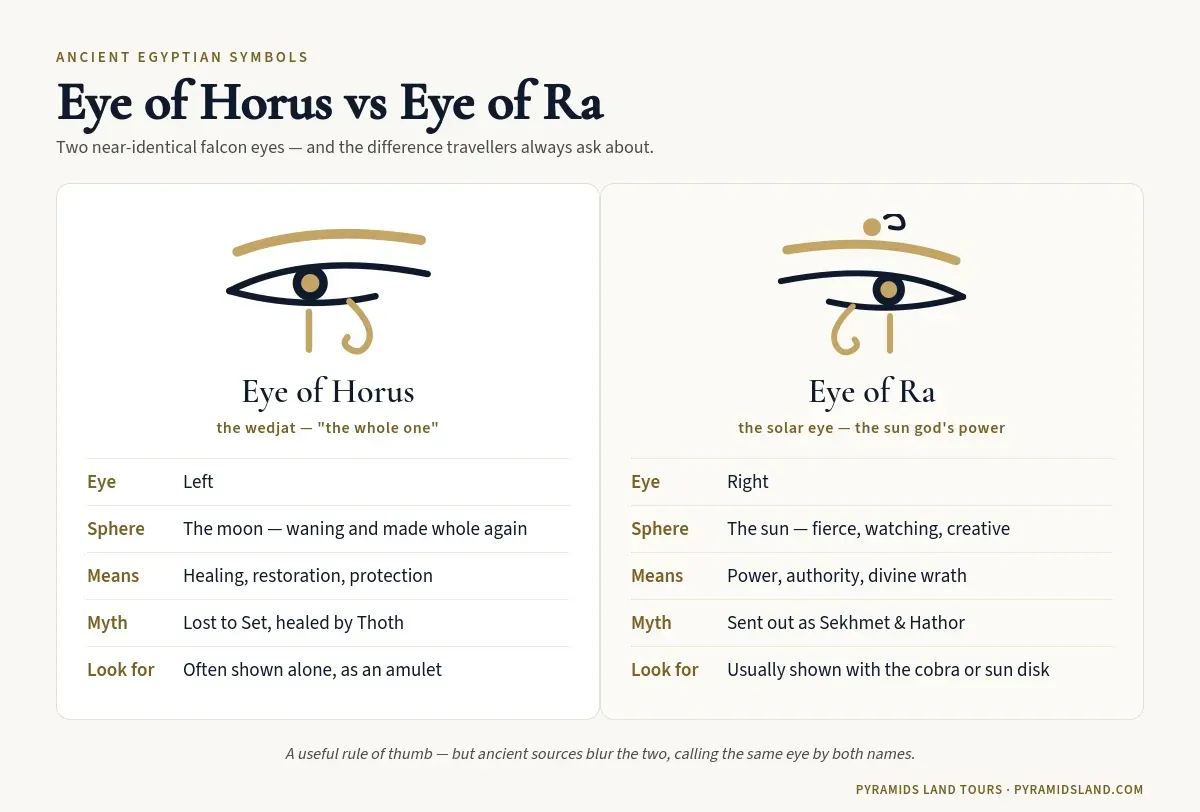
In short: the Eye of Horus is the left, lunar eye of healing, restoration, and protection; the Eye of Ra is the right, solar eye of power, royal authority, and wrath.
This is the single most common point of confusion, and most of the internet handles it badly — including, on close reading, several pages that contradict their own diagrams.
Here is the clean version most people are looking for:
The Eye of Horus is the left eye, linked to the moon, and it stands for healing, restoration, and protection. Its story is the one above — an eye damaged and made whole.
The Eye of Ra is the right eye, linked to the sun, and it stands for fierce power, royal authority, and divine wrath. It is not a story of healing but of force: a destructive feminine power that the sun god sends into the world, personified as goddesses such as Sekhmet, Hathor, Wadjet, and Bastet, to punish his enemies. → The Eye of Ra — the sun, the goddesses, and the wrath of the sun god
If you remember nothing else: Horus = left, moon, healing. Ra = right, sun, power.
Now the honest part, because this is where a real Egyptologist parts company with the souvenir caption. The neat left-right, moon-sun split is a modern simplification. In the ancient sources the picture is far messier: the word wedjat was applied to the eyes of several gods, the two "eyes" were sometimes treated as a pair belonging to a single sky deity (sun and moon), the eye was at times called the Eye of Ra, at times the Eye of Horus, and even the Eye of Osiris; ancient texts are frequently not clear about which eye, left or right, is meant. Visually, the two symbols are nearly identical; the most reliable tell is context, and the Eye of Ra is more often shown wrapped by, or paired with, the rearing cobra (the uraeus). So use the clean rule as a guide, but know that the Egyptians themselves were comfortable with an overlap that modern infographics pretend does not exist. Knowing that ambiguity, and being able to point to where it shows up on a temple wall, is exactly what separates a guide who reads a plaque from one who reads the texts.
The Wedjat Amulet: Egypt's Most Popular Protective Charm
If you visit the amulet cases at the Egyptian Museum or the Grand Egyptian Museum, one shape repeats more than any other. The wedjat eye was the most common protective amulet in ancient Egypt, worn by the living and, above all, placed with the dead.
It was made in every material the Egyptians valued: blue and green faience (the colors of regeneration and new growth), carnelian (a stone they linked to the setting sun and used against the evil eye), lapis, gold, and glazed steatite. The living wore wedjat amulets as pendants, rings, and bracelet beads for everyday protection and health. But the symbol's deepest job was funerary. Wedjat eyes were sewn into mummy wrappings and laid across the body — and one was very often placed directly over the embalming incision, the cut in the left flank through which the internal organs had been removed. The logic is the myth made literal: the eye that was wounded and healed was set over the body's wound to magically heal and seal it, restoring the dead to wholeness for the afterlife.
Tutankhamun's burial alone contained scores of amulets layered through his wrappings, the wedjat among the most prominent protective forms — part of the world's most complete record of how the Egyptians armored a king for eternity. You can see that collection, reunited and displayed as never before, at the Grand Egyptian Museum. → Egypt's Royal Mummies and their amulets at the NMEC
The symbol also went to sea. Egyptian sailors painted the wedjat on the bows of their boats so the vessel could see its course and ward off danger — a habit that never really died. The painted "eyes" you still see on fishing boats and feluccas around the Mediterranean and the Nile are the same protective instinct, three thousand years downstream.
In front of the Tutankhamun galleries at the Grand Egyptian Museum, my clients are always drawn to the massive gold pectorals. But I always point them to the tiny green faience wedjat amulets. When travellers realise that these delicate charms were placed directly over the mummy's embalming incision to magically "heal" the split flank of the king, you can see their perspective shift. It stops being pretty jewellery and becomes a deeply personal shield for eternity.
The Eye of Horus and Ancient Egyptian Medicine
Because the wedjat was the emblem of a healed eye, it became tied to medicine and healing more broadly — a connection that has drawn the attention of modern doctors, and one reason the most-read pages on this symbol are written by ophthalmologists rather than tour guides.
Two threads are worth separating. The first is genuine and well-documented: the Egyptians were sophisticated, practical healers, and eye complaints were among the most common ailments treated in medical papyri. Health, soundness, and the restored eye sat naturally together in their thinking, and the wedjat was the visual shorthand for that idea of being made whole.
The second thread is the popular claim that the modern pharmacy symbol, the ℞ ("Rx") at the head of every prescription, descends from the Eye of Horus. It is repeated everywhere, and it is almost certainly not true. The standard, well-supported explanation is that ℞ is an abbreviation of the Latin recipe, meaning "take," with the cross-stroke added later as a flourish or as an abbreviation mark. The origin of the Eye of Horus is a charming piece of folk etymology, not established history. It is worth knowing because you will hear it stated as fact almost everywhere the symbol is discussed.
The Famous "Eye of Horus Fractions" — and Why Scholars Now Doubt the Story
Here is the story almost every article tells, and it is genuinely lovely.
The six parts of the wedjat eye, the tale goes, each stood for a fraction: 1/2, 1/4, 1/8, 1/16, 1/32, and 1/64. Egyptian scribes supposedly used these "eye-pieces" to write fractions of the hekat, the standard measure of grain. Add the six fractions together, and you get 63/64 — not a whole. The missing 1/64, the romantic version says, was the part Thoth supplied by magic when he restored the eye: the gods' contribution that makes the broken thing whole, or a reminder that perfection is never quite reached in this life.
It is a beautiful idea. The problem is that modern scholarship has taken it apart.
The connection was first proposed by Georg Möller in 1911 and entered the standard reference grammars in the 1920s, above all in Alan Gardiner's classic Egyptian Grammar (1927), which is why it became canonical and still appears in serious books today. But as early as 1923, T. Eric Peet pointed out that the hieroglyphs supposedly representing the eye pieces do not appear before the New Kingdom, far too late to be the origin of measure signs already in use. And in 2002, the historian of mathematics Jim Ritter analyzed how the actual measure signs evolved and showed that "the further back we go, the further the hieratic signs diverge from their supposed Horus-eye counterparts." In other words, the capacity-measure signs came first, with ordinary administrative meanings; the resemblance to the eye and the elegant 63/64 story were a later reinterpretation, most likely a New Kingdom scribal flourish, not the source.
So, tell the story, enjoy the story, but know that it is an ancient (or possibly not-so-ancient) piece of poetry layered onto a dry accounting system, rather than the literal reason the symbol exists. The Egyptians were perfectly capable of finding myth in their own mathematics after the fact, which is, in its way, a more interesting truth than the tidy version. → Ancient Egyptian Symbols — the wider language of meaning the Egyptians built
The Eye, the Brain, and the "Third Eye": Modern Theories
Search for the Eye of Horus online, and you will quickly meet two more claims: that the symbol maps onto a cross-section of the human brain, and that it represents the pineal gland or the spiritual "third eye." Both are worth addressing directly because they are genuinely popular and routinely presented as ancient Egyptian knowledge. They are not.
The brain-mapping idea comes from a small number of modern medical papers which observe that if you overlay the six parts of the wedjat onto a side-view (sagittal) image of the human brain, the parts line up surprisingly well with structures associated with the senses: the eyebrow near regions linked to thought, the teardrop near the centres for touch, and so on, sometimes including the thalamus and the corpus callosum. It is a striking visual coincidence, and an enjoyable one. But it is a modern retrospective interpretation, a twenty-first-century observation about anatomy laid over an ancient symbol, not something the Egyptians recorded or, as far as the evidence shows, knew.
The pineal gland and "third eye" readings belong to modern spirituality rather than Egyptology. They draw on much later traditions of an inner eye of perception and graft them onto the wedjat. There is nothing wrong with finding personal meaning in a 3,000-year-old symbol — people have been doing exactly that since the Greeks and Romans adopted it. The honest distinction is simply this: protection, healing, and restoration are what the symbol meant to the Egyptians; the brain and the third eye are what it has come to mean to us.
Is the Eye of Horus the Eye on the Dollar Bill?
No — and this is the single most useful myth to clear up, because the assumption is almost universal.
The eye inside a triangle, hovering over a pyramid on the United States one-dollar bill, is the Eye of Providence, sometimes called the All-Seeing Eye. It is a Renaissance-era Christian symbol representing the eye of God watching over humankind (an eye within a triangle symbolizing the Holy Trinity), and it was added to the dollar's design as part of the Great Seal of the United States. It was later adopted into Freemasonry as a symbol of the "Great Architect." It is not the wedjat; it did not come from Egypt, and its triangle-and-sunburst form is entirely different from the falcon-marked Egyptian eye.
The Illuminati association is later still and is essentially a modern conspiracy theory; the standard Masonic use of the eye postdates the Great Seal by years, and the Bavarian order it is blamed on left almost no symbolic record at all. There is a thin thread of genuine influence: Renaissance European artists were fascinated by Egyptian hieroglyphs they only half understood, and single-eye imagery did feed into European iconography. But the dollar-bill eye is a Christian image with a European pedigree, not a smuggled piece of pharaonic religion.
And one anxiety worth retiring completely: the Eye of Horus is not, and never was, an "evil" or sinister symbol. In ancient Egypt, it was the opposite — among the most benevolent and protective images a person could own, reached for by mothers, sailors, kings, and the dead alike precisely because it kept harm away.
The Eye of Horus in Tattoos and Jewelry
A large share of people who look up the Eye of Horus are choosing a tattoo or buying a piece of jewelry, and the symbol is a thoughtful choice for both — once you know what you are actually wearing.
As a tattoo, the wedjat carries the meanings the Egyptians gave it: protection, healing, recovery after a hard period, and wholeness restored. That is why it resonates with people marking survival or a turning point, far more than the "all-seeing surveillance" reading the internet sometimes attaches to it. If the healing-and-restoration side speaks to you, the Eye of Horus is your symbol; if you were drawn instead to raw power and protective ferocity, that is closer to the Eye of Ra — a distinction worth getting right before it is permanent.
In jewelry, the wedjat has been worn protectively for thousands of years and remains one of the most common motifs in Egypt. A genuine word of caution belongs here, though, because it is one of the most consistent complaints in traveler forums: visitors are frequently steered by commission-based guides into "registered" shops and sold ordinary pieces at heavily inflated prices, only to discover the value at home. The eye on the pendant is real; the markup often is not.
A few checks protect you regardless of who you travel with. Gold and silver in Egypt are sold by weight against the day's posted rate, so ask the piece to be weighed in front of you and the price worked out from that — a number pulled from the air is the warning sign. Look for the Egyptian assay hallmark stamped into the metal; genuine gold and silver bear it, and the absence of any stamp is the most common red flag in forum reports. And be wary of any "factory" or "government-approved" shop you were driven to rather than chose. None of this requires us — but a guide on a fixed daily rate rather than a cut of your spending has no reason to march you to a particular counter, which is simply why we work the way we do.
For twenty-five years I have watched travellers get steered into "government-approved" papyrus and jewellery shops by commission-hungry drivers, paying $300 for a silver pendant worth $40. If you want a wedjat or a custom cartouche to take home, buy from an established, fixed-price shop rather than wherever a driver decides to take you, and have your private guide check the piece with you before you pay. Real value in Egypt is weight and craftsmanship — never a glossy tourist brochure.
Where You'll See the Eye of Horus in Egypt
The best places to see the Eye of Horus in Egypt are the Temple of Horus at Edfu, the double temple at Kom Ombo, and the amulet and Tutankhamun galleries of the Grand Egyptian Museum — with more in the painted tombs of the Valley of the Kings and at Dendera.
This is the payoff, and it is the reason the symbol belongs in a travel guide rather than only in an encyclopedia. You do not have to imagine the wedjat — you can stand in front of it.
Edfu — the Temple of Horus. Halfway between Luxor and Aswan, on nearly every Nile cruise itinerary, stands the best-preserved major temple in Egypt, built for Horus himself between 237 and 57 BC. Two enormous black-granite falcons, Horus in his own form, guard the entrance, and the great pylon shows the god triumphing over Set, the very conflict that cost him his eye. Inside, the walls carry the "Sacred Drama" of Horus and Set in carved detail. This is the home temple of the god the wedjat belongs to, and walking it with the myth already in your head changes it from impressive masonry into the climax of a story.
Kom Ombo. A short sail north of Aswan, this unusual double temple honors the crocodile god Sobek alongside Haroeris — "Horus the Elder." Its famous wall of carved instruments has long been read as a depiction of healing and surgical tools, tying this Horus temple back to the wedjat's association with health and restoration. → Kom Ombo Temple
The Grand Egyptian Museum, Cairo. In the Tutankhamun galleries and the amulet collections, you will find the wedjat in gold and faience, in pectorals, rings, and protective amulets — the symbol not as carved decoration but as a working object, made to protect a body for eternity.
Dendera and the tomb walls. The Hathor temple at Dendera (Hathor being Horus's consort, honored each year when her image "traveled" to Edfu for their sacred-marriage festival) and the painted tombs of the Valley of the Kings both carry the eye, woven into ceilings, offering scenes, and protective texts. → Valley of the Kings Guide
Edfu and Kom Ombo are the heart of it, and both sit on the classic Luxor-to-Aswan stretch of the Nile, which is why a cruise is the natural way to see Horus's Egypt in sequence rather than in fragments. → Egypt Nile River Cruises — Edfu, Kom Ombo, and the temples of the south
Most tour buses dump their guests into the chaos of the Edfu carriage queues at 7 a.m., turning what should be a pilgrimage into a survival exercise. On our private tours we time our arrival to miss the cruise-ship rush entirely. When you stand in front of the twin black-granite falcons guarding the pylon without five hundred people shouting around you, the sheer scale of Horus's triumph over Set finally makes sense.
How to See Horus's Egypt — and Why a Guide Changes It
The wedjat is everywhere in Egypt, but it is also easy to walk straight past. At Edfu, the average cruise group is moved through in under an hour, often after an uncomfortable horse-carriage ride from the dock that nobody warned them about, and most visitors photograph the falcons without ever learning that the pylon behind them tells the story of how the eye was lost. The difference between "an old temple" and "the temple of the god whose healed eye half the world still wears" is entirely a matter of who is standing beside you.
That is what a private Egyptologist is for. We arrange the transfers so the visit is comfortable rather than chaotic, we time the major temples to avoid the worst of the crowds and the heat, and, the part that actually matters, we read the walls. The Osiris myth, the contest with Set, the meaning of the wedjat over the embalming incision, the honest truth about the fractions and the dollar bill: these are not on the plaques. They come from the person walking with you.
Every Pyramids Land tour is private and built around your interests, led by licensed Egyptologist guides who are paid a fixed rate and never on commission — so the only agenda on your trip is your trip. We have operated from Cairo as a private-only company since 2001, with a 4.9-star rating across more than 2,600 reviews on TripAdvisor and Viator.
If the symbols, gods, and stories are what draw you to Egypt, tell us — Horus's temples sit on the Luxor–Aswan Nile route, and we will build the itinerary around them.
→ Browse private Egypt Nile cruises — Edfu, Kom Ombo, and the temples of the south → See all private Egypt tour packages
Prefer to talk it through? Message Ashraf directly on WhatsApp — dawn-access and special-interest enquiries answered within hours during Cairo business hours.
Frequently Asked Questions
What does the Eye of Horus mean?
The Eye of Horus, called the wedjat ("the whole one"), is an ancient Egyptian symbol of protection, healing, restoration, and royal power. It comes from the myth in which the god Horus loses his eye in his battle with Set and has it healed and made whole again by Thoth. Because of that story, Egyptians used it for three thousand years as a charm for health and safety, and especially as a funerary amulet to protect and restore the dead.
What is the difference between the Eye of Horus and the Eye of Ra?
As a rule of thumb, the Eye of Horus is the left eye, linked to the moon, and means healing, restoration, and protection; the Eye of Ra is the right eye, linked to the sun, and means power, royal authority, and divine wrath. The two look almost identical and the Eye of Ra is more often shown with a cobra. In ancient texts, though, the distinction was blurry (the same eye was sometimes called both), so the clean left/right, moon/sun split is best treated as a modern simplification.
Is the Eye of Horus good luck or bad luck?
Good luck. In ancient Egypt the wedjat was one of the most benevolent and protective symbols a person could own — worn against harm and illness, painted on boats for safe passage, and placed with the dead to protect them. It was never an "evil" or sinister symbol; that reputation comes from confusing it with the unrelated "all-seeing eye" of modern conspiracy theories.
Is the Eye of Horus the same as the eye on the dollar bill?
No. The eye in a triangle on the US one-dollar bill is the Eye of Providence, a Renaissance-era Christian symbol of the eye of God, later used by Freemasonry. It is not the Eye of Horus, did not come from Egypt, and looks quite different — the wedjat carries falcon markings and has no triangle. The Illuminati connection is a modern myth, not history.
Is the Eye of Horus the left or the right eye?
By the common convention, the Eye of Horus is the left eye (the moon) and the Eye of Ra is the right eye (the sun). But ancient sources are inconsistent about which eye is meant, and the word wedjat was applied to both, so the left/right rule is a useful guide rather than a firm fact.
Are the "Eye of Horus fractions" real?
The famous idea that the eye's six parts represent the fractions 1/2 through 1/64 (summing to 63/64, with Thoth supplying the missing 1/64) was popularised in the 1920s but has been undermined by later scholarship. Research published in 2002 showed that the Egyptian measure-signs came first with ordinary administrative meanings, and the connection to the eye was a later reinterpretation — a beautiful story layered onto the symbol, not its origin.
Where can I see the Eye of Horus in Egypt?
The best places are the Temple of Horus at Edfu (the best-preserved temple in Egypt, on most Nile cruises), the Horus-and-Sobek temple at Kom Ombo, and the amulet and Tutankhamun collections at the Grand Egyptian Museum in Cairo, where you can see real wedjat amulets in gold and faience. The symbol also appears in the painted tombs of the Valley of the Kings and at the temple of Dendera.
Is it disrespectful to get an Eye of Horus tattoo?
Most Egyptians and Egyptologists regard the wedjat as a positive, protective symbol with no religious prohibition on its use, and it has been adopted respectfully across cultures since antiquity. Choosing it for its real meaning, protection and healing, is generally seen as honouring the symbol rather than appropriating it. The main thing to get right is the meaning: pick the Eye of Horus for healing and protection, the Eye of Ra for power.
Related Guides
- The Eye of Ra — the sun, the goddesses, and the wrath of the sun god
- Ancient Egyptian Symbols — the full visual language
- The Ankh — the Egyptian symbol of life
- Ancient Egyptian Religion — Osiris, Isis, Horus, and the cosmos
- Egyptian Astrology — the Dendera ceiling and the Egyptian zodiac
- Women in Ancient Egypt — Isis, Hathor, and the divine feminine
- Ancient Egyptian History — the timeline that makes the temples make sense
- Kom Ombo Temple
- Valley of the Kings Guide
- Egypt Nile River Cruises
- Egypt Tour Packages
Ashraf Fares