
The Uraeus: The Cobra on the Pharaoh's Crown and What It Meant
The short answer: The uraeus is the rearing cobra worn on the forehead of Egyptian kings and gods. It was the goddess Wadjet, protector of the pharaoh, and it stood for sovereignty and divine protection — a serpent poised to spit fire at the king's enemies.
Look at almost any image of a pharaoh — the golden mask of Tutankhamun, a colossus at a temple gate, a carved king on a wall — and you will find a small cobra rising from the brow, hood spread, ready to strike. That cobra is the uraeus, and it is one of the most loaded of all ancient Egyptian symbols. It is not decoration. It is a goddess, a claim to the throne, and a weapon, all coiled into one upright serpent.
At a glance
Key Facts
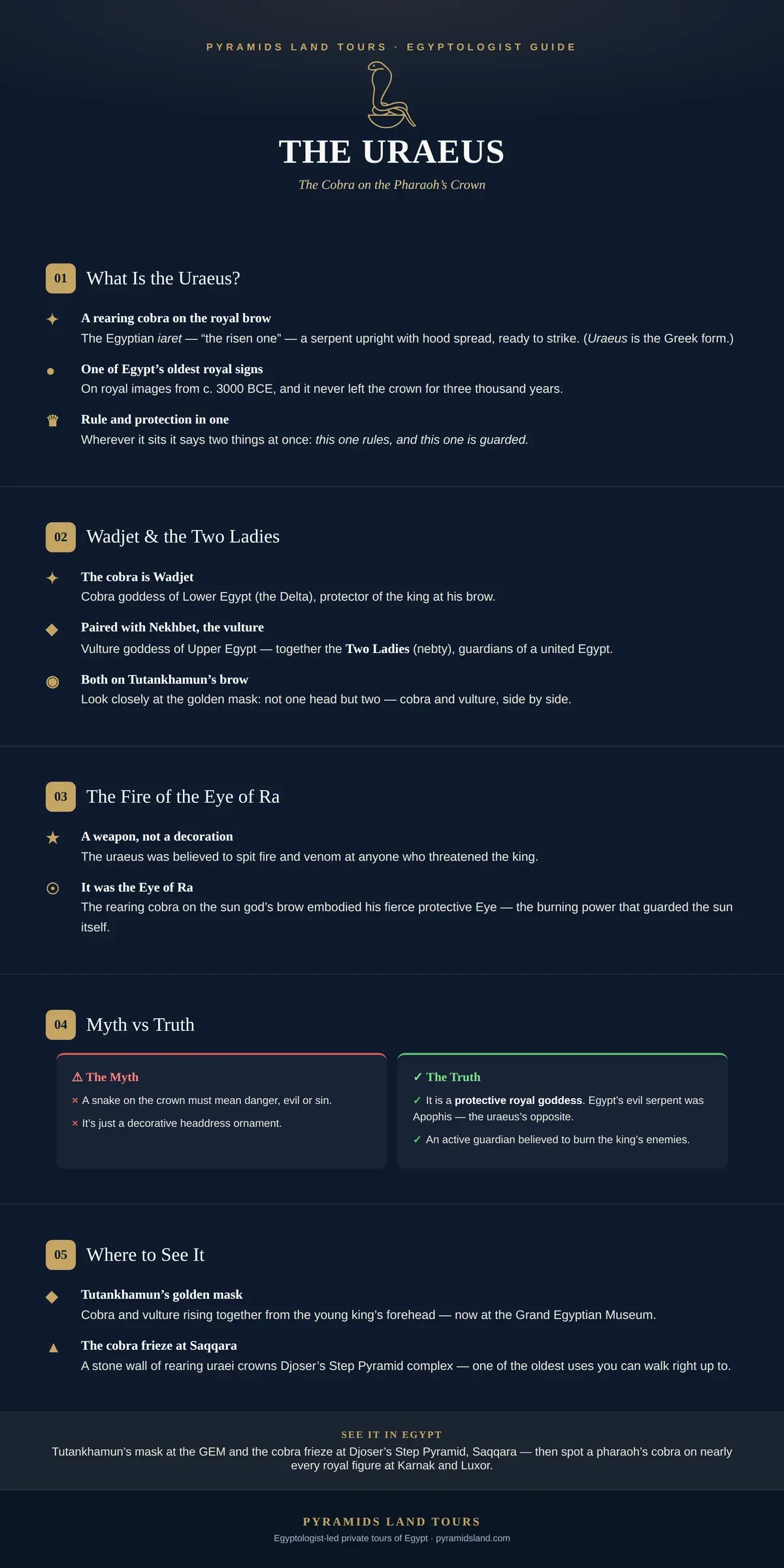
- What it is: a rearing Egyptian cobra worn on the royal brow
- Egyptian name: iaret , “the risen one” ( uraeus is the Greek form)
- The goddess: Wadjet, cobra goddess of Lower Egypt
- Her partner: Nekhbet, vulture of Upper Egypt — together the “Two Ladies”
- What it did: marked kingship and protected the king, spitting fire at his enemies
- Deeper meaning: it embodied the Eye of Ra, the fiery protective power of the sun
- Best places to see it: Tutankhamun’s mask at the GEM; the cobra frieze at Djoser’s Step Pyramid, Saqqara
What is the uraeus?
The uraeus is the image of a rearing Egyptian cobra (Naja haje), worn at the front of a king's crown or headdress. The Egyptians called it the iaret — "the risen one" — which is exactly what it is: a serpent risen upright, hood flared, in the posture a cobra takes when it is about to defend itself. The word we use, uraeus, comes from the Greek rendering of that idea.
It is one of Egypt's oldest emblems of kingship: the rearing cobra appears on royal images from the early dynasties, around 3000 BCE, and never left the crown across the next three thousand years. Worn on the royal brow, it marked the wearer as king and as divinely protected. You will see it on crowns, on the striped nemes headcloth, on the brows of gods, and rearing in rows along the tops of shrines and walls. Wherever it sits, it says the same two things at once: this one rules, and this one is guarded.
Usually, there is a single cobra. But look closely at the Kushite pharaohs of the 25th Dynasty — Nubian kings such as Taharqa, who ruled Egypt from the south — and you will often find two cobras rearing side by side: a double uraeus, claiming both Egypt and the Nubian realm up the Nile. It became one of the visual trademarks of Kushite rule. (That is a different thing from the cobra-and-vulture pairing you will meet in a moment.)
Which goddess is the uraeus?
The uraeus is the goddess Wadjet, the cobra deity of Lower Egypt (the northern Delta), whose cult center was the city of Per-Wadjet, called Buto by the Greeks. Her name means "the Green One" — the green of papyrus and the Delta marshes she ruled — so the cobra on the crown was, in a sense, the living Delta itself, reared up to guard the king.
But she rarely worked alone. Wadjet was paired with Nekhbet, the vulture goddess of Upper Egypt (the south), whose home was the city of Nekheb. Together, the cobra and the vulture were the Two Ladies — nebty — the twin protectors of a unified Egypt, north and south. One of the pharaoh's five great names was the "Two Ladies" name, taken under their joint protection. This is why, if you look closely at the brow of Tutankhamun's golden mask, you will find not one head but two: a cobra and a vulture, Wadjet and Nekhbet, guarding the king shoulder to shoulder. Most retellings mention only the cobra and miss her partner entirely.
And the cobra was never the king's alone. Queens, royal mothers and goddesses wore the uraeus too, though its heart always beat for kingship. The most famous wearer came last of all: Cleopatra VII, the final pharaoh of Egypt, shown in some portraits with a rare triple uraeus — three cobras on her diadem, a flourish that seems to have been hers alone.
One cobra, two, or a cobra and a vulture?
Three crown arrangements get muddled constantly — here is the quick key:
| On the brow | What it is | What it says |
|---|---|---|
| A single cobra | one rearing uraeus (Wadjet) | the standard royal mark — a goddess poised to strike for the king |
| A cobra + a vulture | Wadjet and Nekhbet, the Two Ladies | rule over both Lower and Upper Egypt |
| Two cobras | the double uraeus | dual rule — Egypt and Nubia, worn by the Kushite kings |
How did the uraeus protect the pharaoh?
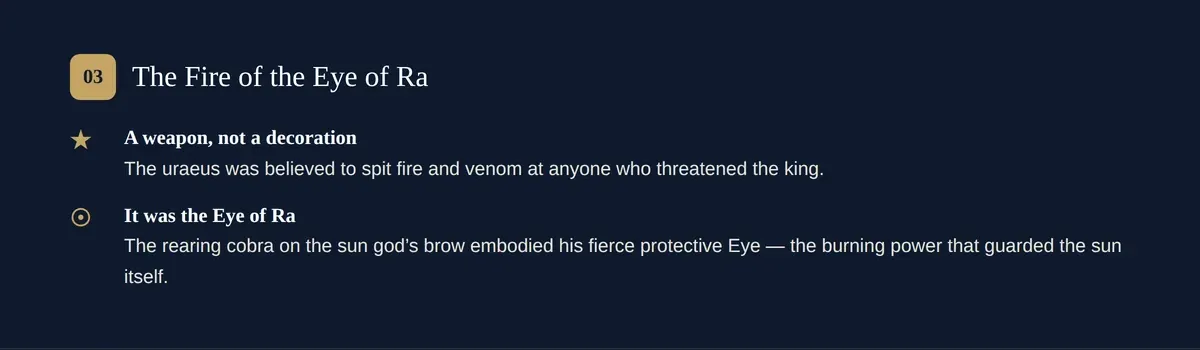
Actively and violently. The uraeus was believed to defend the king by spitting fire and venom at anyone who threatened him — a living alarm and weapon fixed to the crown. This was not a metaphor to the Egyptians; the cobra was thought to blast the king's enemies with flame.
That fire connects the uraeus to a much larger idea: the Eye of Ra. The Eye of Ra was the fierce, protective aspect of the sun god — often imagined as a goddess who went out to destroy his enemies — and the rearing cobra on the sun god's brow was that Eye, made visible. So the little serpent on a pharaoh's forehead carried the whole weight of solar power: the king was shielded by the same burning force that defended the sun itself. It is why cobras coil around sun disks throughout Egyptian art, and why the uraeus feels less like jewelry and more like a loaded charge. (The two are not quite the same thing: the Eye of Ra is the wider solar force, expressed through several goddesses, while the uraeus is that force narrowed to a single cobra on the brow.)
The Egyptians even had a name for the magic inside the crown: Weret Hekau, "Great of Magic." The rearing cobra was not a symbol of royal power — she was the power, a goddess coiled on the king's brow. And a king did not simply put her on; he was given her. One golden pendant from Tutankhamun's tomb shows the boy-king nursing from the cobra goddess herself, drinking in the life and dominion a coronation was meant to confer. Before a royal statue, then, you are looking at a goddess, not an ornament.
Myth-check
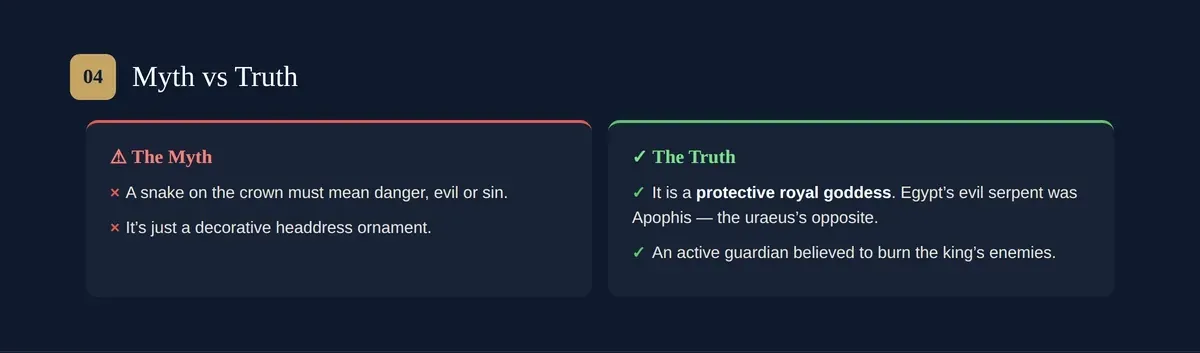
A couple of things worth setting straight. First, the uraeus is specifically a cobra — the Egyptian cobra rearing with its hood spread — not a generic snake. The pose is the whole point.
Second, and more importantly, not every serpent in Egypt was evil. Modern readers, trained to see the snake as a villain, assume the cobra on the crown must signify danger or sin. The opposite is true. The uraeus is a protective, royal goddess. The Egyptian serpent of evil was a different creature entirely — Apophis, the great chaos-snake who attacked the sun god's boat each night and had to be driven back. The uraeus and Apophis sit at opposite poles: one guards the king and the sun, the other tries to swallow them. So when you see a cobra on a pharaoh's brow, read protection and power, not menace.
Where to see the uraeus in Egypt
You almost cannot avoid it, once you know to look. The most famous example is the golden mask of Tutankhamun, now among the treasures at the Grand Egyptian Museum — the cobra and vulture rising together from the young king's forehead. Then, in the Egyptian Museum in Tahrir, do not rush past the little gold Uraeus of Senusret II: barely 7 cm of solid gold, its head carved from deep-blue lapis and its flared hood inlaid with blood-red carnelian, found at el-Lahun around 1920. Loops on its back once fixed it to a crown long since vanished — before Tutankhamun's tomb, this was the only royal cobra ever found on an Egyptian king.
For the serpent at architectural scale, go to Saqqara: the Step Pyramid complex of Djoser is crowned in places by a magnificent frieze of rearing cobras, a stone wall of uraei standing guard — one of the oldest and most striking uses of the symbol you can still walk up to, in the very same complex where the djed pillar makes one of its earliest appearances. And from there, keep looking: on the crowns of temple statues at Karnak and Luxor, ringing the cornices at Edfu, Philae, and Abu Simbel, the cobra is everywhere a king or a god appears. Once a guide points out the first one, you will spot a pharaoh's cobra on nearly every royal figure in Egypt.
And there is one cobra you will not find carved on any wall. The pyramid-shaped peak that towers over the Valley of the Kings had its own cobra goddess: Meretseger, "She Who Loves Silence." The tomb-builders of Deir el-Medina believed she struck liars blind with her venom — and forgave those who repented. Next time you are in the valley, glance up at her mountain.
Frequently Asked Questions
What is the uraeus?
The rearing Egyptian cobra worn at the front of a king's crown or headdress. The Egyptians called it the iaret, "the risen one" — a serpent upright with its hood flared. Worn on the brow, it marked the wearer as king and as divinely protected.
Which goddess is the uraeus?
Wadjet, the cobra goddess of Lower Egypt. She was usually paired with Nekhbet, the vulture goddess of Upper Egypt; together the cobra and vulture were the "Two Ladies" (nebty), twin protectors of a unified Egypt.
How did the uraeus protect the pharaoh?
The Egyptians believed the cobra actively defended the king by spitting fire and venom at his enemies — a living weapon fixed to the crown. It also embodied the Eye of Ra, the fierce protective power of the sun, so the serpent carried the full weight of solar force.
Why does Tutankhamun's mask have both a cobra and a vulture?
Because they are Wadjet and Nekhbet, the Two Ladies, marking the king's rule over both Lower and Upper Egypt. Most kings wore a single cobra, so the double crest on Tut's mask is a rarer, richer statement of sovereignty over the whole land.
Is the cobra on the crown a symbol of evil?
No — the opposite. The uraeus is a protective, royal goddess. Egypt's serpent of evil was a different creature: Apophis, the chaos-snake who attacked the sun god's boat each night. On a pharaoh's brow, read protection and power, not menace.
Where can I see the uraeus in Egypt?
The most famous is the golden mask of Tutankhamun at the Grand Egyptian Museum, with the cobra and vulture rising together from his brow. For the serpent at architectural scale, the Step Pyramid complex of Djoser at Saqqara is crowned in places by a frieze of rearing cobras. Beyond those, look for it on the crowns of temple statues at Karnak and Luxor.
Want an Egyptologist to point out the cobra on every royal brow and unpack what it meant? Every Pyramids Land tour is private and guide-led, shaped around exactly what you want to see. Plan your private tour on WhatsApp →
Ashraf Fares