
Cleopatra Egypt: The Real History Behind the Myth
When most people think of Cleopatra, they picture Elizabeth Taylor in a shimmering gown. That image has buried one of antiquity's most formidable minds. Cleopatra VII Philopator was not a seductress who stumbled into power — she was a political strategist of the first order, a linguistic genius, and the last active pharaoh of ancient Egypt. If you're planning a trip to Egypt, understanding the truth about Cleopatra transforms how you experience Cairo, Alexandria, and the monuments of her era.
Who Was Cleopatra? The Truth Behind the Legend
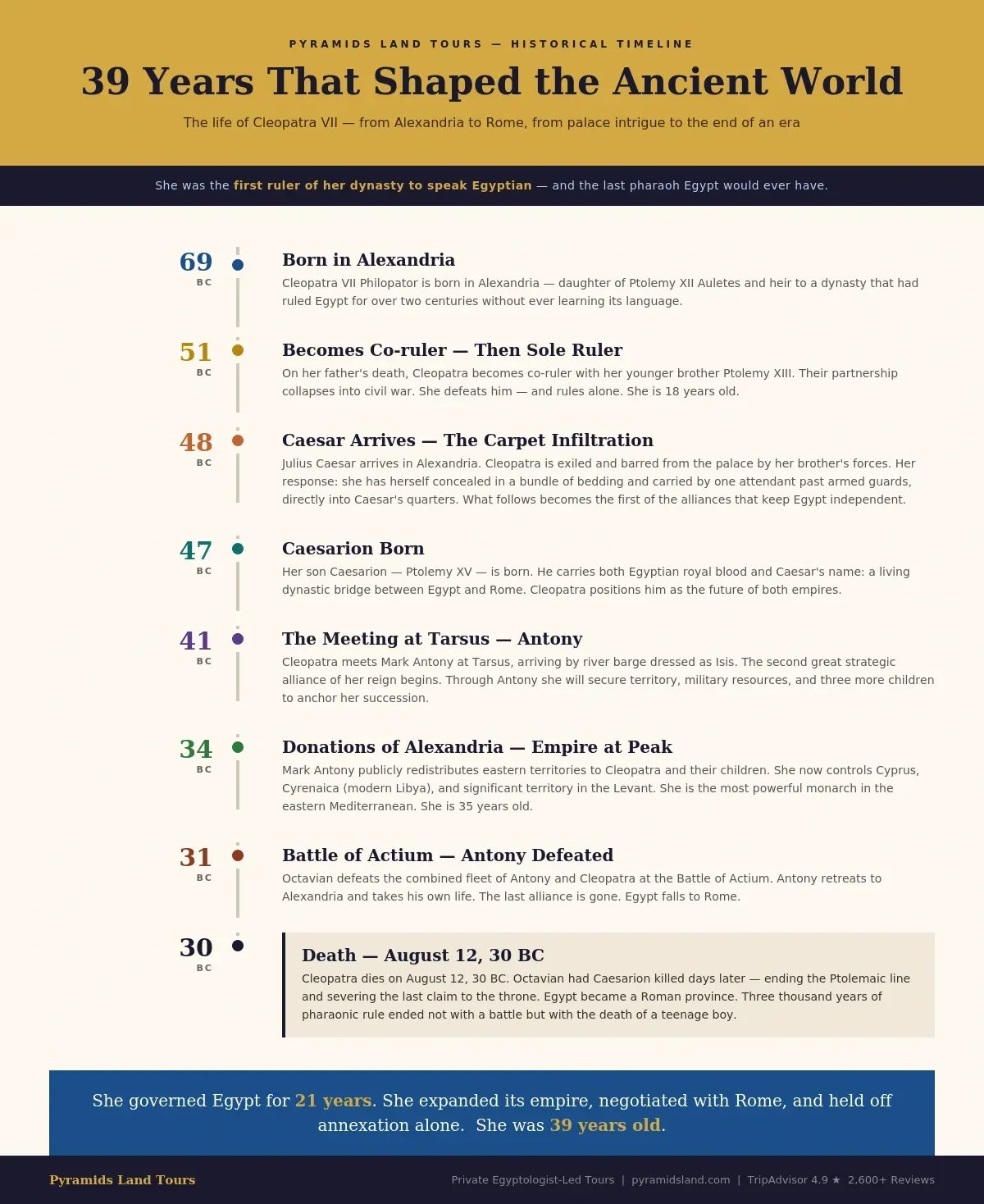
Cleopatra was not Egyptian by ethnicity. She was Macedonian Greek by patrilineal descent, descended from Ptolemy I — the Macedonian general who became pharaoh after Alexander's death — through the Ptolemaic dynasty that ruled Egypt for three centuries. (Her mother's identity is unknown, and some scholars allow for partial Egyptian ancestry.) What distinguished her from every ruler before her was a single, calculated choice: she learned the Egyptian language.
She was the first of her dynasty to do so. That was not sentiment — it was a deliberate political act that connected her to three thousand years of pharaonic tradition and earned her a legitimacy no other Ptolemaic ruler had bothered to claim.
The Ptolemies practiced brother-sister marriage to maintain the bloodline. Cleopatra became co-ruler with her brother Ptolemy XIII in 51 BC. Their partnership collapsed into civil war. She defeated him and ruled alone.
Born in 69 BC, she grew up navigating palace intrigue in a kingdom in decline. Egypt was no longer the superpower of the New Kingdom. Rome was rising, and Egypt's survival depended on intelligence, strategy, and powerful alliances. Cleopatra grasped what others could not: survival required navigating between empires without being consumed by either.
The Linguist Who Could Outthink Any Rival
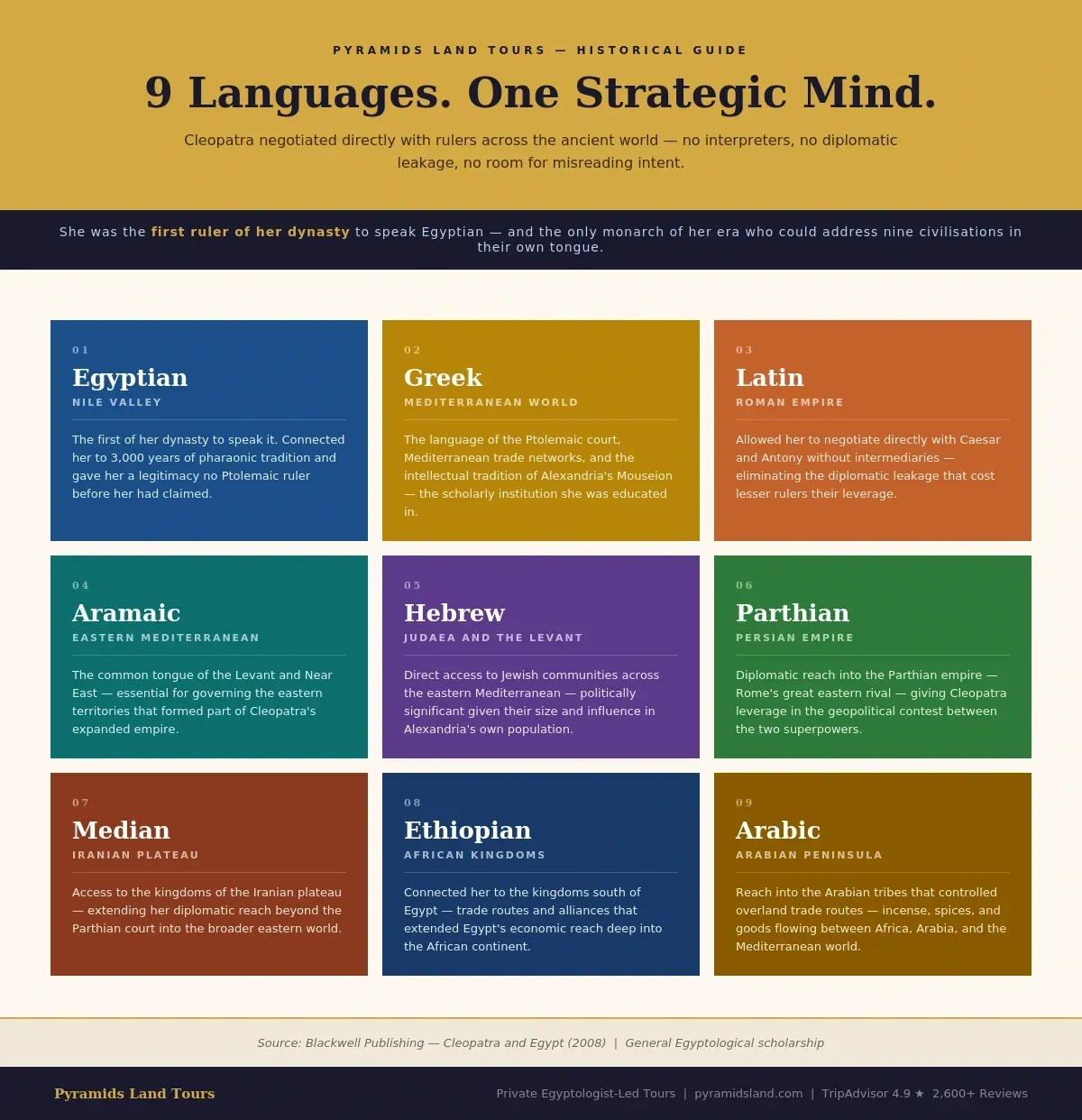
Cleopatra's greatest strategic asset was her intellect. She spoke nine languages — Egyptian, Greek, Aramaic, Hebrew, Latin, Parthian, Median, Ethiopian, and Arabic — and could negotiate directly with rulers across the Mediterranean and the East without interpreters. That eliminated diplomatic leakage. It eliminated the miscommunication that doomed lesser rulers. It gave her a decisive read on every room she entered.
She was educated at the Mouseion — the great scholarly institution connected to the Library of Alexandria — making her one of the most learned people of her age. She understood mathematics, astronomy, philosophy, and medicine. She could debate with scholars and generals alike, and she was formidable in both rooms.
For travelers visiting Alexandria today, this matters: Cleopatra's Egypt was not an isolated kingdom. It was cosmopolitan, multilingual, and connected to the entire ancient world. The city she ruled from was its intellectual capital.
The Queen Who Expanded an Empire
At her height, Cleopatra controlled far more than the Nile Valley. Her empire included Cyprus, Cyrenaica (modern Libya), and significant territory in the Levant. This expansion reached its peak in 34 BC at the Donations of Alexandria — a public ceremony in which Mark Antony redistributed eastern territories to Cleopatra and their children, making her the most powerful monarch in the eastern Mediterranean.
This happened while Egypt was internally fractured and externally threatened by Rome. That Cleopatra not only survived but expanded her dominion reveals the scale of her political genius. When you visit the monuments of her era, you're looking at the work of a ruler who defied every structural disadvantage she was handed.
The Alliances That Kept Egypt Independent
The seductress myth distorts this chapter of her story the most. Cleopatra's relationships with Julius Caesar and Mark Antony were not love stories — they were strategic alliances with the two most powerful men in the Roman world, pursued at precisely the moments Egypt needed them most.
The first alliance began with a feat of pure operational nerve. Caesar had arrived in Alexandria with Cleopatra's brother controlling access to the palace. She was exiled, barred from the city, and one wrong move would cost her her life. Her solution: she had herself concealed in a bundle of bedding and carried through the palace by a single attendant — a Sicilian named Apollodorus — past guards loyal to her brother, directly into Caesar's private quarters. Plutarch records the episode in his Life of Caesar. When the bundle was unrolled, Cleopatra stood before the world's most powerful military commander. She then proceeded to make her case.
That is not seduction. That is operational intelligence, physical courage, and an extraordinary read of the situation.
Through Caesar, she secured a son — Caesarion (Ptolemy XV) — who represented a dynastic bridge between Egypt and Rome, the son she had positioned as the future of both empires. Through Antony, she secured territory, military resources, and three children who could anchor her succession. She held an impossible position against overwhelming odds for nearly two decades. The ancient world had no shortage of brilliant men who failed at far less. Cleopatra's genius was the reading of power, and the willingness to act on what she saw.
The Living Goddess: How Cleopatra Used Religion as Power
Cleopatra understood that political authority and spiritual authority were inseparable in Egypt. She presented herself as the living incarnation of Isis — the greatest goddess in the Egyptian pantheon — tying herself to the tradition of divine kingship that stretched back three thousand years.
This was statecraft, not pageantry.
When you visit Alexandria, Isis imagery is woven into the city's surviving collections and archaeological sites — the visual language Cleopatra used to govern. The Greco-Roman Museum, which houses the finest Ptolemaic sculpture in Alexandria, is currently closed for renovation; your guide can advise on access and direct you to where this material is on view. Alexandria was the most cosmopolitan city in the ancient world — the place where Greek philosophy, Egyptian mysticism, and Roman pragmatism met and merged. The great Lighthouse of Alexandria stood in her time, one of the Seven Wonders of the ancient world, visible for miles out to sea.
"I stop clients right in front of the best Isis statues and say: 'Look at her face. This isn't the old Egyptian Isis anymore — this is Isis with a Greek soul and a Roman crown. The features are softer, almost seductive, but she still wears the exact same throne headdress and the protective knot Cleopatra used on her own coins.'
Then I lean in and drop the line that always makes them pause: 'This is exactly how Cleopatra wanted to be seen — the living goddess Isis, ruling from Alexandria. Every time she walked these streets, this is the image looking back at her. This statue isn't just art. It's the face of the last queen of Egypt.'"
— Ashraf Refaat, Egyptologist and Director, Pyramids Land Tours
Beneath Alexandria's harbor today, the sunken ruins of the royal quarter — Cleopatra's palace complex, known as Antirhodos — lie on the seafloor. Archaeologist Franck Goddio's mission has been mapping the site since 1996, recovering statues, columns, and artifacts from the buildings where she governed. The ruins are accessible via licensed specialist dive expeditions, and what has been recovered confirms both the scale and the sophistication of the world she operated from.
"Standing on the Corniche with the Eastern Harbor stretching out in front of us, I point down at the water and say quietly: 'Cleopatra's palace — the real one, where she lived with Caesar and Antony — is right there, somewhere beneath these waves, only 6 to 8 meters down. The entire royal quarter, including the Isis temple attached to her palace, sank after the earthquakes.'
I let the silence sit for a second, then add: 'While we're standing here drinking coffee and watching the ferries, we're literally floating above her bedroom and throne room. Nothing in Egypt makes the past feel so close — and so heartbreakingly lost — as this spot.'"
— Ashraf Refaat, Egyptologist and Director, Pyramids Land Tours
This was Cleopatra's capital. When you stand on that harbor wall, you are standing above it.
The Woman, Not the Legend
What did Cleopatra actually look like? Plutarch, in his Life of Antony, tells us she was not conventionally beautiful by the standards of her time. Ancient coins bearing her portrait — surviving in museum collections worldwide — show a strong nose, defined chin, and commanding profile that bears no resemblance to any Hollywood depiction. What she possessed was presence. Her voice was compelling, her wit relentless. What drew people to her was not her appearance — it was the authority she carried without effort and the intelligence that made every room she entered feel smaller.
She died on August 12, 30 BC. By then, Antony had already fallen — defeated at the Battle of Actium and dead by his own hand. Egypt had fallen to Octavian, who would become Emperor Augustus. With no alliance left to forge and no exit available, Cleopatra chose the terms of her own ending. The traditional account says she died from an asp bite — an Egyptian cobra — as a final act of defiance, choosing a death laden with pharaonic symbolism. Modern historians debate this; poison is considered equally likely.
Octavian had Caesarion — the son she had built her Roman strategy around — killed days after her death. Plutarch records that one of Octavian's advisors counseled that the world could not hold "too many Caesars." With Caesarion gone, the last thread connecting the pharaonic tradition to any future was severed. Egypt became a Roman province. Three thousand years of continuous civilization ended not with a battle but with the death of a teenage boy.
Why Cleopatra Still Matters
Two thousand years is a long time to hold the world's attention. The reason Cleopatra has is that every era has found something different in her story to argue about.
In antiquity, Roman writers portrayed her as a dangerous foreign queen — the threat that justified Octavian's conquest of Egypt. In the Renaissance, Shakespeare rewrote her as tragedy: his Antony and Cleopatra (first performed around 1607) drew directly from Plutarch and gave her one of the most complex female roles in the English canon. In the twentieth century, Hollywood reduced her to spectacle — the 1963 Elizabeth Taylor film cost so much to produce it nearly bankrupted a studio and fixed an image of Cleopatra that had almost nothing to do with the historical record.
What each era got wrong, and what the historical record shows, is that she was primarily a ruler. The sexual mythology that surrounds her — the stories of seduction and promiscuity that have circulated for two thousand years — originates almost entirely from Roman writers working under Octavian after her death, a deliberate political strategy to justify the conquest of Egypt by discrediting its last ruler. The romantic framing was applied to her by people who found it more comfortable than the alternative: that a woman had run one of the most sophisticated political operations in the ancient world, held off Rome for twenty years, and lost only when the odds became mathematically impossible.
That reframing is still happening. Archaeologists are still searching for her tomb. Historians are still debating her death. She remains, two millennia later, an open case.
Cleopatra: Six Myths vs. the Record
The historical Cleopatra and the Hollywood version diverge at almost every point. Here is where the record stands.
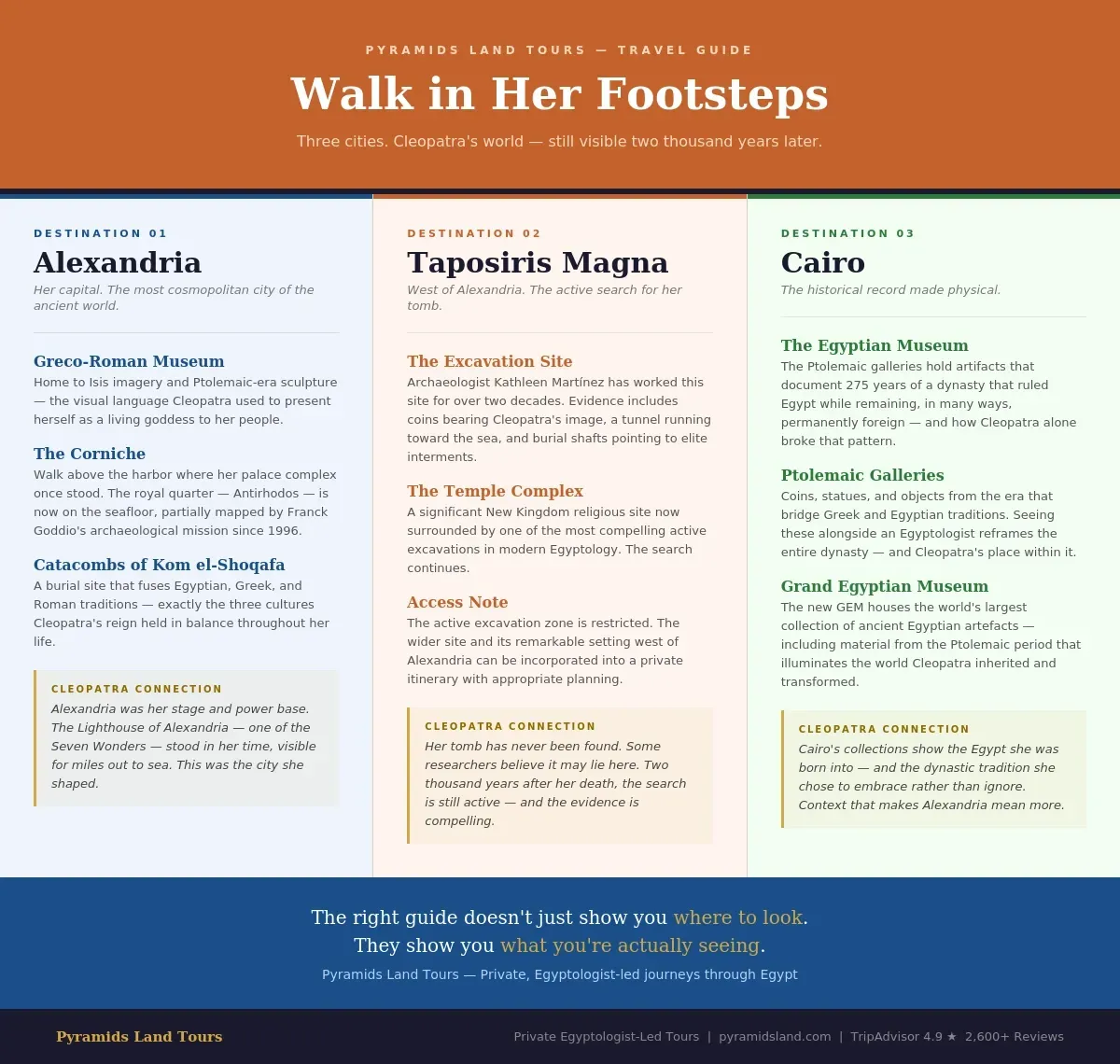
She was Macedonian Greek by patrilineal descent — not Egyptian by ethnicity — and the first of her dynasty to speak Egyptian, a calculated political move rather than a birthright. Her relationships with Caesar and Antony were strategic alliances with the two most powerful men in the Roman world, pursued at moments of acute national vulnerability rather than romantic entanglements. Ancient coins bearing her portrait and Plutarch's own account both contradict the beauty myth — what she possessed was presence, authority, and a voice people remembered long after she left the room. The carpet story, far from being a romantic gesture, was a tactical infiltration: she needed access to Caesar, her brother controlled every entrance, and she solved the problem with operational precision. At her peak, she was not a minor regional ruler but the dominant monarch of the eastern Mediterranean, controlling Cyprus, Cyrenaica, and the Levant following the Donations of Alexandria in 34 BC. And her death was not an act of grief — it was a refusal. With no alliance left to forge and Roman captivity certain, she chose the terms of her own ending, consistent with every decision she had made across two decades in power.
This is paragraph text. Click it or hit the Manage Text button to change the font, color, size, format, and more. To set up site-wide paragraph and title styles, go to Site Theme.
Frequently Asked Questions
Was Cleopatra Egyptian?
Not by ethnicity. Cleopatra VII was Macedonian Greek by patrilineal descent, from the Ptolemaic dynasty founded by Ptolemy I — the Macedonian general who became pharaoh after Alexander's death. She was, however, the first ruler of her dynasty to speak the Egyptian language — a deliberate act that made her, in the eyes of her subjects, a legitimate heir to the pharaonic tradition.
What is the Cleopatra carpet story?
The traditional account — recorded by Plutarch in his Life of Caesar — describes Cleopatra having herself concealed in a bundle of bedding and carried by her attendant Apollodorus past guards loyal to her brother, directly into Julius Caesar's private quarters in the palace. Stripped of its romantic framing, it is a precise tactical operation: she needed access to the most powerful military commander in the world, her brother controlled every conventional entry point, and she solved the problem. The "carpet" in popular culture is a loose translation of the Greek; the original word refers to a bedding bundle or linen sack.
What languages did Cleopatra speak?
Nine: Egyptian, Greek, Aramaic, Hebrew, Latin, Parthian, Median, Ethiopian, and Arabic. This range allowed her to negotiate directly with rulers across the ancient world — without interpreters, without diplomatic leakage.
What did Cleopatra look like?
Plutarch describes her as not conventionally beautiful. Ancient coins bearing her portrait show a strong-featured profile — nothing like any Hollywood portrayal. What she possessed was presence: a compelling voice, relentless wit, and authority that needed no physical advertisement.
Where is Cleopatra buried?
Her tomb has never been found. It remains one of archaeology's great unsolved mysteries. Archaeologist Kathleen Martínez has spent over two decades excavating Taposiris Magna, west of Alexandria, where evidence including coins bearing Cleopatra's image and a tunnel leading toward the sea points to a possible location. The search is ongoing.
Was Cleopatra the last pharaoh of Egypt?
Yes. When she died in 30 BC, Egypt became a Roman province. Octavian also had her son Caesarion killed shortly after — ending the Ptolemaic line and severing the last dynastic claim to the throne. The pharaonic tradition that had endured for three thousand years ended with them.
See Egypt with an Expert
Cleopatra's world didn't end in 30 BC — it went underground, into the harbor floors, museum galleries, and temple walls of Egypt. The right guide doesn't just show you where to look. They show you what you're actually seeing.
Rated 4.9 on TripAdvisor across 2,600+ reviews, Pyramids Land Tours offers private, Egyptologist-led journeys through Egypt — including Alexandria, Cairo, Luxor, Aswan, and Abu Simbel. Our Egyptologist guides specialize in separating the historical record from myth and helping travelers see the real Egypt: the one Cleopatra actually ruled. Browse all private Egypt tour packages
Ready to see the Egypt she shaped? Plan your private tour here.
Sources: Blackwell Publishing — Cleopatra and Egypt (2008); Plutarch, Life of Caesar; Plutarch, Life of Antony; Franck Goddio Foundation — Alexandria excavation records; general Egyptological scholarship.
pyramidsland.com
Walk in Her Footsteps
Egypt is not one monument. It is a sequence of worlds — and Cleopatra's is one of the most layered and least understood.
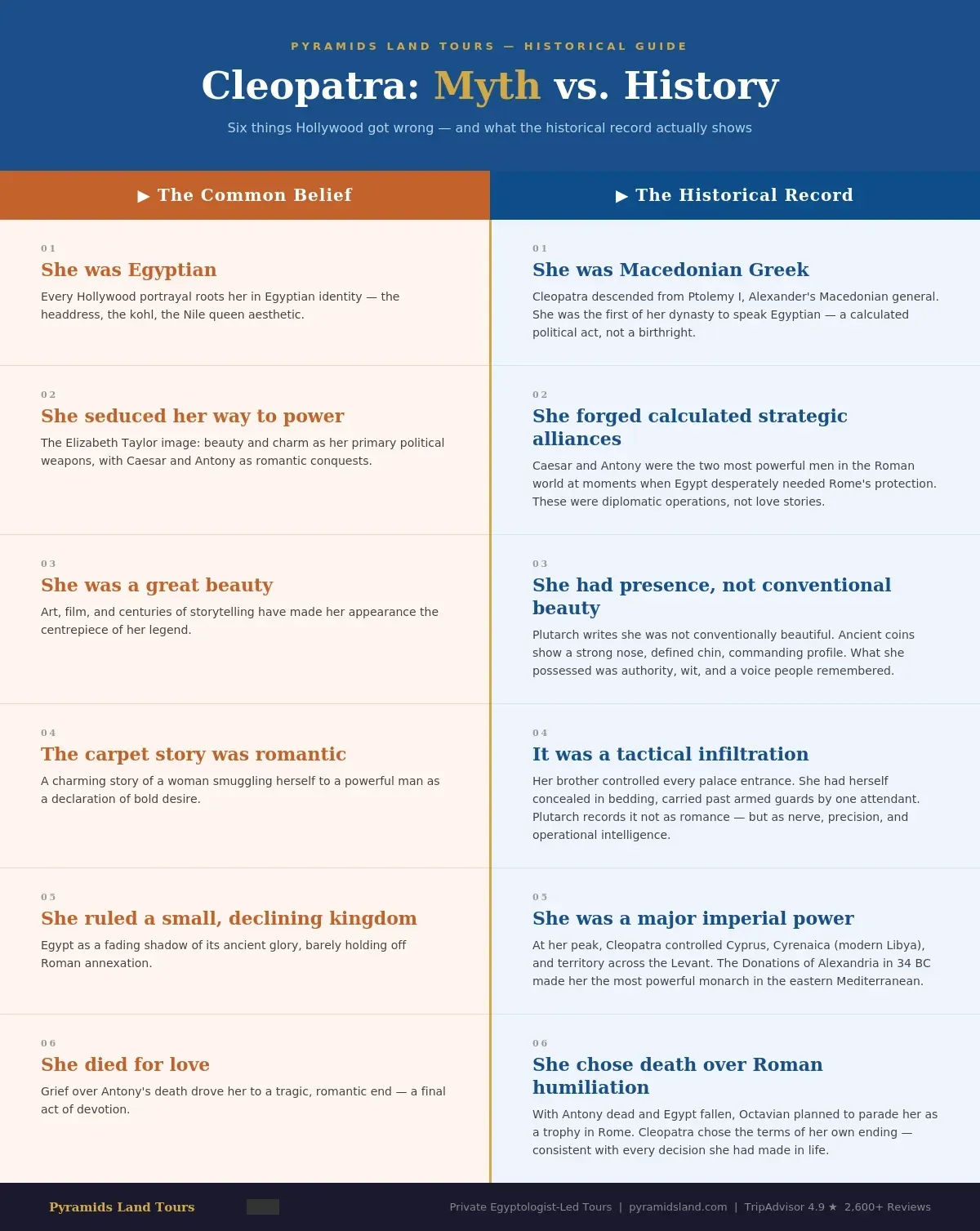
In Alexandria, you can walk the Corniche above the harbor where her palace once stood — the royal quarter now submerged only six to eight metres below the surface — and explore the Catacombs of Kom el-Shoqafa, a burial site that fuses Egyptian, Greek, and Roman traditions in precisely the way Cleopatra's reign fused those three cultures in life. The Greco-Roman Museum, which holds the finest Ptolemaic sculpture collection in Alexandria, is currently closed for renovation; your guide will advise on current access and ensure you see the Isis imagery that defined how Cleopatra presented herself to her city.
West of Alexandria, the temple site of Taposiris Magna has become one of the most significant active excavations in Egypt. Archaeologist Kathleen Martínez has spent over two decades working the site, and the evidence she has assembled — including coins bearing Cleopatra's image, a tunnel running toward the sea, and burial shafts pointing to elite interments — makes a credible case that Cleopatra's tomb may lie here. The excavation is ongoing, and the site is restricted, but proximity to Taposiris Magna can be built into a western Alexandria itinerary for travelers who want to understand what the active search for Cleopatra looks like in the field.
Near Luxor, the Hathor Temple at Dendera holds one of the only surviving large-scale depictions of Cleopatra VII — carved on the exterior rear wall. Most visitors walk straight past it. Your guide stops and points her out: a queen who commissioned temples in Upper Egypt while simultaneously negotiating with Rome, rendered in stone two thousand years ago and still standing. Dendera is a half-day detour from Luxor and one of the most complete Ptolemaic temple interiors in Egypt. Dendera is included in our Luxor day tours
In Cairo, the Egyptian Museum houses Ptolemaic-era artifacts that flesh out the historical record. The Ptolemaic galleries reveal a dynasty that ruled Egypt for 275 years while remaining, in many ways, permanently foreign — and how Cleopatra alone broke that pattern.
Understanding Cleopatra doesn't just reframe the history. It reframes the monuments. You begin to see not just what was built, but who had the intelligence, the alliances, and the will to keep building when everything was falling apart.
Ready to build your itinerary? Message Ashraf directly on WhatsApp — no forms, no call centers, no waiting.
Ashraf Fares