
The Egyptian Scarab Beetle: Meaning, Khepri & the Symbol of Rebirth
The short answer: The scarab beetle was ancient Egypt's symbol of creation, the rising sun, and rebirth. Egyptians linked the dung beetle to the sun-god Khepri, who they believed rolled the sun into the sky each dawn — making it a powerful emblem of rebirth."
Of all the signs the Egyptians left behind, few surprise people more than the scarab. It is not a lion, a falcon, or a king — it is a beetle that lives in dung. Yet for more than two thousand years it was one of the most powerful symbols in the entire civilization: carved onto seals, strung onto necklaces, and laid over the hearts of the dead. To understand why, you have to look at the beetle the way an Egyptian did.
At a glance
Key Facts
- Symbol of: creation, the rising sun, and rebirth
- God: Khepri — the scarab-headed dawn sun, self-created
- Real insect: Scarabaeus sacer , the sacred dung beetle
- Word link: kheper (ḫpr) means both “beetle” and “to come into being”
- First appears: seal-amulets from c. 2000 BCE; heart scarabs from the New Kingdom
- Heart scarab: green-stone scarab over the heart, inscribed with Book of the Dead Spell 30B
- Best place to see one: the giant granite scarab by the Sacred Lake at Karnak
What did the scarab beetle symbolize?
The scarab symbolized creation, the rising sun, and rebirth — the idea that existence renews itself endlessly. It was the emblem of becoming: the force that brings the new day and the new life out of darkness. That is why it appears everywhere from a child's protective amulet to the most sacred object placed on a mummy.
Why did the Egyptians love the scarab beetle?
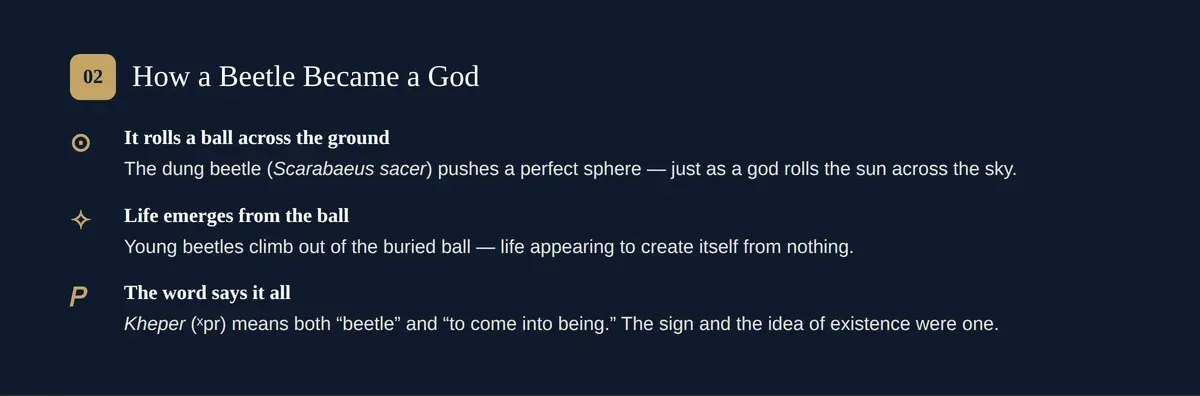
Because of what they watched it do. The sacred scarab of Egypt is a real insect — Scarabaeus sacer, a dung beetle still living in the country today. It gathers animal dung, rolls it into a neat sphere larger than itself, pushes it across the ground with its back legs, and buries it. Inside that ball it lays its eggs, and weeks later young beetles climb out of the earth — appearing to be born from the ball itself.
To a people who read the natural world for signs of the divine, this was extraordinary. A creature rolling a perfect disc across the ground looked exactly like something rolling the sun across the sky. And a creature whose young emerged from buried matter looked as if life were generating itself. The Egyptians took the reading further than we would: to them, the beetle was self-created, bringing its own life out of the buried ball with no parent needed. (Centuries later, Greek and Roman writers — Plutarch, Aelian, Pliny — pushed it into a literal claim that the scarab had no females at all and fathered itself; that flourish was theirs, not Egypt's.) Either way, the vision of a self-made creature is the seed of everything the symbol came to mean.
Language sealed it. The Egyptian word for the beetle, kheper (ḫpr), also meant "to come into being," "to become," "to exist." The same three letters wrote both the insect and the idea of existence itself. When a scribe drew the little scarab hieroglyph 𓆣, he might be naming a beetle — or writing the most fundamental verb in the language. Sign and meaning were fused at the root.
The real insect, Scarabaeus sacer, is a dung beetle found on every continent except Antarctica — one of roughly 8,000 dung-beetle species.
Who was Khepri, the scarab god?
Out of this grew one of Egypt's oldest gods: Khepri, shown as a scarab or as a man with a scarab for a head. He is named already in the Pyramid Texts — the oldest religious writing in the world, carved inside Old Kingdom pyramids around 2350 BCE — where the sun-god is hailed as the beetle who came into being of his own accord. Khepri was the sun at the instant of dawn — the sun becoming, heaving itself over the horizon as the beetle heaves its ball. He was self-created, needing no parent, generating his own existence each morning.
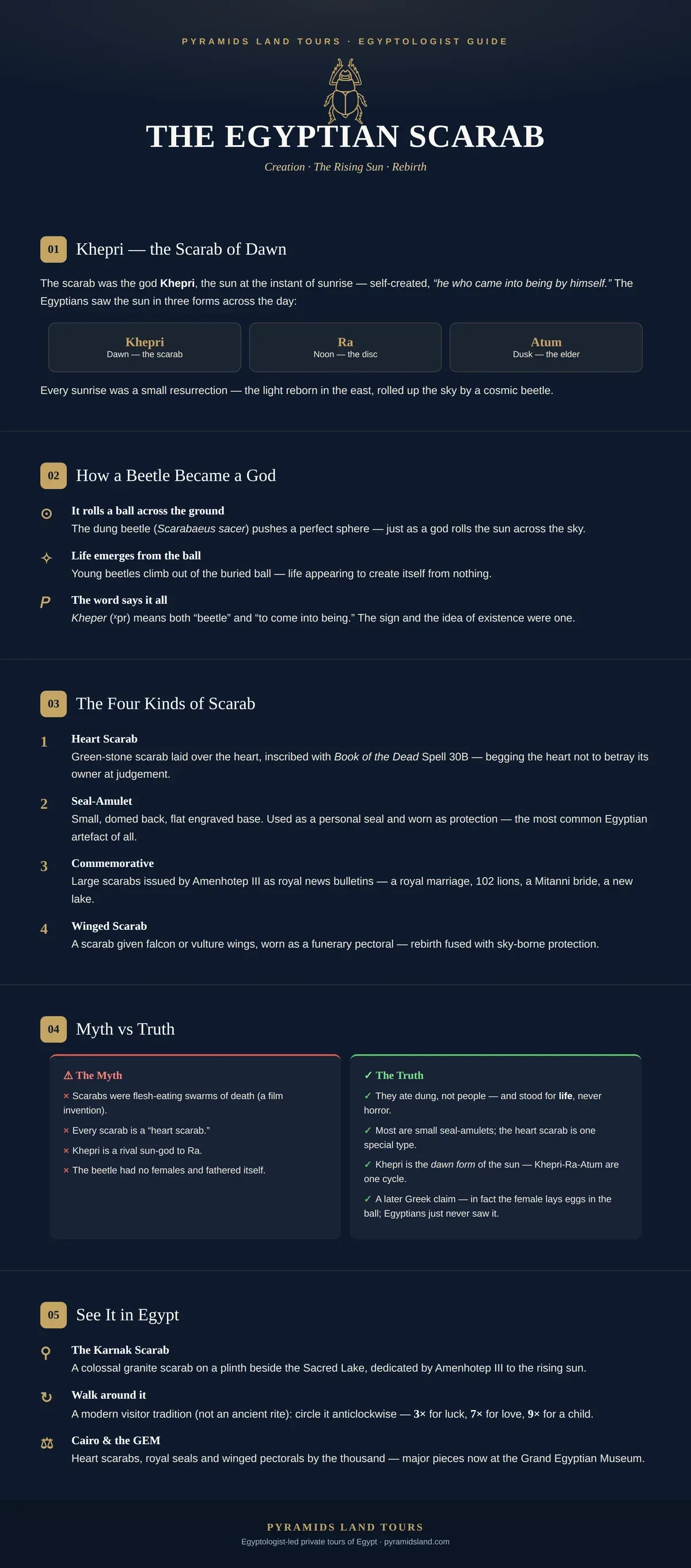
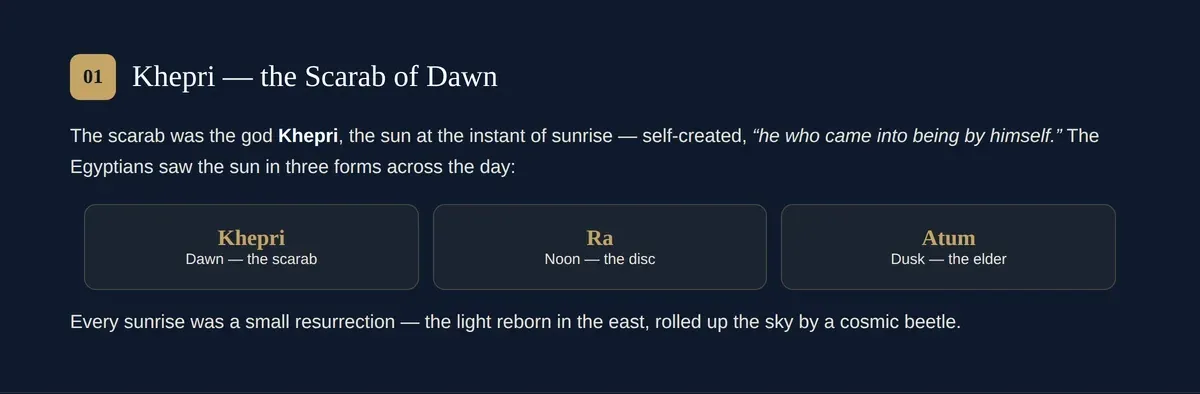
The Egyptians pictured the sun in three forms across the day: Khepri the scarab at dawn, Ra the blazing disc at noon, and Atum the elder at dusk. Khepri was not a rival to Ra but his first form — the sun in the act of being born, the same solar cycle you can trace in the Eye of Ra and across ancient Egyptian religion. Every sunrise was, in this view, a small resurrection.
Why is the scarab a symbol of rebirth?
Follow that logic, and you reach the heart of it. If the sun is reborn each dawn, and the scarab is the force behind that rebirth, then the scarab is the perfect guarantee of resurrection — and resurrection was the Egyptian obsession. The whole machinery of their tombs and spells existed to ensure the dead would rise like the morning sun.
So the scarab moved from the sky to the tomb. To be buried with one was to bind yourself to the single creature that promised renewal — the beetle that made new life out of decay was exactly the ally you wanted for your own passage back into being. This is why the scarab sits at the center of the rebirth family of ancient Egyptian symbols, beside the ankh and the lotus.
What are the different types of scarab?
"Scarab" is not a single object but a family of objects, and they appear at different points in Egyptian history. Knowing them apart will change how you read any museum case in Egypt.
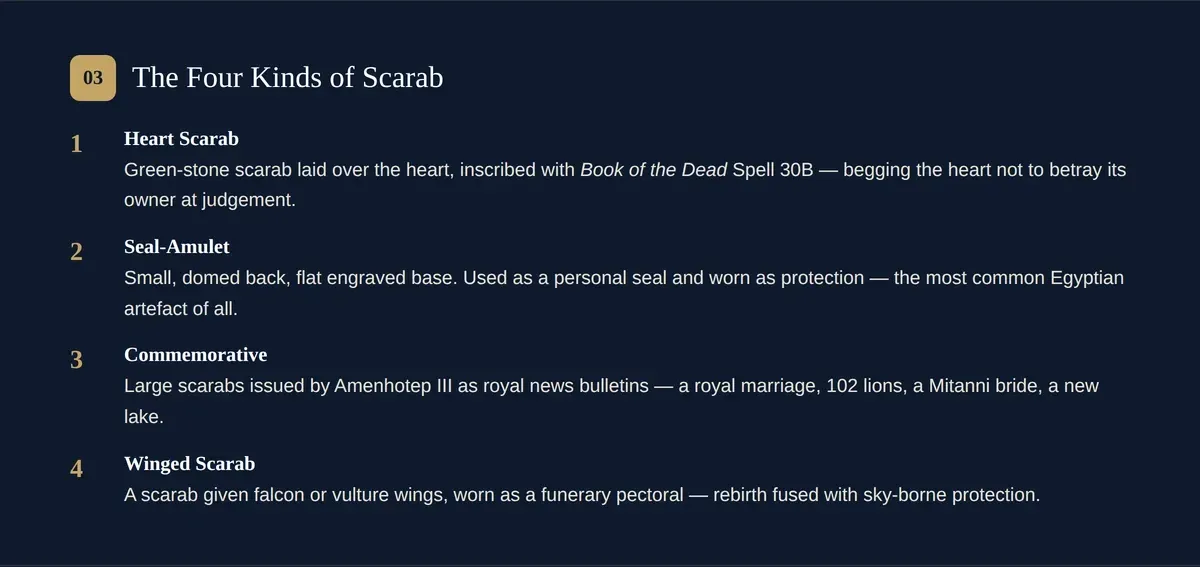
Seal-amulet scarabs are the oldest and by far the most common, appearing from around the First Intermediate Period and spreading through the Middle Kingdom (c. 2000 BCE). Small, with the domed beetle on top and a flat underside engraved with names, titles, gods, or good-luck motifs, they served as personal seals — pressed into wet clay to sign documents — and as protective amulets. They are among the most numerous inscribed objects that Egypt ever produced.
Heart scarabs appear later, from the Second Intermediate Period onward. This is the most sacred type: a large scarab, usually of green stone — nephrite, green jasper, or other hard green stone — placed directly over the heart of the mummy and inscribed with Spell 30B of the Book of the Dead. To see why it mattered, you have to know what the heart was to an Egyptian: the ib was not a pump but the seat of thought, memory, and character — mind and conscience together. Alone among the organs, it was left inside the body during mummification, because it was the person, and at the weighing of the heart, it was set against the feather of Maat, truth itself. Spell 30B is a plea to that heart not to testify against its owner — the Egyptians feared their own conscience might speak, and the heart scarab was their insurance against it.
Commemorative scarabs were a royal innovation of Amenhotep III (c. 1390–1350 BCE), who issued large inscribed scarabs like official news bulletins — mass-produced in many copies and distributed across Egypt and beyond, turning up as far away as Cyprus and the Levant. Five types are known, each announcing an event of the reign: his marriage to Queen Tiye (pointedly naming her non-royal parents, Yuya and Thuya); a wild-bull hunt (of 170 bulls sighted, the king's scarab claims 56 taken in a single day); a lion-hunt tally of 102 lions killed in his first ten years; the arrival of the Mitanni princess Gilukhepa with a retinue of 317 women; and the digging of a vast pleasure lake for Tiye in his eleventh year, on which the royal couple sailed a barge named The Aten Gleams. They are, in effect, the press releases of the fourteenth century BCE.
Winged scarabs gave the beetle the outstretched wings of a falcon or vulture, worn as a pectoral over the chest of the dead, fusing the rebirth power of the scarab with the sky-borne protection of wings. The most famous of all is Tutankhamun's pectoral, its central scarab carved from pale
Libyan desert glass — a natural glass forged in the Sahara by ancient heat, which Carter at first mistook for chalcedony — glows where the sun would sit.
| Type | Purpose | Who used it |
|---|---|---|
| Seal-amulet | Everyday personal seal + protective charm | Everyone — officials and ordinary people |
| Heart scarab | Laid over the heart of the mummy, inscribed with Book of the Dead Spell 30B | The elite / anyone given a full burial |
| Commemorative | Large "news-bulletin" scarabs announcing royal events | Kings (esp. Amenhotep III) |
| Winged scarab | Funerary pectoral — rebirth fused with sky-borne protection | Royalty / high-status burials |
Why are scarabs so often green or blue?
The material was itself part of the message. Everyday seal-amulets were usually carved from steatite and glazed a blue-green; heart scarabs were cut from hard green stone, often set in gold; funerary scarabs tucked into the mummy wrappings were frequently blue or green faience. Green was the color of wadj — new growth, fertility, and Osiris reborn — so a green scarab carried its promise of rebirth twice over: in its shape and in its very stone.
Do Egyptian scarabs still exist?
Yes — in two senses. The living beetle, Scarabaeus sacer, still rolls its ball across Egyptian ground today, exactly as it did for the pharaohs. And ancient scarabs survive in enormous numbers: heart scarabs, royal seals and winged pectorals fill the collections in Cairo, with major pieces now on display at the Grand Egyptian Museum. Scarabs are also among the most copied souvenirs in Egypt. If you buy one, buy it as the lovely modern keepsake it is — the carved stone and faience scarabs sold at markets and temple shops are new, and any dealer swearing a piece is a "genuine antiquity" is either mistaken or breaking the law, since real antiquities cannot legally leave Egypt. The authentic ancient ones all live behind museum glass.
One practical note if you're buying: much of the cheap "stone" at tourist stalls is really resin or plastic — genuine stone or faience feels noticeably cooler and heavier in the hand. For the reliable tests (and how gold is priced by weight), see our guides to spotting real stone vs. resin and the Gold & Silver Jewelry Buying Rules.
The symbol never really died, either. The scarab remains one of the most popular motifs in modern amulets and tattoos, still chosen for exactly the meaning the Egyptians gave it: protection, renewal, and a fresh start.
Common myths about the scarab
A few things get repeated that an Egyptologist would gently correct.
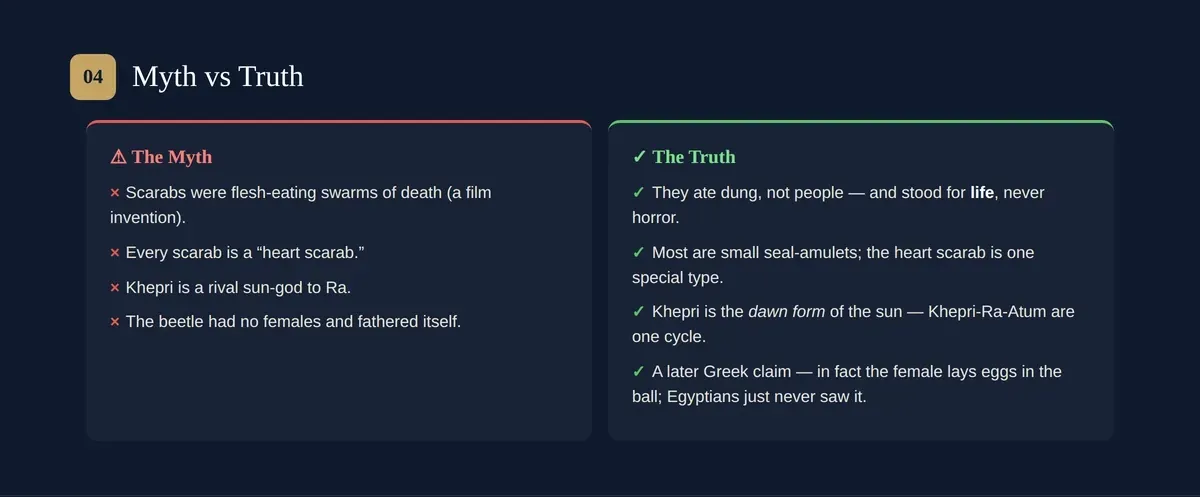
The scarab was never a symbol of death or menace. The flesh-eating swarms of certain films are pure invention — real scarabs eat dung, not people, and to the Egyptians, the beetle stood for life.
Khepri is not a separate sun-god competing with Ra. He is one of the sun's forms — the dawn — so it is more accurate to speak of Khepri-Ra-Atum as one cycle than of three rival gods.
The "self-creating" beetle was a misreading of something the Egyptians simply could not see: the female lays her eggs inside the buried ball, and the young hatch out of it. No fatherless birth — just a life cycle unfolding underground. The wonder they felt was real, even where the biology was not.
And not every scarab is a heart scarab. The vast majority are small seal-amulets; the true heart scarab is a specific, larger funerary object with its own spell and its own job in the afterlife.
See the scarab in Egypt
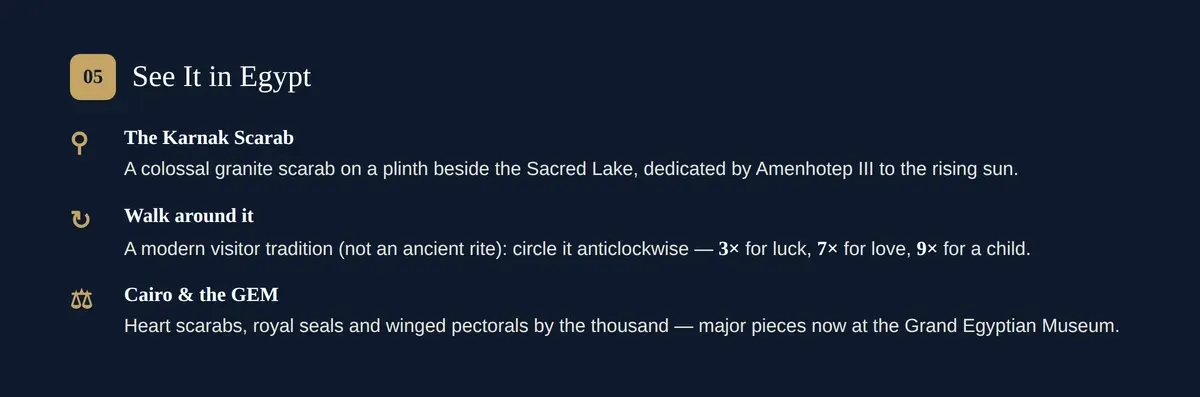
At Karnak, beside the great Sacred Lake, stands a colossal granite scarab on a plinth, dedicated by Amenhotep III to the rising sun. I bring guests to it on almost every Luxor tour, and there is always the same ritual — a modern tradition, not an ancient rite: visitors circle the scarab anticlockwise, three times for good luck, seven for marriage and love, nine for a child, and then make their wish. Whether or not it comes true, walking around that stone beetle at the water's edge with the temple towering behind you is one of the quiet highlights of Karnak.
For scarabs at every scale, the collections in Cairo and the Grand Egyptian Museum are unmatched. Seen up close and read correctly, a case of little green beetles stops being a curiosity and becomes what it always was: a civilization's insistence that life comes back.
Frequently Asked Questions
Is Khepri the same as Ra?
Not quite — Khepri is one form of the sun, its dawn phase. The Egyptians saw a single sun moving through three identities across the day: Khepri the scarab at sunrise, Ra the blazing disc at noon, and Atum the elder at dusk. It is more accurate to speak of Khepri-Ra-Atum as one cycle than of three separate gods.
What is a heart scarab, exactly?
A large scarab of hard green stone, laid over the heart of the mummy and inscribed with Spell 30B of the Book of the Dead — a plea to the heart not to testify against its owner when it was weighed against the feather of truth. It is the most sacred type of scarab, quite different from the small seal-amulets most people picture.
Are the scarabs sold in Egypt real?
The carved stone and faience scarabs at markets and temple shops are modern keepsakes — buy them as that, and they make lovely ones. Genuine ancient scarabs cannot legally leave Egypt, so any "real antiquity" on sale is either a mistake or illegal. The authentic ancient ones live behind museum glass.
Why are so many scarabs green or blue?
Because the colour carried the meaning. Green (wadj) stood for new growth, fertility, and Osiris reborn; blue-green faience echoed it. A green scarab said "rebirth" twice over — in its shape and in its stone.
Where can I see a real scarab in Egypt?
The collections in Cairo and the Grand Egyptian Museum hold the finest examples, from tiny seal-amulets to Tutankhamun's winged pectoral. And the great granite scarab still stands by the Sacred Lake at Karnak.
Where can I see Tutankhamun's scarab pectoral?
At the Grand Egyptian Museum in Giza. Since the GEM's King Tut galleries opened, all 5,398 objects from his tomb — including the famous winged-scarab pectoral, whose central scarab is carved from rare Libyan desert glass — are displayed together there for the first time since 1922. (Older guides still point to the Egyptian Museum on Tahrir; that's out of date.)
What stone is a heart scarab made of?
Usually a hard green stone — nephrite, green jasper, or similar — because green (wadj) was the color of new life and rebirth. The green heart scarab was placed over the heart of the mummy and inscribed with Spell 30B of the Book of the Dead.
Is the scarab lucky?
Yes — it's one of the most popular good-luck and protection charms to come out of Egypt, worn today much as the ancient seal-amulet was: for protection, renewal, and good fortune. The luck traces straight back to its old meaning as the beetle of the rising sun and rebirth.
Is the scarab evil?
No. The flesh-eating scarab swarms of the 1999 film The Mummy are pure fiction — real scarabs are harmless dung beetles, and to the Egyptians the beetle stood for life, protection and rebirth, never death or evil.
What is the oldest scarab?
The first scarab amulets appear in the late Old Kingdom (around the 6th Dynasty, roughly 2100 BCE), evolving from earlier "button seals." Rare at first, they became common in the Middle Kingdom, about 2000 BCE.
What does a scarab tattoo mean?
A scarab tattoo usually stands for rebirth, transformation, protection and overcoming obstacles — drawn from the beetle's link to Khepri and the daily rebirth of the sun. A winged scarab adds a sense of ascent and the soul's journey; a scarab paired with an ankh reads as eternal life.
Want to stand in front of the Karnak scarab with an Egyptologist who can read the walls around it? Every Pyramids Land tour is private and led by a licensed Egyptologist guide who brings symbols like this to life on the spot. Plan your private tour on WhatsApp →
Ashraf Fares