
Karnak Temple: What You Are Actually Looking At
Karnak is not a single temple. It is a complex of temples, chapels, pylons, obelisks, and sacred lakes that was built, expanded, modified, and rebuilt continuously for 1,500 years — from around 2000 BC to the Ptolemaic period. Every major pharaoh from the Middle Kingdom to the Roman era added something. The result is the largest religious structure ever constructed, covering over 200 acres.
This is also why Karnak confuses most visitors. Without a guide, you walk through an overwhelming accumulation of stone and wonder who owns what and why. With a guide — or with this article — the chronology unlocks, and Karnak becomes one of the most intellectually rewarding sites in Egypt.
Why Karnak Exists: The Home of Amun-Ra
Karnak was not built for tourism, prestige, or civic pride. It was built because the Egyptians believed a god lived there.
Amun began as a local deity of Thebes (modern Luxor). When Theban rulers unified Egypt and founded the New Kingdom around 1550 BC, their local god rose with them. Amun merged with Ra, the ancient sun god, to become Amun-Ra — king of the gods, creator of the universe, and the divine force behind the pharaoh's authority. Thebes became the religious capital of the empire. Karnak became Amun-Ra's residence on earth.
The temple was not a church. Ordinary people did not enter it to pray. It was the house of the god — literally. Deep inside the sanctuary, in the smallest, darkest room, stood a cult statue of Amun-Ra. Every morning, priests broke the seal on the shrine's doors, washed the statue, anointed it with sacred oil, dressed it in fresh linen, offered food and incense, recited hymns, and then resealed the shrine. This happened every single day for approximately 1,500 years. The entire temple complex — every pylon, column, courtyard, and lake — existed to support this daily ritual and to house the god in a manner worthy of his status.
Every pharaoh who ruled from Thebes added to Karnak because maintaining and expanding the god's house was the king's primary religious obligation. Building at Karnak was not optional. It was the physical expression of divine favor — proof that the pharaoh was worthy of Amun-Ra's support. The bigger your addition, the stronger your claim to legitimacy. This is why Karnak grew continuously for 1,500 years: competitive piety, expressed in stone.
→ Ancient Egyptian Religion — Amun-Ra, Ma'at, and the temple's theological purpose
The Essential Layout
Karnak is organized around a central east–west axis that leads from the entrance (the First Pylon) deep into the temple toward the sanctuary of Amun-Ra. As you walk inward, the spaces get smaller, darker, and more sacred. This is deliberate — it mirrors the Egyptian understanding of sacred architecture: the further in you go, the closer you are to the god.
The outer courtyard (accessible to more people in antiquity) is vast and open. The Hypostyle Hall is the transition zone — enormous but enclosed. The inner sanctuaries were restricted to priests and the pharaoh. Understanding this gradient — public to sacred — is the key to reading the entire site.
The complex also has a north–south axis (the Mut precinct) and a sacred lake, but for a first visit, the central east–west route is what matters.
What to See — In Walking Order
The Avenue of Sphinxes & The Opet Festival
Before you enter Karnak, you walk along the beginning of the Avenue of Sphinxes — a 2.7 km ceremonial road lined with ram-headed sphinxes connecting Karnak to Luxor Temple. The avenue was fully reopened in 2021 after decades of excavation. Walking even a portion of it before entering Karnak sets the ritual context for everything inside.
This avenue was the processional route for the Opet Festival — the most important religious event in ancient Thebes. Held annually during the Nile flood season (roughly August–September), the festival lasted 11 days during the early New Kingdom, eventually extending to 27 days by the reign of Ramesses III.
During the Opet Festival, the cult statue of Amun-Ra was carried from Karnak to Luxor Temple in an elaborate procession — accompanied by priests, musicians, dancers, soldiers, and enormous crowds. At Luxor Temple, the pharaoh entered the inner sanctuary and communed with the god. When he emerged, his divine authority had been renewed for another year. The festival was both a religious ceremony and a political theatre: the public reaffirmation that the king ruled with the god's blessing.
The reliefs on the walls of the colonnade at Luxor Temple — carved by Tutankhamun — depict this procession in extraordinary detail: the barque carried on priests' shoulders, the musicians playing, the crowds celebrating, the sacrificial bulls. When you walk the Avenue of Sphinxes today, you are walking the same route.
The First Pylon
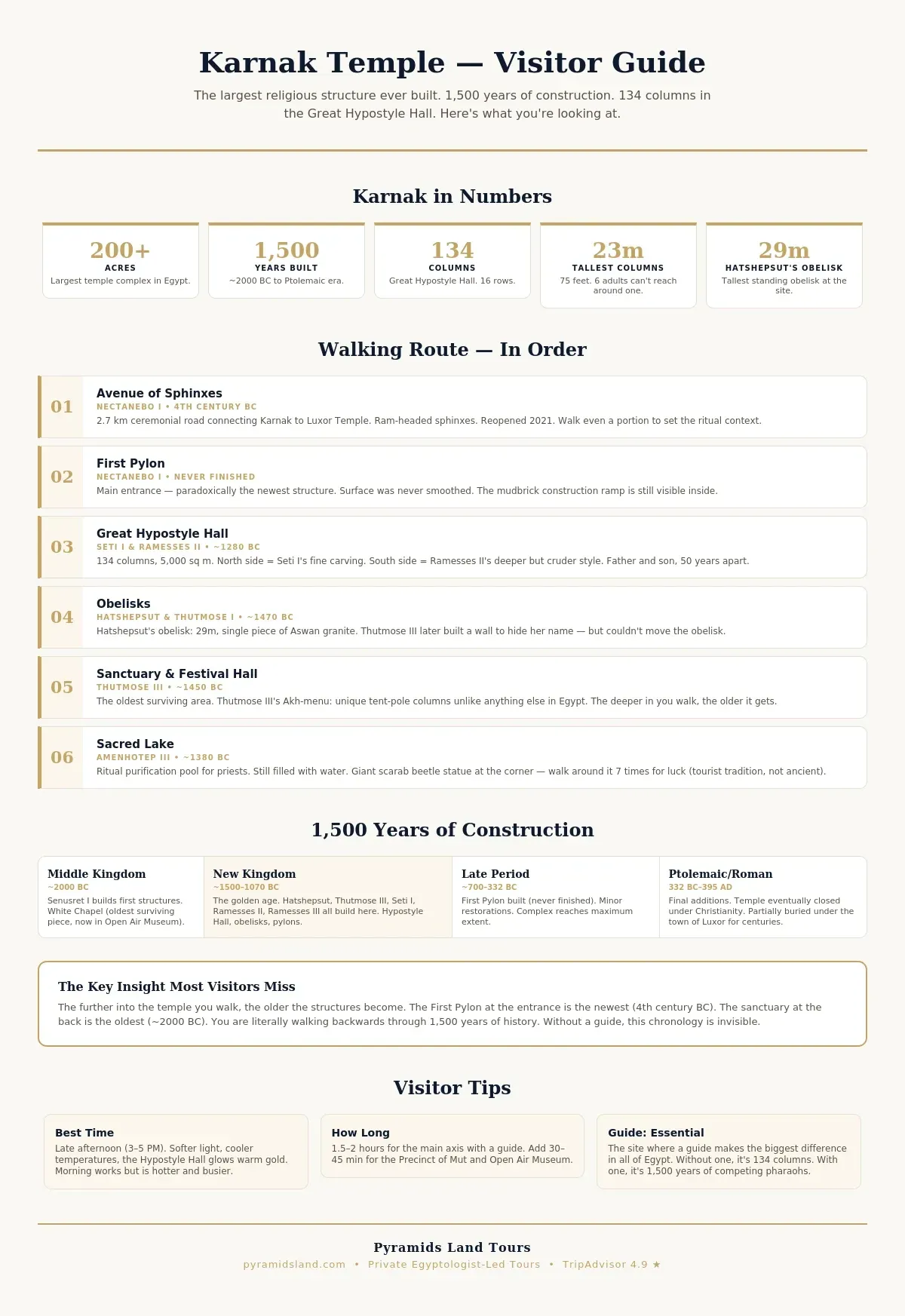
The main entrance. Built by the 30th Dynasty pharaoh Nectanebo I (4th century BC), making it paradoxically the newest major structure in the complex. It was never finished — the surface was never smoothed or decorated. The mudbrick construction ramp is still visible on the interior side, preserved exactly as the builders left it 2,400 years ago.
The Great Hypostyle Hall
This is the centerpiece of Karnak and one of the most visually overwhelming spaces in the ancient world. 134 massive columns arranged in 16 rows. The 12 central columns rise to 23 meters (75 feet) — each wide enough that six adults standing in a circle cannot reach around them. The 122 outer columns are shorter (15 meters), creating a clerestory effect that originally allowed light to filter through stone window grilles.
Every surface is carved with religious scenes and hieroglyphic texts. The central columns show Seti I (north side, finer carving) and Ramesses II (south side, deeper but cruder carving). The contrast between the two styles — father and son, 50 years apart — is visible if you know how to look.
Allow 30–45 minutes in the Hypostyle Hall. This is not a space to walk through quickly. Stand in the center, look up, and let your guide explain how this room functioned as a symbolic primeval marsh — the columns representing papyrus stalks rising from the waters of creation.
The Outer Wall — The World's First Known Peace Treaty
Walk out of the Hypostyle Hall and turn to face the south exterior wall. This is one of the most important inscriptions in the ancient world, and almost every visitor walks past it.
Carved into the stone is the Egyptian version of the Hittite-Egyptian peace treaty of c. 1259 BC — the earliest known international peace treaty in recorded history. Concluded between Ramesses II and Hittite king Hattusili III after more than a decade of cold war following the Battle of Kadesh, the treaty established mutual non-aggression, a mutual defense obligation, and an extradition clause for political refugees.
The Hittite version was inscribed in cuneiform on a silver tablet. A replica of it now hangs in the United Nations headquarters in New York — the world's oldest diplomatic agreement displayed as a model for modern international law. The Egyptian version is here, on this wall, and you can stand in front of it.
Your guide points to the cartouches of Ramesses II and reads the key clauses. The treaty's language is remarkably modern: "If another enemy comes against the lands of Ramesses II... the king of Hatti shall send his troops and his chariots and they shall slay his enemy." It reads like a NATO mutual-defense clause written 3,200 years ago.
Most visitors are inside the Hypostyle Hall when they should be looking at this wall. That is one of the things a guide changes.
The Obelisks
Two obelisks survive inside the temple. The taller one — Hatshepsut's obelisk, 29 meters high, carved from a single piece of Aswan granite — is one of the tallest standing obelisks in the world. Her stepson, Thutmose III, later built a wall around it to hide her name, but the obelisk itself was too massive to remove. It still stands, her cartouche still visible.
A second obelisk, erected by Thutmose I, stands nearby. The base of a third (now in Istanbul's Hippodrome) is also marked.
The Sacred Lake
A large rectangular pool used for ritual purification by the priests who served Amun. The lake is still filled with water. A giant granite scarab beetle statue sits at the northwest corner — dedicated by Amenhotep III. Local tradition says that walking around the scarab seven times brings good luck. Tourists do this; the original priests did not.
Thutmose III's Festival Hall (Akh-menu)
Behind the main sanctuary, most visitors turn around and miss this entirely. That is a mistake. The Festival Hall of Thutmose III — called the Akh-menu ("Effective of Monuments") — is one of the most unusual structures in Egypt. Its columns are carved to resemble wooden tent poles, wider at the top than the bottom, evoking the military tent of a campaigning pharaoh. No other Egyptian temple uses this design.
Inside, the so-called "botanical garden" room contains carved reliefs of plants and animals that Thutmose III encountered during his military campaigns in Syria and the Levant. Exotic flowers, birds, and trees — species foreign to Egypt — are cataloged on the walls like a natural history survey in stone. This room is one of the most quietly remarkable spaces at Karnak, and it is almost always empty of visitors.
The Open Air Museum
Located in the northwest corner of the complex (separate ticket, usually ~100 EGP). Contains reconstructed structures that were found dismantled and buried inside Karnak's pylons — including the White Chapel of Senusret I, the oldest surviving structure at the site (~2000 BC), and the Red Chapel of Hatshepsut, with finely carved reliefs showing her coronation and the Opet Festival. These chapels were dismantled by later pharaohs who reused the stone blocks as fill inside their own constructions. Archaeologists recovered and reassembled them. The Open Air Museum is small but historically significant — and far less crowded than the main axis.
The Khonsu Temple
In the southwest corner of the complex, easily overlooked. A small but complete temple dedicated to Khonsu, the moon god and son of Amun and Mut. Built by Ramesses III and decorated by later pharaohs. Its compact size and intact structure make it one of the easiest temples at Karnak to understand architecturally — you can see the full progression from entrance to sanctuary in a single line of sight.
The Precinct of Mut
South of the main temple, connected by an avenue of sphinxes. Dedicated to the goddess Mut, consort of Amun. Less visited than the central temple but atmospheric — a crescent-shaped sacred lake and a vast collection of black granite statues of the lion-headed goddess Sekhmet line the interior.
Scholars estimate that there were originally approximately 730 Sekhmet statues — two for each day of the year (one seated, one standing) — commissioned by Amenhotep III. Many survive, though they are now scattered across museums worldwide. The ones that remain at Karnak are arranged in rows, their lion faces staring outward, and the effect is genuinely unsettling. Sekhmet was the Eye of Ra in her most fearsome form — the divine weapon sent to punish humanity. Placing 730 of her statues here was not decoration. It was a wall of divine protection surrounding the precinct.
If you have 2+ hours at Karnak, the Mut Precinct is worth the walk. It is quieter, more atmospheric, and the Sekhmet statues — once you understand what they represent — are among the most powerful objects at the entire site.
→ The Eye of Ra — what Sekhmet represents and why she is here
The History in Five Minutes
Understanding who built what transforms Karnak from a field of stones into a timeline.
Middle Kingdom (~2000 BC). Senusret I builds the first significant structures — a small limestone chapel (the White Chapel, now reconstructed in the Open Air Museum). This is the oldest surviving structure at Karnak and already establishes the east-west sacred axis that all later builders followed.
Early New Kingdom (~1550–1450 BC). Theban rulers reunify Egypt, and Amun becomes king of the gods. Thutmose I builds the 4th and 5th pylons and erects the first obelisks at Karnak — asserting Theban dominance in stone. Hatshepsut adds her own obelisks (the tallest surviving one is 29 meters tall) and builds the Red Chapel. Her stepson Thutmose III — Egypt's greatest military pharaoh — builds the Festival Hall (Akh-menu) behind the sanctuary and constructs the 6th and 7th pylons. He also dismantles Hatshepsut's Red Chapel and buries the blocks inside his own pylon (they were recovered and reconstructed 3,400 years later). The pattern of competitive building is already established: each ruler adding, modifying, and sometimes erasing the work of their predecessors.
Late New Kingdom (~1400–1070 BC). Amenhotep III builds the 3rd pylon and the massive 10th pylon on the southern axis, dramatically expanding the complex's footprint. Seti I begins the Great Hypostyle Hall — the finest carving at Karnak is his, on the north side of the central columns. His son Ramesses II finishes the Hall, carving the south side in a deeper but cruder style. The contrast between father and son, visible on opposite sides of the same columns, is one of the most instructive details at the site. Ramesses III adds his own temple in the outer courtyard — a complete mini-temple inside the larger complex.
Late Period and Ptolemaic (~700–30 BC). The First Pylon is built by Nectanebo I (never finished — the construction ramp is still visible). The Ptolemies add the gate of Euergetes and make minor restorations. The complex reaches its maximum extent. After the Roman period, the temple was gradually abandoned, and the town of Luxor grew over and around it.
Key insight: The further into the temple you walk, the older the structures become. The newest part (the First Pylon) is at the front. The oldest parts (the sanctuary, the White Chapel fragments) are at the back. You are literally walking backward through time.
Visit Karnak on a Nile cruise: Karnak is included in every Nile cruise between Luxor and Aswan. Your private Egyptologist walks you through the Hypostyle Hall, the Sacred Lake, and the chapels that group tours skip. → See Nile cruise options
Practical Information
Tickets. The standard Karnak entry ticket covers the main temple complex including the Hypostyle Hall, obelisks, sanctuary area, Sacred Lake, and Precinct of Mut. As of 2026, the foreign adult ticket is approximately 450 EGP (~$9 USD). Students with valid ID receive a 50% discount. The Open Air Museum requires a separate ticket (~100 EGP). Tickets are purchased at the entrance — no advance online booking is required (unlike the GEM). Arrive, buy, enter.
When to visit. Late afternoon (3:00–5:00 p.m.) is ideal. The light is softer, the temperature is dropping, and the Hypostyle Hall glows in warm tones. Morning visits (8:00–10:00 a.m.) work but are hotter and busier with group tours. Avoid 11:00 a.m.–2:00 p.m. in any season.
How long. 1.5–2 hours with a guide for the main axis (First Pylon → Hypostyle Hall → obelisks → sanctuary → Sacred Lake). Add 30–45 minutes for the Precinct of Mut and Open Air Museum.
Guide value. Essential. Karnak is the site where a guide makes the biggest difference of any in Egypt. Without one, you see 134 columns and some carvings. With one, you see the difference between Seti I's and Ramesses II's carving styles, understand why Hatshepsut's name was erased from some walls but not others, and grasp how 1,500 years of competing pharaohs built over, around, and on top of each other's work.
Sound and Light Show. An evening show with projected lights and narration among the ruins. Tourist-oriented but atmospheric. Not essential.
Photography. Permitted throughout. No flash. The Hypostyle Hall photographs best in late-afternoon light when the sun enters from the west.
→ 1 Day in Luxor — Karnak is the afternoon centerpiece → Valley of the Kings Guide — the morning companion → Ancient Egyptian Religion — Amun-Ra and the temple's purpose → Luxor Day Tours → Ancient Egyptian Temples — the reading method that makes Karnak legible, and the honest ranking of every major temple
Frequently Asked Questions
How long do you need at Karnak?
1.5–2 hours with a guide covers the main axis (First Pylon through to the Sacred Lake). Add 30–45 minutes for the Festival Hall, Open Air Museum, and Precinct of Mut. A thorough visit with all sections takes 2.5–3 hours.
Is Karnak the same as Luxor Temple?
No. Karnak and Luxor Temple are two separate temple complexes, 2.7 km apart, connected by the Avenue of Sphinxes. Karnak was the main residence of Amun-Ra. Luxor Temple was used for the annual Opet Festival and for the renewal of the pharaoh's divine authority. Most visitors see both in the same day — Karnak in the afternoon, Luxor Temple at dusk.
What is Karnak Temple famous for?
The Great Hypostyle Hall — 134 massive columns, the tallest reaching 23 metres, in the largest columned hall in the ancient world. Also the Avenue of Sphinxes (reopened 2021), Hatshepsut's obelisk, the Sacred Lake, and 730 Sekhmet statues in the Precinct of Mut.
Can you visit Karnak at night?
The Sound and Light Show runs most evenings — a narrated light display among the ruins. It is atmospheric but tourist-oriented. The daytime visit is far more valuable for understanding the site. Karnak itself is not open for regular nighttime walks.
Is Karnak free?
No. The standard entry fee for foreign adults is approximately 450 EGP (~$9 USD) as of 2026. The Open Air Museum inside the complex requires a separate ticket (~100 EGP). Tickets are purchased at the entrance.
Do you need a guide at Karnak?
You don't need one to enter, but Karnak is the single site in Egypt where a guide makes the biggest difference. Without one, you see 134 columns and carvings you cannot read. With one, you see 1,500 years of competing pharaohs, understand why Hatshepsut's name was erased, and learn what the carvings actually depict. We recommend a guide here more strongly than at any other site in Egypt.
Ashraf Fares