
Read This Before You Cancel Your Egypt Trip
You have already read the other article.
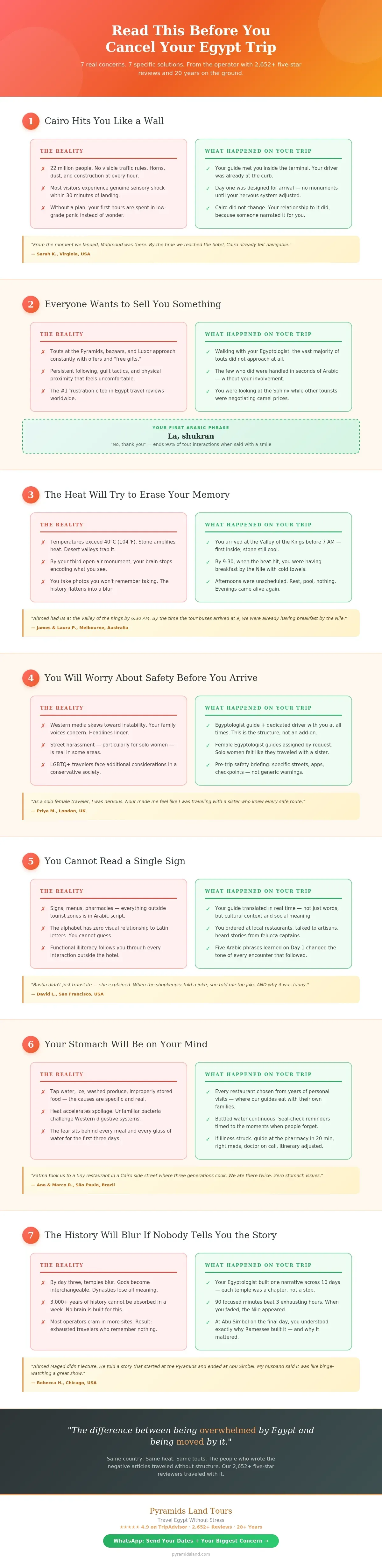
The one where someone spent two weeks in Egypt and told you to cancel your trip. The one where the writer described touts, chaos, heat, scams, and stomach problems — then paid $1,000 to leave early. Or maybe it was the Reddit thread. Or the Facebook comment from a friend of a friend who "would never go back."
Those experiences are real. We are not going to pretend they are not.
But here is what none of those articles told you: every single thing they described is a symptom of traveling in Egypt without the right structure around you. Not without luxury. Not without money. Without structure. Without someone who has spent 20 years learning exactly where every one of those problems lives — and how to route around it.
We are Pyramids Land Tours. We have guided thousands of travelers through Egypt — first-timers, families with young children, solo women, honeymooners, people who almost canceled because of an article exactly like the one you just read. We hold a 4.9 rating across 2,652 reviews on TripAdvisor. Not because Egypt is easy. Because we have made it clear.
Here are seven things that will overwhelm you in Egypt. We are going to name each one honestly, and then show you — in specific, operational detail — exactly what happens differently when you travel with us.
1. Cairo Hits You Like a Wall
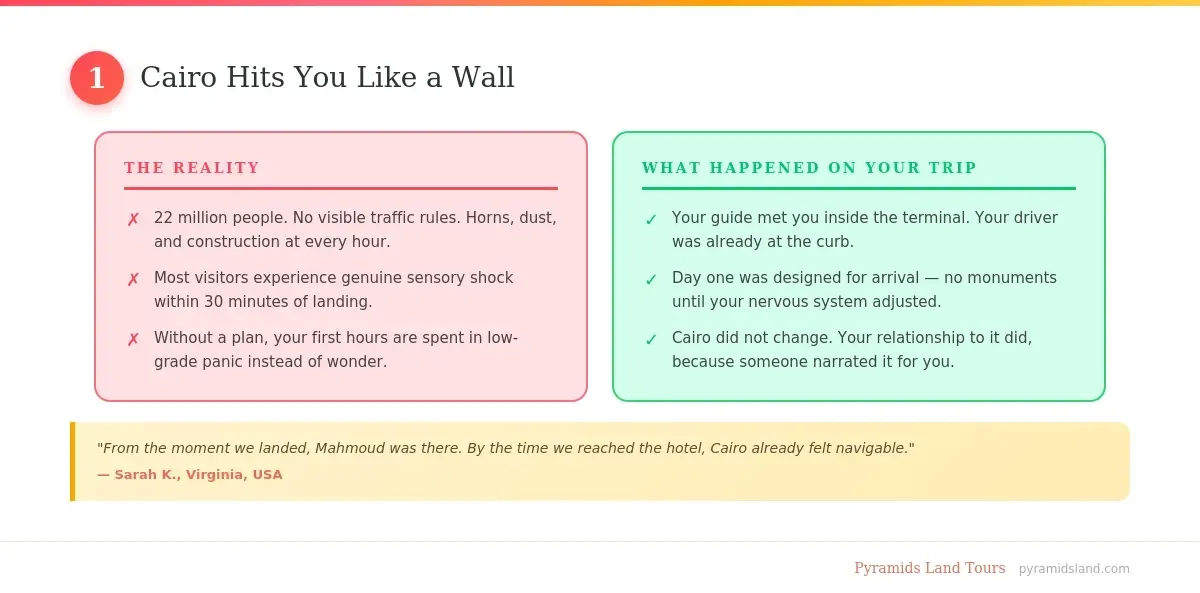
You land at Cairo International. You step outside. Twenty-two million people are already in motion. The traffic has no lanes, no visible logic, and no silence — horns layer over horns over the call to prayer over construction. Cars, microbuses, motorcycles, and donkey carts coexist in the same space. Dust hangs in the air. The density is physical.
Most visitors feel genuine sensory shock within 30 minutes of landing. The ones without a plan spend their first two hours in a state of low-grade panic, trying to figure out a taxi, a route, a direction — while jetlagged and dehydrated.
"From the moment we landed, Mahmoud was there. He met us before we even cleared the terminal. By the time we reached the hotel, Cairo already felt navigable — not because it changed, but because he explained it." — Sarah K., Virginia, USA
What happened on your trip: Your guide, Mahmoud, met you in the arrivals hall before you stepped into any of it. Your private driver pulled up to the terminal. You sat in an air-conditioned car while Cairo unfolded outside the window — and Mahmoud narrated it. He told you why the traffic moves the way it does, pointed out the Citadel on the skyline, and explained what the neighborhood near your hotel is like after dark.
You did not visit the Pyramids on day one. That was deliberate. Your first day in Cairo was designed for arrival — hotel check-in, a quiet lunch, and an evening walk through Zamalek or along the Nile Corniche. By the time you stood at the foot of the Great Pyramid the next morning, you were ready to actually see it.
Cairo did not change. Your nervous system did.
2. Everyone Wants to Sell You Something
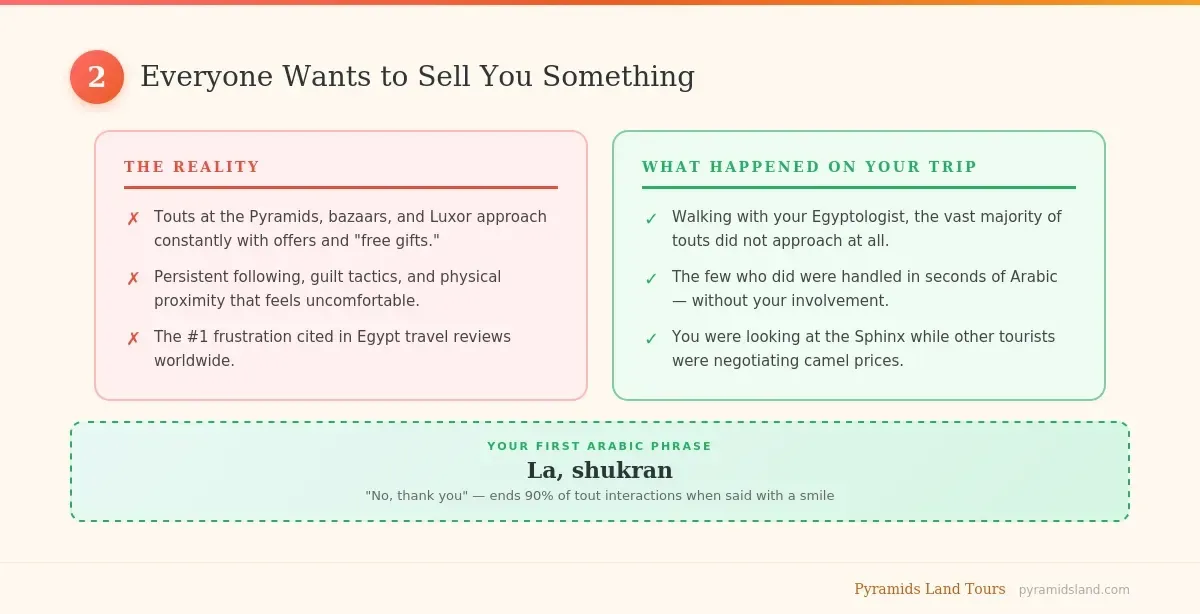
At the Pyramids, it started within 30 seconds. A man with a camel. A man with a headscarf wanted to wrap it around you "for free." A child holding papyrus bookmarks. At Khan El Khalili, it intensified — shopkeepers stepping out of doorways, calling prices, following for half a block. In Luxor's West Bank, alabaster vendors are stationed at every parking lot.
This is the most frequently cited frustration in travel reviews of Egypt. We have read thousands of them. The word that appears most often: "relentless."
The economic reality is straightforward. Many of the people approaching you at monument sites are not government employees. They work independently, and their income depends entirely on engaging tourists before someone else does. The pressure you feel is survival math.
"I was dreading the touts — it was honestly my biggest fear. But walking with Zenab, nobody approached us. She said two words in Arabic to someone near the entrance and that was it for the entire visit." — Michelle T., Toronto, Canada
What happened on your trip: You walked through the Giza plateau with your Egyptologist, Zenab. The dynamic shifted immediately. Touts read body language and social signals — when you were clearly accompanied by a local professional, the vast majority did not approach. The ones who did were handled in two seconds of Arabic you did not have to understand.
Before your first monument visit, Zenab had already explained how the informal economy works, taught you "la, shukran" (no, thank you), and set your expectations. Nothing caught you off guard. The selling did not stop. It stopped being your problem. You were looking at the Sphinx while other tourists were negotiating camel prices.
✶ Your first Arabic phrase: La, shukran — "No, thank you." Said with a smile and without breaking stride, this phrase ends 90% of tout interactions. Your guide teaches you this — and five more phrases that change the tone of every encounter — on your first morning.
3. The Heat Will Try to Erase Your Memory
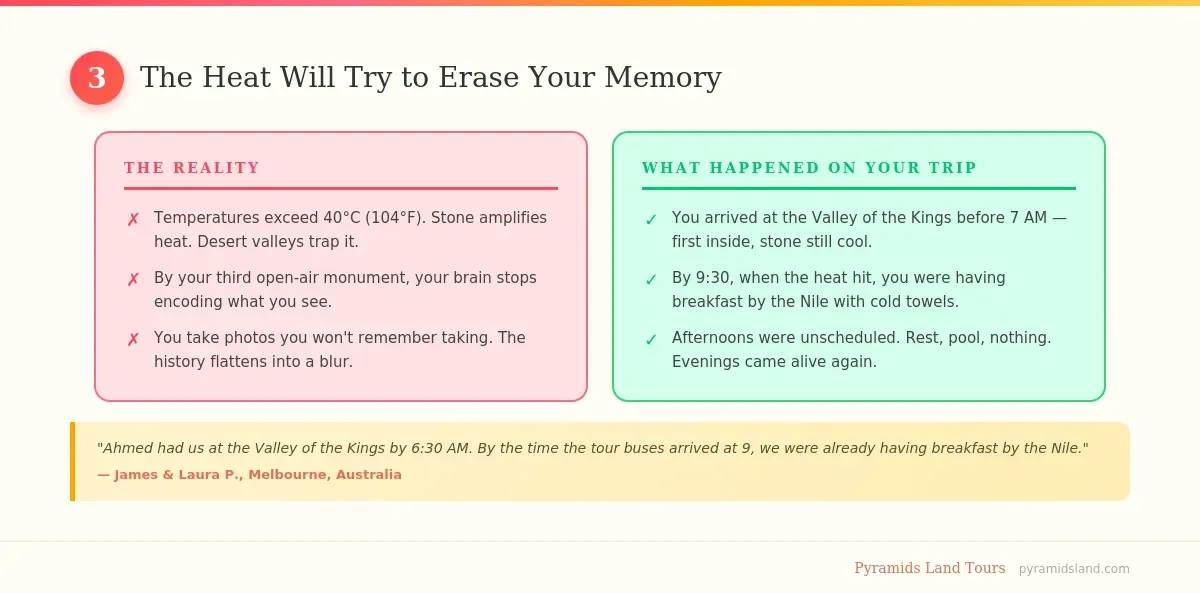
Depending on when you visit, outdoor temperatures in Upper Egypt — Luxor, Aswan, Abu Simbel — exceed 40°C (104°F). The sun is not the sun you know. It is vertical and constant, with almost no shade at archaeological sites. Stone absorbs and radiates heat. The Valley of the Kings is a desert valley with no wind circulation. The air inside the tombs is thick and still.
Temple fatigue is a real phenomenon. By your third open-air monument in a single morning, your brain stops encoding what your eyes are seeing. You take photos you will not remember taking. The carvings blur. The history flattens. You came to Egypt for this, and the heat is stealing it from you.
"Ahmed had us at the Valley of the Kings by 6:30 AM. We were the first people inside KV9. By the time the big tour buses arrived at 9, we were already having breakfast by the Nile with cold towels." — James & Laura P., Melbourne, Australia
What happened on your trip: You arrived at the Valley of the Kings before 7:00 AM, when the stone was still cool, and the corridors were empty. Ahmed led you to the tombs in a specific order — the one with the best-preserved color first, while your eyes were fresh. By 9:30, when the heat became aggressive, you were already in an air-conditioned car heading to a shaded restaurant on the Nile's West Bank.
The afternoon was not scheduled. You rested at the hotel. You sat by the pool. You did nothing — deliberately. Because the Karnak Temple Sound and Light show was that evening, and Ahmed wanted you to experience it rested, not wrecked.
Water was not something you thought about. It was continuous — in the car, at the site, at lunch, refilled without asking. Your driver kept a cooler in the vehicle. The cold bottle was always already in your hand.
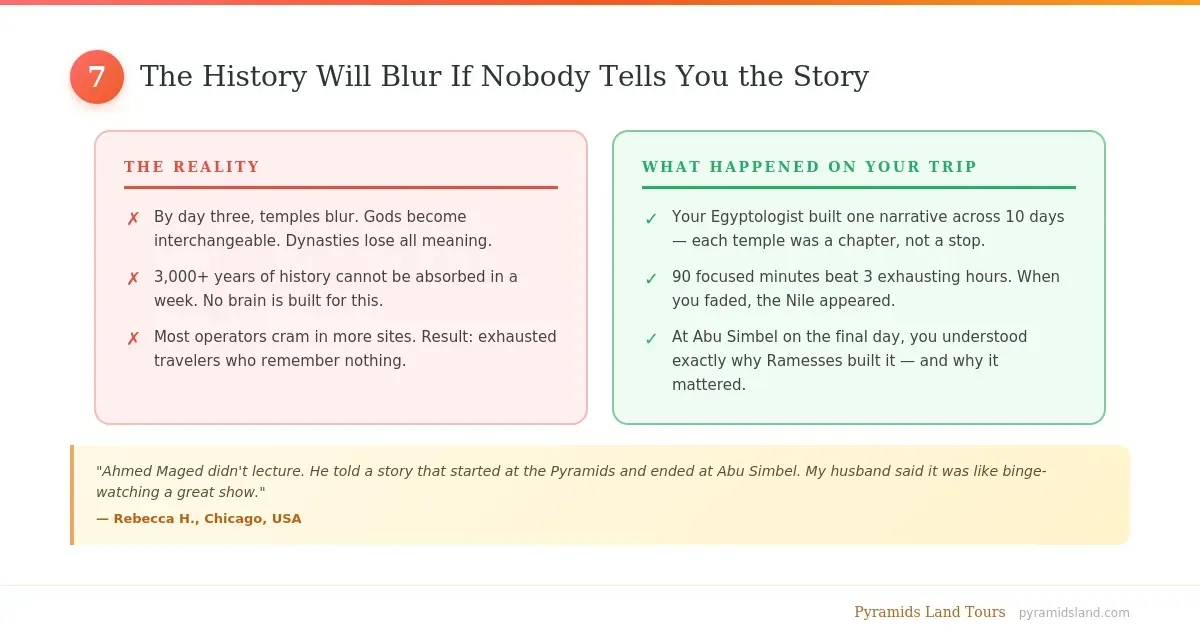
4. You Will Worry About Safety Before You Arrive
This fear is different from the others because it starts before you land. It lives in the headlines your mother sends you. In the friend who says, "Be careful." In the articles that conflate an entire country with a news cycle. If you are a woman traveling solo, the anxiety doubles. If you are LGBTQ+, there is a real additional layer.
Let us be direct: the Egypt in the news and the Egypt tourists experience are genuinely different realities. Major tourist areas — Cairo, Luxor, Aswan, the Red Sea — have dedicated tourism police, extensive security infrastructure, and a hospitality industry that has operated safely for decades. Street harassment exists. It is not universal. And it is almost entirely neutralized by the presence of a guide.
"As a solo female traveler, I was nervous. Nour made me feel like I was traveling with a sister. She knew every security checkpoint, every safe walking route, every neighborhood to avoid after dark." — Priya M., London, UK
What happened on your trip: You were never alone in an unfamiliar area unless you chose to be. Your Egyptologist guide and dedicated driver accompanied you at all times during tours — not as a luxury add-on, but as the fundamental structure of every trip we operate.
Before you arrived, you received a practical safety briefing specific to your itinerary. Not generic warnings — specific: which neighborhoods to walk in at night. How to use Uber and Careem. What to expect at hotel security and monument checkpoints. The goal was to replace the vague dread with concrete knowledge, because concrete knowledge is what actually dissolves anxiety.
For solo women, we assigned Nour — one of our most experienced female Egyptologist guides. For LGBTQ+ travelers, we provided confidential guidance on public conduct norms. For
seniors and travelers with limited mobility, we adjusted the route, the pace, and the site selection. Your guide was your ally and your cultural buffer in every social situation
The worry did not disappear on the plane. It disappeared on the ground when the structure proved itself real.
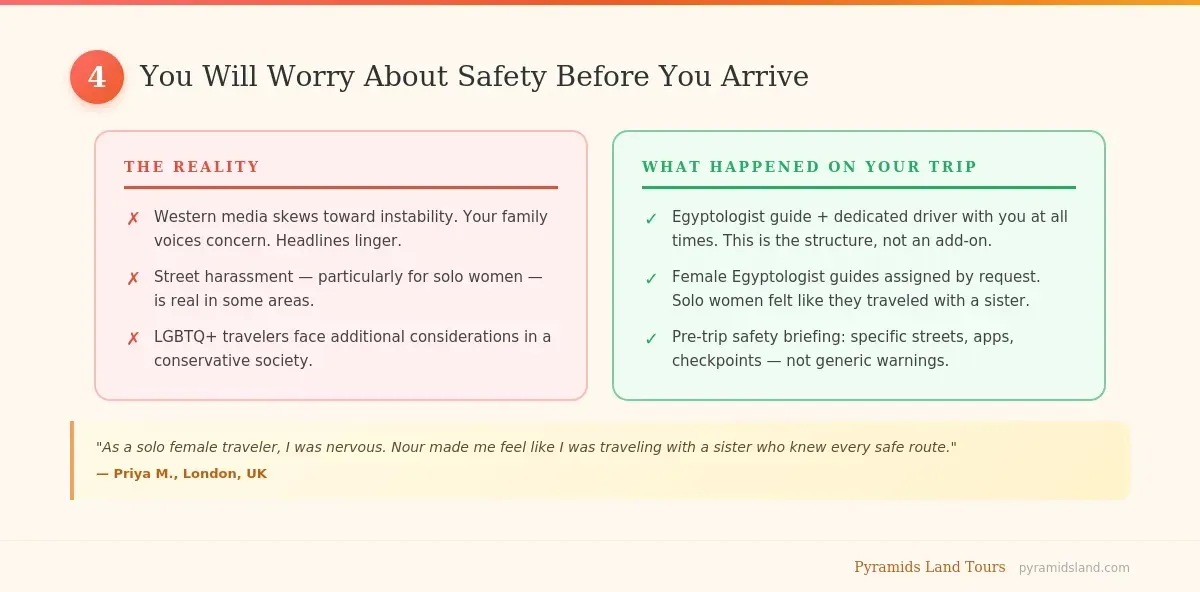
5. You Cannot Read a Single Sign
Street signs: Arabic. Restaurant menus outside tourist zones: Arabic. The pharmacist's instructions: Arabic. Taxi meter disputes: Arabic. The script has no visual relationship to any Latin alphabet. You cannot sound out a word. You cannot guess at a meaning. You are functionally illiterate in a country where you need to eat, move, and make decisions every hour.
This disorientation is rarely discussed in travel blogs because it is not dramatic. It is quiet. It is the low hum of incompetence that follows you through every interaction outside the hotel.
"Rasha didn't just translate — she explained. When the shopkeeper in Aswan told a joke, she told me the joke AND why it was funny in Egyptian culture. I felt like I was actually inside the conversation." — David L., San Francisco, USA
What happened on your trip: You wanted to buy a handwoven scarf in the Aswan souk. Your guide Rasha did not just negotiate the price — she asked the weaver where the cotton came from, how long the pattern takes, and whether his daughter was learning the craft. Then she translated all of it. You did not just buy a scarf. You met the person who made it.
This happened at every level. Rasha ordered at local restaurants in Arabic — not tourist restaurants, the places where the food is actually extraordinary. She translated the felucca captain's stories on the Nile. She explained why the hotel concierge reacted the way they did and what the culturally appropriate response was.
Translation is mechanical. Cultural interpretation is human. Your guide provided both, continuously, without you having to ask.
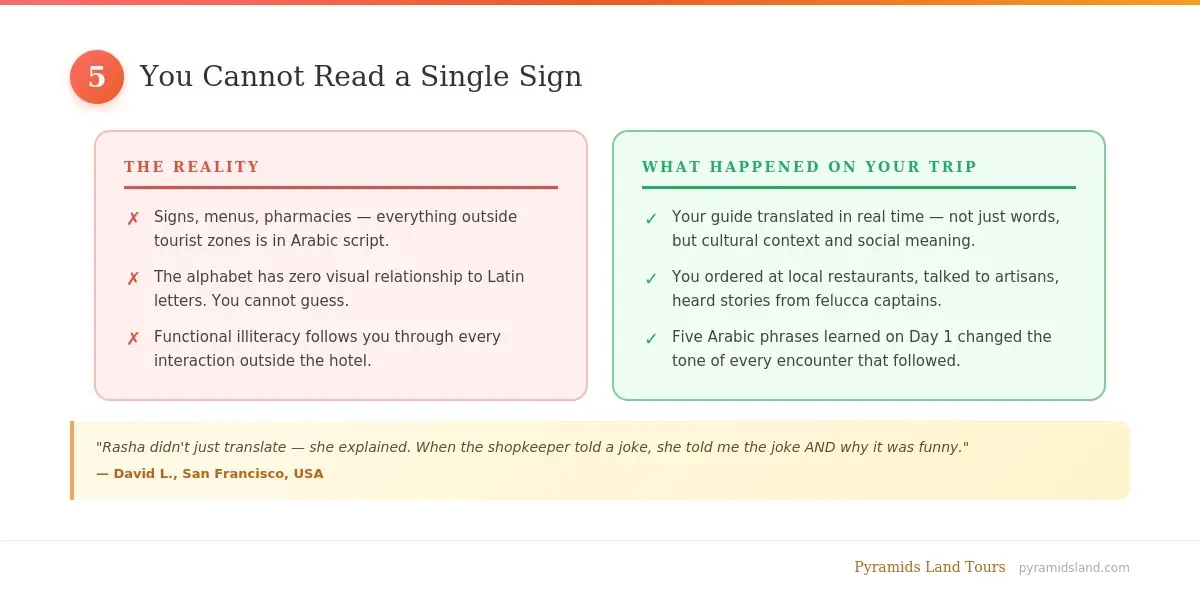
6. Your Stomach Will Be on Your Mind
Traveler's stomach affects a meaningful percentage of visitors to Egypt. The causes are specific: tap water used to make ice cubes, to wash produce, or to brush teeth. Improperly stored food at street stalls. Heat-accelerated spoilage. Unfamiliar bacterial profiles that Western digestive systems are not adapted to.
This is the fear that sits behind every meal for the first three days. You watch other tourists eating street food and wonder if you are being too cautious. You drink something and spend the next two hours monitoring your body. It is exhausting.
"Fatma took us to a restaurant in Cairo that we would never have found — a tiny place in a side street where three generations of the same family cook. We ate there twice. Not a single stomach issue the entire 10 days." — Ana & Marco R., São Paulo, Brazil
What happened on your trip: Every restaurant on your itinerary was chosen from years of repeated personal visits — not online reviews, not tourist recommendation engines. The places where our guides eat on their days off. The places Ashraf brings his own family to. Hygiene was the first filter. Authenticity and quality came after.
Bottled water was provided continuously throughout the day. Your guide reminded you to check the seal. She suggested bottled water for brushing teeth at smaller hotels. She steered you away from the ice in your lemonade at a Luxor café — gently, without making it awkward. These interventions were timed to the moments when people forget, which our guides know from years of experience.
On the one trip where a traveler did get sick despite precautions, Fatma was at the pharmacy within 20 minutes, returned with the right medication, coordinated with the hotel doctor, and adjusted the next day's itinerary to allow recovery. You were not Googling symptoms alone in a hotel room at 2:00 AM. You had someone who had handled this situation dozens of times.
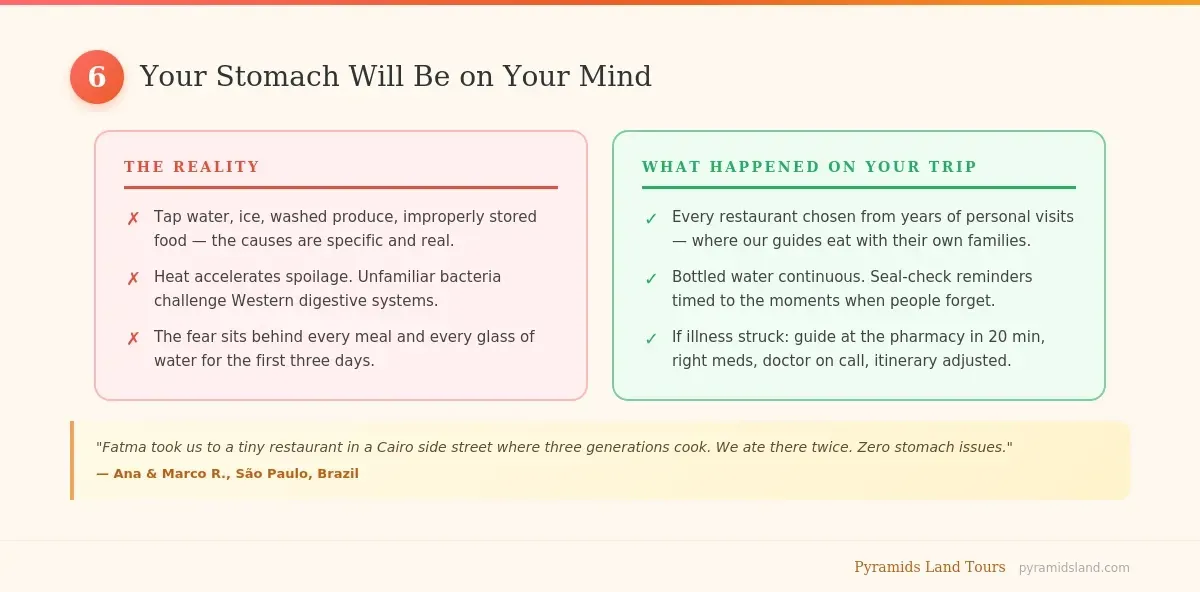
7. The History Will Blur If Nobody Tells You the Story
By day three, the temples blended together. Columns looked similar. Gods became interchangeable. You could not remember whether it was Ramesses II or Amenhotep III who built the thing you saw that morning. The carvings were magnificent — and meaningless, because you had lost the thread.
This is not a failure of intelligence. It is a predictable cognitive response to processing more historical information in three days than most people encounter in a decade. Egypt's monumental history spans 3,000 years — longer than the gap between the Roman Empire and today. The pharaohs who built the Pyramids at Giza were as ancient to Cleopatra as Cleopatra is to us.
Most tour operators respond by cramming in more sites. Quantity as value. The result is exhausted travelers who remember nothing clearly and return home with 2,000 photos of things they cannot name.
"Ahmed Maged didn't lecture. He told us a story that started at the Pyramids and ended at Abu Simbel — and every temple in between was a chapter. By the end, I could actually follow the timeline. My husband said it was like binge-watching a great show." — Rebecca H., Chicago, USA
What happened on your trip: Ahmed Maged did not recite dates. He built a single narrative across your entire 10-day itinerary — one that started at the Old Kingdom and moved forward through time as you moved south through the country. Each site is connected to the last. Each pharaoh was related to the previous one. The temples were not random stops on a checklist. They were chapters.
He limited the density deliberately. Ninety focused minutes at Karnak Temple — understanding what you saw — beats three exhausting hours that would have left you with a blur of columns and a headache. When you were fascinated, he went deeper. When you were fading, he took you to the Nile.
And the rhythm of each day was designed: temples in the morning, markets or food or river views in the afternoon, rest before evening experiences. History, then contrast. Intensity, then space. Your brain had time to encode each experience before the next one arrived.
By the final day, you were not confused. You were connected. You stood at Abu Simbel and understood exactly why Ramesses II built it, where it fit in the story, and why it mattered — because Ahmed had been building toward that moment for nine days.
What You Actually Came Home With
Egypt was not easy. Nobody told you it would be. But the difficulty was not the point, and it was never your burden.
You felt the heat on the stone at Karnak. You heard the call to prayer echoing through Islamic Cairo at dusk. You smelled cumin and coriander in a kitchen where three generations cooked side by side. You touched the wall of a tomb that had been sealed for 3,000 years. You tasted sugarcane juice pressed on a Luxor side street while your guide laughed at the look on your face.
You experienced all of it. You just never experienced it alone, unprepared, or without someone who could translate it into something that would stay with you.
That is the difference between being overwhelmed by Egypt and being moved by it.
The people who write the "don't go" articles traveled without this. The people who write our 2,700+ five-star reviews traveled with it. Same country. Same heat. Same touts. Completely different experience.
Your Trip Starts With One Message
You already know your biggest concern. You have been carrying it since you started researching Egypt.
Tell us your travel dates and that one concern — and we will send you the specific itinerary that addresses it. No brochure. No sales pitch. Just the plan, the guide who will lead it, and the price. Worried about tipping? We wrote the guide
WhatsApp: +20 122 362 4703 — Send Your Dates and Your Biggest Concern →
Or if you are in the US: +1 (928) 923-2598
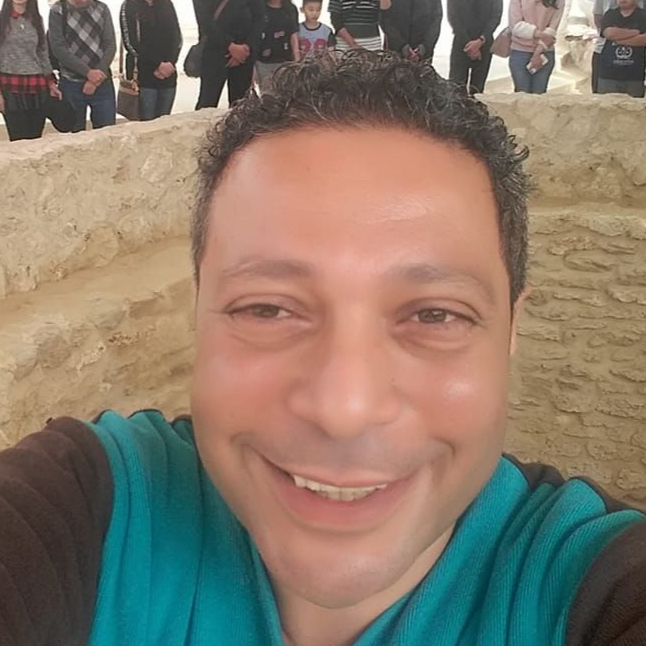
About Ashraf
Founder of Pyramids Land Tours. IATA-certified operator. Twenty years in Egypt's monuments — and still the first person in the office every morning because the day he stops being fascinated is the day he stops doing this.
Pyramids Land Tours — Travel Egypt Without Stress ★★★★★ 4.9 on TripAdvisor · 2,700+ Reviews · 20+ Years pyramidsland.com
Ashraf Fares