
Cairo Travel Guide 2026: Things to Do, Museums, and How to Plan It
***Edited June 10, 2026
Short answer: Cairo needs two to three focused days. Spend one on the Pyramids of Giza and the Grand Egyptian Museum, one on the older city — Islamic and Coptic Cairo — with a second museum, and a third on Saqqara if you have it. The big 2026 change: the Grand Egyptian Museum is fully open beside the pyramids, and you now have to book tickets online in advance at visit-gem.com. Is Cairo worth it? Yes — it's intense, but it rewards travelers who plan for that rather than improvise.
Cairo is a city of more than twenty million people, 4,500 years of monuments, and a pace that surprises almost everyone on the first day. It is loud, dense, and fast — and it is also one of the most rewarding cities on earth, with the only surviving wonder of the ancient world on its doorstep and the greatest collection of Egyptian antiquities ever assembled now housed in a single new museum. This guide is built to give you the structure that turns the first into the second.
Is Cairo Worth Visiting?
Yes — with a caveat worth being honest about. Read enough reviews, and you will find the same city described as the trip of a lifetime and as a sensory assault people couldn't wait to leave. Both are real. Cairo compresses more history, noise, traffic, and human energy into a day than almost any other city, and travelers who arrive expecting a relaxed European-style city break feel ambushed by it.
The travelers who love Cairo are almost always the ones who planned for what it actually is: short, focused days; a fixed base; transport sorted in advance; and realistic pacing. Two to three days is the sweet spot — long enough to see the essentials, short enough for the intensity to stay thrilling rather than exhausting. The city rewards a visit built around structure rather than improvisation.
ASHRAF FARES · Egyptologist I always tell nervous first-timers on the drive from the airport: "The next 45 minutes are going to feel like absolute chaos — horns, crowds, dust, people trying to sell you things. That's normal. Cairo throws everything at you in the first hour. Just breathe. You've got a plan, a driver who knows exactly where he's going, and me waiting for you tomorrow."<br><br>The change is dramatic. The next morning, when they step out of the hotel with a clear schedule and a calm driver, you can see their shoulders drop. They stop clutching their bags so tightly. By the end of Day 1 they're smiling at the same streets that terrified them the night before. Structure turns the intensity from overwhelming to exciting.
The Best Things to Do in Cairo
The Pyramids of Giza and the Sphinx
This is why most people come, and it does not disappoint. The three great pyramids of Khufu, Khafre, and Menkaure, and the Great Sphinx, sit on the Giza Plateau, about 30–45 minutes from central Cairo, depending on traffic. Go early — the plateau is cooler, the light is best, and you reach the panoramic viewpoint before the coaches and the camel touts arrive. You can go inside the Great Pyramid on a separate ticket; it is a steep, hot, claustrophobic climb to a bare chamber, worth it for the curious and skippable for everyone else.
Be ready for the social environment rather than be surprised by it: vendors, camel and horse operators, and photo offers are part of the plateau. It is not a danger; it is an economy that has worked this spot for generations. A firm, friendly "no thank you," without breaking stride, handles most of it — and a guide changes the dynamic entirely.
→ Full detail: Giza Pyramids Guide → Private Pyramids, Sphinx & Grand Egyptian Museum Tour
Cairo's Three Museums — and Which to Visit
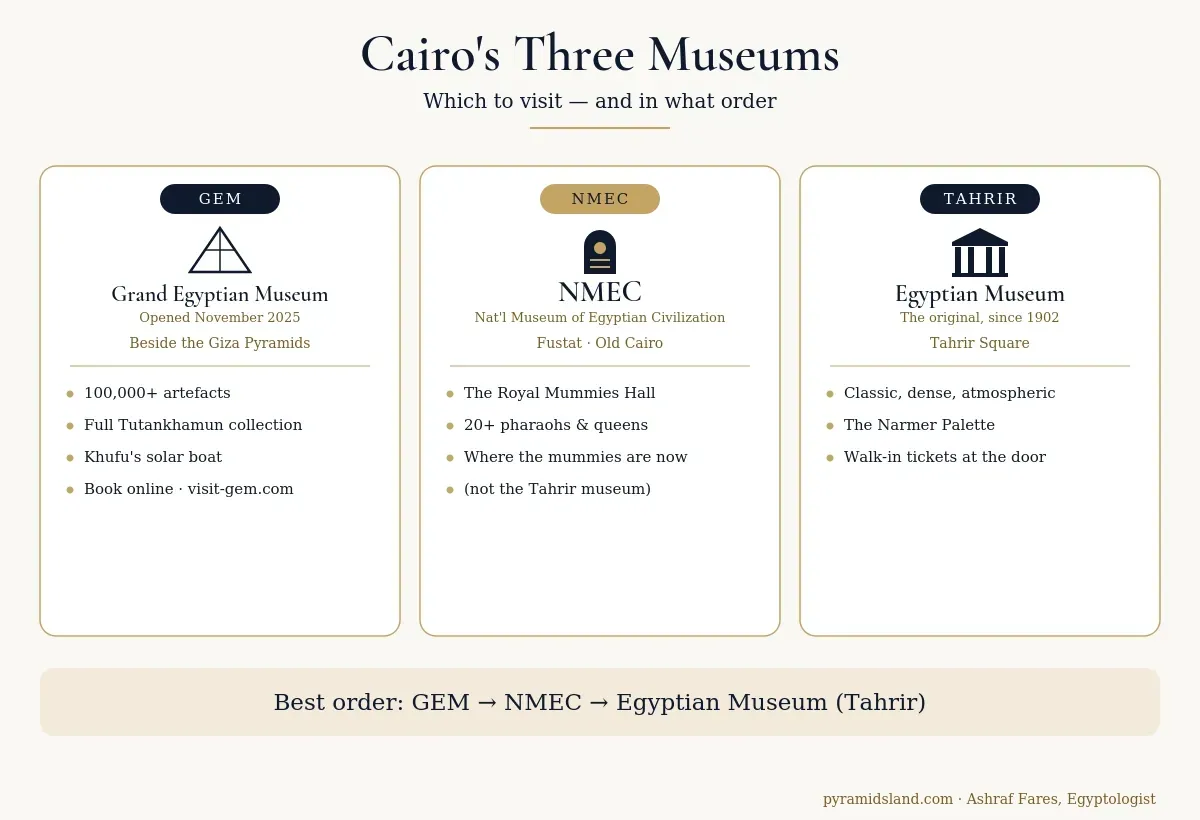
This is the part of Cairo that changed most in 2025–2026, and the part that older guides get wrong most often. There are now three major museums, and they are not interchangeable.
The Grand Egyptian Museum (GEM) is the headline. It opened fully in November 2025, beside the Giza Pyramids — not in central Cairo, and roughly 40 minutes from downtown. It holds over 100,000 artifacts, the complete Tutankhamun collection (all 5,398 objects shown together for the first time, where the old museum displayed barely a third), and Khufu's restored solar boat. It is vast; give it half a day, not an hour. The one rule that catches people out: since 1 December 2025, GEM tickets must be booked online in advance at the official site, visit-gem.com. On-site ticketing was closed to manage crowds, and the daily cap is enforced — do not turn up expecting to buy at the door.
The National Museum of Egyptian Civilization (NMEC), in Fustat (Old Cairo), is where the Royal Mummies Hall now lives — more than twenty pharaohs and queens, including Hatshepsut, Thutmose III, and Seqenenre Tao, moved here in 2021. If you want to stand in front of the actual mummies of the New Kingdom kings, this is the place — not the old museum, where most outdated guides still send people.
The Egyptian Museum on Tahrir Square — the pink colonial building from 1902 — is still open and still worth it, confirmed to run at least through 2030. It has lost the headline pieces to GEM but keeps the Narmer Palette and a dense, atmospheric attic-of-treasures character that the modern museum deliberately lacks. Tickets are sold at the door.
The order that works best for most travelers is GEM first (especially if the day already includes Giza), then NMEC for the mummies, then the Tahrir museum if you have a third museum slot and like the old-world feel.
ASHRAF FARES · Egyptologist What surprises people most in the new Grand Egyptian Museum is the sheer scale — it feels endless, and after about 90 minutes, their eyes start to glaze over. I steer them straight to the smaller, quieter galleries after the Tutankhamun halls: the royal statues on the ground floor, the daily-life artifacts, and especially the jewelry and scarab collection upstairs.<br><br>To stop the burnout I'm strict: a maximum of two to two-and-a-half hours, with a proper sit-down break in the café halfway through. I tell them, "This museum is a marathon, not a sprint — we're here to fall in love with it, not survive it." The clients who listen leave on a high; the ones who try to push through everything end up exhausted and remember almost nothing.
Saqqara, Memphis, and Dahshur
The Old Kingdom didn't start at Giza. Half an hour south of the pyramids lies Saqqara, home to Djoser's Step Pyramid — designed by Imhotep around 2670 BC, the first monumental stone building in human history and the prototype for everything that followed. Nearby Dahshur holds Sneferu's Bent and Red Pyramids, where the geometry of the true pyramid was worked out by trial and error, and Memphis — the Old Kingdom capital — keeps a colossal recumbent statue of Ramesses II. It is a quieter, less crowded day than Giza and, for many travelers, the more memorable one. If you have a third day in Cairo, give it to this.
→ Private Giza, Saqqara & Dahshur Day Tour
Islamic Cairo
The medieval heart of the city is a UNESCO-listed warren of mosques, madrasas, and gates. The Citadel of Saladin offers the city's best skyline view and houses the alabaster Mosque of Muhammad Ali; the Sultan Hassan and Al-Rifa'i mosques face each other on a monumental scale; Al-Azhar, founded in 970 AD, is one of the oldest universities in the world. And then there is Khan el-Khalili, the great bazaar. A tip the forums repeat: the stalls clustered at the entrance, where the buses drop off, sell mostly imported plastic; walk deeper into the lanes for the workshops that still make brass, glass, and textiles by hand.
Coptic Cairo
In Old Cairo, the Christian quarter sits inside the walls of a Roman fortress. The Hanging Church, suspended over a Roman gatehouse, the Ben Ezra Synagogue, and the Coptic Museum tell the story of Egypt between the pharaohs and Islam that most itineraries rush past. It pairs naturally with NMEC, which is close by.
The Nile at Sunset
However you spend the days, give one evening to the river. A felucca under sail or a quiet dinner cruise reframes the whole city — the noise drops away, the skyline lights up, and Cairo briefly becomes calm. It is the simplest antidote to a hard day of sightseeing.
How Many Days Do You Need in Cairo?
Two to three full days cover it well. A workable shape:
Day one: the Pyramids of Giza, the Sphinx, and the Grand Egyptian Museum next door. Day two, the Egyptian Museum on Tahrir (or NMEC for the mummies) in the morning and Islamic Cairo in the afternoon. Day three, if you have it, Saqqara, Memphis, and Dahshur, or Coptic Cairo paired with NMEC. Resist the urge to cram more — Cairo's traffic and scale mean two well-paced sites a day beat four rushed ones.
→ For a detailed day-by-day plan, see 2 days in Cairo.
Where to Stay in Cairo
For a short stay, pick one base and don't move hotels. Three areas make sense. Giza puts you near the pyramids and the GEM, with pyramid-view rooms at the higher end — ideal if your priority is an early plateau start. Zamalek, the leafy island district, is quieter and more characterful, with good restaurants and Nile views, and reasonable access to the center. Downtown / Garden City is the most central and walkable to the Tahrir Museum and the Nile, in historic (if faded) surroundings. International chains are widely available across all three.
Getting Around
Ride-hailing apps (Uber and the local Careem) are the single best tool for an independent traveler — fixed fares, no haggling, and a GPS record of the ride. They work well for Giza, the GEM, and the museums. For a day that connects several sites, a private driver (roughly $40–70 per day) is more flexible and eliminates navigation friction entirely. The metro is cheap and avoids traffic on a few central routes, but it doesn't reach most tourist sites. Two realities to plan around: traffic is genuinely heavy, so budget more transit time than the map suggests, and the GEM is out by the pyramids in Giza, not downtown — sort that transfer before the day, not on arrival.
For arrivals, the airport-to-hotel run is the moment first-timers feel most exposed; it's worth pre-arranging.
→ Egypt Transportation Guide → Cairo Airport Arrival — the first 30 minutes
Practicalities: Costs, Visa, Food, Shopping, Safety
What it costs. Cairo spans every budget — hostels at the low end, international five-stars at the top, with comfortable mid-range hotels in between. Meals run from a few dollars at a street vendor to restaurant prices closer to a European city at the top hotels. (Figures move with the exchange rate and inflation; treat any number you read as approximate and confirm current rates close to your trip.)
Visa. Most nationalities can get a visa on arrival for $30 USD, payable in cash at the airport before passport control, or arrange an e-visa in advance.
→ Egypt visa and entry requirements
Food. Cairo's food is underrated — koshari, ful, taameya, fresh bread, and grilled meats are the everyday staples worth seeking out.
Shopping. Khan el-Khalili is the place; bargain hard, go past the entrance stalls for quality, and check craftsmanship before paying.
Safety and scams. Tourist areas are heavily policed, and Cairo is broadly safe; the real friction is commercial, not criminal — overpriced "guides" who attach themselves outside sites, taxi disputes, and persistent vendors. Agree on prices first, use the ride apps, and keep an eye on belongings in crowds.
→ Is Egypt safe? · How to avoid tourist scams · Solo female travel in Egypt
Want Cairo planned so the intensity never reaches you — early starts, a driver who knows the traffic, GEM tickets sorted in advance? Message us on WhatsApp and we'll build your days. No obligation.
Common Questions
Is Cairo worth visiting?
Yes. Cairo is intense — loud, dense, and fast — but it holds the Pyramids of Giza, the Grand Egyptian Museum, and 4,500 years of history, and travellers who plan for the intensity rather than improvise almost always come away glad they came. Two to three focused days is the sweet spot.
How many days do you need in Cairo?
Two to three. One day for the Pyramids and the Grand Egyptian Museum, one for the older city and a second museum, and a third for Saqqara if you have it. Cairo's traffic and scale reward two well-paced sites a day over four rushed ones.
Is the Grand Egyptian Museum open, and do I need to book online?
Yes, it opened fully in November 2025, beside the Giza Pyramids. Since 1 December 2025, tickets must be booked online in advance through the official site, visit-gem.com — on-site sales were closed and there is a daily visitor cap, so don't arrive expecting to buy at the door.
GEM or the Egyptian Museum — which should I visit?
Both, if you have time, but they're different. The Grand Egyptian Museum (near Giza) is modern, vast, and holds the full Tutankhamun collection and the solar boat. The Egyptian Museum on Tahrir is the historic 1902 building — denser and more atmospheric, with the Narmer Palette. A common plan is GEM first, then the Tahrir museum later.
Where are the royal mummies in Cairo?
At the National Museum of Egyptian Civilization (NMEC) in Fustat, Old Cairo — the Royal Mummies Hall, where more than twenty pharaohs and queens were moved in 2021. They are no longer at the Egyptian Museum on Tahrir, despite what many older guides say.
How far are the pyramids from central Cairo?
The Giza Plateau is about 30–45 minutes from downtown, depending on traffic. The Grand Egyptian Museum is right beside it — also out in Giza, not in the city centre.
Is Cairo safe for tourists?
Tourist areas are heavily policed and broadly safe. The common friction is commercial rather than criminal — pushy vendors, taxi disputes, and self-appointed "guides." Agree prices first, use ride-hailing apps, and stay aware in crowds.
Is Uber available in Cairo?
Yes — Uber and the local app Careem both operate widely and are the easiest way to get around independently, with fixed fares and no haggling.
Plan Cairo the Right Way
Cairo overwhelms the travelers who treat it as a city to wander, and rewards those who give it structure — early starts, a fixed base, transport arranged in advance, and a realistic two or three days. Get that right, and the noise becomes part of the experience rather than the thing you remember.
Tell us your dates and we'll build your Cairo days — pyramids at first light, GEM tickets handled, no shopping stops. Message us on WhatsApp.
Ashraf Fares