
Tipping in Egypt: Who, How Much, and How to Do It With Grace
Screenshot the table below. It is the only tipping reference you need.
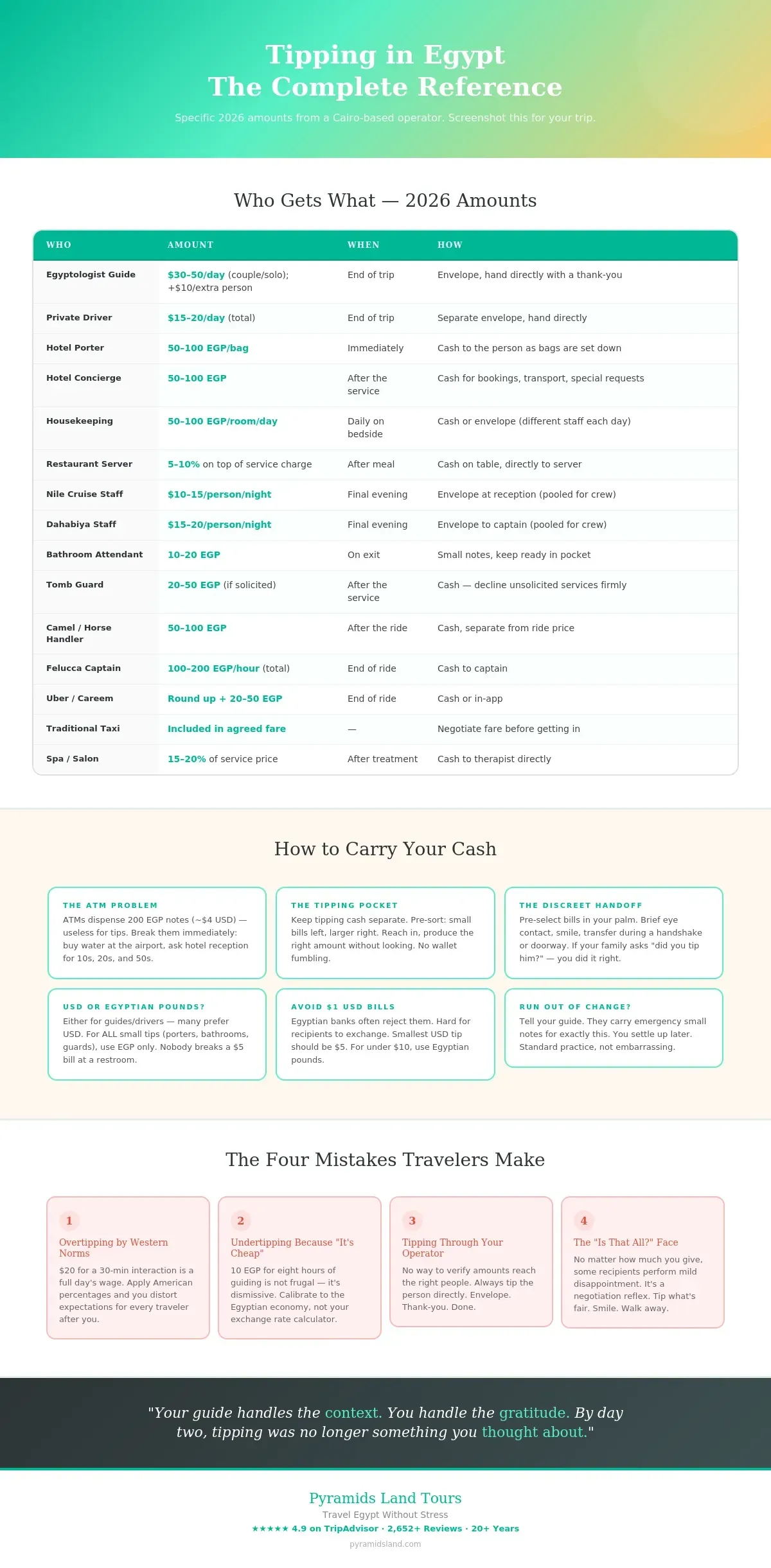
The Quick Reference — 2026 Amounts
| Who | Amount | When | How |
|---|---|---|---|
| Egyptologist guide (private) | $30–50/day (couple or solo); add $10 per extra person | End of trip | Envelope, hand directly, with a thank-you |
| Private driver | $15–20/day (total) | End of trip | Envelope, hand directly |
| Hotel porter | 50–100 EGP/bag | Immediately | Cash to the person carrying bags |
| Hotel concierge | 50–100 EGP | After the service | Cash for restaurant bookings, transport, special requests |
| Housekeeping | 50–100 EGP/room/day | Daily on bedside | Cash or envelope (different staff each day) |
| Restaurant server | 5–10% on top of service charge | After meal | Cash on table, directly to server |
| Nile cruise staff | $10–15/person/night | Final evening | Envelope at reception (pooled for all crew) |
| Dahabiya cruise staff | $15–20/person/night | Final evening | Envelope to captain (pooled for all crew) |
| Bathroom attendant | 10–20 EGP | On exit | Small notes, keep ready in pocket |
| Tomb guard (if solicited) | 20–50 EGP | After the service | Cash — decline unsolicited services firmly |
| Camel / horse handler | 50–100 EGP | After the ride | Cash, separate from the ride price |
| Felucca captain | 100–200 EGP/hour (total) | End of ride | Cash to captain |
| Uber / Careem driver | Round up or add 20–50 EGP | End of ride | Cash or in-app |
| Traditional taxi | Tip included in agreed fare | - | Negotiate fare before you get in |
| Spa / salon at hotel | 15–20% of the service | After treatment | Cash to therapist |
All amounts are 2026 estimates based on the current exchange rate (~$1 = 50–52 EGP). Check the rate before your trip — the Egyptian pound fluctuates.
A note on other guides you may read online: Some operator-owned sites recommend $80–100/day for guide tips. These inflated figures typically reflect operators whose guides work on commission rather than salary. Our amounts are calibrated for fair, sustainable tipping within the Egyptian economy — generous enough to be meaningful, honest enough not to distort expectations for the next traveler.
Now — the context behind every line in that table.
What Baksheesh Actually Means
Every guide, every forum thread, every traveler who has been to Egypt uses this word. You need to understand it before you land.
Baksheesh is not simply "tip." It is a social practice that encompasses tipping for service, charitable giving, and the small financial exchanges that lubricate daily life in Egypt. When a parking attendant helps you find a space, when a doorman opens a gate, when a child hands you a tissue in a restaurant — baksheesh is what you give. It is woven into the culture in a way that has no exact Western equivalent.
The mistake most visitors make is treating every baksheesh moment as a transaction to be evaluated: "Did this person earn this? Was the service worth this amount?" In Egypt, baksheesh is often less about earning and more about acknowledging — acknowledging that someone was present, that they offered something, that you noticed.
Understanding this reframes the entire experience. You stop calculating and start participating.
Why These Amounts Are What They Are
The average monthly salary in Egypt is roughly $300 USD. Many workers in tourism — drivers, porters, boat crews, restaurant servers, bathroom attendants — earn less. The Egyptian pound has lost enormous value: in 2012, one dollar equaled about 6 EGP. Today it equals roughly 50 EGP. Imported goods have risen nearly tenfold while wages have stagnated.
Tips are not bonuses in Egypt. For many people in the service industry, they are a core part of their income. A tip that feels small to you — $5, $10 — can represent a meaningful addition to someone's week.
That said, tipping should reflect the service you received. It is not a guilt payment. It is not an obligation regardless of quality. If the service was poor, you do not need to tip — a genuine smile and a polite departure is perfectly acceptable. And tipping should never be so large as to distort the local economy. When Americans apply their domestic 20% norms directly, the result is a guide receiving the equivalent of a full day's wage for a single interaction — which sets an unsustainable expectation for every traveler who follows.
The amounts in the table above are calibrated by people who live in this economy and work alongside the people you will be tipping.
The Details Behind Each Row
Your Egyptologist Guide
$30–50 per day for a couple or solo traveler. For groups of 3+, add approximately $10 per additional person.
Your guide is with you for 8 to 10 hours. They are the most skilled person on your trip — a licensed Egyptologist who studied for years to tell you the stories behind the stones. A good guide does not just narrate a site. They build a narrative throughout your entire trip, transforming disconnected temples into chapters of a single story.
If you have the same guide for multiple days, tip at the end of the trip, not daily. The envelope ritual matters: sit with your guide on the final morning, thank them for specific moments — the story they told at Karnak, the way they handled the crowd at the Valley of the Kings, the restaurant they chose that surprised you. Then hand over the envelope. Some travelers write a note inside. Some guides, after thousands of tours, still get visibly moved. This is the emotional payoff of the entire trip, not just the tip.
Your Private Driver
$15–20 per day (total, not per person).
Your driver navigates Cairo traffic for you, positions the car as close as possible to every site, keeps the vehicle air-conditioned and stocked with water, and waits patiently through every stop. This is physically demanding, high-skill work that most visitors never fully appreciate until they see Cairo's roads.
Same rule: tip at the end if you have the same driver for multiple days. Separate the envelope from the guide. Hand it directly to your driver, make eye contact, and say thank you.
Hotel Porters
50–100 EGP per bag. Hand it to the person who carried your bags as they set them down in your room. Not after. Not later. Immediately — while the interaction is still happening.
Hotel Concierge
50–100 EGP depending on the level of service. If the concierge booked a restaurant, arranged transport, or handled a special request, tip when the service is delivered. Not every traveler interacts with a concierge — but if you are staying at a 4 or 5-star hotel and someone went out of their way for you, this is how you acknowledge it.
Hotel Housekeeping
50–100 EGP per room per day. Leave it on the bedside table with a note or in the envelope provided. Do this daily, not at the end of your stay — different staff may clean your room on different days. The person who cleaned your room on Tuesday may not be working on Thursday.
Restaurant Servers
Most sit-down restaurants in Egypt include a 10–12% service charge on the bill. Check the bottom of your receipt. If a service charge is included, an additional 5–10% left in cash on the table for the server is a generous addition. Much of the service charge goes to the restaurant ownership, not the individual server — though this varies by establishment.
At small, informal restaurants and street food vendors, rounding up the bill or leaving 20–50 EGP is appreciated but not expected.
Nile Cruise Staff
Standard cruise ship: $10–15 per person per night in an envelope at the reception desk on the final evening. This tip is pooled and shared among the entire crew — the people you see (waiters, cabin stewards) and the people you do not (kitchen staff, laundry workers, engineers). Write the amount on the envelope.
Dahabiya: $15–20 per person per night. The crew-to-guest ratio on a dahabiya is dramatically higher than a standard cruise ship, the service is more personal, and the crew is smaller — your tip represents a larger share of their income. Give the envelope to the captain on the final evening.
If a specific crew member on either vessel was exceptional — a waiter who remembered your coffee order, a cabin steward who went beyond the standard — a small additional tip of 50–100 EGP handed to them directly is appropriate and deeply appreciated.
Bathroom Attendants
10–20 EGP. Carry small notes specifically for this. At tourist sites and restaurants, an attendant is almost always present. This is one of the most frequent baksheesh exchanges — prepare for it by keeping 10 and 20 EGP notes in an accessible pocket.
Tomb Guards, Monument Staff, and Unsolicited Photographers
This is where baksheesh gets complicated. At some sites — particularly Saqqara, the Nobles' Tombs in Luxor, and smaller tombs — guards may offer to show you a hidden detail, open a normally closed area, or take your photo. They will expect a tip.
20–50 EGP is appropriate for a solicited service. Be aware: some guards initiate the interaction without being asked and then demand payment. You are not obligated to tip for unsolicited services. A firm "la, shukran" works. Your guide handles these situations before they become uncomfortable.
At certain sites, the guard may expect payment BEFORE showing you the detail — not after. If you don't agree up front, you don't see it. Your guide negotiates the amount in Arabic before you enter, so there is no ambiguity afterward.
A related scenario at open-air sites like the Pyramids and Karnak: someone will take your photo — with your phone or theirs — without being asked, then demand 50–100 EGP for the "service." If you do not want the photo taken, say "la, shukran" and turn away before they start. If they take it before you can stop them, you are not obligated to pay — but your guide will typically step in before the situation escalates.
Camel and Horse Handlers
50–100 EGP after the ride, separate from the ride price. At the Pyramids, you negotiate the ride cost with the handler directly — or your guide negotiates it for you. The ride price and the tip are two different things. The handler controls the animal for the duration of your ride, helps you mount and dismount, and waits while you take photos. A tip of 50–100 EGP afterward is customary and fair.
Felucca Captains and Small Boat Crews
100–200 EGP for a one-hour ride (total, not per person). For longer sunset sails or multi-hour trips, adjust upward proportionally.
Uber and Careem Drivers
Even on a Pyramids Land tour, you may venture out alone in the evening. For Uber or Careem rides, rounding up the fare or adding 20–50 EGP is appreciated — the fare is metered, and a tip on top is a separate gesture. You can also tip in-app. Your guide can recommend amounts for specific routes.
Traditional Taxi Drivers
Traditional taxis in Egypt do not use meters. You negotiate and agree on a fixed fare before you get in — this agreed price is the total, and the tip is already built into the negotiation. Rounding up slightly is a generous addition but is not expected the way it is with Uber or Careem. The key rule: never get into a taxi without agreeing on the fare first.
Spa and Salon Services at Hotels
15–20% of the service price, given in cash directly to the therapist or stylist after the treatment. This follows the same norms as tipping at Western spas.
How to Carry Your Cash
This section solves 80% of the tipping stress.
Withdraw Egyptian pounds from an ATM on arrival. ATMs are at the airport and in every major tourist area. The problem: ATMs in Egypt typically dispense 200 EGP notes — the largest denomination, worth roughly $4 USD. This is almost useless for tipping.
Break your large notes immediately. Buy a bottle of water or a snack at the airport using a 200 EGP note. At your hotel, ask the front desk to break two or three 200 EGP notes into 10s, 20s, and 50s. Most hotels will do this without hesitation. This gives you a stack of small bills that will last several days.
The $50 visa trick: If you are buying your visa on arrival at Cairo Airport, pay with a $50 USD bill for the $25 visa. Ask for change in small Egyptian pound notes. The bank teller will hand you a mix of 10s, 20s, and 50s — exactly the denominations you need for tipping. One transaction solves two problems before you leave the airport.
Carry a dedicated tipping pocket or pouch. Keep your tipping cash separate from your spending cash. Pre-sort small bills on the left, larger bills on the right. This prevents the awkward moment of rifling through your wallet in front of someone waiting — and lets you reach into your pocket and produce the right amount without looking.
USD or Egyptian pounds? Either works for guides and drivers. Many prefer USD because it holds its value. Egyptian pounds are perfectly appropriate and, in some ways, more respectful — you took the time to exchange into the local currency. For all small tips (porters, housekeeping, bathroom attendants, tomb guards), use Egyptian pounds only. Nobody can break a $5 bill in a public restroom.
Do not use $1 USD bills. Egyptian banks often reject them. They are difficult for recipients to exchange. Your smallest USD tip should be $5 — or stick to Egyptian pounds for everything under $10.
What if you run out of small bills? It happens. Your guide carries emergency small notes for exactly this situation. Tell them they will cover the tip, and you will settle up later. This is not embarrassing — it is a standard part of guided travel in Egypt.
The Discreet Handoff
How you tip matters almost as much as how much you tip.
The best technique, practiced by experienced Egypt travelers: pre-select the bills and hide them in your palm. When the moment arrives — passing through a doorway, shaking hands, the natural pause at the end of an interaction — make brief eye contact, smile, and transfer the bills in one smooth motion. No announcement. No wallet fumbling. No performance.
One traveler described it this way: "I would slip the bills during a handshake at a doorway. Quick eye contact, smile, done. My family would ask, 'Did you give him something?' That's how you know you did it right."
One cultural nuance: if the person politely declines the tip on first offer, insist gently once. In Egyptian culture, the initial refusal is often a gesture of modesty — declining before accepting. If you take the first "no" at face value and pocket the money, you have committed a small social error. Offer once more with a smile. If they decline a second time with genuine firmness, respect it.
The discretion is not about secrecy. It is about dignity — for both parties.
The Four Mistakes Travelers Make
Overtipping by applying Western norms. Americans, in particular, tend to convert their domestic 20% habits directly. A $20 tip for a 30-minute interaction is a full day's wage in the Egyptian economy. You feel generous, but you have distorted expectations for every traveler who follows you. The forums are full of European and South African travelers who say, "The American insistence on tipping anything that moves has caused unreasonable expectations."
Undertipping because "everything is cheap here." The opposite extreme. Leaving 10 EGP for a guide who spent eight hours making your visit extraordinary is not frugal — it is dismissive. The amounts in this guide are calibrated to be fair within the Egyptian economy.
Tipping through your tour operator. Some operators offer to "include" tips in the package price and handle distribution. Be cautious. There is no way to verify that the amounts actually reach the individuals who served you. Always tip the person directly. Envelope. Thank-you. Done.
Panicking at the "is that all?" face. This is the moment every forum warns about and no blog prepares you for. No matter how much you tip — $15 or $50 — some recipients will give you a look of mild disappointment. It is a performance, not a judgment. A TripAdvisor destination expert with 19,000 posts put it bluntly: "You will get the same 'is that all??' performance, no matter how much you give. So don't feel embarrassed and give more." Tip what is fair. Smile. Walk away. Do not let a facial expression renegotiate the amount.
What Your Guide Told You Before Your First Tip
On your first morning in Cairo, before your first site visit, your guide sat down with you and explained all of this. Not as a lecture — as a practical briefing over coffee. He told you who you would encounter during the day, what baksheesh is customary, and what amounts are appropriate. He helped you break your large bills at the hotel. He carried small notes himself for moments when you did not have change.
At the Pyramids, when a guard offered to show you a hidden alcove, your guide agreed on the amount in Arabic before you entered — 30 EGP, settled in advance, no ambiguity afterward. When someone tried to photograph you without asking, your guide stepped in before the camera was raised. At the restaurant, he pointed to the service charge on the bill and suggested how much to leave on the table. In the bathroom, he had a 10 EGP note ready before you even thought about it.
By day two, tipping was no longer something you thought about. The amounts were sorted in your pocket. The rhythm was natural. You tipped with a smile and a "shukran" and moved on to the thing you actually came to Egypt for.
On the final morning, you sat with your guide and handed him the envelope. You told him that the story he built from the Pyramids to Abu Simbel was the reason the trip exceeded every expectation. He read the note you wrote inside later that evening. He has kept it.
That is what we mean by "Travel Egypt Without Stress." Not that the complexity disappears — but that someone who understands it is standing next to you, translating it in real time.
A Note for Travelers From Non-Tipping Cultures
If you are traveling from a country where tipping is not standard — much of Europe, Australia, Japan, parts of South America — or where $30/day is a significant amount relative to your own economy, adjust proportionally. Your guide understands that generosity looks different in different economies. A heartfelt thank-you and a fair tip, given with warmth, will always be well received, regardless of the amount.
The amounts in this guide are benchmarks, not mandates. The spirit matters more than the math.
One Less Thing to Worry About
Tipping is one of dozens of small logistics that can add up to stress or fade into the background. On a Pyramids Land tour, your guide handles the context. You handle the gratitude.
WhatsApp: +20 122 362 4703 — Ask Us Anything About Your Trip →
About Pyramids Land Tours
Cairo-based. Egyptian-owned. 20+ years guiding travelers through every aspect of Egypt — including the parts that have nothing to do with temples. Every tour is private, led by a licensed Egyptologist, and designed around one principle: you should remember Egypt for what you experienced, not for what confused you.
★★★★★ 4.9 on TripAdvisor · 2,700+ Reviews · pyramidsland.com
Ashraf Fares