
What to Wear in Egypt: The Advice Your Guide Gives You Before You Pack
Every week, someone on our team reads a packing blog written by a tourist who spent ten days in Egypt and now considers themselves an authority on how to dress here. The advice is always the same: loose linen, cover your shoulders, bring a scarf.
That advice is not wrong. It is just shallow enough to leave you making mistakes that no blog warned you about — like discovering your white cotton dress becomes see-through the moment you step into Egyptian sunlight. Or learning that sport leggings, marketed as "breathable travel wear," become a suffocating second skin in 40-degree heat. Or wearing designer logos through a bazaar and watching every price triple before you open your mouth.
We are Pyramids Land Tours — Cairo-based, Egyptian-owned, operating for over 20 years. Our guides walk beside travelers every day, in every season, at every type of site from Islamic Cairo to the Valley of the Kings. We see what works. We see what fails. And we see the social signals clothing sends in Egypt — signals tourists rarely notice, but that Egyptians read instantly.
This is the clothing guide we give our own travelers before they pack.
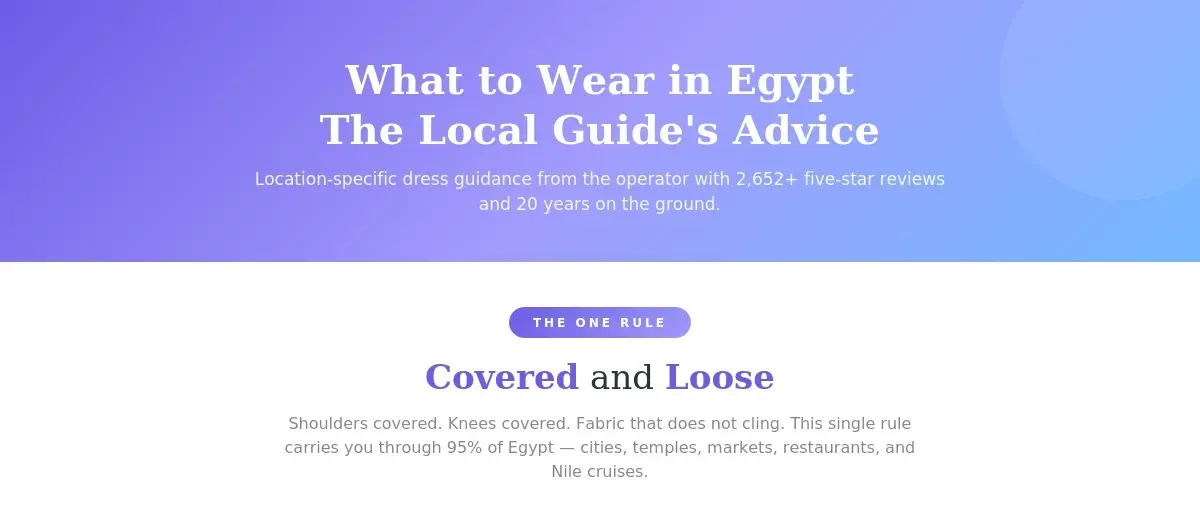
The One Rule That Replaces Every Other Rule
Forget the word "modest." It confuses Western visitors because it implies restriction. Think instead: covered and loose.
Shoulders covered. Knees covered. Fabric that does not cling to your body. If your clothing meets those three conditions, you will move through 95% of Egypt — cities, temples, markets, restaurants, Nile cruises — without a single uncomfortable moment.
The remaining 5% is mosques and a handful of conservative neighborhoods. Your guide will always let you know if a headscarf or extra coverage is needed before you arrive.
This is not about Egypt policing tourists. Egyptians are genuinely welcoming and tolerant of visitors. But clothing that exposes significant skin in non-resort areas creates a social friction you will feel before anyone says a word — more staring, more approaches, more comments. Our guides see this every day. The travelers who dress in loose, covered clothing have a noticeably more relaxed experience. Not because Egypt punishes the alternative, but because the social texture of your day changes completely.
What to Wear in Cairo
Cairo is more liberal than most visitors expect — and more conservative than the travel blogs suggest. You will see young Egyptian women in fitted jeans and tunics. You will also see women fully veiled. The spectrum is wide. As a visitor, you land somewhere in the middle.
What worked on your trip: You wore loose cotton trousers or a maxi skirt, a top with sleeves to the elbow or beyond, and flat, comfortable shoes. You carried a light scarf in your bag. You blended in. Nobody stared. Your guide, Zenab, told you later that the Khan El Khalili bazaar vendors barely registered you, which meant you shopped without pressure and paid fair prices.
The details that matter in Cairo:
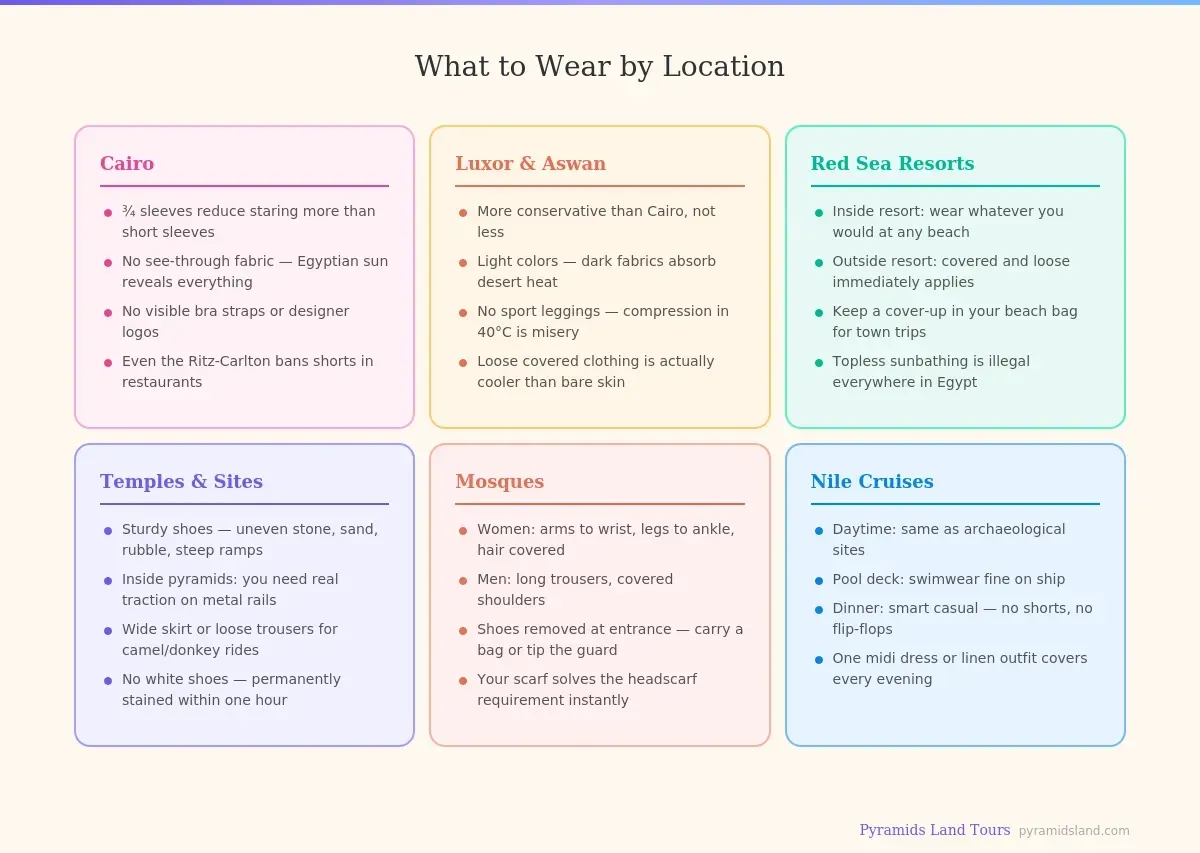
Three-quarter sleeves reduce staring more than short sleeves. It sounds like a small difference — it is not. Short sleeves in Cairo immediately mark you as a tourist. Sleeves past the elbow read as someone who understands where they are.
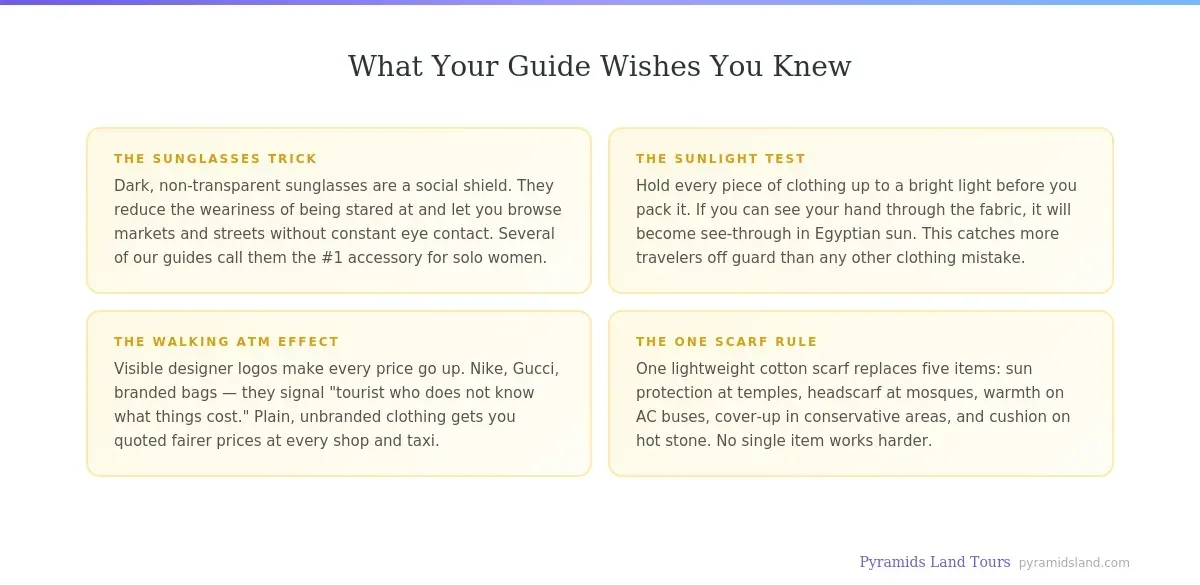
Avoid anything see-through. Egyptian sunlight is brutally revealing. Fabric that looks completely opaque indoors becomes transparent the moment you step outside. Hold your clothing up to a bright light before you pack it. If you can see your hand through it, leave it at home.
No visible bra straps. Not for religious reasons — for social ones. In Cairo, visible undergarments signal either carelessness or provocation, and neither is the impression you want to make.
No visible cleavage. This is called out specifically because V-neck tops and wrap dresses that feel modest in the West read very differently in Cairo. Multiple experienced travelers and local sources identify low necklines as the single most common clothing mistake foreign women make in Egypt — more than bare shoulders, more than short skirts. If in doubt, hold your top up in the mirror: if you can see skin below the collarbone, swap it for a crew neck or add a scarf layer.
Skip the designer logos. Visible brand names in Egyptian markets are a price multiplier. Our guides call it the "walking ATM effect." Wear plain, unbranded clothing, and you will be quoted lower prices at every shop, every taxi, every interaction.
Even the Ritz-Carlton in Cairo does not allow shorts in its restaurants. That should tell you everything about the city's baseline expectations.
What to Wear in Luxor and Aswan
Here is something most travel blogs get backward: Luxor and Aswan are more conservative than Cairo, not less. These are smaller cities with stronger traditional values. The tourist areas around the temples feel relaxed, but the moment you step into the town itself — the souks, the local restaurants, the neighborhoods — you are in a more traditional environment than anything you experienced in the capital.
What worked on your trip: You wore the same covered-and-loose formula as Cairo, but you noticed the difference. In Luxor's West Bank area, there were almost no local women with bare arms. Your guide, Ahmed, told you that the families in these villages notice clothing choices more than anyone in downtown Cairo does — not with hostility, but with attention. The less attention your clothing attracted, the more genuine the interactions felt.
The heat factor: Upper Egypt is significantly hotter than Cairo. This is where the instinct to strip down becomes strongest — and where resisting that instinct matters most. The counterintuitive truth that experienced desert travelers know: loose, covered clothing is actually cooler than exposed skin. A lightweight long-sleeved cotton shirt protects you from direct sun and creates an air gap between the fabric and your skin. Bare arms in the Valley of the Kings are not just culturally questionable — they are a sunburn guarantee.
Pack light-colored linen or cotton. Avoid black and dark colors — they absorb heat. Avoid synthetic "performance" fabrics — they trap moisture against your body and become unbearable by midday. Avoid sport leggings entirely. Compression garments in 40-degree heat are a recipe for heat rash and misery.
What to Wear at Temples and Archaeological Sites
Temples and tombs are not mosques — there is no enforced dress code. You will see tourists at the Pyramids in shorts and tank tops. They are technically allowed. They are also the tourists getting the most aggressive attention from touts, baking in the direct sun with no protection, and spending more mental energy on discomfort than on the monuments.
What worked on your trip: You wore loose trousers, a cotton top with three-quarter sleeves, sturdy shoes, and a wide-brimmed hat. Your guide, Mahmoud, later pointed out that the vendors at Giza barely approached you — they focus on the visitors who look unaccompanied and underprepared.
Shoes matter more than any other item at sites. The ground at Egyptian archaeological sites is uneven sandstone, loose sand, sharp rubble, and crumbling stairs. Inside the Great Pyramid, the entry corridor slopes downward over metal rails — you need shoes with real traction. At Saqqara, you walk through deep sand. At the Valley of the Kings, dust coats everything within minutes.
Wear closed-toe walking shoes or sturdy trekking sandals with thick soles. Not fashion sandals. Not flip-flops. Not white shoes of any kind — they will be permanently stained within an hour. Many experienced travelers pack an older pair of shoes specifically for archaeological sites and discard them at the end of the trip.
If you plan to ride a camel at the Pyramids or a donkey on the West Bank, wear a wider skirt or loose trousers rather than a fitted maxi dress. You need to bend your knees without hiking the fabric up to your thighs. This is a practical detail almost nobody mentions until you are sitting sideways on a camel trying to figure it out.
One detail that catches travelers at open-air sites: wind. The Giza plateau, Saqqara, the West Bank in Luxor, and the Red Sea coast are all consistently windy. A loose maxi skirt that feels elegant at your hotel becomes a liability at the Pyramids — whipping sideways, catching on railings, requiring one hand to hold down while you are trying to take photographs or climb steps. If you prefer skirts, choose a heavier drape or wear lightweight leggings underneath. Several experienced travelers recommend wrapping a scarf around the waist as a wind anchor. Or simply default to loose trousers at any site with open desert exposure.
What to Wear at Mosques
When your guide took you to the Mohamed Ali Mosque inside the Citadel, you were prepared because she told you the rules the night before.
Women: arms covered to the wrists, legs covered to the ankles, hair covered with a scarf. No exceptions. Some mosques (like Al-Azhar) provide robes for underprepared tourists — communal, oversized green cloaks that look and feel exactly as unflattering as you imagine. Be aware that the mosque attendants can be fickle: one TripAdvisor poster was given the cloak despite wearing three-quarter pants and a fitted t-shirt that covered everything. If your clothing is fitted rather than loose — even if your skin is covered — they may still insist. Loose is the keyword here, not just covered.
Men: long trousers, covered shoulders. Shorts above the knee are not permitted.
Everyone: shoes removed at the entrance. The mosque caretaker holds them for you. A small
tip of a few Egyptian pounds when you collect them is customary. Alternatively, carry a plastic bag in your daypack and bring your shoes inside with you — some travelers prefer this. One cultural note that applies everywhere, not just mosques: never point the sole of your shoe or foot at someone. In Egyptian culture, showing the bottom of your foot is deeply disrespectful. Tuck your legs in when sitting on the ground, and be mindful of how you cross your legs.
The scarf you are already carrying in your bag solves the headscarf requirement entirely. This is why we recommend it as your single most important accessory. One lightweight cotton or linen scarf serves as sun protection at temples, a headscarf at mosques, warmth on air-conditioned buses, a cover-up at conservative sites, and a cushion on hot stone benches. No single item in your suitcase will be used more.
What to Wear on a Nile Cruise
Nile cruises have their own social world. During the day, when you disembark for temple visits, dress exactly as you would at any archaeological site — covered and loose. On the ship itself during the day, you can relax in lighter clothing. The pool deck is fine for swimwear.
The shift happens at dinner. Most Nile cruise dining rooms expect smart casual in the evening. This does not mean formal — it means no shorts, flip-flops, or athletic wear. Women: a midi or maxi dress works perfectly. Men: long trousers and a collared shirt.
One specific night on most cruises is the "galabeya party" — a costume night where passengers wear traditional Egyptian robes. The ship usually has them available for purchase, or your guide can help you find one in a local market. It is genuinely fun and worth participating in.
What worked on your trip: You packed one evening outfit — a simple midi dress or linen trousers with a nicer top — and it carried you through every cruise dinner, every upscale restaurant, and one sunset cocktail at a Luxor hotel rooftop. One outfit. That is all you needed.
What to Wear at Red Sea Resorts
Hurghada and Sharm El Sheikh operate on completely different rules from the Nile Valley. Inside resort compounds — the pool, the beach, the hotel restaurants — you can wear whatever you would wear at any beach resort anywhere in the world. Swimwear, shorts, tank tops, sundresses — all completely normal.
The rule changes the moment you step outside the resort into town. Hurghada's town center, El Dahar, and the local markets expect the same covered-and-loose approach as Cairo. The transition can feel abrupt. Keep a cover-up or a light shirt in your beach bag so you can adapt quickly if you decide to explore beyond the hotel.
Topless sunbathing is illegal everywhere in Egypt, including private resort beaches.
What Men Should Actually Know
Most clothing guides devote two sentences to men and move on. Here is what our male travelers actually needed to hear:
No shorts in cities. Not because it is illegal, but because Egyptian men do not wear shorts in public outside of resort areas. A Western man in shorts walking through downtown Cairo or Luxor reads as someone who did not bother to learn anything about the place. Long lightweight trousers are cooler than you think and infinitely more appropriate.
No tank tops or sleeveless shirts. Same reason. Egyptian men wear shirts with sleeves. A sleeveless gym shirt at the Pyramids or in a bazaar generates the same social signal as a woman in a crop top — you are advertising that you are a tourist who does not know the customs.
Collared shirts earn respect. This is subtle but real. Egyptian men dress relatively smartly in public — even in casual settings. A simple polo or linen button-down, rather than a graphic tee, shifts how vendors, restaurant staff, and security personnel treat you. Your guide noticed this difference consistently.
Shoes, not sandals, in cities. Open-toed sandals on men are rare in Egyptian urban areas. Save them for the resort. In Cairo and Luxor, closed-toe shoes — even simple canvas sneakers — look more appropriate and protect your feet from the dust and debris on Egyptian streets.
The Packing List Your Guide Would Write
If our guides packed your bag, this is what would be inside:
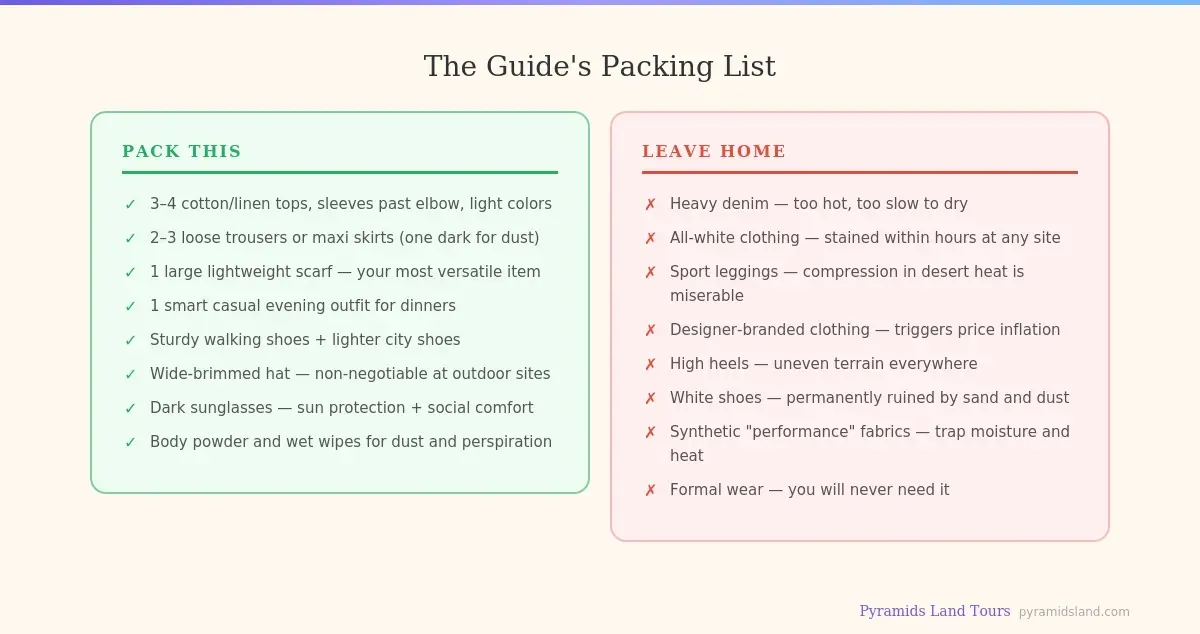
3–4 lightweight tops with sleeves to the elbow or longer. Cotton or linen. Light colors. No logos. No sheer fabric.
2–3 bottoms. Loose cotton trousers, a maxi skirt, or wide-leg linen pants. At least one pair should be dark enough to hide dust stains from archaeological sites.
1 lightweight scarf. Cotton, linen, or a cotton-silk blend. Large enough to cover your head and shoulders. This is your most versatile item — sun protection, mosque entry, warmth, modesty layer, and emergency seat cover.
1 evening outfit. A midi dress or a nicer top with linen trousers. Covers every cruise dinner, every upscale restaurant, and every rooftop bar.
2 pairs of shoes. One sturdy pair for sites — trekking sandals with thick soles or trail walking shoes. One lighter pair for cities and evenings. Both should be shoes you do not mind getting dusty.
A wide-brimmed hat. Non-negotiable for any outdoor site visit. Your guide will remind you, but we are reminding you now.
Sunglasses. Not just for sun protection — for social comfort. Dark, non-transparent sunglasses reduce the weariness of being constantly looked at. Several of our guides recommend them as the single best accessory for solo women travelers who want to observe markets and streets without constant eye contact.
What to leave home: heavy denim (too hot, takes too long to dry), all-white clothing (stained within hours at any archaeological site), sports leggings (compression in desert heat is miserable), anything with visible designer branding, high heels, and formal wear you will never use.
How to think about it: Think safari, not beach. A TripAdvisor forum poster nailed the framing in five words, and it applies to every packing decision.
One more tip: Laundry services are available at virtually every Egyptian hotel and most Nile cruise ships — fast, cheap, and reliable. You do not need to pack for every day. Five days of clothing covers a two-week trip.
The Social Truth Nobody Writes About
We are going to tell you something that most travel companies avoid saying because packing blogs have made it a sensitive topic.
What you wear in Egypt directly affects how much hassle you receive. This is not a judgment. It is an observation from two decades of walking beside thousands of travelers.
The travelers in crop tops and short skirts at the Pyramids were approached by touts two to three times more often than the travelers in covered, loose clothing. The solo women who dressed conservatively reported fewer instances of unwanted attention dramatically. The men in shorts received more aggressive pricing at shops than the men in trousers.
This is not Egypt's fault. It is not your fault. It is simply how social signaling works in a culture where clothing communicates differently from the way it does in the West. You do not have to change how you dress. But if your goal is to experience Egypt with the least friction and the most genuine interactions, the covered-and-loose approach gives you that advantage every single day.
Your guide neutralizes most of this dynamic simply by being with you. But dressing thoughtfully gives you an additional layer of ease that compounds across an entire trip.
Month-by-Month: What to Expect
October through March (peak tourist season): Days are warm to hot (20–30°C in Cairo, higher in Upper Egypt). Evenings can be genuinely cold — especially on the Nile and in the desert. Bring a light jacket or a warm layer you can add after sunset. December and January nights in Aswan and the desert can drop below 10°C. The scarf doubles as warmth.
April, May, September (shoulder season): Hot. Temperatures regularly exceed 35°C. This is where lightweight, loose, light-colored clothing becomes essential. Stay ahead of the heat with hydration and sun protection. Your guide schedules outdoor sites for early morning.
June through August (summer): Extremely hot, 40°C+ in Upper Egypt. Most travelers avoid this period in the Nile Valley. If you are visiting, the clothing rules do not change — but the urgency of shade, hats, and continuous water increases dramatically. Timing your site visits around the heat becomes the single most important factor in your day.
You Packed Right. Here Is What Happened.
You walked into Khan El Khalili wearing loose linen trousers, a three-quarter-sleeve cotton top, dark sunglasses, and no visible brands. Your guide, Manar, noticed immediately: the shopkeepers engaged you differently. They quoted reasonable opening prices. They talked to you about their craft rather than pushing a sale. You bought a hand-stitched leather bag for a fair price — because nothing about your appearance said: "tourist who does not know what anything costs."
At the Valley of the Kings the next morning, your wide-brimmed hat and covered arms kept you comfortable until 10 AM while other groups were already retreating to their buses. Inside the tombs, your sturdy shoes gripped the stone corridors where someone in sandals slipped ahead of you. Your scarf covered your hair when you visited the Al-Azhar Mosque that evening — pulled from the same bag it had been in all week, weighing almost nothing, solving every situation it was asked to solve.
You did not think about your clothes once that day. That is the point. The right clothing in Egypt does not make a statement. It makes you invisible to the hassle and visible to the experience.
Still Have Questions?
Your Egyptologist guide will give you specific advice tailored to your itinerary, travel dates, and the sites you are visiting. This is part of every trip we operate — not an add-on, but a standard pre-trip briefing.
If you want that guidance before you book, send us your dates and your questions. We will tell you exactly what to pack.
About Pyramids Land Tours
Cairo-based. Egyptian-owned. 20+ years guiding travelers through Egypt. Every tour is private, led by a licensed Egyptologist, and built around one principle: you should remember Egypt for what you experienced — not for what went wrong.
★★★★★ 4.9 on TripAdvisor · 2,700+ Reviews · pyramidsland.com

Ashraf Fares