
Sharm El Sheikh Travel Guide: Reefs, Resorts, and the Sinai Edge
Sharm el-Sheikh sits at the southern tip of the Sinai Peninsula, where the desert drops into the Red Sea. It is a resort town, and it does not pretend to be anything else — but the reefs offshore are among the best in the world, the mountains behind it are biblical (literally), and the quality of the diving and snorkeling makes it one of the few beach destinations that serious underwater travelers return to repeatedly.
Sharm is quieter than Hurghada, more polished, and more expensive. It attracts couples, divers, and travelers who want a calm, high-quality beach experience without the noise of a busy Egyptian town. If your idea of the Red Sea involves walking from your room to a house reef and seeing parrotfish before breakfast, Sharm is the place.
What Makes Sharm Different
Three things set Sharm apart from every other Red Sea destination.
The house reefs
Many Sharm resorts are built directly above healthy coral reefs. You walk down a jetty, put on a mask, and you are snorkeling over hard coral, clownfish, and lionfish within two minutes. This is not the case in Hurghada, where you typically need a boat trip to reach a quality reef.
Ras Mohammed National Park
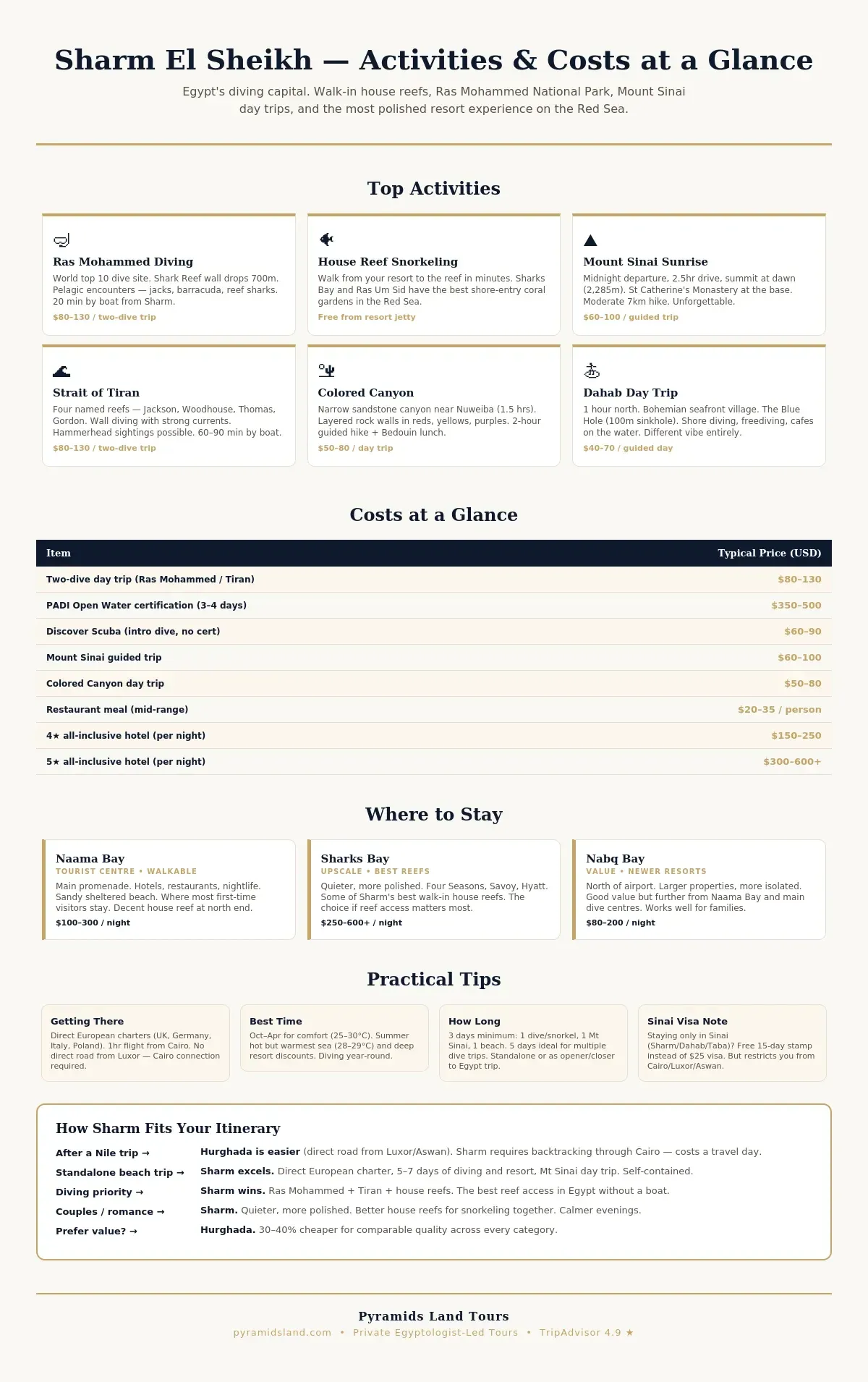
Twenty minutes south of Sharm by boat, Ras Mohammed is consistently ranked among the top 5–10 dive sites in the world. The wall at Shark Reef drops from 5 metres to over 700 metres. The current brings pelagics — jacks, barracuda, and occasionally reef sharks. The coral cover is dense and healthy. For divers, Ras Mohammed alone justifies a trip to Sharm.
The Sinai backdrop
Sharm is not just a beach. Behind the resorts, the Sinai mountains rise — granite peaks, coloured canyons, and the route to Mount Sinai and St Catherine's Monastery. No other Red Sea resort offers a day trip that takes you from sea level to a 2,285-metre summit where Moses is said to have received the Ten Commandments.
Where to Stay
Sharm is divided into several bays, each with a different character.
Naama Bay
is the main tourist centre. Hotels, restaurants, shops, and nightlife line the waterfront promenade. This is where most first-time visitors stay. The beach is sandy, the bay is sheltered, and the concentration of amenities is highest. The house reef at the northern end of Naama Bay is decent for casual snorkeling.
Sharks Bay
(no relation to actual sharks) is quieter, more upscale, and home to some of Sharm's best house reefs. Hotels here include the Four Seasons, the Savoy, and the Hyatt Regency. If reef access matters more than proximity to nightlife, this is the stronger choice.
Hadaba
sits on a cliff above the sea, offering panoramic views but requiring a shuttle or stairs to reach the water. More affordable than Sharks Bay, with a local feel.
Nabq Bay
is north of the airport — newer resorts, larger properties, and a more isolated feel. Good value but further from Naama Bay and the main dive centres.
Hotel tiers:
- For luxury: Four Seasons Sharm El Sheikh (Sharks Bay), Rixos Premium Seagate, Savoy Sharm El Sheikh.
- For mid-range: Stella Di Mare Beach Hotel, Jaz Mirabel Beach, Reef Oasis Beach Resort.
- For divers: Camel Hotel (Naama Bay, budget but legendary among divers), Sharks Bay Umbi Diving Village.
Diving and Snorkeling
Sharm is Egypt's diving capital. Over 30 recognised dive sites are within 90 minutes by boat.
Ras Mohammed National Park
Shark Reef and Yolanda Reef — the signature dive. Wall diving with drop-offs, current, and a cargo of toilets from a 1980 shipwreck scattered across the reef (the Yolanda wreck). Visibility commonly exceeds 30 metres.
Strait of Tiran
Four reefs — Jackson, Woodhouse, Thomas, and Gordon — guard the entrance to the Gulf of Aqaba. Strong currents bring pelagic fish. Hammerhead sightings are possible (though rare and documented). Best for experienced divers.
The Thistlegorm
A WWII British transport ship sunk by German bombers in 1941, carrying motorcycles, trucks, train carriages, and ammunition. Resting at 30 metres. Accessible from Sharm as a long day trip (3–4 hours each way by boat) or more comfortably from Hurghada. One of the world's top 5 wreck dives.
Local reef sites
The Gardens, Tower, Ras Um Sid, and Near Garden are all within 10–20 minutes by boat and are excellent for less experienced divers and snorkelers.
PADI certification
is available at virtually every dive centre. An Open Water course takes 3–4 days and costs $350–500, including equipment. Discover Scuba (a single introductory dive) costs $60–90.
Snorkeling from shore:
The house reefs at Sharks Bay resorts are the best shore-entry snorkeling in Sharm. Ras Um Sid beach also offers good shore snorkeling with coral gardens in shallow water.
Beyond the Beach
Mount Sinai sunrise hike
Depart Sharm at midnight, drive 2.5 hours to St Catherine, begin the hike at 2:00 a.m., reach the summit for sunrise at approximately 5:30 a.m. The climb is 7 km with a 750-metre elevation gain — moderate difficulty, mostly a wide camel path. St Catherine's Monastery at the base (one of the oldest continuously operating Christian monasteries in the world, founded in the 6th century) opens after sunrise. This is the most popular day trip from Sharm and one of the most memorable experiences in Egypt.
Ras Mohammed by land
If you do not dive, you can visit Ras Mohammed National Park by car. The mangrove channel, the Magic Lake, and the cliff viewpoints over the reef are accessible without getting in the water. Snorkeling from the beach at Ras Mohammed is also possible.
Colored Canyon
A narrow sandstone canyon about 1.5 hours north of Sharm (near Nuweiba), with layered rock walls in reds, yellows, and purples. A 2-hour guided hike through the canyon. Combined with a Bedouin lunch in the desert.
Dahab day trip
An hour north of Sharm by road. A former Bedouin fishing village with a laid-back seafront strip, the Blue Hole (a 100-metre-deep sinkhole popular with freedivers), and excellent shore diving. Dahab has a completely different atmosphere from Sharm — bohemian, backpacker-friendly, and unhurried.
Practical Information
When to visit
October–April for comfortable temperatures (25–30°C). Summer (June–August) is hot (38–42°C), with water temperatures at their warmest (28–29°C), and resorts offer deep discounts. Diving is year-round.
How long
3 days is the minimum for a meaningful Sharm visit: one day diving/snorkeling, one day Mount Sinai, one day beach. 5 days is ideal if combining multiple dive trips.
Costs
Sharm is more expensive than Hurghada. A 5-star all-inclusive runs $300–600/night. Mid-range $150–250. Budget options exist in Naama Bay ($50–80). Dining outside resorts: $20–35/person at mid-range restaurants.
Getting there
Direct European charters (UK, Germany, Poland, Italy). Domestic flights from Cairo (1 hour). No direct road from Luxor to Sharm requires a Cairo connection or a Hurghada-to-Sharm ferry (which has inconsistent service).
Sinai visa exception
Travelers staying in the Sinai Peninsula (Sharm, Dahab, Taba) and not traveling to the Egyptian mainland can receive a free 15-day entry stamp instead of the standard $25 visa. However, this restricts you from visiting Cairo, Luxor, or Aswan. If your Egypt trip includes mainland destinations, get the standard visa.
How Sharm Fits Into an Egypt Itinerary
For most travelers taking the Cairo → Luxor → Aswan route, Hurghada is the easier Red Sea add-on (with a direct road from Luxor/Aswan). Sharm requires backtracking through Cairo, which costs a travel day.
Sharm works best as:
A standalone Red Sea trip — direct flight from Europe, 5–7 days of diving and resort time, with a Mount Sinai day trip.
An opening or closing segment for a longer Egypt itinerary — fly into Sharm, spend 3 days, then fly to Cairo to begin the historical route (or reverse).
A combination with Dahab and the Sinai interior — for travelers who want desert, mountains, and sea rather than temples and tombs.
→ Compare with Hurghada → Full Sinai Peninsula Guide → How to plan your Egypt trip → Contact us
Ashraf Fares