
Valley of the Kings: Which Tombs to Visit, What to Know, and How to Plan Your Time
The Valley of the Kings contains 63 known tombs cut into the limestone cliffs of the Theban necropolis on Luxor's West Bank. For 500 years — from the 16th to the 11th century BC — every New Kingdom pharaoh was buried here in secret, hidden tombs designed to protect their bodies, their treasures, and their passage into the afterlife.
Every tomb was robbed in antiquity except one: Tutankhamun's, discovered intact by Howard Carter in 1922. The others were emptied of their gold centuries ago. What remains — and what makes the Valley worth visiting — is the art. The painted walls and ceilings inside these tombs are among the finest surviving works of ancient Egyptian civilization: scenes from the Book of the Dead, the Amduat, the Book of Gates, and other funerary texts that mapped the pharaoh's journey through the underworld to eternal life.
You are not visiting a ruin. You are walking into a 3,300-year-old illustrated guide to the afterlife.
Why the Valley? The End of the Pyramid
For nearly a thousand years, Egypt's kings were buried beneath pyramids. The Great Pyramid of Khufu at Giza, built around 2560 BC, was the most ambitious structure ever built. By 1550 BC — 1,000 years later — the New Kingdom pharaohs had abandoned the pyramid entirely and were burying themselves in hidden rock-cut tombs in this remote wadi. The reason is both practical and symbolic.
The practical reason: pyramids do not work as security. Every pyramid in Egypt was robbed in antiquity. The very scale that made them magnificent also announced exactly where the treasure was. By the New Kingdom, pharaohs understood that a hidden tomb was a more effective guardian than a visible monument.
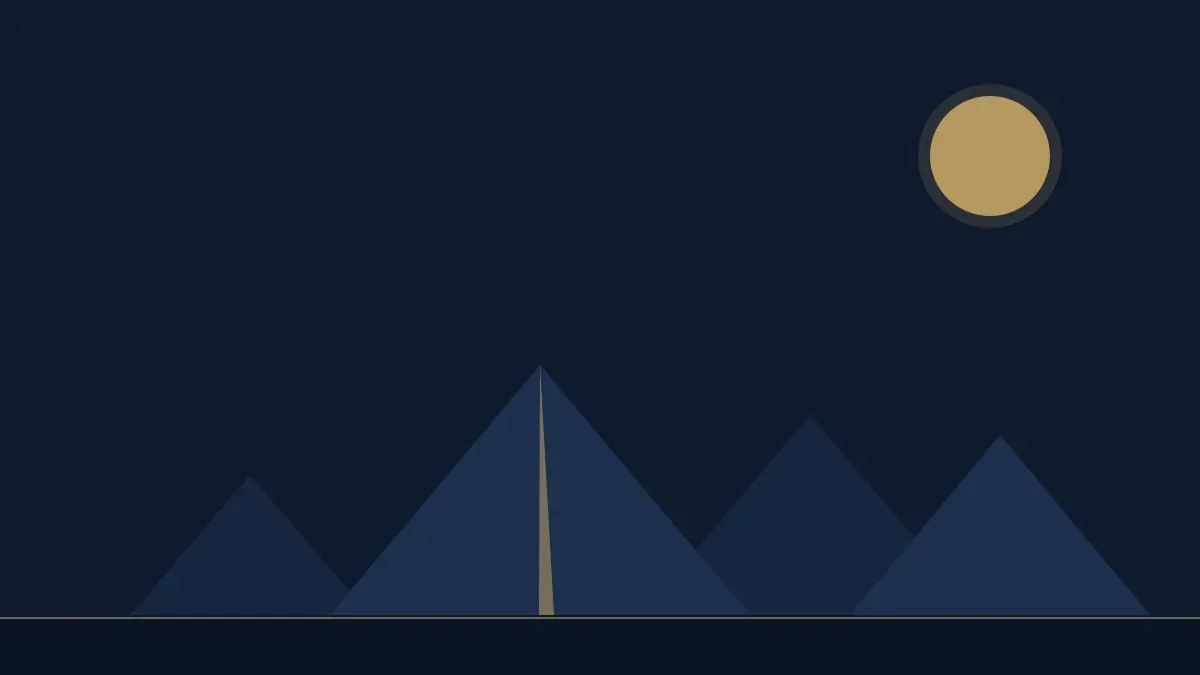
The symbolic reason is subtler. Look up at the ridge directly above the Valley of the Kings. The peak is called Al-Qurn — "the horn" — a naturally pyramid-shaped limestone summit that rises to 420 meters above sea level. The ancient Egyptians believed this peak was a manifestation of the goddess Meretseger ("She Who Loves Silence") and that its pyramid form already expressed divine power without needing to be built. The Valley sits in its shadow. The pharaohs were burying themselves beneath a natural pyramid that they did not have to construct.
The geology also mattered. The Theban limestone here is unusually solid — ideal for cutting large, complex tomb corridors without collapse. The Valley is geographically isolated, enclosed by cliffs on three sides, and distant enough from the Nile floodplain to remain dry in most years.
It did not stay secret. All but one of the 63 known tombs were emptied by robbers during the Third Intermediate Period (1070–664 BC), when Egypt's central authority collapsed and the workers who had built the tombs — and knew exactly where they were — were no longer being paid. The priests eventually gathered the surviving royal mummies into two hidden caches. The Deir el-Bahri cache, discovered in 1881, contained 40 mummies, including Ramesses II. The Valley had hidden its dead. The hidden cache hid them again.
How Tickets Work
The standard Valley of the Kings ticket allows entry to three tombs of your choice from a rotating selection (typically 8–12 tombs are open on any given day). The selection changes periodically for conservation reasons.
Premium tombs require separate tickets:
| Tomb | Ticket | Why It's Separate |
|---|---|---|
| Seti I (KV17) | Separate premium ticket (~2000 EGP) | Finest painted tomb in Egypt. Full-colour reliefs covering 300+ sq metres. Limited daily visitors. |
| Tutankhamun (KV62) | Separate ticket (~700 EGP) | The only intact royal burial ever found. Small but historically significant. |
| Ramesses V/VI (KV9) | Separate ticket (~200 EGP) | Spectacular astronomical ceiling. One of the most photographed tomb ceilings in the Valley. |
Photography: As of 2026, photography is permitted inside most tombs (no flash). Some premium tombs may restrict cameras. Check at the entrance.
Which Tombs to Choose
This is the question every visitor asks, and the answer depends on what you respond to: scale, colour, narrative, or historical significance.
If You Want the Best Painted Walls
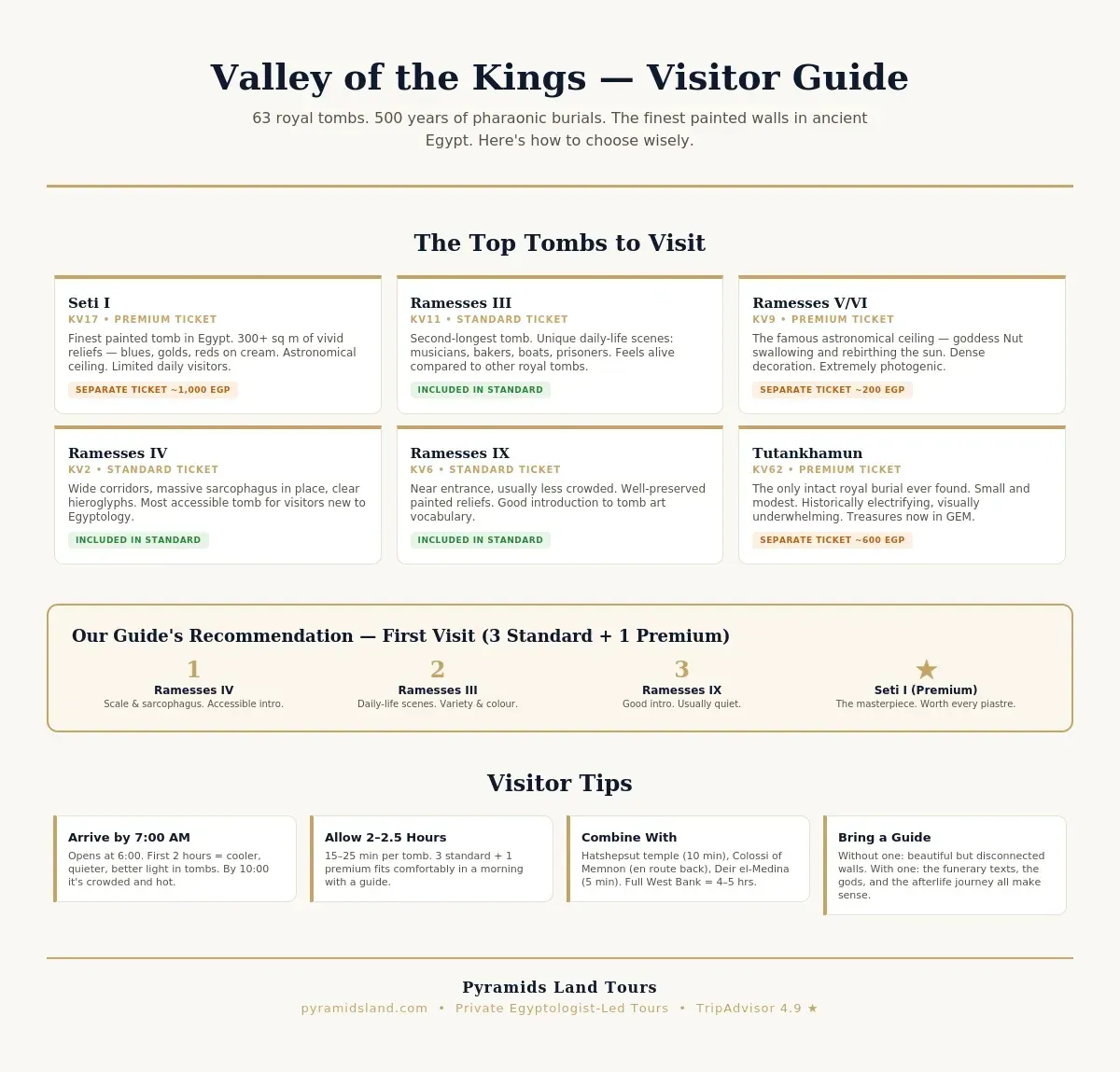
Seti I (KV17) — The undisputed finest. Every surface is covered in carved and painted reliefs depicting the pharaoh's journey through the Duat (underworld). The colors — deep blues, golds, reds, and whites on a cream background — are vivid after 3,300 years. The astronomical ceiling in the burial chamber shows constellations and deities. This is the Sistine Chapel of ancient Egypt. A separate ticket is required and worth every piastre.
Ramesses III (KV11) — The second-longest tomb in the Valley. Side chambers with painted scenes of daily life (unusual for a royal tomb): musicians, bakers, boats, and foreign prisoners. The variety of scenes makes this tomb feel alive in a way most royal tombs do not.
If You Want Scale and Drama
Ramesses IV (KV2) — Wide corridors, massive sarcophagus still in place, and walls covered with funerary texts in clear hieroglyphs. One of the most accessible and understandable tombs for visitors without a deep Egyptology background. Included in the standard ticket.
Ramesses IX (KV6) — Near the entrance, often less crowded. Well-preserved painted reliefs with the pharaoh before the gods. Good introduction to tomb art if it is your first.
KV7 — The Tomb of Ramesses II (Currently Closed for Restoration)
The largest tomb in the Valley by floor area belongs to Ramesses II — Egypt's longest-reigning pharaoh. KV7 stretches over 180 meters into the limestone hillside and covers approximately 690 square meters of floor space. It was built early in Ramesses's reign and took an estimated 10–12 years to complete. Its walls were decorated with scenes from the Book of Gates, the Book of the Dead, the Book of the Heavenly Cow, the Imydwat, and the Litany of Ra — one of the most comprehensive funerary programs in any royal tomb.
KV7 is not currently open to visitors. The tomb sits at a low point in the Valley floor, making it particularly vulnerable to the flash floods that periodically sweep through the wadi. Centuries of flood debris have filled and damaged the interior, and ongoing restoration work by archaeologists means access is suspended. When restoration is complete and the tomb reopens, it will almost certainly require a premium ticket given its scale and significance.
Ramesses II's mummy was not found in KV7. During the Third Intermediate Period, priests first moved it to the tomb of his father, Seti I, and then to the Deir el-Bahri royal cache (DB320), where it was discovered in 1881. It is now in the Royal Mummies Hall at the National Museum of Egyptian Civilization (NMEC) in Fustat, Old Cairo — not the Egyptian Museum on Tahrir Square, as many guides still state.
Even without access to KV7, Ramesses II is present throughout the Valley. His sons are buried in KV5 — the largest non-royal tomb in the necropolis, with over 120 chambers — directly opposite KV7. His father, Seti I, is in KV17, the finest painted tomb in the Valley. His successor, Merenptah, is in KV8. Understanding Ramesses II — his 66-year reign, the Battle of Kadesh, the peace treaty, Abu Simbel — changes what you see in every 19th Dynasty tomb you enter.
→ Complete guide to Ramesses II — his reign, his monuments, and where to see his work today
If You Want the Famous Ones
Tutankhamun (KV62) — The most famous tomb in the world, and the smallest royal tomb in the Valley. The burial chamber still contains the outer stone sarcophagus and the painted walls depicting Tutankhamun's funeral and his meeting with the gods. It is historically electrifying yet physically underwhelming — the tomb is tiny compared to those of Seti I or Ramesses III. The treasures are now in the GEM. Separate ticket.
→ The complete Tutankhamun guide — his tomb, his treasures, and whether the KV62 ticket is worth it
Ramesses V/VI (KV9) — The astronomical ceiling here — the sky goddess Nut stretching across the burial chamber, swallowing and rebirthing the sun — is one of the most reproduced images in Egyptology. The tomb is large, and the decoration is dense. Separate ticket but affordable.
Our Guide's Standard Recommendation (3 Tombs + 1 Premium)
For a first visit: Ramesses IV (accessible, impressive scale) + Ramesses III (variety of scenes, daily life) + Ramesses IX (good introduction, usually quiet) with the standard ticket, plus Seti I on the premium ticket. This combination gives you range, scale, color, narrative, and the finest painted tomb in Egypt.
If you can add a second premium, add Ramesses V/VI for the astronomical ceiling.
Skip Tutankhamun unless the historical significance matters to you more than the visual experience. The tomb itself is modest; the story is extraordinary.
Visit the Valley of the Kings on a Nile cruise: Every Nile cruise between Luxor and Aswan includes the Valley of the Kings with a private Egyptologist. The 4-Night Luxor to Aswan cruise includes a full West Bank morning. The 7-Night cruise gives you more time at the tombs and adds Abu Simbel. → See all Nile cruise options
What Happened to the Contents: The Robbery and the Caches
Every tomb in the Valley was robbed. Almost none of the grave goods survive in the tombs you visit — the gold, the furniture, the canopic jars, the ushabti figurines, the chariots, the bows and arrows placed with the pharaoh for the afterlife. They were removed in antiquity. What survives, and what makes the Valley extraordinary, is the art on the walls. That could not be carried away.
The robberies were not random. They were systematic and almost certainly carried out by the same workers who built the tombs. During the reigns of Ramesses IX and Ramesses XI (c. 1100 BC), Egypt's central administration was collapsing. The tomb workers at Deir el-Medina — who had been building and maintaining the royal necropolis for generations — were no longer being paid. The papyrus records of tomb robbery trials from this period survive and are remarkably specific: named workers, identified tombs, listed stolen objects, and described punishments. The Valley was robbed by people who knew exactly where to look because they had built what they were robbing.
The priests responded to the crisis. Rather than allow the royal mummies to be destroyed — the physical bodies of the pharaohs, whose preservation was essential to the theological order of Egypt — they gathered them from their violated tombs and resealed them in two secret caches.
The first cache, at Deir el-Bahri (DB320), was discovered in 1881 and contained 40 mummies, including Ramesses II, Seti I, Thutmose III, and Ahmose I — effectively most of the New Kingdom's greatest rulers, wrapped and stacked in a single hidden chamber. The second cache, in the tomb of Amenhotep II (KV35), was found in 1898.
The mummies are now mostly in the Royal Mummies Hall at the National Museum of Egyptian Civilization (NMEC) in Fustat, Old Cairo. Walking into that hall, you are looking at the faces of the same people whose empty tombs you visited that morning in the Valley.
When to Visit
Arrive before 7:00 a.m. The Valley opens at 6:00 a.m. and the first two hours are the best — cooler temperatures, fewer crowds, and the light entering the tombs creates better conditions for seeing the wall paintings.
By 10:00 a.m., the Valley is crowded and hot. Tour buses from Hurghada arrive between 9:00 and 10:00, and the temperature inside the tombs rises as more visitors breathe humid air into enclosed spaces.
Season matters. October–March is ideal (20–30°C). April–May and September are manageable with an early start. June–August is extremely hot (40°C+) — possible but punishing. Start at 6:00 a.m. and be out by 9:00.
Practical Information
Getting there. The Valley is on Luxor's West Bank, a 15-minute drive from the Nile crossing point. Most private tours use the bridge; some use a boat crossing (more atmospheric, slightly slower). A tram runs from the car park to the tomb entrances — a short ride that saves a hot walk.
How long. Allow 2–2.5 hours for three tombs plus one premium. Each tomb takes 15–25 minutes, depending on the tomb's size and your guide's level of detail.
Combine with. Hatshepsut's temple at Deir el-Bahri (10-minute drive), the Colossi of Memnon (on the route back), and optionally Deir el-Medina (the workers' village, 5 minutes away, almost never crowded). The standard West Bank morning covers the Valley + Hatshepsut + Colossi in 4–5 hours. → Ancient Egyptian Temples — how to pace temples against tombs and avoid temple fatigue
Guide value. High. Without a guide, the tombs are beautiful but disconnected — you see painted walls without understanding the narrative. A good Egyptologist explains the funerary texts, identifies the gods, and connects what you see to the religion article's framework of Ka, Ba, Akh, and the weighing of the heart. The art suddenly makes sense.
→ 1 Day in Luxor — full West Bank + East Bank itinerary → 2 Days in Luxor — adds Abydos and Deir el-Medina → Ancient Egyptian Religion — the belief system behind the tomb art
Frequently Asked Questions
How much is the Valley of the Kings ticket?
The standard entry ticket (April 2026) is 600 EGP and includes access to three tombs from the open rotation. Premium tombs require separate tickets: Seti I (KV17) at 2,000 EGP, Tutankhamun (KV62) at 700 EGP, and Ramesses V/VI (KV9) at 220 EGP.
How many tombs can you visit on one ticket?
Three tombs with the standard entry ticket, from a rotating selection of approximately 10 open tombs. Premium tombs (Seti I, Tutankhamun, Ramesses V/VI) require additional tickets on top of the standard entry.
Can you take photos inside the tombs?
Yes, photography is permitted in most tombs as of 2026. No flash. Some premium tombs have specific camera restrictions — check at the entrance. The ban on cameras that existed for some years has been lifted for most tombs.
Is the tomb of Ramesses II open?
Not currently. KV7 — the largest tomb in the Valley by floor area — is closed for restoration. The tomb sits at a low point in the valley and has been severely damaged by flash floods over centuries. When it reopens, it will likely require a premium ticket. Ramesses II's mummy is at the National Museum of Egyptian Civilization (NMEC) in Fustat, Old Cairo.
Is the Valley of the Kings worth it without Tutankhamun's tomb?
Yes — emphatically. Tutankhamun's tomb (KV62) is the most historically significant in the Valley but one of the least visually impressive. It is small. The painted walls are modest. The treasures are in the GEM. Seti I's tomb (KV17) is the finest painted tomb in Egypt. Ramesses III's tomb has extraordinary variety. Ramesses V/VI has the most spectacular ceiling in the Valley. Tutankhamun is worth visiting for historical reasons; if you have to choose, prioritise Seti I.
How early should you arrive?
6:00 AM — when it opens. The Valley is manageable in the first two hours before the heat and the tour coaches from Hurghada arrive (typically 9:00–10:00 AM). In summer (June–August), arriving after 9:00 AM at outdoor sites is not recommended.
How do you get to the Valley of the Kings?
By private car or taxi from Luxor, crossing to the West Bank via the bridge or boat. From Luxor city centre: approximately 15–20 minutes by car. A tram runs from the Valley's main car park to the tomb entrances — a short ride that saves a hot walk. Private tours include all transfers.
Where did the mummies go?
Most were gathered from their robbed tombs during the Third Intermediate Period and placed in two hidden caches: the Deir el-Bahri cache (DB320, discovered 1881) and the cache in KV35 (discovered 1898). They are now almost entirely in the Royal Mummies Hall at the NMEC, Fustat, Old Cairo.
Ashraf Fares