
Red Sea Diving Guide: Where to Dive, What to See, and What It Costs
The Red Sea is one of the top three diving destinations in the world, alongside the Great Barrier Reef and the Coral Triangle. It has been on every serious diver's list for decades, and for good reason: visibility regularly exceeds 30 meters, water temperature rarely drops below 22°C, and the reef systems support over 1,200 species of fish and 250 species of coral — 10% of which are found nowhere else.
What makes the Red Sea particularly good for divers — as opposed to just snorkelers — is the variety. Wall dives, wreck dives, drift dives, cave dives, shore dives, and pelagic encounters are all available within a single trip. You can dive a WWII cargo ship at 30 meters in the morning and snorkel a shallow coral garden in the afternoon.
This guide covers the major dive sites by region, the practical logistics of diving in Egypt, certification options, costs, and how to build a dive trip into a wider Egypt itinerary.
The Major Dive Regions
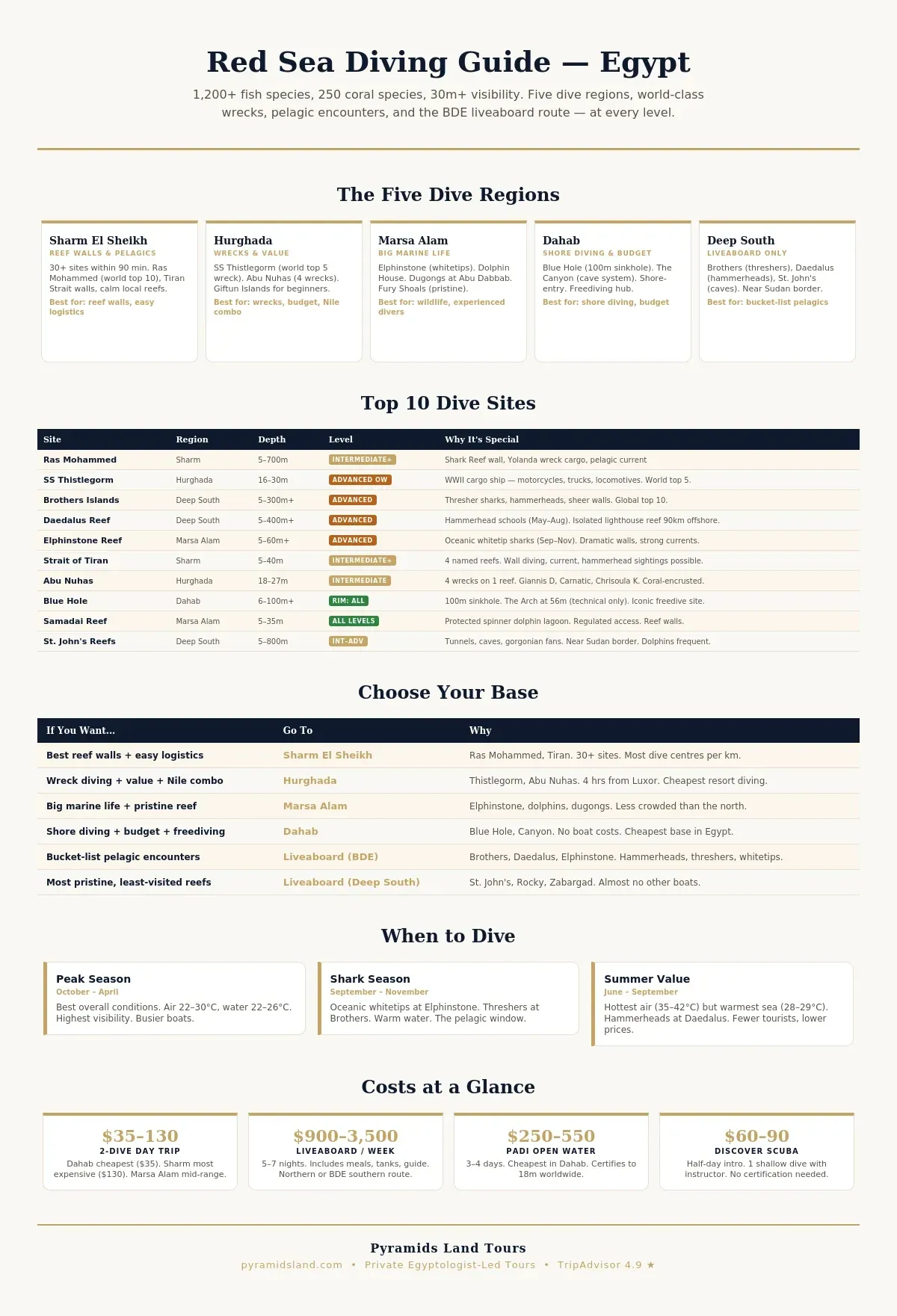
Egypt's Red Sea diving breaks down into five distinct areas, each with its own strengths.
Sharm El Sheikh & South Sinai
The most established dive hub in Egypt. Over 30 recognized sites within 90 minutes by boat.
Ras Mohammed National Park. The crown jewel. Shark Reef is a vertical wall dropping from 5m to 700m+, swept by a current that brings jacks, barracuda, tuna, and occasional grey reef sharks. Yolanda Reef, adjacent, features the cargo of a 1980 shipwreck — a surreal scattering of toilets and bathtubs among healthy coral. The two are typically dived as a single drift dive. Visibility: 25–40m. Level: intermediate to advanced (current can be strong).
Strait of Tiran. Four reefs — Jackson, Woodhouse, Thomas, Gordon — mark the entrance to the Gulf of Aqaba. Wall diving with strong currents and pelagic encounters. Hammerhead sharks are occasionally sighted at Jackson Reef. Best from the boat; the crossing takes 60–90 minutes. Level: intermediate to advanced.
Local sites. The Gardens (1, 2, 3), Tower, Ras Um Sid, and Near Garden are all within 10–20 minutes by boat. Excellent for training dives, night dives, and less experienced divers. Coral cover is healthy, fish life is dense, and conditions are usually calm.
Best for: Reef wall diving, pelagic encounters, easy logistics, wide range of experience levels.
Hurghada & El Gouna
The mainland hub. More wreck diving than Sharm, with a wider range of budget options.
SS Thistlegorm. A 126-meter British transport ship was sunk by German bombers in October 1941 in the Strait of Gubal. Resting at 30m with the deck at 16m. Cargo includes BSA motorcycles, Bedford trucks, Bren carriers, ammunition, and two railway locomotives. Penetration diving into the holds is possible for experienced divers. Consistently ranked among the top 5 wreck dives in the world. The site is accessible from both Sharm and Hurghada, but Hurghada boats reach it in 3–4 hours, compared with 4–5 hours from Sharm. Level: advanced open water minimum.
Abu Nuhas. A reef in the Strait of Gubal with four shipwrecks on a single site — the Giannis D (Greek freighter), the Carnatic (19th-century mail ship), the Chrisoula K (Italian freighter), and the Kimon M. The wrecks range from 18m to 27m in depth. Coral growth on the older wrecks is spectacular. Level: intermediate.
Giftun Islands. Shallow reef diving and snorkeling. The drift dive at Small Giftun is excellent for beginners — gentle current, dense coral, and frequent turtle sightings. Level: all levels.
Umm Gamar. An offshore reef with a shallow plateau and a wall dropping to 40m+. Dolphins, barracuda, and eagle rays are common. Level: intermediate.
Best for: Wreck diving, budget-friendly dive operations, and combining with a Nile trip (Hurghada is 4 hours from Luxor by road).
Marsa Alam & The Southern Coast
Less developed, less crowded, and closer to pristine reef systems.
Elphinstone Reef. A 300-meter offshore reef with dramatic walls and strong currents. The main draw: oceanic whitetip sharks, reliably sighted between September and November. Also: hammerheads (rare), grey reef sharks, and dense soft coral walls. The north and south plateaus are the best entry points. Level: advanced (current, open water, depth).
Samadai Reef (Dolphin House). Spinner dolphins rest in the protected lagoon. Divers explore the outer reef walls (15–35m) with excellent coral and occasional turtle encounters. Regulated access — boats are limited. Level: all levels (outer reef intermediate).
Abu Dabbab. Shore-entry dive with seagrass beds. Dugongs and green turtles. Low visibility compared to offshore sites (10–15m), but the wildlife encounters compensate. Level: all levels.
Fury Shoals. A chain of reefs 2–3 hours south by boat or accessed via liveaboard. Shaab Claudio, Shaab Sataya (another dolphin reef), and Malahi (the "playground") offer swim-throughs, coral arches, and minimal boat traffic. Level: intermediate.
Best for: Big marine life encounters (dolphins, dugongs, oceanic whitetips), pristine reef, experienced divers seeking less-visited sites.
Dahab
A compact shore-diving destination on the east coast of the Sinai Peninsula, 1 hour north of Sharm El Sheikh.
The Blue Hole. A 100-metre-deep sinkhole in the reef flat, 15 minutes north of Dahab. Famous among freedivers and infamous for its depth-related fatalities. For recreational scuba divers, the experience is the rim of the hole (6–30m) and the short tunnel ("The Arch") connecting the Blue Hole to the open sea at 56m — far beyond recreational limits. Most divers explore the surrounding reef and peer into the abyss. Level: the rim is all levels; the Arch is technical only.
The Canyon. A narrow fissure in the reef leading to a swim-through cave system at 18–30m. Atmospheric, with shafts of light penetrating from above. One of the most photogenic dives in Egypt. Level: intermediate (buoyancy control required for the narrow sections).
The Islands and Eel Garden. Shallow shore-entry dives perfect for beginners. Garden eels, moray eels, and healthy coral in 5–15m. Level: all levels.
Best for: Shore diving (no boat needed), freediving, long-stay divers on a budget, relaxed atmosphere.
The Deep South: Brothers, Daedalus & St. John's (Liveaboard Only)
The most spectacular diving in Egypt is inaccessible by day boat. The offshore reefs south of Marsa Alam — reached only by liveaboard on 5–7 night itineraries — are where the Red Sea earns its place alongside the Coral Triangle and the Maldives.
Brothers Islands (El Akhawein). Two small islands 60 km offshore. Sheer walls dropping hundreds of meters, swept by open-ocean current. Thresher sharks are regularly sighted at the smaller island's north plateau — one of the most reliable thresher encounters anywhere in the world. Hammerheads patrol the deeper walls. Grey reef sharks, barracuda walls, and dense soft coral complete the picture. The Brothers are consistently ranked among the top 10 dive sites globally. Level: advanced (current, depth, open ocean).
Daedalus Reef. An isolated oval reef 90 km offshore, marked by a lighthouse. The walls drop vertically to 400m+. Hammerhead sharks school here between May and August — sometimes in groups of 20 or more. Oceanic whitetips, threshers, and silky sharks are also sighted. The reef top (15–20m) has stunning soft coral and Napoleon wrasse. Level: advanced.
St. John's Reefs. A vast reef complex near the Sudan border. Tunnels, caves, swim-throughs, and coral towers in relatively sheltered conditions compared to Brothers and Daedalus. Habili Ali drops to 800m with beautiful gorgonian fans. Dolphins are frequent. The caves at Umm Arouk are atmospheric and photogenic. Level: intermediate to advanced (depending on site).
Rocky and Zabargad Islands. Near the Sudan border. Rocky is a tiny island with dramatic walls and unpredictable currents — hammerheads, mantas, dolphins, and reef sharks are all possible. Zabargad is a volcanic island with a turquoise lagoon, gentle slopes, and the wreck of a small cargo ship at 24m. Level: advanced for Rocky, intermediate for Zabargad.
Best for: The BDE route (Brothers, Daedalus, Elphinstone) is the bucket-list Red Sea liveaboard. The deep south (St. John's, Rocky, Zabargad) is for experienced divers who want the most pristine, least-visited reefs in Egypt.
Marine Life: What You'll See and When
The Red Sea's appeal is not just coral — it's the encounters. Here is what to expect by species and season:
| Species | Where | Best Season | Level |
|---|---|---|---|
| Oceanic whitetip sharks | Elphinstone, Brothers | September–November | Advanced |
| Hammerhead sharks | Brothers, Daedalus, Tiran | May–August | Advanced |
| Thresher sharks | Brothers (small island) | Year-round (best Jun–Sep) | Advanced |
| Whale sharks | Northern sectors, Daedalus | May–June | Intermediate+ |
| Manta rays | Southern sites, Daedalus | June–August | Intermediate+ |
| Spinner dolphins | Samadai, Satayah, Fury Shoals | Year-round | All levels |
| Dugongs | Abu Dabbab (Marsa Alam) | Year-round (best Mar–May) | All levels |
| Green & hawksbill turtles | All regions | Year-round | All levels |
| Napoleon wrasse | Most reef sites | Year-round | All levels |
| Grey reef sharks | Ras Mohammed, Brothers | Year-round | Intermediate+ |
| Guitar sharks | Sandy sites, southern coast | Year-round (rare) | Intermediate+ |
The general pattern: the further south you go, the larger the marine life. Northern sites (Sharm, Hurghada) excel at reef diversity and wrecks. Southern sites (Marsa Alam, Brothers, Daedalus) deliver the pelagic encounters.
Choose Your Base
| If You Want... | Go To | Why |
|---|---|---|
| Best reef walls + easy logistics | Sharm El Sheikh | Ras Mohammed, Tiran, 30+ sites within 90 min. Most dive centres per km. |
| Wreck diving + value + Nile combo | Hurghada | Thistlegorm, Abu Nuhas. 4 hrs from Luxor. Cheapest resort diving. |
| Big marine life + pristine reef | Marsa Alam | Elphinstone, dolphins, dugongs, Fury Shoals. Less crowded. |
| Shore diving + budget + freediving | Dahab | Blue Hole, Canyon. No boat costs. Cheapest base in Egypt. |
| Bucket-list pelagic encounters | Liveaboard (BDE route) | Brothers, Daedalus, Elphinstone. Hammerheads, threshers, whitetips. |
| Most pristine, least-visited reefs | Liveaboard (deep south) | St. John's, Rocky, Zabargad. Near Sudan border. Almost no other boats. |
Liveaboard vs Day-Boat
Day-boat diving operates from Sharm, Hurghada, Marsa Alam, and Dahab. You leave the marina at 7–8 a.m., do two dives, and return by 2–3 p.m. Advantages: you sleep in a hotel, you can mix dive and non-dive days, and the cost is lower per dive. Disadvantage: You are limited to sites within 2–3 hours of port.
Liveaboard diving puts you on a purpose-built boat for 5–7 nights. You sleep, eat, and dive from the boat. Advantages: access to remote sites (Fury Shoals, Brothers Islands, Daedalus Reef, Rocky and Zabargad) that day-boats cannot reach. Three to four dives per day, including night dives. Disadvantage: you are on a boat for a week — seasickness, no shore breaks, and higher cost.
Liveaboard routes worth noting:
The Northern Route (from Hurghada): Thistlegorm, Abu Nuhas wrecks, Ras Mohammed, Tiran. 5–7 nights. Best for wreck enthusiasts.
The Southern Route (from Marsa Alam or Port Ghalib): Elphinstone, Fury Shoals, Brothers Islands, Daedalus Reef. 5–7 nights. Best for big marine life and pristine reefs.
Liveaboard costs: $900–1,800/week for mid-range boats. $1,800–3,500 for premium/luxury boats. Includes accommodation, meals, tanks, weights, guide. Equipment rental extra ($100–200/week).
Certification
The Red Sea is one of the most popular places in the world to learn to dive. Warm water, excellent visibility, and a high concentration of PADI/SSI dive centers make certification straightforward.
PADI Open Water Diver. 3–4 days. Pool sessions, theory, and 4 open water dives. Cost: $350–500 in Sharm/Hurghada, $250–400 in Dahab (lower overhead). Certifies you to dive to 18m worldwide.
Advanced Open Water. 2 days, 5 dives including deep dive and navigation. Cost: $250–400. Certifies to 30m. Recommended before a liveaboard trip.
Discover Scuba Diving. Half-day introductory experience, no certification. 1 shallow dive with an instructor. Cost: $60–90. Good for testing whether you want to commit to a full course.
Nitrox (Enriched Air) certification. Half-day theory course, no extra dives. Cost: $100–150. Extends bottom time on repetitive dives — highly recommended for anyone doing 3+ dives per day on a liveaboard.
Safety
The Red Sea is a safe diving destination when treated with respect. It is not without risk.
Depth and current. Many of the best sites feature walls dropping to 40 m+, strong drift currents, and open-ocean exposure. Elphinstone, Brothers, Tiran, and Ras Mohammed all require solid buoyancy control and current-awareness skills. Do not dive these sites with a newly minted Open Water certification — get your Advanced Open Water first.
The Blue Hole. Over 200 divers have died at the Blue Hole in Dahab, almost all attempting the Arch at 56m — far beyond recreational limits. The rim of the Blue Hole (6–30m) is safe and beautiful. The Arch is a technical dive requiring specific training, equipment, and gas mixes. Do not attempt it on recreational gear regardless of what anyone tells you on the beach.
Hyperbaric chambers. Sharm El Sheikh has the Hyperbaric Medical Center (one of the best in the Middle East). Hurghada is home to the Naval Hyperbaric and Research Center. Marsa Alam and Dahab do not have local chambers — emergency transfer to Sharm or Hurghada is required. If diving in the south, carry DAN (Divers Alert Network) insurance. Annual membership costs approximately $35–75 and covers emergency evacuation and chamber treatment worldwide.
Choosing an operator. Dive with PADI or SSI-affiliated centers only. Check that the equipment appears to be maintained — inspect the regulators, BCDs, and tanks before you accept them. Ask when the tanks were last visually inspected. Cheap operators sometimes cut corners on gear maintenance. The price difference between a $45 and a $65 two-dive trip is often the difference between maintained and neglected equipment.
Dive insurance. Strongly recommended for any Red Sea trip, especially liveaboards and southern sites. DAN insurance is the industry standard. Many liveaboard operators require proof of dive insurance before boarding.
Reef Conservation
The Red Sea's northern reefs — particularly around Sharm and Hurghada — have been damaged by decades of anchor drops, fin kicks, diver contact, and boat traffic. The southern reefs are healthier precisely because they are harder to reach and attract fewer visitors.
You can help preserve what remains:
Do not touch the reef. No grabbing coral for stability, no standing on the reef, no collecting shells or coral fragments. A single fin kick can destroy coral that took decades to grow.
Use reef-safe sunscreen. Chemical sunscreens containing oxybenzone and octinoxate are toxic to coral. Use mineral-based (zinc oxide) sunscreen, or better yet, wear a rash guard and apply sunscreen only to your face.
Maintain buoyancy. Poor buoyancy control is the single biggest source of reef damage from recreational divers. If you are kicking up sand or bumping the reef, you are too close. Practice in open water before diving on delicate reef sites.
Support regulated sites. Samadai Reef's boat-limit system protects its dolphin population. Ras Mohammed's mooring buoys prevent damage to anchors. These regulations exist because unrestricted access destroyed other sites. Respect them.
When to Dive
The Red Sea is diveable year-round. Conditions vary by season:
October–April. Best overall conditions. Air 22–30°C, water 22–26°C. Visibility at its highest. Best months for Ras Mohammed and Tiran (calmer seas). High season for tourism — dive boats are busier.
June–September. Hot (35–42°C air) but water is warmest (27–29°C), and soft coral is at peak color. Fewer tourists, lower prices. Manta rays are more common in summer at southern sites. Afternoon winds can create surface chop.
September–November. The oceanic whitetip shark season at Elphinstone and the Brothers Islands. Water is still warm. This is the window for big pelagic encounters.
Costs Summary
| Item | Budget | Mid-Range | Premium |
|---|---|---|---|
| Two-dive day trip (Sharm/Hurghada) | $50–70 | $70–100 | $100–130 |
| Two-dive day trip (Marsa Alam) | $45–65 | $65–85 | $85–110 |
| Two-dive day trip (Dahab, shore) | $35–50 | $50–70 | $70–90 |
| Liveaboard (per week) | $900–1,200 | $1,200–1,800 | $1,800–3,500 |
| Equipment rental (full set/day) | $15–25 | $25–35 | Included |
| Dive computer rental (per day) | $8–12 | $10–15 | Included |
| Open Water course | $250–350 | $350–450 | $450–550 |
| Advanced Open Water course | $200–300 | $300–400 | $400–500 |
| Nitrox supplement (per day) | $8–12 | Included | Included |
| Ras Mohammed park entry fee | ~$10 | ~$10 | Included |
| Samadai Reef access fee | ~$5 | ~$5 | Included |
| DAN dive insurance (annual) | $35–75 | $35–75 | $35–75 |
| Liveaboard crew tip (per week) | $50–80 | $80–120 | $120–200 |
Dahab is consistently the cheapest base for diving in Egypt. Sharm is the most expensive for day-boat diving. Liveaboards from Hurghada and Marsa Alam offer the best value for multi-day trips.
How to Build a Dive Trip Into an Egypt Itinerary
Option 1: Dive extension after a Nile trip. Complete your Cairo → Luxor → Aswan route, then drive from Aswan or Luxor to Hurghada (or Marsa Alam for southern sites). Add 3–5 days of day-boat diving. Fly home from Hurghada airport.
Option 2: Standalone dive trip. Fly direct to Sharm or Hurghada from Europe. 5–7 days of diving (day-boat or liveaboard). No pyramids, no temples, just the reef.
Option 3: Combined liveaboard + Cairo. Fly to Cairo, spend 2–3 days seeing the Pyramids, GEM, and Old Cairo. Fly to Hurghada, board a 7-night liveaboard. Return to Hurghada, fly home. Total: 10–11 days.
Option 4: Dahab deep dive. Fly to Sharm, transfer to Dahab (1 hour). 5–7 days of shore diving, freediving, and the Blue Hole. Add a Mount Sinai sunrise hike. Fly home from Sharm. This is the budget-conscious diver's Egypt trip.
→ Hurghada Travel Guide → Sharm El Sheikh Travel Guide → Marsa Alam Guide → Contact us to plan a dive trip
Frequently Asked Questions
Is the Red Sea good for beginner divers?
Yes — some of the best learning conditions in the world. Warm water (never below 22°C), excellent visibility (20–30m even on average days), and hundreds of PADI/SSI centres with English-speaking instructors. Sharm, Hurghada, and Dahab all have shallow, current-free sites specifically suited to training dives. You can go from zero experience to certified Open Water Diver in 3–4 days.
Do I need a liveaboard?
For the northern sites (Ras Mohammed, Thistlegorm, Abu Nuhas, Tiran, Giftun) — no. Day-boats from Sharm, Hurghada, and Dahab access all of these. For the deep south (Brothers Islands, Daedalus Reef, St. John's, Rocky, Zabargad) — yes. These sites are 60–120 km offshore and only reachable by liveaboard. Elphinstone and Fury Shoals can be reached by day-boat from Marsa Alam, but a liveaboard gives you more dives and better timing.
How much does a dive trip to Egypt cost?
A budget shore-diving week in Dahab (accommodation + 10 dives) can cost as little as $400–600. A mid-range week in Sharm or Hurghada with day-boat diving runs $800–1,200. A liveaboard week costs $900–3,500 depending on the boat and route. Egypt is one of the cheapest quality dive destinations in the world.
Is Red Sea diving safe?
Yes, when you dive within your certification limits and choose reputable operators. The main risks are depth-related (narcosis, decompression) at sites with deep walls, and current at exposed sites like Elphinstone and Brothers. Sharm has an excellent hyperbaric chamber. Carry DAN insurance, especially for liveaboard and southern trips.
What is the best month for shark encounters?
Oceanic whitetips at Elphinstone and Brothers: September–November. Hammerheads at Brothers and Daedalus: May–August. Whale sharks in northern sectors: May–June. Thresher sharks at Brothers: year-round but best June–September. Grey reef sharks at Ras Mohammed: year-round.
Can non-divers enjoy a Red Sea trip?
Absolutely. Snorkeling is excellent at Giftun Islands (Hurghada), Ras Um Sid (Sharm), Abu Dabbab and Sharm El Luli (Marsa Alam), and Hamata Islands. Glass-bottom boats and the Sinbad Submarine in Hurghada offer reef views without getting wet. Mount Sinai sunrise hikes and desert safaris provide non-water activities from Sharm and Marsa Alam.
Ashraf Fares