
Dahabiya vs Nile Cruise: The Honest Comparison From an Operator Who Books Both
We book dahabiya cruises. We also book standard Nile cruise ships. We have no financial reason to steer you toward either one — our job is to match you with the experience that will make you say, years from now, that the Nile was the best part of the trip.
That is why this guide exists. Not to sell you one option. To help you choose the right one — based on who you actually are, not who a marketing page wishes you were.
We are Pyramids Land Tours — Cairo-based, 20+ years of operation. We have put thousands of travelers on the Nile, on every type of vessel, in every season. We know what each experience actually delivers once the brochure language fades and you are standing on the deck.
The Core Difference in One Paragraph
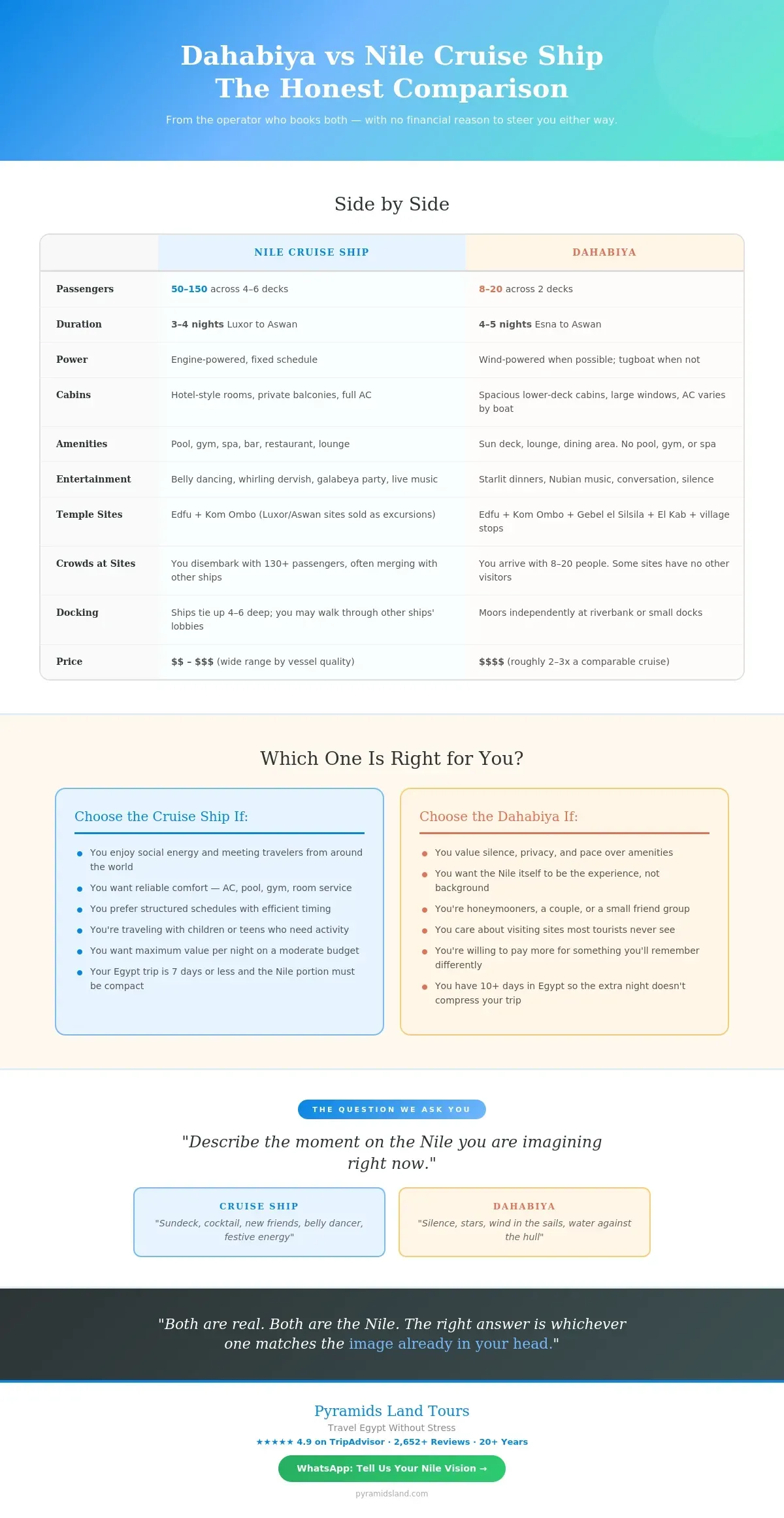
A standard Nile cruise ship is a floating hotel — accommodating 50 to 150 passengers, with multiple decks, a pool, a restaurant, a bar, nightly entertainment, air-conditioned cabins, and a fixed schedule that travels efficiently between Luxor and Aswan in 3 to 4 nights.
A dahabiya is a traditional wooden sailing boat — 8 to 20 passengers, two decks, no pool, no gym, wind-powered when possible, and a slower pace that takes 4 to 5 nights between the same cities, with stops at places the large ships physically cannot reach.
One is a resort on water. The other is a journey on water. Both are extraordinary. They are not the same experience.
What the Cruise Ship Actually Feels Like
What happened on your trip: You boarded in Luxor. Your cabin had a private balcony overlooking the river, air conditioning that worked perfectly, and a bed that rivaled the one at your hotel. The ship had 72 cabins and roughly 130 passengers — international, friendly, and social. Dinner was a buffet with Egyptian and international options. The food was consistent and good, if not exceptional.
After dinner on the first night, a belly dancer performed in the lounge. The second night was a whirling dervish show. The third night was a galabeya party where passengers wore traditional Egyptian robes and danced. The energy was festive and communal.
At Edfu Temple the next morning, you disembarked with 130 other passengers and walked to the site together. A second ship had docked alongside yours — to reach the shore, you walked through their lobby. At the temple, your group merged with groups from four other ships. Hundreds of tourists moved through the same corridors at the same time.
Your Egyptologist guide positioned you well, found quieter corners, and told the story effectively — but the crowd was a constant presence. The temples arrived as impressive. The Nile itself arrived as scenery between stops, viewed from the sun deck with a drink in hand.
The honest downside: At major docking points, cruise ships often tie up side by side — sometimes four to six vessels deep. To reach shore, you may walk through the lobby of two or three other ships. This is normal and not a sign of a bad operator. It is simply how the Nile's docking infrastructure works for vessels of this size. The experience of the Nile itself — the sailing, the silence, the landscape — is secondary to the sites and the social life aboard.
What the Dahabiya Actually Feels Like
What happened on your trip: You boarded in Esna — a small town south of Luxor where the large cruise ships cannot dock. Your boat had six cabins and eleven passengers. The crew outnumbered the guests. Your cabin was on the lower deck, half below the waterline, which kept it naturally cool. The windows were large, and the river was close enough to touch.
The sails went up after lunch. The engine was off. For three hours, the only sounds were wind, water, and a conversation you were having with a couple from New Zealand in the deck hammock. When the wind died, a small tugboat appeared ahead and towed the dahabiya silently — the engine noise stayed 50 meters away. You barely noticed it.
The boat stopped at Gebel el Silsila — ancient sandstone quarries cut directly into the riverbank, accessible only by small vessels. No other tourists. No ticket booth. Your guide walked you through corridors carved by workers 3,000 years ago. You were alone with the stone and the river.
Dinner was served on the upper deck under the stars. The chef had prepared four courses with ingredients bought that morning from a village market. A Nubian musician played softly. By 9 PM, most passengers were reading or talking quietly. By 10, the boat was silent.
The honest downside: There is no pool. There is no gym. There is no spa. Entertainment is conversation, reading, and the river. Some dahabiyas turn the generator off at night — which means no air conditioning while you sleep. On the boat we used, the lower-deck cabins stayed cool naturally because of the waterline, but in peak summer, this could be uncomfortable. The sails are not decorative — but they are also not always sufficient. When the wind fails, the tugboat appears. This is not a flaw. It is how dahabiyas have operated for centuries. But if you imagined yourself under billowing sails for three days straight, adjust that expectation now.
The food on a good dahabiya is excellent — fresh, personal, and prepared specifically for your small group. On a mediocre dahabiya, it can be basic and repetitive. This is where your operator's knowledge of specific boats matters enormously. We only book dahabiyas that we have personally vetted for the kitchen and crew.
The Sites: What Each One Visits
This matters more than most travelers realize. The two options do not visit the same places.
Standard cruise ships stop at: Luxor sites (Karnak, Luxor Temple, Valley of the Kings — usually as optional excursions before or after the cruise), Edfu Temple, Kom Ombo Temple, and Aswan sites (Philae Temple, High Dam — again as optional excursions). The sailing between stops is relatively fast. Much of the time, the ship is docked and serving as a floating hotel.
Dahabiyas stop at: Esna (boarding point), Gebel el Silsila (ancient quarries — cruise ships cannot reach this), El Kab (Pharaonic and Greco-Roman tombs in a cliff face — cruise ships cannot stop here), Edfu Temple, Kom Ombo Temple, and smaller villages along the riverbank. Some dahabiyas also include a stop at a Nubian village. Luxor and Aswan sites are visited before or after the cruise, not during it — the dahabiya covers only the stretch between the two cities.
The dahabiya visits two to three sites that are completely inaccessible to cruise ships. If those hidden sites appeal to you — and if the idea of standing in an ancient quarry with no other tourists is worth the trade-off of a slightly longer journey — that is a strong signal toward the dahabiya.
Choose Based on Who You Are
Stop trying to decide which is "better." They are different experiences for different people. Here is the honest match:
The Cruise Ship Is Right for You If:
You enjoy social energy — meeting travelers from around the world, sharing meals with new people, dancing at themed nights. You want reliable comfort — air conditioning all night, a pool for midday heat, a gym, and room service. You prefer a structured schedule with efficient timing — you have 7 or 10 days in Egypt, and the Nile portion needs to be compact. You are traveling with children or teenagers who need activity and stimulation. You are on a moderate budget and want maximum value per night.
The Dahabiya Is Right for You If:
You value silence, privacy, and pace over amenities and entertainment. You want the Nile itself to be the experience — not background scenery between temple stops. You are a couple seeking romance, a solo traveler seeking solitude, or a small group of friends seeking an intimate shared experience. You are a honeymooner who chose Egypt for its drama, not its nightlife. You care about visiting sites that most tourists never see. You are willing to pay more for something you will remember differently than everything else on the trip. You have at least 10 days in Egypt, so the extra night on the river does not shorten your time in Cairo.
Either Works Well If:
You are a first-time visitor who simply wants to be on the Nile and will be happy with either style. You are an active senior — cruise ships have elevators and more accessible layouts; dahabiyas have fewer stairs but less infrastructure.
The Numbers
Standard Nile cruise: 3 nights / 4 days between Luxor and Aswan. Prices range from budget (3-star vessel) to luxury (5-star vessel with suite). Meals are typically included. Shore excursions may or may not be included depending on the package. A good 5-star cruise costs significantly less than a comparable dahabiya.
Dahabiya: 4 to 5 nights between Esna (near Luxor) and Aswan. Prices are higher — expect to pay roughly two to three times the cost of a standard cruise, per person, for a quality vessel. Meals are always included. The crew-to-guest ratio is dramatically higher. The experience is more exclusive by design.
We provide exact pricing when we know your dates, group size, and which vessel is available. The quality difference between dahabiyas is much wider than between cruise ships — a mediocre dahabiya at a premium price is the worst possible outcome. This is where working with an operator who knows specific boats by name protects you.
The Question We Actually Ask You
When a traveler asks us, "Dahabiya or cruise ship?" we do not answer immediately. We ask this instead:
"Describe the moment on the Nile you are imagining right now."
If you describe a sundeck with a cocktail, new friends, and a belly dancer — that is the cruise ship. If you describe silence, stars, wind in the sails, and the sound of water against the hull — that is the dahabiya.
Both are real. Both are the Nile. The right answer is whichever one matches the image already in your head.
Tell Us What You Are Imagining
Send us your dates, your group size, and your answer to that one question. We will recommend a specific vessel by name — not a category, a boat — with photos, reviews, and a price.
WhatsApp: +20 122 362 4703 — Tell Us Your Nile Vision →
Or if you are in the US: +1 (928) 923-2598
About Pyramids Land Tours
Cairo-based. Egyptian-owned. 20+ years booking every type of vessel on the Nile — from budget cruise ships to the most exclusive dahabiyas on the river. We have no allegiance to either. We are committed to matching the right boat to the right traveler.
★★★★★ 4.9 on TripAdvisor · 2,700+ Reviews · pyramidsland.com
Ashraf Fares