
The Sistrum: Ancient Egypt's Sacred Rattle of Hathor
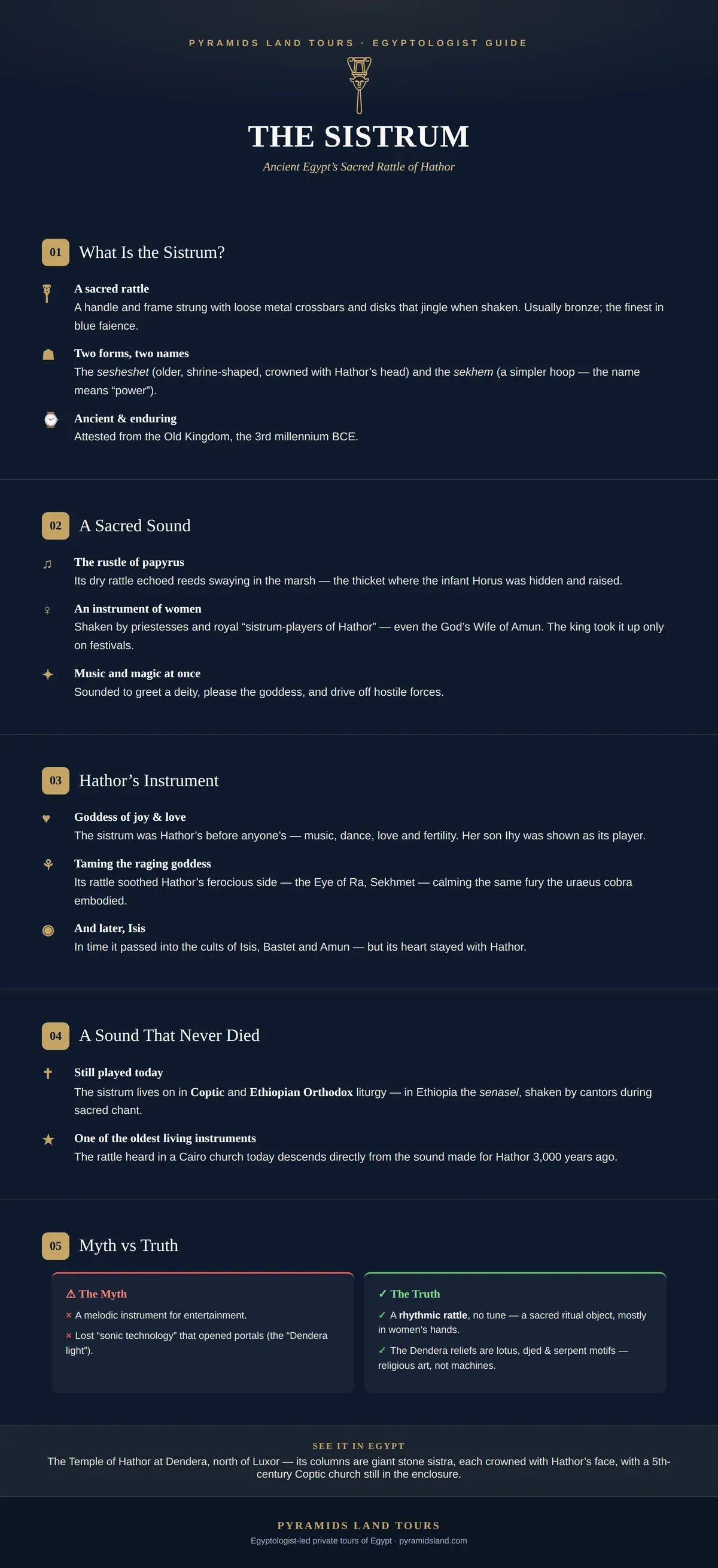
The short answer: The sistrum was a sacred rattle of ancient Egypt — a handle topped by a frame strung with loose metal crossbars that jingled when shaken. Priestesses shook it in temple ritual to please the gods, above all the goddess Hathor, and its whispering sound was thought to echo the rustle of papyrus reeds. Remarkably, it is still played in Egypt's churches today.
Of all the objects an Egyptian priestess might hold, the sistrum is the one you could hear. Shake it and loose metal disks slide and clash on their rods with a bright, dry rattle — a sound the Egyptians compared to wind moving through a bed of papyrus. It was never background music. It was a sacred instrument for touching the divine, and its voice has not fallen silent in five thousand years.
At a glance
Key Facts
- What it is: a sacred handheld rattle (pronounced SIS-trum )
- Two types: the shrine-shaped sesheshet and the hoop-shaped sekhem
- The goddess: Hathor — music, joy, love and fertility
- Its twin: the menat , a beaded necklace rattled in the priestess’s other hand
- Who played it: overwhelmingly women; the king only at festivals
- Its sound: a dry rattle, said to echo wind through the papyrus marsh
- Still played today: in Coptic and Ethiopian Orthodox liturgy — one of the oldest instruments still in use
- Best place to see it: the sistrum-shaped columns at the Temple of Hathor, Dendera
What is a sistrum?
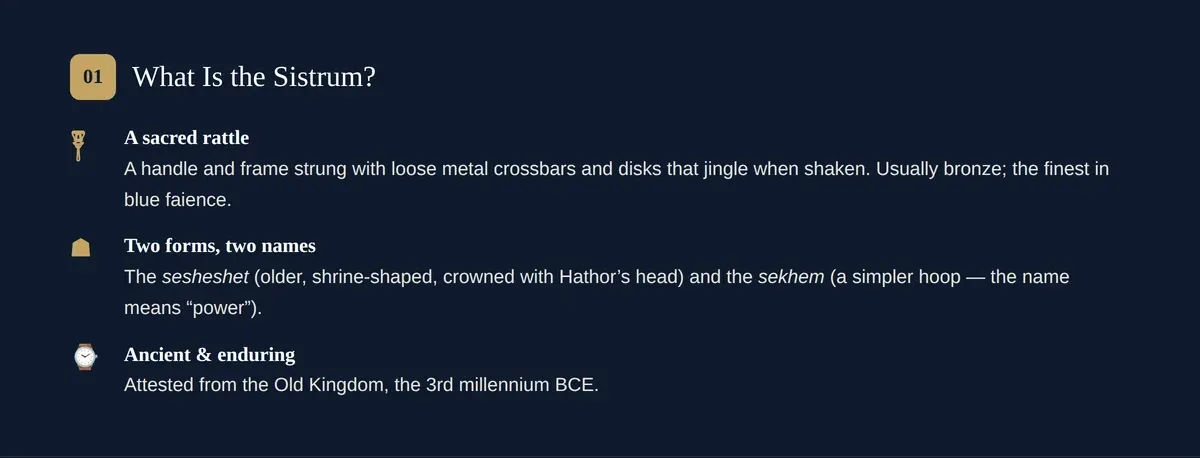
A sistrum (pronounced SIS-trum) is a handheld rattle: a handle carrying a frame, through which run loose metal rods threaded with small disks or rings. Shake it, and the disks slide along the rods and clash against one another — in the finest pharaonic examples, the rod-ends are shaped as tiny rearing cobras. Most were made of bronze, which gives that thin, dry, carrying sound; the finest were glazed blue faience.
The Egyptians had two forms and two names. The older, the sesheshet (sšš.t), is naos-shaped — its frame is a little shrine (a naos), and its handle is usually crowned with the head of the goddess Hathor, cow-eared, so that holding it was like holding a tiny temple in your hand. Its name is onomatopoeic: say sesheshet aloud, and you hear the rattle. The second form, the sekhem (sḫm), is a simpler hoop or arch — its name means "power" — and it became especially common in the Greco-Roman period. Both point back to Hathor: the loop of the frame was seen as her cow horns, and the whole silhouette was likened to the ankh, the sign of life. The sistrum is old, attested from the Old Kingdom, in the third millennium BCE — and among the most distinctive of all ancient Egyptian symbols, the one you could hear.
The menat: the sistrum's twin
The sistrum rarely traveled alone. In the priestess's other hand, you will usually find the menat — a heavy, many-stranded bead necklace with a counterweight at the back, itself sacred to Hathor. Held by that counterweight and swung, the strands of beads rattle like a second instrument. Priestesses pressed it against worshippers to pass on the goddess's blessing of health, joy, and rebirth.
Sistrum in one hand, menat in the other: that is the complete instrument of Hathor's cult. Her son Ihy holds exactly that pair on the temple wall at Dendera, and once you know it, you will see it again and again.
At a glance
The three instruments of Hathor
| Instrument | Form | How it sounds | What it says | |
|---|---|---|---|---|
| Sesheshet sšš.t | Shrine-shaped frame, Hathor's head on the handle | Disks clash on rods — the older, naos sistrum | The temple in your hand; the rustle of the marsh | |
| Sekhem sḫm | A plain hoop or arch, ankh-like in silhouette | The same rattle, in a simpler frame | “Power”; the common form in Greco-Roman times | |
| Menat | Bead necklace with a back counterweight | Strands of beads swung and rattled | Hathor's blessing, pressed into a worshipper's hand | |
What was the sistrum used for?
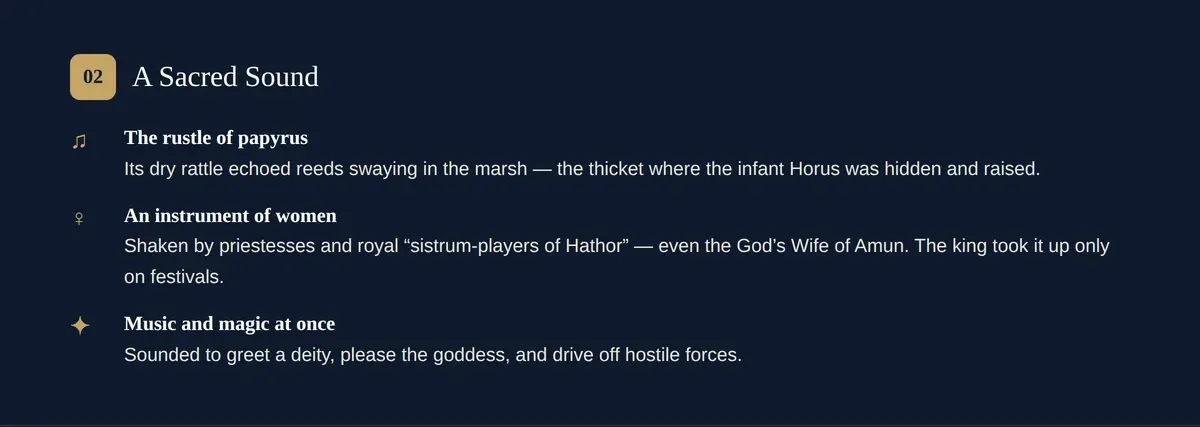
It was shaken in worship — in temple rites, festival processions, and sacred dance — to greet a deity, to please and honor the goddess, and to drive off hostile forces. The sound itself was the point. That dry rustle was thought to echo the swaying of papyrus stalks in the marsh — some said it was the sound of the great Hathor-cow herself wading through the reeds — and it recalled the myth in which the infant Horus was hidden and raised among them. To shake the sistrum was to summon that protective, life-giving rustle into the temple.
And it was, overwhelmingly, an instrument of women. Priestesses, noblewomen, and royal women carried the title "Sistrum-player of Hathor" or "of Amun"; the powerful God's Wife of Amun shook it in the great Theban rites. Men — even the king — took it up only on particular festival occasions, when the pharaoh himself might rattle the sistrum to present offerings to Hathor. In the hand of a chantress, it was both music and magic at once.
It was not only for the living. From its earliest appearances, women shook the sistrum and the menat to revive the dead — Hathor's music coaxing the deceased back toward life. In the tomb reliefs of the Beautiful Feast of the Valley, daughters hold the sistrum out to their dead parents, and the gift is not a tune but the goddess's own blessing: well-being and life without end.
Why is the sistrum Hathor's instrument?
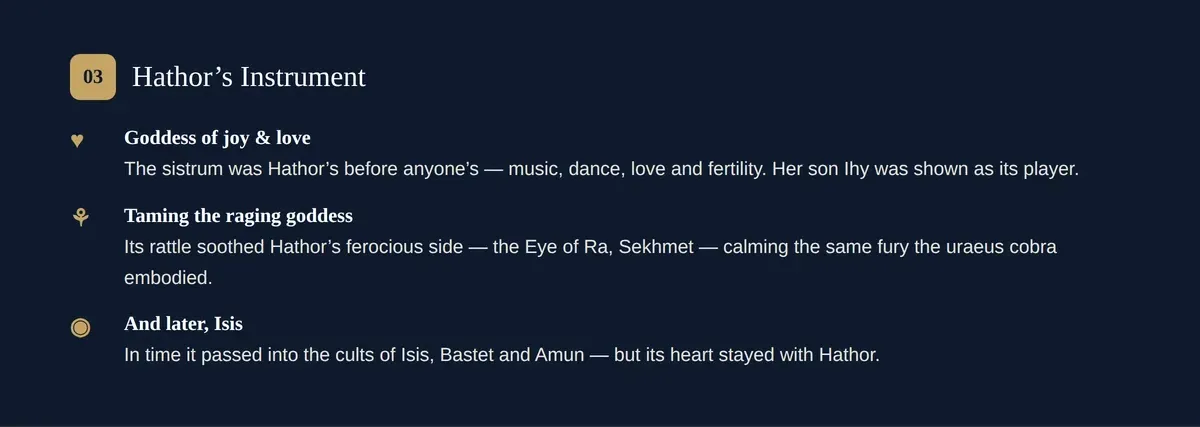
Because Hathor was the goddess of exactly what it stood for: music, dance, joy, love, and fertility. The sistrum was hers before it was anyone's, and it carried her erotic, life-giving warmth wherever it sounded. Her son Ihy — a naked child-god whose very name meant sistrum-player — was the instrument's divine embodiment. His home is Dendera: on the temple's own wall, the family stands together, and Ihy holds a sistrum in one hand and a menat in the other, exactly as his mother's priestesses did. The mammisi, the birth-house in the temple enclosure, celebrates his divine birth. The instrument may reach back further still to Bat, a minor early cow-goddess often compared to Hathor and eventually eclipsed by her.
But there is a deeper, sharper reason. Hathor had two faces — the gentle lady of love and the ferocious lioness who, as the raging Eye of Ra, could turn on humankind (the aspect the Egyptians also knew as Sekhmet). A central task of her cult was to pacify that fury, and the sistrum was the tool for it: its soothing rattle calmed the enraged goddess and coaxed her back to her kind self. The Egyptians did not only tell this as a story — they threw a festival for it. At the Festival of Drunkenness, they re-enacted the raging goddess's homecoming with music, dance, red-dyed beer, and the shaken sistrum, coaxing the lioness back into the loving Lady of Dendera. The same protective sound was also thought to help ward off hostile forces, like the chaos of the god Set. That is the sistrum's real power — the same idea of taming a dangerous divine force that you meet in the rearing cobra of the uraeus. In time, the instrument passed into the cults of Isis, Bastet, and Amun too, but its heart stayed with Hathor.
Myth-check
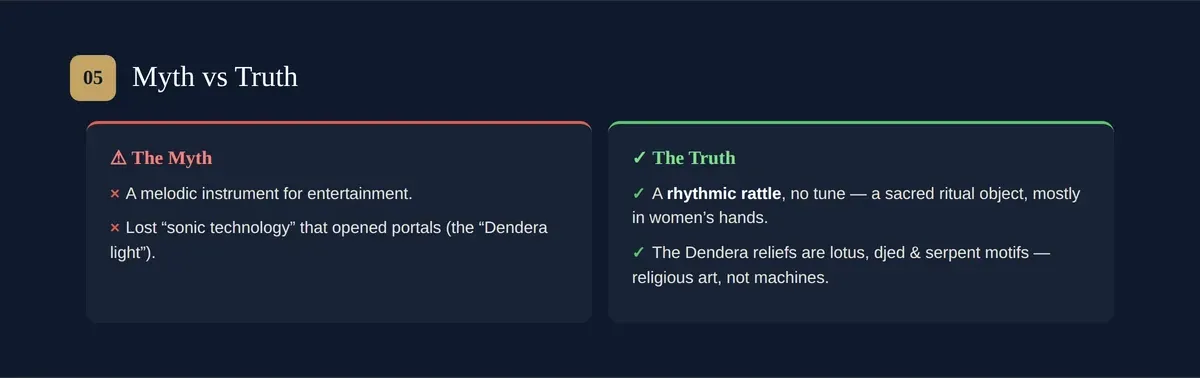
A few things to set straight. First, the sistrum is a rattle, not a melodic instrument — it makes no tune, only a rhythmic, hissing clatter, and its role was ritual, not entertainment. Second, it was not a generic instrument for anyone: in Egypt, it was overwhelmingly a sacred object in the hands of women and priests, tied to specific deities.
And third, you may run into corners of the internet claiming the sistrum was a piece of lost "sonic technology" — a frequency device that "opened portals," often bundled with the so-called "Dendera light" carvings said to show ancient electric bulbs. It was not. The Dendera reliefs are religious imagery — lotus, djed and serpent motifs — not machinery, and the sistrum was a ritual rattle, not a resonance engine. The real story needs no invented technology.
A sound that never died
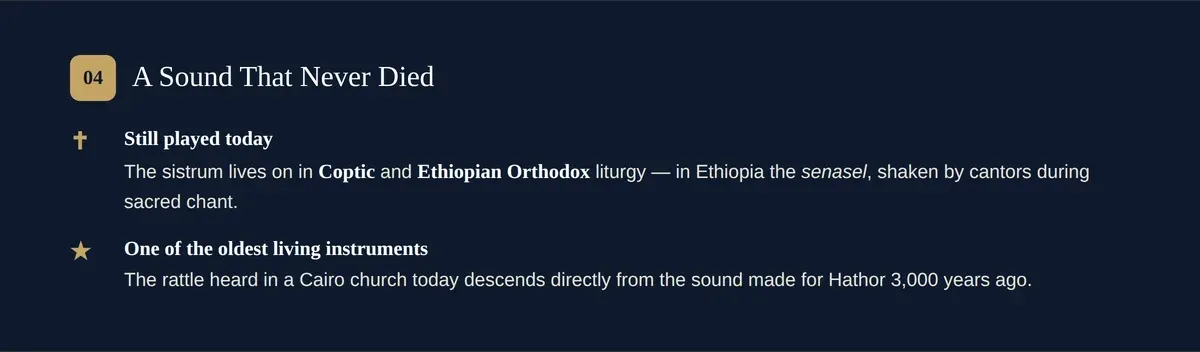
Here is what makes the sistrum extraordinary. When the temples of Hathor and Isis finally closed, the instrument did not die with them — it changed religions. The sistrum survives to this day in the liturgy of the Coptic Orthodox Church of Egypt and the Ethiopian Orthodox Tewahedo Church, where (in Ethiopia, it is called the senasel) it is shaken by cantors, the debtera, during sacred chant and dance at church festivals. In Coptic use, it is shaken toward the four points of the compass to signify the reach of creation — a new theology, carried on an old sound.
Its journey out of the temples began earlier, with the cult of Isis, which carried the sistrum across the Mediterranean; archaeologists have found sistra as far away as Pompeii. Tellingly, it was the plain hoop sistrum that traveled: the naos type, with Hathor's face on the handle, seems never to have left Egypt at all. But the through-line is the astonishing part: the bright rattle a worshipper hears in a Coptic church in Cairo today is the direct descendant of the sound made for Hathor three thousand years ago, making the sistrum one of the oldest continuously used instruments on earth.
Ashraf Fares, Egyptologist: "This temple is dead silent now, but the acoustic heartbeat of this room didn't actually die out; it just moved down the road. If you walk into a Coptic Christian mass anywhere in Egypt today, you will hear the exact same metallic, rhythmic clatter of cymbals and triangles driving the liturgy. It's an unbroken sonic time machine — the exact same metallic rattle that shook these pharaonic walls three thousand years ago, kept alive by a population that changed the religion but completely refused to drop the beat."
Where to see the sistrum in Egypt
There is one place above all: the Temple of Hathor at Dendera, a short trip north of Luxor and often paired with Abydos on a full day out. Dendera is one of the best-preserved temples in Egypt, still carrying much of its original painted color — and its great columns are themselves giant stone sistra, each shaft rising to a sistrum-shaped capital crowned with the face of Hathor. To walk the hypostyle hall is to stand in a forest of stone sistra.
Ashraf Fares, Egyptologist: "Look up at those twenty-four massive columns and you aren't just looking at structural support; you are standing inside a giant stone orchestra. See how the column shaft mimics a handle, and the massive block on top forms the soundbox of a sistrum — the sacred rattle of Hathor. I tell my clients to imagine the acoustic madness when priests shook hundreds of metal instruments in here, turning this entire enclosed hall into a vibrating amplifier meant to shake the goddess awake."
But look closely at those columns, and you will see something else: on most of them, Hathor's face has been chiseled away. When Christians took over the temple, they not only built a church in the enclosure — they went at the goddess with hammers, and they went for the face. The capitals are sistra because of that face; erase it and the instrument is silenced in stone. Traces of the blue paint from her hair still survive above the damage. It is not vandalism to hurry past: it is the clearest measure of how much power this quiet rattle was thought to hold. And fittingly, a fifth-century Coptic church still stands in the same enclosure — the faith that erased the face kept the sound.
Ashraf Fares, Egyptologist: "When clients look up at those smashed, faceless stone heads of Hathor and sigh about 'senseless vandalism,' I stop them right there. The early Christians who swung those heavy iron chisels weren't just angry vandals; they were absolutely terrified. They didn't see harmless ancient art — they believed those statues were living, breathing pharaonic demons staring down at them from the dark, and they hacked away the eyes just to blind the stone and strip it of its power."
For a queen, holding the sistrum was a claim to divinity. At Abu Simbel, on the facade of the Small Temple, the colossal statues of Nefertari — carved to the same height as Ramesses II's own — show her holding a sistrum, deified as Hathor herself. It is one of the boldest statements about a woman ever carved in Egypt, and the rattle is part of it.
One practical note: Dendera's famous subterranean crypt — the one with the so-called "Dendera light" reliefs — is reached through a small opening in the floor and a steep, narrow descent into a confined corridor. It is remarkable, but it is genuinely awkward, and not for anyone unsteady or uneasy in tight spaces. Ihy and his sistrum, happily, are up in the daylight.
Beyond Dendera, look for actual bronze and faience sistra in the Egyptian Museum and the Grand Egyptian Museum, for chantresses shaking them in tomb and temple reliefs, and for the instrument in the Isis temples of Philae. Once a guide points out the Hathor-headed columns, you will never mistake that shape again.
Few instruments outlive their gods. The sistrum outlived hers — carrying the sound made for Hathor out of Egypt's temples and into its churches, and it is still being shaken today.
Frequently Asked Questions
What is a sistrum?
A sacred handheld rattle: a handle carrying a frame through which run loose crossbars threaded with small metal disks that clatter when shaken. Egypt had two forms — the older sesheshet, shrine-shaped and crowned with the head of Hathor, and the simpler hoop-shaped sekhem, whose name means "power."
Why is the sistrum Hathor's instrument?
Hathor was the goddess of music, dance, joy, love and fertility — everything the sistrum stood for. Its rattle also had a sharper job: to pacify Hathor's ferocious side, the raging Eye of Ra, soothing the enraged goddess and coaxing her back to her gentle self.
Who played the sistrum?
Overwhelmingly women. Priestesses, noblewomen and royal women held the title "Sistrum-player of Hathor," and the powerful God's Wife of Amun shook it in the great Theban rites. Men, even the king, took it up only on particular festival occasions.
What did the sistrum's sound represent?
A dry, hissing rattle that the Egyptians compared to wind moving through a bed of papyrus reeds — recalling the marsh where the infant Horus was hidden. It was a ritual sound, not a tune: the sistrum makes no melody, only a rhythmic clatter.
Is the sistrum still played today?
Yes, remarkably. When the temples of Hathor and Isis closed, the instrument changed religions rather than dying. It survives in the liturgy of the Coptic Orthodox Church of Egypt and the Ethiopian Orthodox Church (where it is called the senasel), making it one of the oldest continuously used instruments on earth.
Did men ever play the sistrum?
Rarely, and only in particular roles. The instrument belonged overwhelmingly to women, but the king took it up to make offerings at festivals, and the divine sistrum-player of Egyptian religion was male: Ihy, the child-god of Dendera, whose very name meant sistrum-player.
Where can I see the sistrum in Egypt?
Above all at the Temple of Hathor at Dendera, about ninety minutes north of Luxor and often paired with Abydos: its great columns are themselves giant stone sistra, each rising to a sistrum-shaped capital crowned with the face of Hathor, and a fifth-century Coptic church stands within the same enclosure. Beyond Dendera, look for bronze and faience sistra in the Egyptian Museum and the Grand Egyptian Museum, and for the instrument in the Isis temples at Philae.
Want an Egyptologist to walk you through Dendera's forest of Ha
Want an Egyptologist to walk you through Dendera's forest of Hathor columns and explain the sistrum's five-thousand-year sound? Every Pyramids Land tour is private and guide-led, shaped around exactly what you want to see. Plan your private tour on WhatsApp →
Ashraf Fares