
The Was Scepter: The Egyptian Symbol of Power and Dominion
The short answer: The Was scepter is a long straight staff with a forked base and a stylized animal head, carried by Egyptian gods and kings as the symbol of power and dominion. Its very name, Was (wꜣs), is the Egyptian word for "power." It stood for a ruler's command over the ordered world and the forces of chaos.
Once you can spot it, the Was scepter is everywhere in Egypt: a tall, slender staff, forked like a tuning fork at the foot and topped by the head of a strange long-snouted animal, gripped in the hand of nearly every god carved on a temple wall. It is neither a weapon nor a walking stick. It is power itself, made into an object you can hold — and its name says exactly that.
At a glance
Key Facts
- What it is: a straight staff with a forked base and a stylized animal (Set-animal) head
- Name & meaning: was (wꜣs) is the Egyptian word for “power” / “dominion”
- Symbolizes: power, dominion, control over chaos, and well-being
- Carried by: many gods (Ptah, Anubis, Set, Ra-Horakhty, Amun, Isis, Hathor), pharaohs, and priests
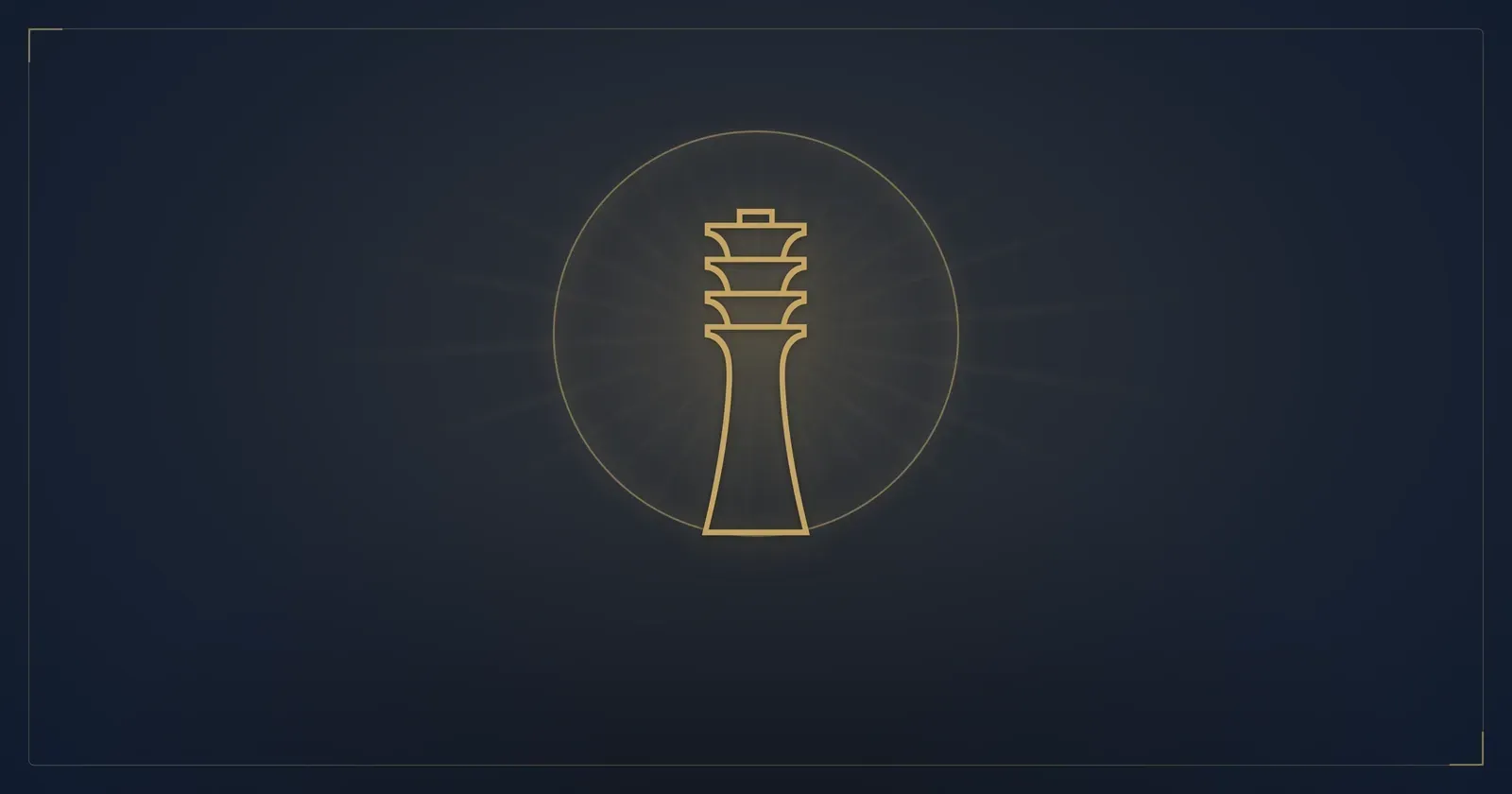
- The triad: ankh + djed + was = life, stability, and dominion, fused in Ptah’s staff
- Cosmic role: the sky was imagined resting on four pillars, sometimes shown as was scepters
- Its city: Thebes was Waset , “the City of the Was Scepter” — today’s Luxor and Karnak
What is the Was scepter?
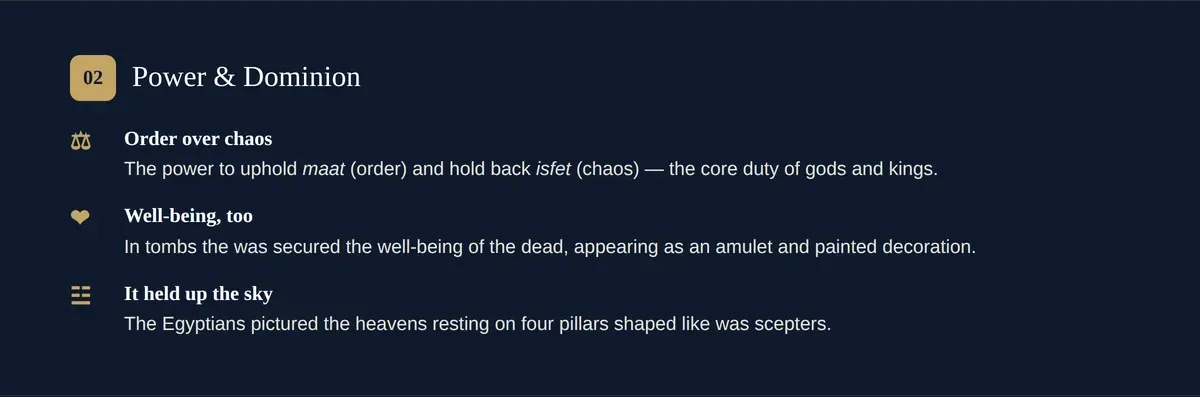
The was is a straight staff with two distinctive features: a forked or pronged base, and a stylized animal head at the top. Its name was (wꜣs), which is simply the ancient Egyptian word for "power" or "dominion," so the object and the idea are one and the same — to carry the Was was to carry power in your hand. The same sign served as the hieroglyph for "dominion" — cataloged by Egyptologists as Gardiner S40 (Unicode U+13300), read wꜣs — and appeared frequently in royal formulas such as "given life and dominion like Ra."
It is genuinely ancient. Was scepters are attested from the First Dynasty (around 3000 BCE): an ivory comb of King Djet — now in the Egyptian Museum — shows two was scepters flanking the king's name beneath the outstretched wings of a falcon, the heavens themselves, so the staff already stood for cosmic power at the very dawn of Egyptian history. Physical fragments survive in faience and wood, and from those earliest kings straight through to the New Kingdom, it never lost its meaning.
How to spot a Was scepter in seconds
- Long and straight, like a tall walking staff.
- Forked or pronged at the base, like a tuning fork.
- Topped with the strange long-snouted Set-animal head.
- Held upright, almost always in a god's or king's hand.
- Often stands right beside an ankh — the two are constant companions.
What does the Was scepter symbolize?
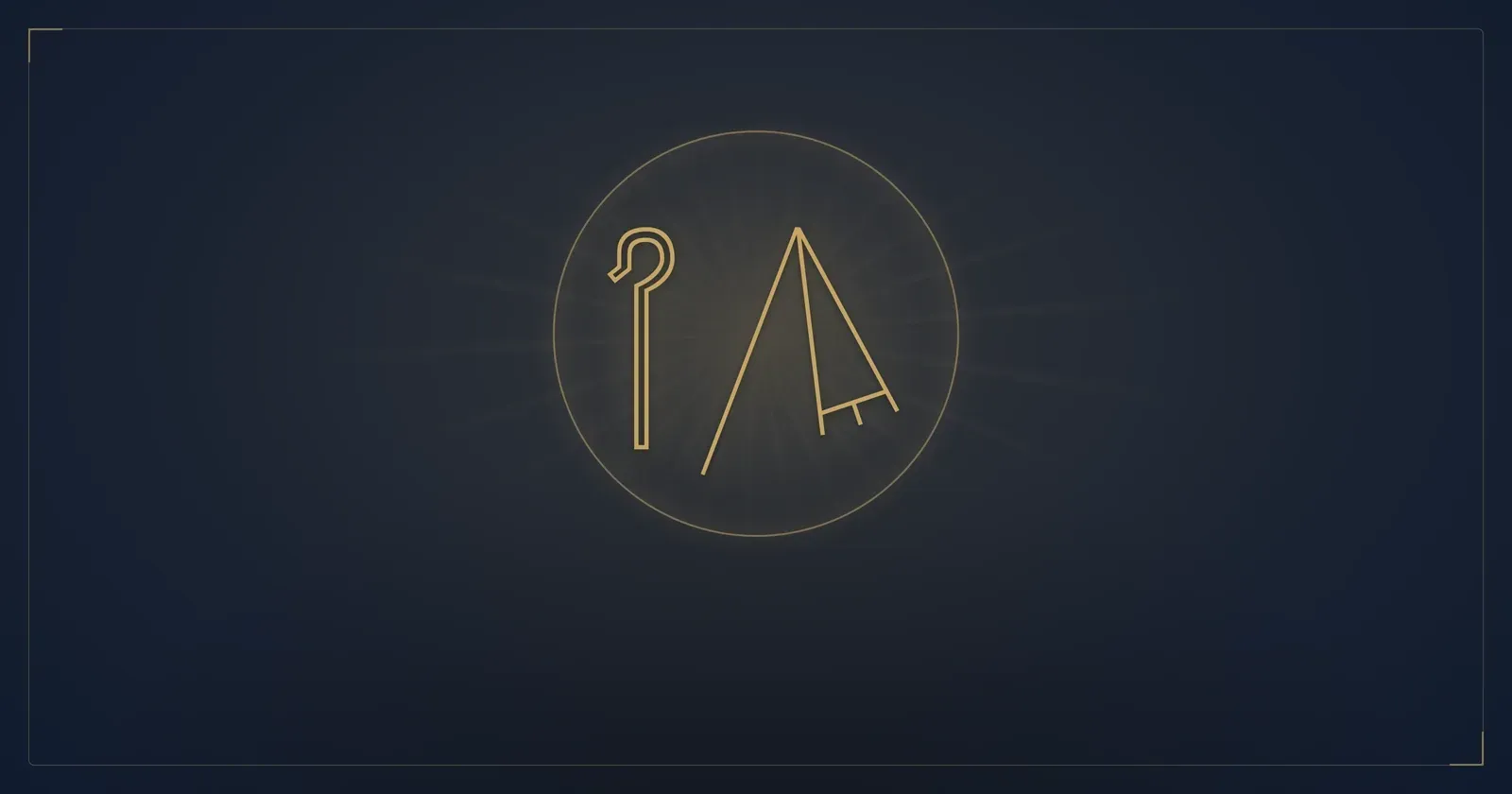
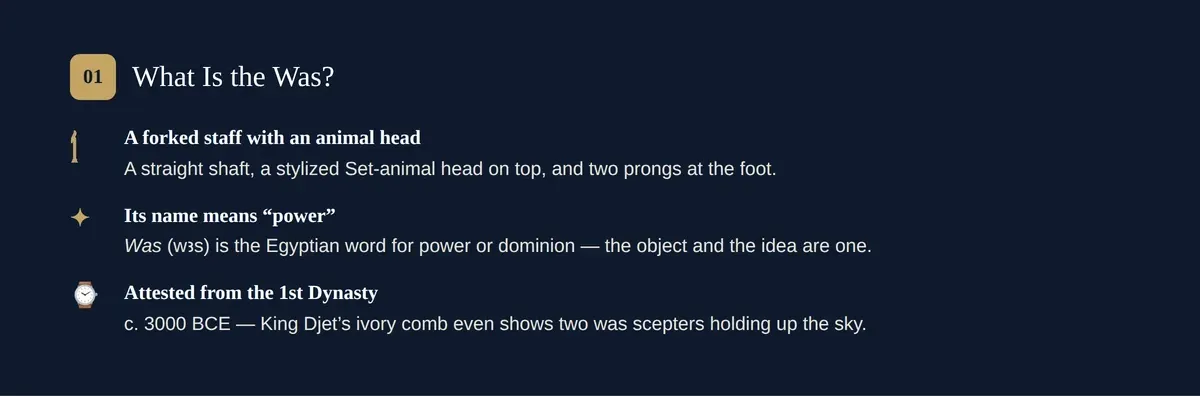
Power and dominion, first and above all — but a very particular kind. The Egyptian universe was a constant balance between maat (order, truth, harmony) and isfet (chaos and disorder) — the central drama of ancient Egyptian religion — and the king's and the gods' great duty was to uphold order. The Was is the emblem of exactly that authority: the power to command the ordered world and to keep chaos at bay. In the pharaoh's grip, it stood alongside the other great royal insignia — the crook and flail — as another statement of rightful rule.
It carried a second, gentler sense too — well-being and prosperity. In a funerary setting, the Was was thought to secure the well-being of the dead, so it appears as an amulet and as painted decoration in tombs and on coffins. And it reached the scale of the cosmos: the Egyptians imagined the sky as resting on four pillars that could take the shape of was scepters, so that the very heavens were held up by "power."
Whose head is on the Was — and is it Set?
The animal head is the Was scepter's enduring puzzle. It is usually identified as the head of the Set animal — the mysterious, long-snouted, square-eared creature of the god Set that no one has ever matched to a living species. (Some standard references hedge even further, calling it simply a gazelle or a generic canine head rather than committing to Set.) Egyptologists still debate whether it is a composite invention or a stylized fennec fox, aardvark, or desert canine. The forked base is often read as the same creature's legs or tail.
But two honest cautions. First, the Was was carried by far more than Set: Ptah, Anubis, Ra-Horakhty, Amun, Isis, Hathor, and many other deities hold it, along with pharaohs and high priests — it is a general emblem of divine power, not Set's personal property. Second, the Set link does not make it a "dark" or evil symbol. Set was the god of the desert and storms — feared, yes, but also needed: he was the one the other gods relied on at the prow of the sun god's boat each night, strong enough to spear Apophis, the serpent of chaos. The Was captures that idea precisely: the power to master chaos, not to serve it. (Goddesses, it is worth noting, more often carry the slender papyrus wadj scepter, though Isis and Hathor appear with the Was as well.)
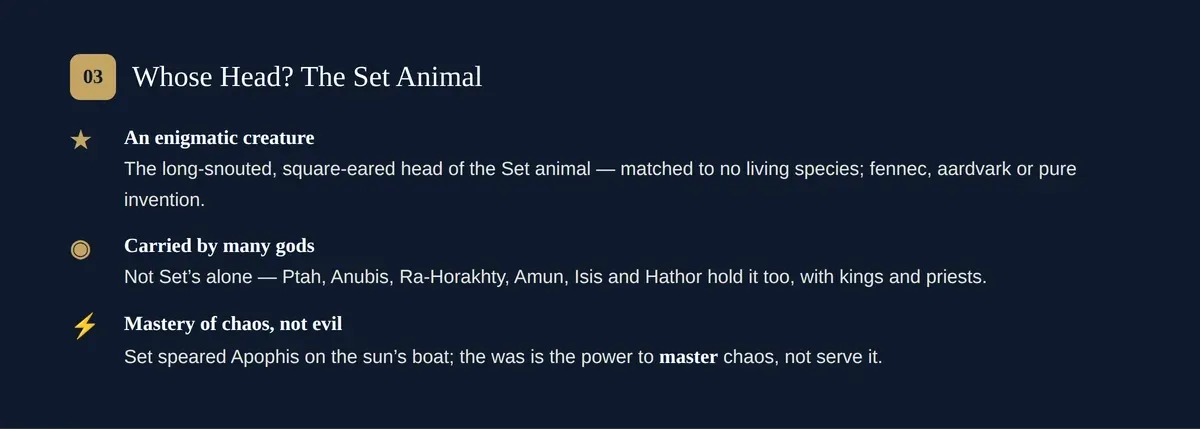
Ankh, Djed, and Was: life, stability, dominion
The Was rarely travels alone in Egyptian art. Again and again, it is paired with two companions you may already know: the ankh, the looped sign of life, and the djed pillar, the backbone of Osiris and sign of stability. Together they spell out a complete wish for a king or a soul — life, stability, and dominion — the three things every reign and every afterlife hoped to hold.
The god Ptah, the craftsman-creator of Memphis, is shown gripping a single composite staff that fuses all three: the Was shaft of dominion, with the ankh of life and the djed column of stability worked into its upper end — one object, three blessings. The same trio runs through temple-blessing formulas, in which a king is granted life, stability, power (and often health) in a single breath. If you learn to read just these three signs, whole walls of Egyptian temple text suddenly open up — which is rather the point of a symbol system built to be seen.
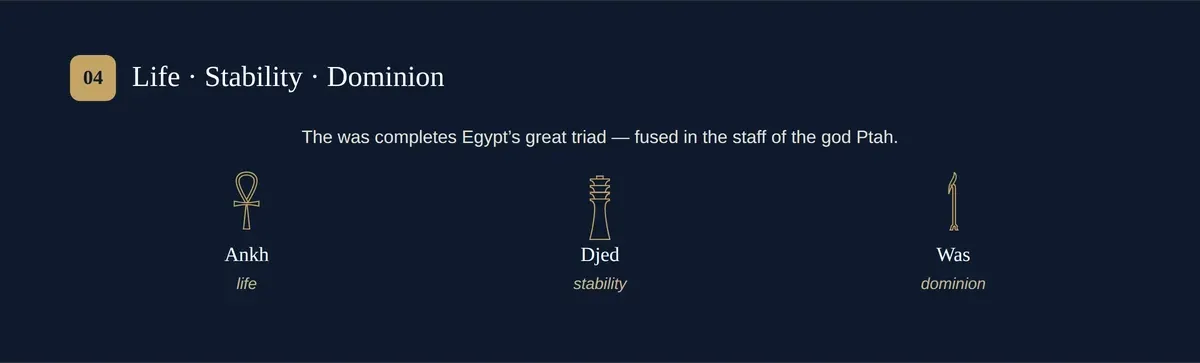
The Egyptian staffs and signs at a glance
Travelers mix these up constantly. Here is the quick key — part of our Egyptian symbols series:
| Symbol | Meaning | Who carries it |
|---|---|---|
| Was | Power, dominion, mastery over chaos | Gods, pharaohs, priests |
| Crook (heka) | Kingship — "to rule" | The pharaoh |
| Flail nekhakha) | Authority; power to provide and punish | The pharaoh |
| Ankh | Life | Gods and kings |
| Djed | Stability, endurance (Osiris's backbone) | Osiris and other gods |
| Wadj (papyrus) | Freshness, greening, prosperity | Mostly goddesses |
Myth-check
A few things to set straight. The Was is not a weapon — despite video-game "staffs of Ra," it was an emblem of authority, not a fighting stick. Nor is the Set-animal head a mark of evil, as above; it signals mastery over chaos. And you may stumble on fringe pages claiming the Was scepter is really an ancient drill bit or machine tool — it is not; that reading ignores everything the Egyptians themselves wrote about it as a sign of dominion.
Its true origin, on the other hand, is genuinely unsettled, and honestly so. Scholars have proposed a herdsman's staff, a snake-catching stick (the fork used to pin a snake's head), a tent pole, and a fighting cane. One striking academic theory even traces the ankh, djed, and Was together to bovine anatomy — parts of a bull's body, rooted in an ancient cattle cult — which, whatever its merits, is a reminder of how much about this everyday-looking staff remains open. Anyone who gives you a single confident origin is overreaching.
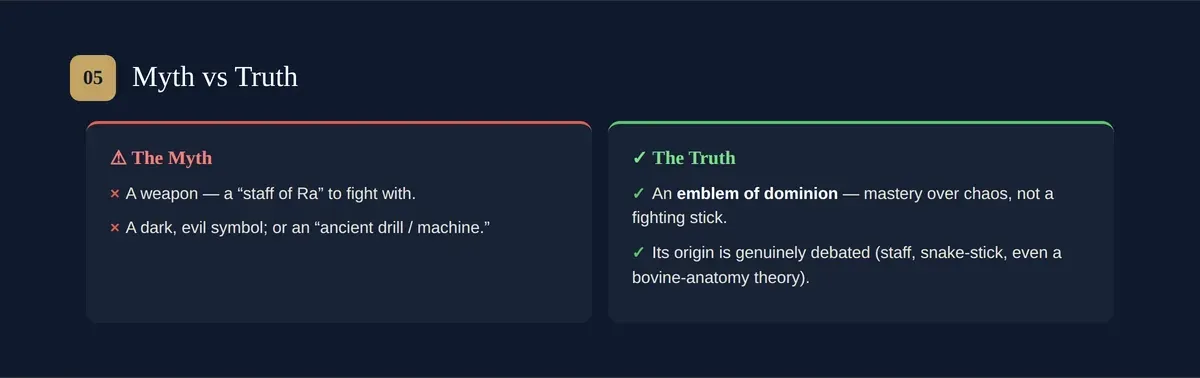
Where to see the Was scepter in Egypt
Start where its name lives. Thebes — modern Luxor, with Karnak at its heart — was called Waset by the Egyptians, a name that means, quite literally, "the Scepter." An obscure town named for the staff grew, over centuries, into the capital the Greeks would rename Thebes — the metropolis of the Was, whose provincial emblem was the staff itself. To stand at Karnak is to stand in the city named after this sign for power.
From there, it is everywhere. Look into the hand of almost any god on a temple or tomb wall, and you will find the forked staff with the animal head — at Karnak and Luxor, at Edfu, Dendera and Philae, and across the painted tombs of the Valley of the Kings. One especially fine example is in the tomb of Thutmose III (KV34), where the god Set himself holds the Was — though be warned this is one of the valley's harder tombs to reach: up a steep staircase across a ravine, then a steep descent inside, so bring a torch and take it slowly. Fittingly, its burial chamber is shaped like a giant cartouche. And in the Egyptian Museum and the Grand Egyptian Museum you can see actual faience Was scepters, the real objects behind the symbol — while the most spectacular survivor sits in London's Victoria and Albert Museum: a blue-green faience Was over two meters tall and weighing some 65 kilos, made for Amenhotep II and recovered from the Temple of Set at Naqada, its Set-animal head unmistakable. It is the point where the symbol stops being a drawing on a wall and becomes an object a priest once actually lifted. It is one of my favorite things to point out to guests, because the moment you catch the first Was, you cannot stop seeing them — and suddenly every god in Egypt is holding power in his hand.
The next time you stand before a temple wall, look past the crowns and watch the hands. An ankh promises life, a djed promises stability, a Was declares power — learn just those three, and thousands of years of Egyptian art begin to read themselves.
Frequently Asked Questions
What is the Was hieroglyph?
The Was is written with the sign cataloged as Gardiner S40 (Unicode U+13300), read wꜣs — the Egyptian word for "power" or "dominion." The same sign that draws the object also spells the idea.
Was every Egyptian god shown holding a Was scepter?
Many were, but not all. The Was is a general emblem of divine power carried by Ptah, Anubis, Set, Ra-Horakhty, Amun, Isis, Hathor and others — while goddesses often hold the slender papyrus wadj scepter instead.
Why is the base of the Was scepter forked?
It is usually read as the legs or tail of the Set-animal whose head tops the staff. Some scholars instead link the fork to a snake-catching stick used to pin a serpent's head.
Did ordinary Egyptians own Was scepters?
No. Unlike the everyday scarab amulet that any Egyptian might wear, the was was an emblem of gods, kings and priests — not a personal possession. Small Was-shaped amulets did, however, appear in funerary equipment to secure the well-being of the dead.
Is the Set animal a real animal?
No one knows. Nobody has matched it to a living species; it may be a composite invention, or a stylized fennec fox, aardvark, or desert canine — and some references simply call the head a gazelle. Its identity is one of Egyptology's enduring small puzzles.
Is the was scepter older than the ankh?
Neither is clearly older — both are attested from the First Dynasty (around 3000 BCE), and they appear together in Egyptian art from very early on.
What is the difference between the Was and the wadj scepter?
The Was is the forked, animal-headed staff of power, carried mainly by gods and kings. The wadj is a slender papyrus stem standing for freshness and renewal, carried mainly by goddesses. Which staff a figure holds is a quick way to tell gods from goddesses on a crowded wall.
What is the ankh-djed-was triad?
Three signs often shown together: the ankh (life), the djed (stability), and the Was (dominion). The god Ptah holds a single staff that fuses all three, and temple blessings pair them as a complete wish for a king — life, stability, and power.
Want an Egyptologist to walk you through Karnak — the City of the Was Scepter — and read the gods' staffs straight off the wall? Every Pyramids Land tour is private and guide-led, shaped around exactly what you want to see. Plan your private tour on WhatsApp →
Ashraf Fares