
The Egyptian Cartouche: Meaning, Your Name in Hieroglyphs & Where to See Them
The short answer: An Egyptian cartouche is an oval loop of rope enclosing a royal name in hieroglyphs. The Egyptians drew it to protect the king's name for eternity — and because it always framed a name, it later became the key that let scholars finally read the entire hieroglyphic script.
If you have ever seen a name written in hieroglyphs inside a rounded oval — on a temple wall, a gold pendant, or a museum label — you have seen a cartouche. It is one of the most recognizable shapes in all of Egyptian art, and one of the most important, because it does something no other symbol does: it tells you, instantly, that the signs inside spell the name of a king.
At a glance
Key Facts
- What it is: an oval rope loop enclosing a royal name in hieroglyphs
- Egyptian name: shenu (šnw) — “that which encircles,” from the shen ring of eternity
- Purpose: to protect the king’s name (the ren ), a core part of the soul, for eternity
- Names inside: the pharaoh’s prenomen (throne name) and nomen (birth name)
- Why it’s famous: the Ptolemy & Cleopatra cartouches let Champollion decipher hieroglyphs in 1822
- Best place to see one: the King List at the Temple of Seti I, Abydos — 76 royal cartouches
What is a cartouche?
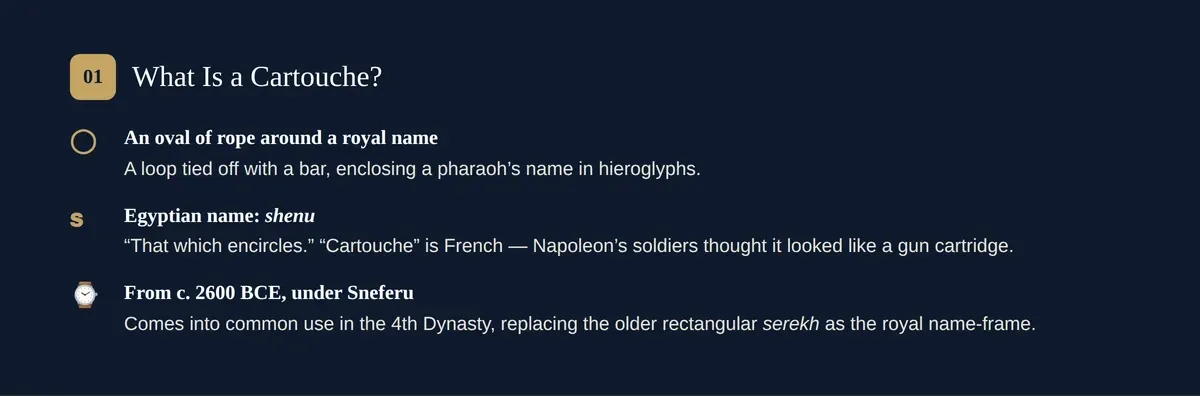
A cartouche is an oval formed by a length of rope, tied off with a horizontal bar at one end, drawn around the name of a pharaoh. The Egyptians called it the shenu (šnw), from a word meaning "to encircle." The name we use today is not Egyptian at all: the French soldiers of Napoleon's expedition thought the oval looked like a paper gun cartouche — a cartridge — and the nickname stuck.
Inside the oval sit the hieroglyphs of a royal name. The bar at the bottom marks where the rope is tied, sealing the loop into an unbroken circle. That unbroken loop is the whole point.
The cartouche came into common use in the Fourth Dynasty, around 2600 BCE, under the pharaoh Sneferu — though the very first examples appear a little earlier, at the end of the Third Dynasty. Before it, kings wrote their names inside a serekh: a tall rectangle drawn as the paneled façade of the royal palace, with the Horus falcon perched on top, declaring the king the living embodiment of the god. The serekh could carry a theology of its own — the Second-Dynasty king Peribsen replaced the Horus falcon with the animal of Set, Horus's rival, and his successor Khasekhemwy crowned his with both gods at once. The cartouche gradually took over as the preferred royal frame, and by the Fifth Dynasty, the familiar pair of cartouches was standard.
Why did the cartouche protect the king's name?
The cartouche grew out of an older symbol, the shen ring — a circle of rope with no beginning and no end, standing for eternity and "everything the sun encircles." Stretch that circle into an oval so a name can fit inside, and you have a cartouche. The message is that the king rules all that the sun goes around, and that the name it holds is protected forever.
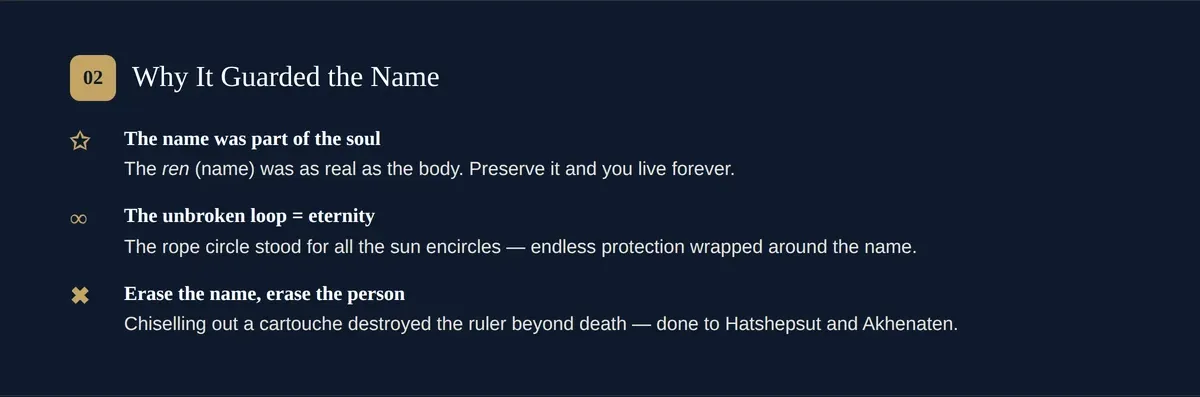
Protection mattered because of what a name was to the Egyptians. The name, the ren, was one of the essential parts of a person's being in Egyptian thought, as real as the body or the soul. To speak a name kept its owner alive; to preserve it in stone was to preserve their existence into eternity.
Just how much power a name held is clear from a story the Egyptians told about their own supreme god. The goddess Isis, wanting Ra's power for herself, secretly fashioned a serpent that bit him; as the venom burned, she offered to heal him only if he surrendered his true, hidden name. Ra recited title after title, but the agony would not ease — until at last he let his secret name pass into her, and his power passed with it. To know a name was to hold its owner; to guard a name was to keep them safe.
The reverse was catastrophic: to chisel out a name was to erase the person from the universe itself. This is exactly what happened to Hatshepsut, whose name was hacked from walls across Egypt after her death, and to Akhenaten. Akhenaten had done it first — sending workmen to cut out the name of the god Amun wherever it appeared, even inside the cartouche of his own father, Amenhotep III, because the god's name sat within it; when his revolution collapsed, the priests returned the favor and erased his names in turn. Wrapping the royal name in the unbroken rope of the cartouche was, in effect, eternal insurance for the king's very existence.
Whose name went inside a cartouche?
Not everyone's — and this matters. Historically, the cartouche was royal. A pharaoh held five official names, built up over the first centuries of kingship:
- the Horus name — the oldest, written in the serekh, naming the king as Horus on Earth;
- the Two Ladies (Nebty) name — placing him under Nekhbet, the vulture of Upper Egypt, and Wadjet, the cobra of Lower Egypt;
- The Golden Horus name — its exact sense still debated;
- the prenomen, or throne name, taken at coronation and introduced by nesu-bit, "he of the sedge and the bee" (King of Upper and Lower Egypt) — written in a cartouche;
- The nomen, or birth name, introduced by sa-Ra, "Son of Ra" — written in a cartouche.
So the two ovals you see side by side on a wall are the throne name and the birth name — and the little signs in front of each cartouche (the sedge-and-bee, and the goose-and-sun of "Son of Ra") are the labels that tell you which is which. Learn just those, and you can pick a king's names out of a wall of hieroglyphs. Over time, queens and even some gods' names were enclosed too — Akhenaten famously gave the sun-disc, the Aten, its own royal cartouches — but for most of Egyptian history, the cartouche was, above all, the mark of royalty. An ordinary Egyptian would never have written their own name this way — a useful thing to know before we get to the souvenir shops.
the same oval was used as a "name-ring" for conquered foreign lands and peoples in temple topographical lists and war reliefs (rows of them at Karnak and Medinet Habu), usually drawn on a bound captive.
How the cartouche cracked hieroglyphics
Here is the part most people never hear, and it is the reason the cartouche deserves a place in the history of human knowledge.
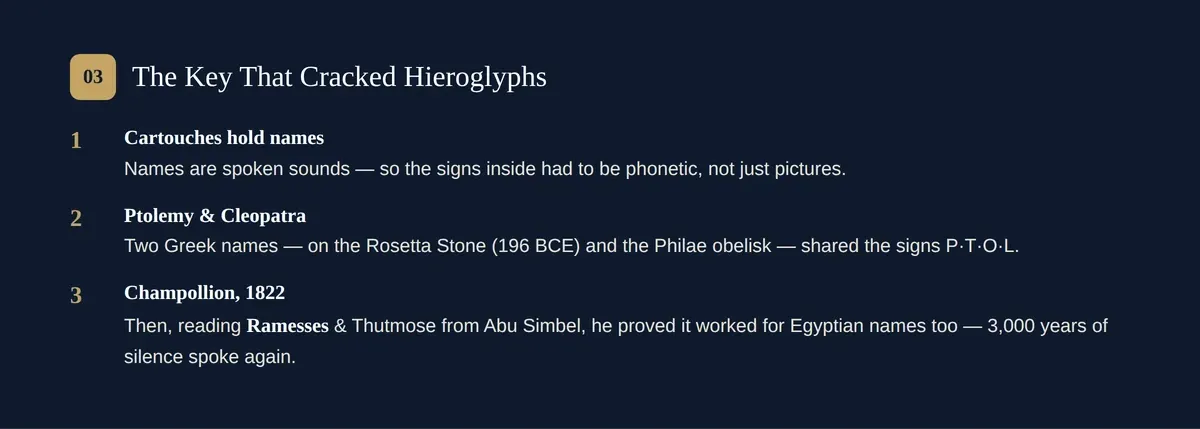
For centuries after the last hieroglyphs were carved, nobody could read them. The script was assumed to be pure symbolism — mystical pictures, not a real language with sounds. The cartouche is what broke that assumption. Because scholars knew cartouches contained names, and names are spoken sounds, they reasoned the signs inside must be phonetic.
The breakthrough came from bilingual monuments — above all the Rosetta Stone, a priestly decree of 196 BCE carved in both Egyptian and Greek and unearthed in 1799. The English polymath Thomas Young had already found part of the key, spotting that the Ptolemy cartouche spelled sounds, but it was the French scholar Jean-François Champollion who unlocked the whole language. In 1822, he lined up the cartouche of Ptolemy (from the Rosetta Stone) against that of Cleopatra (from the Philae obelisk) and matched the signs they shared — the p, the t, the o, the l. Where the sounds overlapped, so did the hieroglyphs.
But a Greek name proved only that hieroglyphs could spell foreign sounds — and Young was convinced that was as far as it went. Champollion's real leap, that same autumn, was to prove the signs spelled Egyptian names too. Studying copies of much older inscriptions from Abu Simbel, he read a cartouche whose first sign was a sun-disc — ra in Coptic, the surviving descendant of the Egyptian language — followed by two signs he sounded out as m and s: Ra‑m‑s‑s, Ramesses. Another cartouche opened with the ibis of the god Thoth: Thoth‑m‑s, Thutmose. The system was phonetic through and through, for pharaohs as much as for Greeks, and three thousand years of silence ended. It began with an oval loop of rope.
How to get your name in a cartouche (without getting scammed)
A gold or silver pendant with your own name in hieroglyphs, inside a cartouche, is one of the most popular things visitors take home from Egypt. As a keepsake, it is lovely — but it comes with one honest caveat and a real buyer's guide, because the cartouche-necklace trade is where many tourists get quietly overcharged.
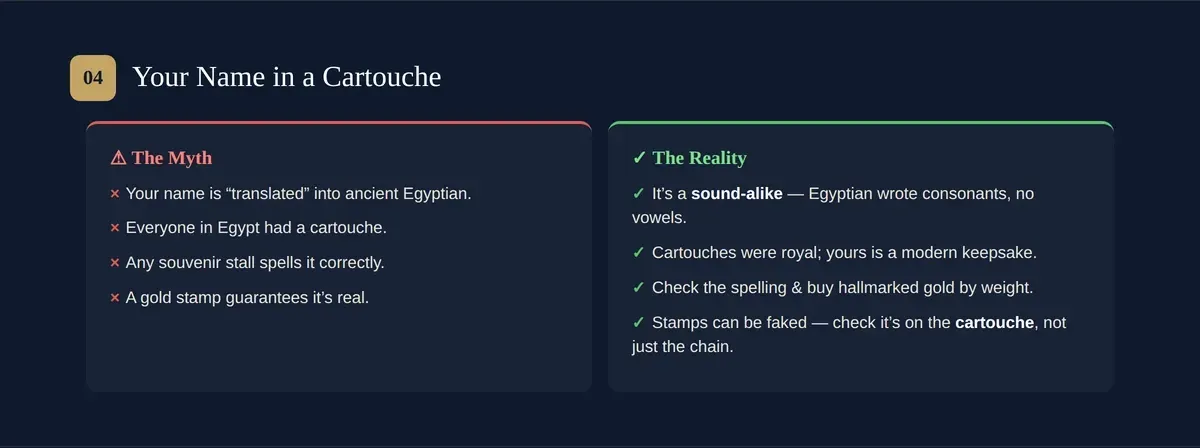
The honest caveat. Your name in a cartouche is a modern tradition. Historically, the oval was royal, and ancient Egyptian didn't spell foreign names the way we do: the script wrote mostly consonants, with no vowels, so a modern name is approximated — each sound matched to the nearest sign in the hieroglyphic "alphabet" of single-sound signs. It is a sound-alike, not a genuine ancient word. Perfect as a keepsake; just not the same as having your name "translated" into ancient Egyptian.
The buyer's guide, from years of taking guests to buy these:
- Gold is priced by a public formula: the piece's weight in grams × the day's gold rate + a workmanship fee. Only the workmanship is really negotiable. A reputable jeweler weighs the piece in front of you and gives a receipt showing that weight — so check the day's gold rate before you shop, and re-check the shop's Egyptian-pound-to-dollar conversion, which is where the numbers quietly drift in their favor. (As a rough idea, travelers have reported around US$150 for a small 18-karat cartouche — but the gold price moves constantly, so treat any figure as a guide, never a fixed quote.)
- Watch the nameplate trick. A classic scam is to charge you for an extra gram of 18-karat gold for the hieroglyphic name, then apply cheaper 9-karat gold, which slowly turns brassy against the purer gold. Insist that the entire piece, including the name, is the same karat.
- A stamp is reassuring, not proof. Hallmark stamps can be faked, so the shop's reputation is the real guarantee. If you do check, 18-karat is stamped 750 and 21-karat 875 — and make sure the stamp is on the cartouche itself, not only on the chain.
- Buy from an established, hallmarked shop rather than a pushy stall or a "warehouse" someone just happens to steer you toward.
- Check the spelling before any metal is cut. Have the signs written out and confirmed — a rushed shop will reverse the reading direction or swap in decorative-but-wrong signs. Don't be shy about asking why each sign was chosen.
- Don't flash a new cartouche on the street. A known trick is for a passer-by or rival vendor to offer to "test" your gold, then hand back a swapped, fake piece.
- Timing: a blank cartouche personalized with your name usually takes about a day (quicker when the shop is quiet). If they offer hotel delivery, agree on a time — but collecting it in person is safer and lets you check the piece.
For the full method — the price formula, karat standards and a step-by-step checklist — see our Gold & Silver Jewelry Buying Rules. And a good guide can simply point you to a jeweler who prices honestly by weight and gets the spelling right, so the name on your chest reads the way you think it does.
Where can you see cartouches in Egypt?
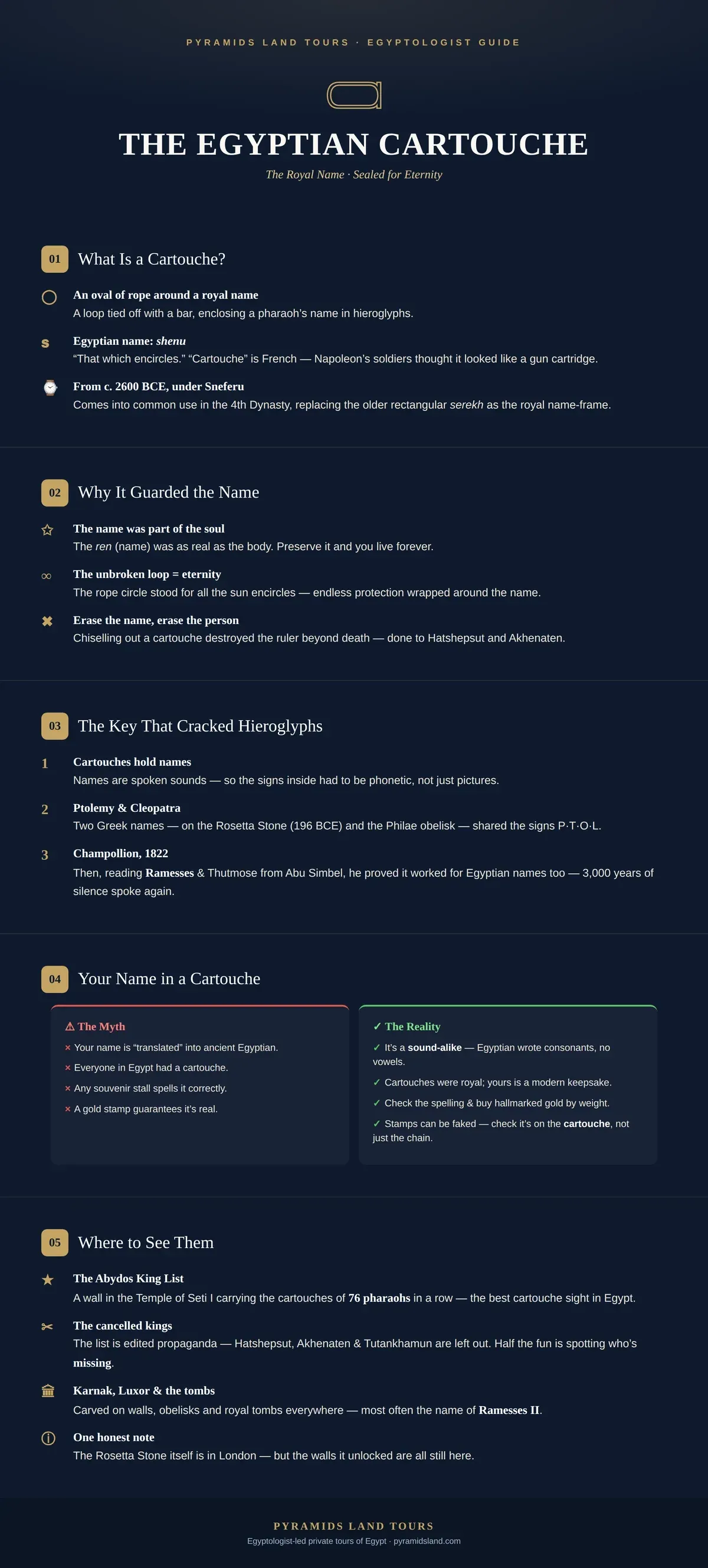
Everywhere a king wanted to be remembered — which is to say, almost everywhere. But one place stands above the rest. In the temple of Seti I at Abydos, the wall known as the King List carries the cartouches of seventy-six pharaohs in sequence, a roll-call of rulers stretching back to the dawn of Egypt. Standing in front of it, reading name after name inside those ovals, is the single best cartouche experience in the country, and one of my favorite walls to bring guests to — because once you can spot a cartouche, you suddenly realize you can half-read a temple.
But the King List is not a neutral record; it is propaganda in stone. Those 76 ancestors are a carefully edited family tree: the messy rulers of the Second Intermediate Period are gone, and so are the "heretics" of the Amarna age — Hatshepsut the woman-king, Akhenaten, Smenkhkare, Tutankhamun and Ay — all quietly deleted so that legitimate kingship appears to flow in an unbroken line straight down to Seti I. Half the fun of the wall is learning to spot who is missing. It was not the only such record, either: the Turin Canon, written on papyrus, once listed almost every ruler with the exact length of each reign, and the far older Palermo Stone carries the royal annals back through the Old Kingdom. Abydos itself is about three hours north of Luxor and usually paired with the temple of Dendera as a full-day excursion, but for anyone who catches the cartouche bug, it is worth every mile.
→ See the Abydos King List on a private Luxor day trip
You will also find cartouches carved across Karnak and Luxor, on obelisks, and throughout the royal tombs of the Valley of the Kings. The name you will spot most often is that of Ramesses II, who carved his cartouches across more of Egypt than any other pharaoh. One honest note: the Rosetta Stone itself now lives in the British Museum in London, not in Egypt (Egypt has campaigned for its return), but faithful replicas are on display across Cairo — including one at the Grand Egyptian Museum in a gallery devoted to the story of its decipherment. — but the walls it helped us read are all still here.
Frequently Asked Questions
What's the difference between a cartouche and a serekh?
Both frame a royal name, but the serekh came first: a rectangle drawn as the palace façade with the Horus falcon on top, used in the first two dynasties. The cartouche — the oval loop of rope — took over from Sneferu's reign onward. A serekh says "the king in his palace, embodiment of Horus"; a cartouche says "the king of all the sun encircles."
What are the five names of a pharaoh?
The Horus name, the Two Ladies (Nebty) name, the Golden Horus name, the prenomen (throne name), and the nomen (birth name). Only the last two — the throne name and the birth name — were written inside cartouches, which is why a king usually appears with two.
Why isn't Hatshepsut or Tutankhamun on the Abydos King List?
Because the list is edited propaganda. Seti I left out every ruler judged illegitimate — the female king Hatshepsut, the Amarna "heretics" (Akhenaten, Smenkhkare, Tutankhamun, Ay), and the chaotic Second Intermediate Period kings — so that kingship appears to pass in an unbroken line down to him.
Where is the Rosetta Stone now?
In the British Museum in London, where it has been since 1802 — not in Egypt. But the temple walls that taught the world to read are all still here. (Egypt has campaigned for its return), but faithful replicas are on display across Cairo — including one at the Grand Egyptian Museum in a gallery devoted to the decipherment story.
Did Champollion or Thomas Young decipher hieroglyphs?
Both, and the credit is still argued. Young first showed that signs in a cartouche could spell sounds; Champollion proved it worked for native Egyptian names too and reconstructed the whole system in 1822. Young cracked the door; Champollion walked through it.
Is my name in a cartouche really "ancient Egyptian"?
It's a modern keepsake, and a lovely one. The oval was historically royal, and Egyptian wrote mostly consonants with no vowels, so a modern name is matched sound-by-sound to the nearest signs — a sound-alike, not a genuine ancient word.
Want to read the cartouches off a temple wall yourself — and get a genuine one made properly? Every Pyramids Land tour is private and led by a licensed Egyptologist guide who can decode the walls and point you to a jeweler you can trust. Plan your private tour on WhatsApp →
Ashraf Fares