
Ancient Egyptian Religion: The Belief System That Built the Pyramids, the Temples, and an Entire Civilisation
***Edited April 8, 2026
You cannot understand the pyramids without understanding Egyptian religion. You cannot make sense of a single temple wall, a single tomb painting, or a single mummified body without it.
For more than 3,500 years — from predynastic village shrines to the last hieroglyphic inscription at Philae in 394 AD — religion was not a separate part of Egyptian life. It was Egyptian life. It determined how the country was governed, how buildings were designed, how the dead were buried, and how ordinary people understood their place in the universe.
Every monument you visit in Egypt was built because of what the Egyptians believed. This article explains what those beliefs were.
Key Facts: Ancient Egyptian Religion
- Type
- Polytheistic (hundreds of gods), with one brief monotheistic period under Akhenaten (~1350 BC)
- Core principle
- Ma'at — truth, balance, and cosmic order
- Key gods
- Ra, Osiris, Isis, Horus, Anubis, Hathor, Amun
- Afterlife
- Judged by the Weighing of the Heart against the feather of Ma'at
- Central text
- The Book of the Dead
- Lasted
- ~3,000 years, ending with the closure of Philae temple in 537 AD
- Where to see it
- Karnak, Valley of the Kings, GEM, Philae, Abydos, Saqqara
The Core Idea: Ma'at and Cosmic Order
At the centre of Egyptian religion was a single governing principle: Ma'at.
Ma'at was not a god in the conventional sense, though she was personified as a goddess with an ostrich feather on her head. She was the concept of truth, justice, balance, and cosmic order. Everything in the universe — the rising of the sun, the flooding of the Nile, the authority of the pharaoh, the behavior of ordinary citizens — was understood as part of Ma'at.
When Ma'at was maintained, the world functioned. When it was disrupted — through injustice, chaos, or neglect of the gods — the consequences were real: famine, invasion, social collapse.
This was not abstract philosophy. It was the operating system of the entire civilization. The pharaoh's primary job was to uphold Ma'at. The temples existed to maintain it. The rituals were designed to reinforce it. And the afterlife was the ultimate test of whether an individual had lived in accordance with it.
The Gods: Not Distant, Not Abstract
Ancient Egyptians worshipped a vast pantheon of gods and goddesses — estimates range from hundreds to over 2,000, depending on how local and regional deities are counted. These were not remote, philosophical concepts. They were active forces in the world, each responsible for specific aspects of existence.
Ra — the sun god, the source of all life. His daily journey across the sky and through the underworld at night was the central metaphor of Egyptian religion: the cycle of death and rebirth, repeated every 24 hours. By the time of the New Kingdom, he had merged with Amun to become Amun-Ra, the king of the gods and the patron deity of Thebes (modern Luxor). The Temple of Karnak — the largest religious structure ever built — was dedicated to him.
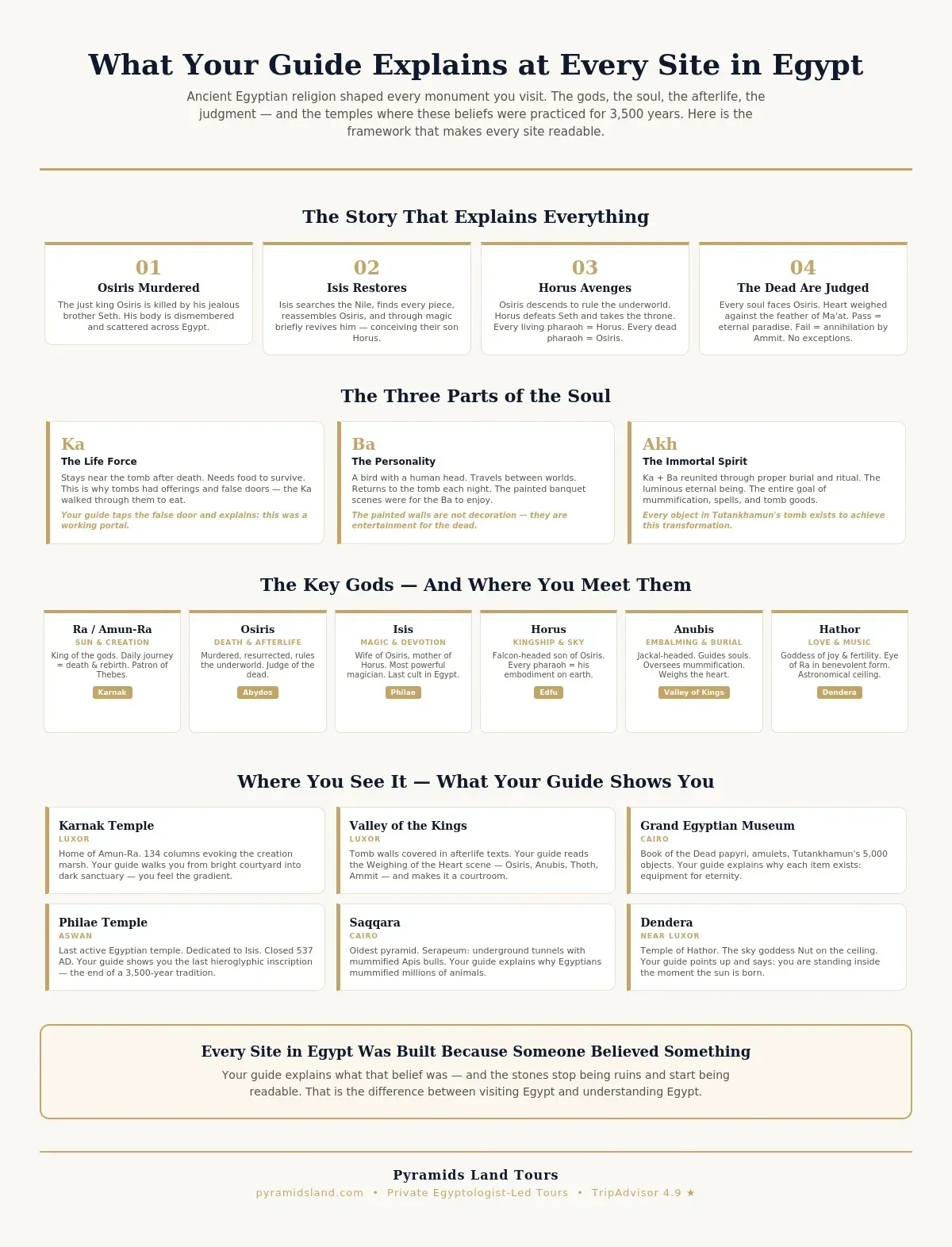
Osiris — god of the dead and the afterlife, and the central figure in the most important myth in Egyptian religion. The story goes: Osiris was a wise and just king of Egypt, beloved by his people. His brother Seth — god of chaos and storms — was consumed by jealousy. Seth constructed an ornate chest, perfectly measured to fit Osiris's body, and presented it at a banquet as a gift for whoever fit inside. Osiris lay down. Seth slammed the lid, sealed it with lead, and threw the chest into the Nile. Osiris drowned.
But Seth was not finished. When Isis — Osiris's wife and the most powerful magician in the Egyptian pantheon — recovered the body, Seth seized it, dismembered Osiris into fourteen pieces, and scattered them across Egypt. Isis searched the length of the Nile, recovered every piece, and reassembled her husband. Through her magic, she briefly revived Osiris — long enough to conceive their son, Horus. Osiris then descended permanently to the underworld, where he became its ruler and the judge of the dead.
Horus grew up, challenged Seth for the throne of Egypt, and after a series of violent contests, won. Every living pharaoh was considered the embodiment of Horus. Every dead pharaoh became Osiris. This is why the throne of Egypt passed from father to son for 3,000 years — it was not just politics. It was theology.
This myth explains mummification (reassembling the body), the afterlife (Osiris ruling the underworld), kingship (Horus on the throne), and the judgment of the dead (Osiris presiding). It is the single most important story for understanding what you see in Egyptian tombs and temples. Your guide tells this story at Abydos — the temple where Egyptians believed these events took place — and at the Valley of the Kings, where every pharaoh prepared to become Osiris.
Isis — goddess of magic, healing, and motherhood. The most widely worshipped goddess in Egyptian history, she eventually had her cult spread far beyond Egypt into the Greco-Roman world. She represented devotion, resourcefulness, and protective power. Her temple at Philae, on an island near Aswan, was one of the last places where traditional Egyptian religion was still practiced — well into the 6th century AD.
Horus — the falcon-headed sky god, son of Osiris and Isis. He represented kingship itself. Every living pharaoh was considered the earthly embodiment of Horus, which is why the falcon appears so prominently in royal imagery. His temple at Edfu, between Luxor and Aswan, is the best-preserved major temple in Egypt.
Anubis — the jackal-headed god of embalming and the dead. He guided souls through the underworld and oversaw the mummification process. His image appears in virtually every tomb in Egypt.
Thoth — the ibis-headed god of wisdom, writing, and knowledge. He recorded the verdict during the judgment of the dead and was credited with inventing hieroglyphs. His cult center was at Hermopolis (modern Ashmunein), and his sacred animals — ibises and baboons — were mummified in enormous quantities.
Hathor — goddess of love, music, fertility, and joy. Her temple at Dendera, between Luxor and Qena, contains some of the most spectacular ceiling decorations in Egypt, including the famous Dendera Zodiac.
Other significant deities include Seth (chaos and storms), Ptah (creation and craftsmanship, patron of Memphis), Sekhmet (war and healing), Bastet (protection and cats), and Khnum (creation of human bodies on his potter's wheel).
The gods were not arranged in a fixed hierarchy. Their prominence shifted over time as political power moved between cities and dynasties. When Thebes dominated, Amun rose. When Memphis was ascendant, Ptah held sway.
Akhenaten: The Pharaoh Who Tried to Erase the Gods
The one dramatic exception came around 1350 BC. The pharaoh Akhenaten — originally named Amenhotep IV — declared that the entire pantheon was false. There was only one god: the Aten, the physical disc of the sun. No Amun. No Osiris. No Isis. No afterlife judgment. No underworld journey. Just the sun, and the pharaoh as its sole intermediary.
Akhenaten closed the temples of Amun, redirected their enormous wealth to the Aten cult, and moved the capital from Thebes to a brand-new city called Akhetaten (modern Amarna) — built in the middle of the desert, dedicated entirely to his new religion. The art changed too: instead of idealized pharaonic images, Akhenaten commissioned startlingly realistic depictions of himself and his family — elongated skulls, soft bellies, intimate domestic scenes. Nothing like this had ever appeared in Egyptian art before.
The experiment lasted about 17 years. When Akhenaten died, the new religion died with him. His son — a boy named Tutankhaten — ascended the throne, changed his name to Tutankhamun (literally "living image of Amun"), reopened the old temples, restored the priesthoods, and returned the capital to Thebes. The gold in Tutankhamun's galleries at the GEM is not just a boy king's treasure. It is the restoration of a belief system — the physical evidence that the old gods won.
Akhenaten's city at Amarna was abandoned and eventually dismantled. His name was erased from the king lists. But the episode left traces — the Amarna art style influenced later periods, and the theological questions he raised (one god vs many, the nature of divine power, the pharaoh's relationship to the divine) echo through religious history far beyond Egypt.
→ For the Eye of Ra — the symbol of the sun god's power that Akhenaten's revolution tried to replace — see The Eye of Ra → For the symbols associated with these gods, see Ancient Egyptian Symbols
The Soul: Ka, Ba, and Akh
The Egyptians did not believe in a single, unified soul. They understood human identity as composed of several distinct spiritual elements, each with its own role in life and in the afterlife.
Ka — the life force. Created at the moment of birth, the Ka was the vital energy that animated the body. After death, it remained near the tomb and required sustenance, which is why tombs included food offerings, and why "ka-chapels" were built for the living to bring provisions to the dead.
Ba — the personality. Often depicted as a bird with a human head, the Ba could travel between the worlds of the living and the dead. It was the aspect of the person who could visit family, enjoy sunlight, and return to the tomb at night.
Akh — the transformed, immortal spirit. When the Ka and Ba were successfully reunited after death — through proper burial, mummification, and ritual — they formed the Akh: a luminous, eternal being that existed among the gods. Achieving the state of Akh was the ultimate goal of Egyptian funerary practice.
This multi-part understanding of the soul explains nearly everything you see in Egyptian tombs: the food offerings (for the Ka), the painted scenes of daily life (for the Ba to enjoy), and the funerary texts (spells and instructions to help the deceased achieve transformation into the Akh).
At the Valley of the Kings, your guide taps a carved false door and explains: the Ka was meant to walk through it. The painted banquet scene on the wall beside it was not for you — it was for the Ba, who would return each night and relive the joys of earthly life. The spells on the ceiling were not decoration — they were instructions, read aloud during the funeral, activated by the power of Heka. Once you understand the three parts of the soul, you'll see that every tomb room has a purpose.
The Afterlife: Judgment, the Weighing of the Heart, and the Field of Reeds
Death was not the end. It was a transition — but a dangerous one. The journey through the underworld (the Duat) was filled with obstacles, demons, and tests. Success was not guaranteed.
The most critical moment was the Weighing of the Heart. In the Hall of Ma'at, the deceased's heart was placed on a scale opposite the feather of truth (the feather of Ma'at). If the heart was lighter than or equal to the feather — meaning the person had lived a just life — they were declared "true of voice" and permitted to enter the Field of Reeds (Aaru), an idealized paradise resembling the best of earthly life: fertile land, abundant food, and eternal peace.
If the heart was heavier than the feather — weighed down by wrongdoing — it was devoured by Ammit, a terrifying composite creature (part crocodile, part lion, part hippopotamus). The person suffered the "second death": total annihilation. No afterlife. No rebirth. Nothing.
This judgment scene — Osiris presiding, Anubis weighing, Thoth recording — is one of the most reproduced images in Egyptian art. You will see it in tombs, on papyrus scrolls, and in museums across Egypt. It appears in the Book of the Dead, a collection of spells and declarations that the deceased carried into the tomb as a guide for navigating the afterlife.
At the Grand Egyptian Museum, your guide opens a glass case containing a Book of the Dead papyrus and walks you through each figure: Anubis adjusting the scale, Thoth's ibis head bent over his tablet, Ammit crouching beneath the scale with her crocodile jaws open, and Osiris on his throne — green-skinned, wrapped like a mummy, holding the crook and flail of kingship. The scene that looked like a decorative painting becomes a courtroom. The stakes become real.
→ For the mummification process that prepared the body for this journey, see Egypt's Royal Mummies
Funerary Practices: Why the Tombs Look the Way They Do
Every tomb, every pyramid, every funerary temple was built to serve the soul's journey. Understanding this transforms how you see the sites.
Mummification preserved the body so the Ka could recognize it and the Ba could return to it. Without a preserved body, the spiritual elements had no anchor — and the afterlife was lost.
Funerary texts evolved over millennia. The Pyramid Texts (Old Kingdom, carved inside royal pyramids at Saqqara) are the oldest religious texts in the world. The Coffin Texts (Middle Kingdom) democratised access to the afterlife by inscribing spells on non-royal coffins. The Book of the Dead (New Kingdom) was the most complete guide, written on papyrus scrolls and placed in tombs.
Tomb goods — food, furniture, clothing, jewelry, games, weapons — were not grave robbery bait. There were provisions for the Ka. The more important the person, the more they need in the next life. This is why Tutankhamun's tomb contained over 5,000 objects.
False doors in tomb chapels served as portals between the living world and the afterlife, allowing the Ka to pass through to receive offerings.
→ For how this shaped the Pyramids specifically, see Ancient Egyptian Pyramids
Temples: Where the Living Met the Divine
Egyptian temples were not churches. The general public did not enter them for worship. They were the residences of the gods — enclosed, dark, progressively more sacred as you moved deeper inside.
The temple's structure followed a deliberate pattern: an open courtyard (accessible to more people) → a hypostyle hall (columns representing a primeval marsh) → an inner sanctuary (the darkest, most restricted room, where the god's cult statue resided). Only priests entered the sanctuary, performing daily rituals that included washing, dressing, and feeding the statue — not because they believed the statue was alive, but because it served as a vessel through which the god's presence could manifest.
At Karnak, your guide walks you through this gradient in real time. The bright courtyard narrows into the Hypostyle Hall — 134 columns blocking the sky, the light fading, the temperature dropping. Then deeper still, past the obelisks, into the sanctuary where the ceiling is low, and the stone is close. You feel the architecture doing what it was designed to do: making you smaller as the god gets nearer. No lecture can replicate what the building communicates through your body.
Major festivals brought the gods out of their temples. During the Opet Festival at Luxor, the cult statue of Amun was carried in procession from Karnak to Luxor Temple along the Avenue of Sphinxes — a route you can still walk today, reopened in 2021 after decades of excavation.
The Beautiful Feast of the Valley brought Amun across the Nile to visit the mortuary temples on the West Bank, connecting the living god with the dead pharaohs. The Wepet Renpet (New Year) festival celebrated the annual Nile flood and the renewal of cosmic order.
→ See the theology in stone — Ancient Egyptian Temples: how to read one
Sacred Animals: Why Egyptians Mummified Millions of Cats
One of the most common questions visitors ask in Egypt: Why did they mummify animals?
The answer is not that Egyptians worshipped animals. They worshipped the gods who manifested through animals. The ibis was sacred to Thoth. The falcon to Horus. The cat to Bastet. The cow to Hathor. The crocodile to Sobek. The jackal to Anubis. The animal was not the god — it was the vessel through which the god's power could be encountered in the physical world.
This belief produced an astonishing industry. At Saqqara alone, archaeologists have excavated millions of mummified ibises and baboons, offered to Thoth by pilgrims seeking wisdom or favorable judgment. Cat cemeteries near Bubastis contained hundreds of thousands of mummified cats. The Serapeum at Saqqara — underground tunnels stretching 400 meters — houses massive granite sarcophagi, each containing a mummified Apis bull, the earthly incarnation of the god Ptah. The Apis bull was identified by specific markings (a white diamond on the forehead and a scarab-shaped mark under the tongue), and when it died, the entire country mourned.
You encounter animal mummies at the GEM, at the Egyptian Museum in Tahrir Square, and at Saqqara. Without this context, they look bizarre. With it, they make perfect sense — they are offerings to the gods, as logical to the Egyptians as lighting a candle in a church is to a Christian.
Where to See Egyptian Religion in Action Today
Every major site in Egypt is a religious site. But some show the belief system more clearly than others:
Temple of Karnak, Luxor — The largest religious complex ever built. Construction continued for 1,500 years under successive pharaohs. The Great Hypostyle Hall (134 columns, the tallest reaching 23 meters) was designed to evoke the primeval marsh of creation. This is where the Opet Festival began.
Temple of Philae, Aswan — Dedicated to Isis. One of the last places where traditional Egyptian religion was practiced was officially closed in the 6th century AD by the Byzantine emperor Justinian. Early Christians defaced some of the divine images but left enough intact to understand the original decorative program.
Valley of the Kings, Luxor — The royal tombs are covered floor-to-ceiling with scenes from the Book of the Dead, the Amduat (the journey of the sun through the underworld), and other funerary texts. The tomb of Seti I is the finest example.
Temple of Horus at Edfu — The best-preserved major temple in Egypt. Its walls contain texts describing temple rituals in extraordinary detail, making it the single most informative source for understanding how daily worship operated.
Temple of Hathor at Dendera — The ceiling of the hypostyle hall, depicting the sky goddess Nut giving birth to the sun, is one of the most visually stunning interiors in Egypt. The astronomical ceiling and the Dendera Zodiac connect religion directly to Egyptian astronomy.
Why This Matters for Travelers
Without religion, the Pyramids are just large structures. Karnak is just a field of columns. The Valley of the Kings is just a series of painted corridors.
With religion, everything locks into place. The pyramids were resurrection machines. Karnak was the home of the king of the gods. The tombs were launch pads for the afterlife. The false doors were portals between dimensions. The food offerings on the altar were sustaining a soul that the living believed was still present. The 5,000 objects in Tutankhamun's tomb were not treasure — they were equipment for eternity.
This is the difference a guide makes. Not names and dates, but the belief system that explains why everything you're looking at exists. Every site in Egypt was built because someone believed something, and when your guide explains what that belief was, the stones stop being ruins and start being readable.
Travelers consistently report that the sites "started to blur together" without a framework. The belief system IS the framework. A guide who explains Ma'at, the soul, and the afterlife turns a week of temples into a single coherent story.
→ Luxor Day Tours — Karnak, Valley of the Kings, Dendera → Cairo Day Tours — GEM, Saqqara, Old Cairo → Aswan Day Tours — Philae, Abu Simbel → Tell us your dates and we'll build the itinerary
Frequently Asked Questions
What did ancient Egyptians believe?
They believed that a cosmic order called Ma'at governed the universe — truth, justice, and balance. The gods maintained this order, the pharaoh upheld it on earth, and every individual was judged against it after death. If you lived in accordance with Ma'at, you entered an eternal paradise. If you didn't, you ceased to exist. This belief system shaped every temple, tomb, and monument in Egypt.
Did ancient Egyptians believe in one god?
For most of their history, no — they worshipped hundreds of gods. The one exception was Akhenaten (~1350 BC), who briefly imposed worship of a single deity, the Aten (the sun disk). The experiment lasted about 17 years and was reversed by his son Tutankhamun. Traditional polytheism then continued for another 1,300 years.
What happens after death in Egyptian belief?
The soul entered the underworld (Duat), navigated dangers using spells from the Book of the Dead, and faced the Weighing of the Heart before Osiris. If the heart was lighter than the feather of Ma'at, the person entered the Field of Reeds — an eternal paradise. If heavier, it was devoured by the monster Ammit, and the person was annihilated.
What is the Book of the Dead?
A collection of spells, prayers, and instructions written on papyrus and placed in the tomb. It was not a single book but a customised selection of roughly 200 possible spells, chosen according to the deceased's wealth and status. The most famous chapter — Chapter 125 — contains the "Negative Confession," a declaration of innocence before the 42 judges of the dead.
Why did Egyptians mummify animals?
Not because they worshipped animals, but because specific gods manifested through specific animals. The ibis was sacred to Thoth, the cat to Bastet, the falcon to Horus, the bull to Ptah. Mummifying and offering these animals was an act of devotion to the god — equivalent to offering a prayer. Millions of animal mummies have been found at Saqqara and other sites.
Can I see all of this on a trip to Egypt?
Yes. A 7–10 day itinerary covering Cairo (GEM + Saqqara), Luxor (Karnak + Valley of the Kings), and Aswan (Philae + Abu Simbel) gives you direct contact with every aspect of the belief system described in this article. Every site is a chapter of the religion made physical.
What did ancient Egyptians believe happened after death?
The soul faced the Weighing of the Heart before Osiris. If the heart was lighter than the feather of Ma'at, the person entered the Field of Reeds (paradise). If heavier, it was devoured and the person ceased to exist.
Did ancient Egyptians worship one god or many?
Many — hundreds of gods for most of their history. The pharaoh Akhenaten briefly imposed worship of a single god (the Aten) around 1350 BC, but it was reversed after his death.
Ashraf Fares