
Sinai Travel Guide: Three Worlds, One Peninsula
Quick Facts — Sinai Peninsula
Location: Between mainland Egypt and Israel, bordered by the Gulf of Suez (west), Gulf of Aqaba (east), and the Mediterranean (north)
Area: 60,000 km² (23,000 sq mi) — 6% of Egypt's total land area
Main towns: Sharm El Sheikh · Dahab · Nuweiba · Taba · Saint Catherine
Highest point: Mount Catherine (2,629 m) · Mount Sinai (2,285 m)
Best months: October–April
Visa: Free 15-day Sinai-Only stamp (South Sinai resorts only) or $30 USD full Egypt visa
Getting there: 1-hour flight from Cairo ($90–140) · 5–6-hour drive ($120–180 per vehicle)
Daily cost: $50–90 budget · $120–200 mid-range · $250–450+ high comfort
Minimum days: 3 (coast only) · 5 (all three zones) · 7 (enthusiasts)
→ Tell us your dates — we'll build the Sinai itinerary · WhatsApp Ashraf
The Sinai Peninsula is a triangular landmass between mainland Egypt and Israel, bordered by the Gulf of Suez to the west, the Gulf of Aqaba to the east, and the Mediterranean to the north, containing three distinct travel zones: the Red Sea coast (Sharm El Sheikh, Dahab, Nuweiba), the desert interior (Colored Canyon, Bedouin communities), and the granite mountains (Mount Sinai at 2,285 meters, Mount Catherine at 2,629 meters).
Most travelers think of Sinai as a beach add-on — a few days in Sharm El Sheikh at the end of an Egypt trip. That undersells it badly.
The Sinai Peninsula offers three distinct travel experiences on one landmass. The Red Sea coast delivers world-class diving and resort comfort. The interior desert offers raw canyon landscapes, Bedouin culture, and silence you will not find anywhere else in Egypt. And the granite mountains in the south — Mount Sinai and Mount Catherine — carry a spiritual weight that has drawn pilgrims for over a thousand years.
This guide is the starting point for planning your Sinai trip. It tells you what each zone offers, what it costs, how many days Sinai actually needs inside your Egypt itinerary, and how to decide whether Sinai belongs in your trip at all. For deeper detail on specific areas, the dedicated guides linked throughout this page take you there.
Every destination in this guide is in South Sinai — a secure, heavily serviced tourist corridor that has operated daily international tourism for decades. North Sinai is a separate military zone that tourists do not visit, and operators do not serve.
I have been organizing private tours through Sinai for over 20 years. The advice here comes from that experience — not from a research desk.
ASHRAF FARES · Egyptologist
"Mainland Egypt is a beautifully overwhelming sensory assault of pharaonic ego — massive stone temples and crowded river valleys screaming for your attention. The moment we cross the canal into Sinai, the landscape switches from human propaganda to raw, un-sculpted geological scale that doesn't care about mankind at all. In Luxor, you are looking at what emperors built to survive time; in Sinai, you are looking at a wilderness that has already won, and that shift instantly strips away my clients' frantic tourist checklists and forces them to just breathe."
What Is There to Do on the Sinai Coast?
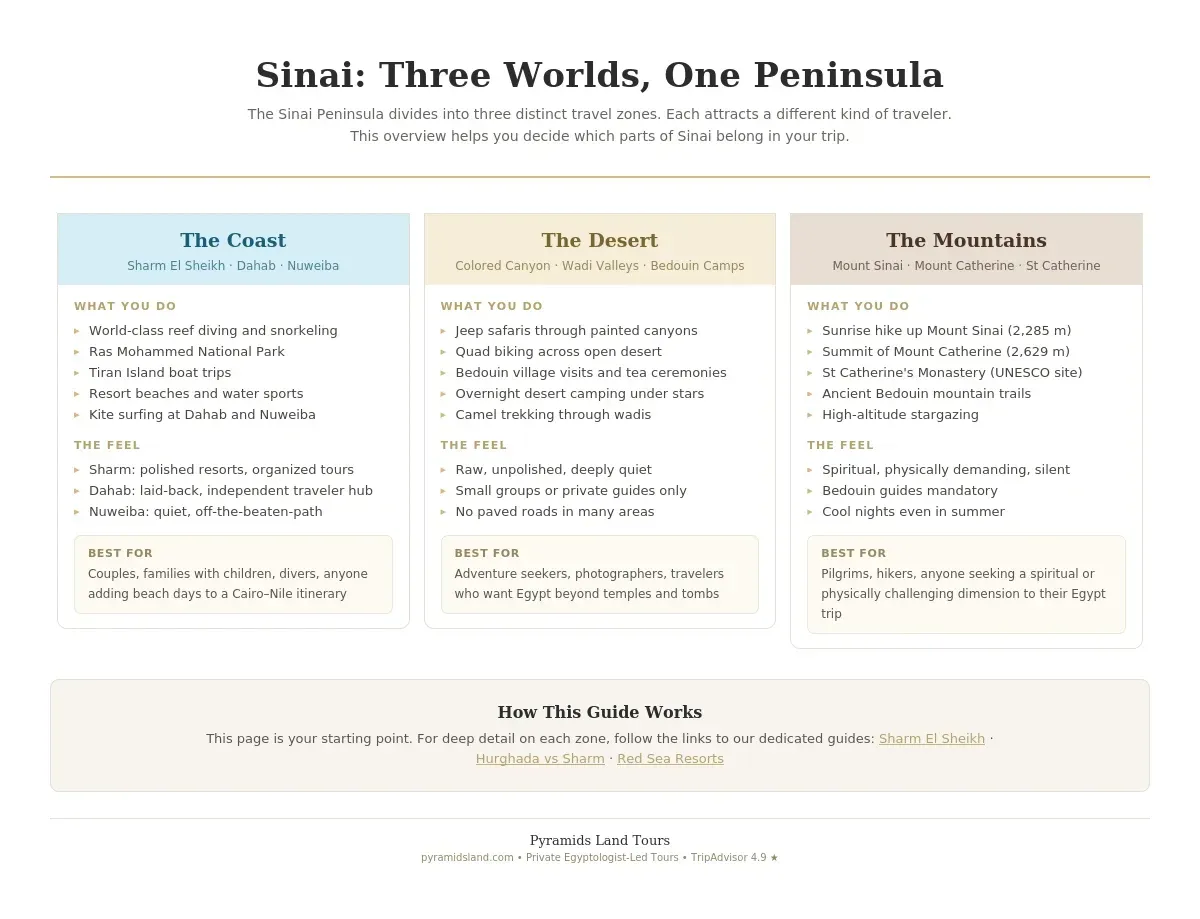
The Sinai coast offers world-class Red Sea diving and snorkeling (Ras Mohammed National Park, Tiran Island, the Blue Hole), resort beaches, kitesurfing, and boat trips across three towns: Sharm El Sheikh (organized resorts, best diving infrastructure), Dahab (budget-friendly, independent traveler hub, shore diving), and Nuweiba (quiet, access to the Colored Canyon).
Sharm El Sheikh is the commercial hub — with reliable infrastructure and direct access to Ras Mohammed National Park, one of the world's top-ten dive sites. The coral walls at Shark Reef and Yolanda Reef drop into deep blue water within meters of the shore. Visibility regularly exceeds 30 meters.
Dahab, an hour north of Sharm, is a different world entirely. Where Sharm attracts resort-goers and families seeking all-inclusive comfort, Dahab draws freedivers, digital nomads, and budget-conscious independent travelers who prefer beachfront cafés over lobby bars. The Blue Hole — a 100-meter-deep sinkhole in the reef — is Dahab's most famous site, though the entire coastline offers accessible shore diving that Sharm cannot match. If Sharm is the polished Red Sea resort experience, Dahab is its bohemian counterpart. The experience is completely different, and choosing the wrong one for your travel style is the most common mistake when booking in Sinai. Nuweiba, further north still, is the quiet option: minimal tourism, wide-open gulf views, and access to the Colored Canyon.
A warning about the Colored Canyon: Some operators in Dahab advertise it using photographs of Arizona's Antelope Canyon — a completely different site on a different continent. Worse, they then take you to the smaller Salama Canyon instead of the real Colored Canyon. Use a licensed operator who names the specific canyon and confirms the route before departure.
The coast is the easiest area for families, couples, and travelers who want to experience Sinai without physical strain. Day trips to the desert or mountains can be arranged from any coastal base and returned to by evening. For a detailed breakdown: Sharm El Sheikh Travel Guide. For the Red Sea comparison: Hurghada vs Sharm El Sheikh.
What Is the Sinai Desert Like?
Inland Sinai is a vertical desert of sharp granite walls, narrow wadis striped in ochre and copper, and Bedouin communities accessible only by jeep or camel. Key activities include jeep safaris ($40–70 per vehicle), quad biking ($30–50 per person), overnight Bedouin desert camping, and camel trekking through canyon systems — all led by indigenous Bedouin guides who navigate without paved roads.
A half-day quad biking trip covers enough terrain to feel the scale of the desert without exhaustion. Jeep tours go deeper, reaching canyon systems and Bedouin settlements inaccessible on foot without a guide.
The experience most travelers remember longest is overnight desert camping — tea with a Bedouin family, food cooked over a charcoal fire, and stars visible from horizon to horizon with near-zero light pollution. This is not a luxury glamping experience. It is simple, authentic, and profoundly quiet. For travelers who have spent a week absorbing the sensory overload of Cairo and the Nile temples, one night in the Sinai desert recalibrates everything.
ASHRAF FARES · Egyptologist
"When we drop camp the first afternoon, clients are always twitchy and stiff, compulsively checking dead phones and sitting on the woven rugs like they're waiting for a corporate meeting to start. By the next morning, that hyper-vigilant Western posture is completely shattered — they're sitting flat in the red dirt, moving with a slower gravity, and staring into the fire embers with a quiet, unbothered gaze. The desert doesn't just show them stars; it violently downshifts their nervous systems by stripping away the ambient noise they didn't even realize was suffocating them back home."
How Hard Is the Mount Sinai Hike?
The Mount Sinai sunrise hike is moderately difficult: a 2–2.5 hour ascent starting at approximately 2 AM, covering 2,285 meters elevation via either the gradual Camel Path (gravel switchbacks, camels available for the first two-thirds) or the steeper Steps of Penitence (3,750 hand-carved stone steps dating to the 6th century). A Bedouin guide is mandatory by local regulation (~650 LE / $13–15 per group). Summit temperatures before dawn can drop below 5°C — bring warm layers, a headlamp, water, and snacks.
Most guided groups ascend via the Camel Path and descend via the Steps. The guide fee is the government-set Bedouin rate — organized tours charge more because they bundle transport, blankets, and logistics. Tip your guide generously. This is a full night of physically demanding work at altitude for a government-fixed rate that does not reflect the difficulty or the responsibility. $10–20 USD per person in tips is appropriate and deeply appreciated.
Be honest with yourself about the summit experience. The sunrise is extraordinary. It is also crowded. Organized tour buses from Sharm and Dahab drop off large groups in waves between 4:00 and 5:00 AM. If you want solitude, consider the sunset hike instead — far fewer people, equally beautiful light, though you descend in darkness on rocky terrain. If you go for sunrise, arrive early and claim a position before the main wave.
ASHRAF FARES · Egyptologist
"Up there at 4:00 AM, it's a freezing, teeth-chattering chaos of heavy wind and tourists huddled in rented Bedouin blankets, murmuring in a dozen languages. But the exact second that first neon-orange line of fire cuts across the jagged peaks, the entire summit goes dead silent, and all you hear is a collective, sharp intake of breath. The glossy Instagram photos show pretty pink rocks, but they completely miss the raw, physical shock of that first solar heat hitting your face, which is the exact moment my clients drop their heads and just weep from pure, primal relief."
Saint Catherine's Monastery — Visiting Details
Saint Catherine's Monastery sits at the mountain's base — a UNESCO World Heritage Site, the oldest continuously operating Christian monastery in the world.
The monastery is typically open only on Monday, Tuesday, Wednesday, Thursday, and Saturday from 9:00 AM to 12:00 PM. It is closed on Fridays, Sundays, and all public holidays — both Christian and Islamic. Hours shift seasonally, and the monastery has closed for restoration without notice in the past. Confirm current hours before making the trip. Arrive by 9:00 AM; late arrivals may not be admitted.
Dress code is strict: shoulders and knees must be covered, no shorts, no sleeveless tops. Women may be asked to cover their hair. Modest clothing is provided at the entrance if needed, but bringing your own avoids the queue.
Inside, the Basilica of the Transfiguration houses one of the world's finest collections of early Byzantine mosaics. The Burning Bush — revered as the site where Moses received his divine commission — grows in the monastery courtyard. The library holds over 3,300 manuscripts in Greek, Arabic, Syriac, and Ethiopian, second in historical significance only to the Vatican's collection. Photography is generally not permitted inside.
Private transfers from Sharm El Sheikh or Dahab to Saint Catherine's and back can be arranged as a day trip — typically departing before dawn to combine the Mount Sinai hike with a morning monastery visit before returning to the coast by afternoon.
Mount Catherine (2,629 meters) is Egypt's highest peak. Harder, less crowded, no camel path. Most visitors go to Mount Sinai. Serious hikers add Catherine.
Who Are the Sinai Bedouin?
The Sinai Bedouin are the indigenous tribal communities who have inhabited the peninsula for centuries — primarily the Jabaliya near Saint Catherine and the Muzeina in the south. Every hiking guide on Mount Sinai, every desert safari driver, and every canyon trek leader is Bedouin. Guided village visits cost $15–25 per person and include tea, conversation, and access to a way of life that has changed remarkably little.
Bedouin guides do not follow scripts. They read weather, terrain, and group energy in real time. A good guide adjusts the pace of a Mount Sinai hike based on how the group is moving. A great one stops at a point where the canyon acoustics change and lets the silence speak for itself.
Photography etiquette matters: ask before photographing people, especially women and children. Small purchases of handwoven textiles, jewelry, or spices directly support the community and are welcome.
ASHRAF FARES · Egyptologist
"Before we step into a Bedouin compound, I tell my clients to put their wallets away and forget every transactional survival instinct they learned in Cairo or Luxor. Westerners are always stunned by the utter absence of a hustle; a Bedouin host will pour you sweet sage tea with the quiet, effortless dignity of an old-world king, asking for absolutely nothing in return. It completely paralyzes my clients' cynical tourist wiring because they suddenly realize they aren't being handled as paying customers, but protected as sacred guests."
Should I Go to Sinai or Hurghada?
Both sit on the Red Sea. Both offer diving, snorkeling, and beach resorts. The difference is what exists beyond the beach.
Choose Sinai if you want beach time combined with a Mount Sinai sunrise hike, desert exploration, or Bedouin cultural experiences. Sinai offers three zones in one destination. Hurghada offers one — the coast — and does it well, but there is no mountain or desert equivalent within day-trip range.
Choose Hurghada if your priority is pure beach relaxation with road access to Luxor and the Valley of the Kings. Hurghada connects to Luxor by road, making it a natural extension of a Nile-focused itinerary. Sinai requires a flight or a long drive from the Nile corridor.
Choose both if you have 14+ days. Spend three nights in Hurghada after the Nile cruise, then fly to Sharm for Sinai exploration. Depart from Sharm's international airport without backtracking to Cairo.
Full comparison: Hurghada vs Sharm El Sheikh. Hurghada detail: Hurghada Travel Guide. Broader options: Red Sea Resorts Guide.
Do I Need a Visa for Sharm El Sheikh?
If you are staying in South Sinai only — Sharm El Sheikh, Dahab, Nuweiba, or Taba — for up to 15 days, you do not need a paid visa. Egypt offers a free Sinai-Only entry stamp at Sharm El Sheikh and Taba airports. Inform the immigration officer that you are staying within Sinai; they scan your passport and apply the electronic stamp. Processing takes under two minutes.
Duration: The stamp is officially valid for 15 days. However, some sources and airline websites cite 14 days. To be safe, plan your departure by day 14. Do not schedule a flight on the final day with no margin.
Strict limitation: The free stamp does not permit travel to mainland Egypt. The moment you leave the Sinai Peninsula — even for a day trip to Cairo — you need the full 30-day tourist visa ($30 USD, payable in cash at any arrival airport).
Ras Mohammed by boat: If you visit Ras Mohammed National Park by land, the Sinai stamp is usually sufficient. However, for boat trips to offshore diving zones, authorities often require a full visa. Confirm with your dive operator before booking.
SS Thistlegorm wreck: This world-famous dive site near Sharm requires a full visa, not the Sinai stamp. If Thistlegorm is on your list, purchase the $30 visa on arrival regardless of your other plans.
The passport must be valid for at least 6 months from the date of entry. Full details: Egypt Visa and Entry Requirements. Customs and airport procedures: Egypt Entry Requirements and Customs Guide.
How Much Does a Sinai Trip Cost?
A Sinai trip costs $50–90 per person per day on a budget (hostels, street food, public beaches), $120–200 per day at mid-range (3–4-star hotels, guided snorkeling, restaurant meals), and $250–450+ per day at high comfort (5-star resorts, private guided dives, private transfers). The biggest cost variable is transport: a Cairo-to-Sharm flight costs $90–140 (one hour) versus $15–25 by bus (6–8 hours).
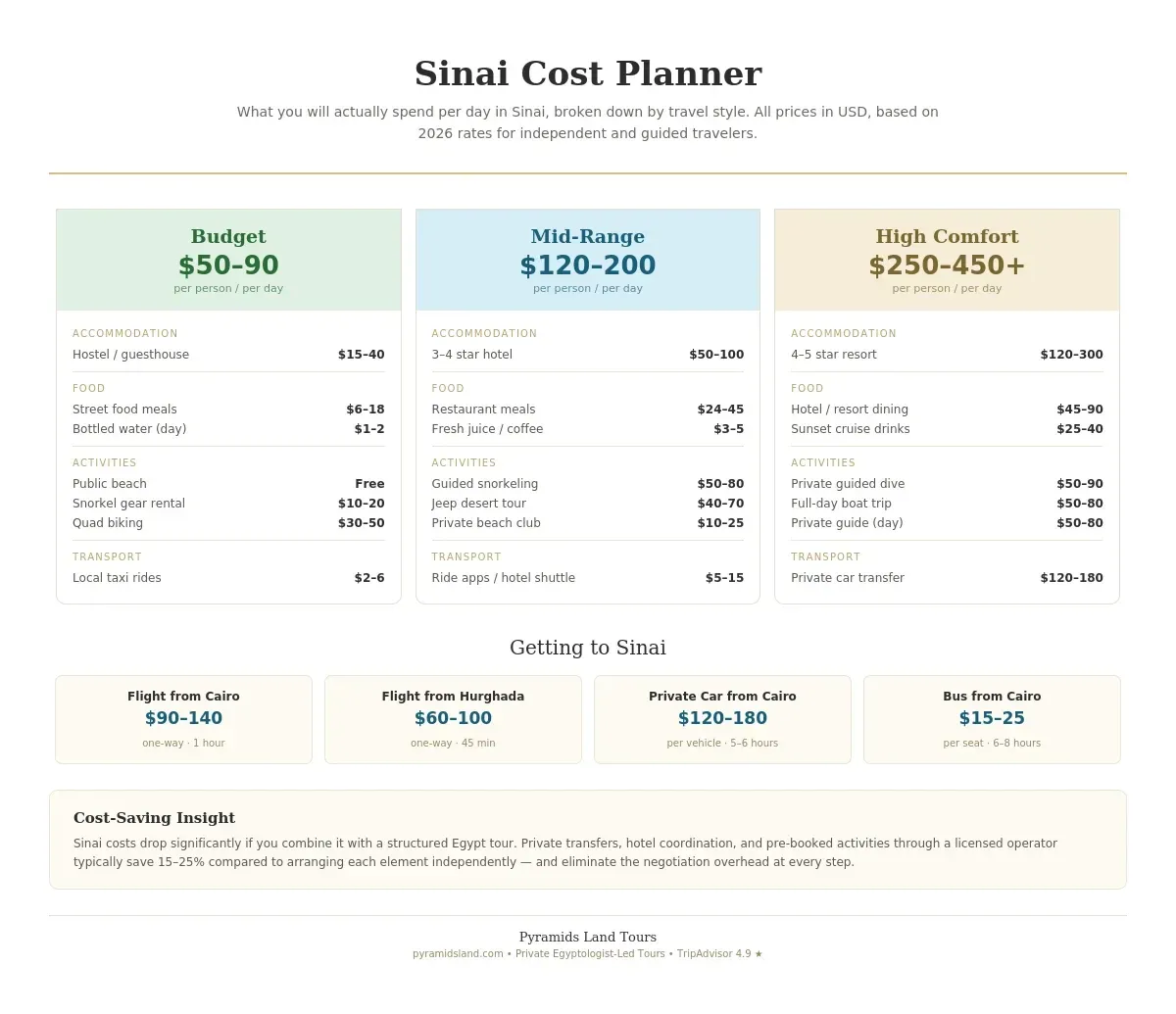
The biggest variable is not accommodation or food — it is how you get there. A private car from Cairo costs $120–180 for the vehicle, not per person. Split between two travelers, that rivals a bus ticket per person with five fewer hours of travel time.
Guided activities are where costs add up and where value concentrates. A $50 guided snorkeling trip at Ras Mohammed includes marine park entry, equipment, boat transfer, and expert reef navigation. Doing it independently costs $30–40 in additional fees without a guide.
Watch for hidden surcharges. Across 4,500+ reviewed Sharm tours, the #1 complaint is costs that appear after booking — "mandatory national park taxes" or "port fees" ranging from 350–800 EGP per person. Ask for the all-inclusive price before you book. If an operator cannot give you a single final number, that is your answer.
Accommodation
Budget ($15–40/night): Hostels and guesthouses, strongest in Dahab. Dahab's budget scene is among the best in Egypt — clean, social, and directly on the water.
Mid-range ($50–100/night): 3–4-star hotels with breakfast. Check location carefully — in Sharm, the difference between Naama Bay and the outskirts is the difference between walking to restaurants and needing a taxi for everything.
High comfort ($120–300/night): 4–5-star resorts with private beaches and concierge tour booking.
Food and Drink
Street food ($2–6/meal): Falafel, grilled fish, koshary, and fresh juice. The best street food in Sinai is in Dahab's waterfront strip and Sharm's Old Market.
Mid-range restaurants ($8–15/meal): Often with a sea view. Ask for the local catch of the day — Red Sea fish grilled simply with lemon and cumin is hard to beat.
Hotel restaurants ($15–30/meal): Room service incurs an additional cost. Drink bottled water only. Deeper guide: Egypt Food and Dining Guide.
Activities
Snorkel gear: $10–20/day. Guided snorkeling: $50–80. Day dives: $50–90. Quad biking: $30–50. Jeep safari: $40–$ 70 per vehicle. Bedouin visit: $15–25. Mt Sinai Bedouin guide: ~650 LE (~$13–15) per group. Kite lesson: $50–80/hr. Boat trips: $10–80. Sunset cruise: $25–40.
Transport detail: Egypt Transportation Guide.
How Do I Get to Sinai from Cairo?
The fastest route from Cairo to Sinai is a one-hour flight to Sharm El Sheikh ($90–140 one-way). Alternatives: private car via the Ahmed Hamdi Tunnel under the Suez Canal ($120–180 per vehicle, 5–6 hours) or bus from Cairo's Turgoman station ($15–25 per seat, 6–8 hours). From Hurghada: 45-minute flight ($60–100) or ferry.
Most travelers fly. The cost difference between a flight and a bus is small relative to the time saved — and for travelers on a 10-day itinerary, that saved day is worth more than the ticket price. Book flights online in advance; early departures are less likely to face delays.
Entering Sinai from Israel or Jordan
The Taba border crossing connects Eilat (Israel) to the Sinai Peninsula and operates daily. Processing takes 30–60 minutes depending on queue length. You will need your passport (minimum 6 months' validity) and either the free Sinai-Only stamp (if staying only in South Sinai) or the full $30 USD Egyptian tourist visa (if continuing to Cairo or the Nile). A taxi from the Taba border to Dahab costs approximately $40–60; to Sharm El Sheikh approximately $80–120.
Travelers arriving from Jordan typically cross at Aqaba to Taba overland through Eilat. A ferry service between Aqaba and Taba has operated intermittently — verify current schedules before planning this route, as the service may be suspended without notice. Confirm your visa situation before crossing — the Sinai stamp is issued at the Egyptian side of the border, not in advance.
Local Transport
Taxis: $2–6 within resort towns. Negotiate the fare before entering. In Sharm, the fare from Naama Bay to Old Market is a fixed $5–7.
Ride apps: Price is fixed in-app. Strongest in Sharm; limited in Dahab; nonexistent in remote areas.
Hotel shuttles: Some resorts provide free or paid transfers. Ask at check-in.
Full picture: Egypt Transportation Guide.
Where Are the Best Dive Sites in Sinai?
The best dive sites in Sinai are Ras Mohammed National Park (Shark Reef and Yolanda Reef, entry $10, visibility 30+ meters), Tiran Island (four named reef systems, boat access, $50–90, best for experienced divers), and Nabq Protected Area (entry $5, shallower water, ideal for beginners, unique mangrove ecosystem). PADI certification courses are available in Sharm and Dahab (3–4 days, $300–450). Introductory Discover Scuba dives cost $50–80 for a single morning.
Certification: If you are not yet certified, both Sharm and Dahab have PADI-accredited dive centers. Full Open Water certification takes 3–4 days. Discover Scuba (a supervised introductory dive without certification) takes a single morning.
Water safety: Check currents and tides before entering. Never venture far from shore without a guide at Ras Mohammed or Tiran, where currents are powerful. Do not touch coral — it damages the reef and can cause painful cuts. Wear reef-safe sunscreen. Avoid swimming alone in unfamiliar areas.
How Many Days Do You Need in Sinai?
Most travelers need 3–5 days in Sinai. Two days cover the coast only (beach + one snorkeling trip). Three days add a desert experience. Five days cover all three zones — coast, desert, and the Mount Sinai sunrise hike — without rushing. Seven days are for diving enthusiasts and serious hikers. Sinai fits best in 10-day or longer Egyptian itineraries; at 7 days, the Cairo–Nile–Aswan cultural core should take priority.
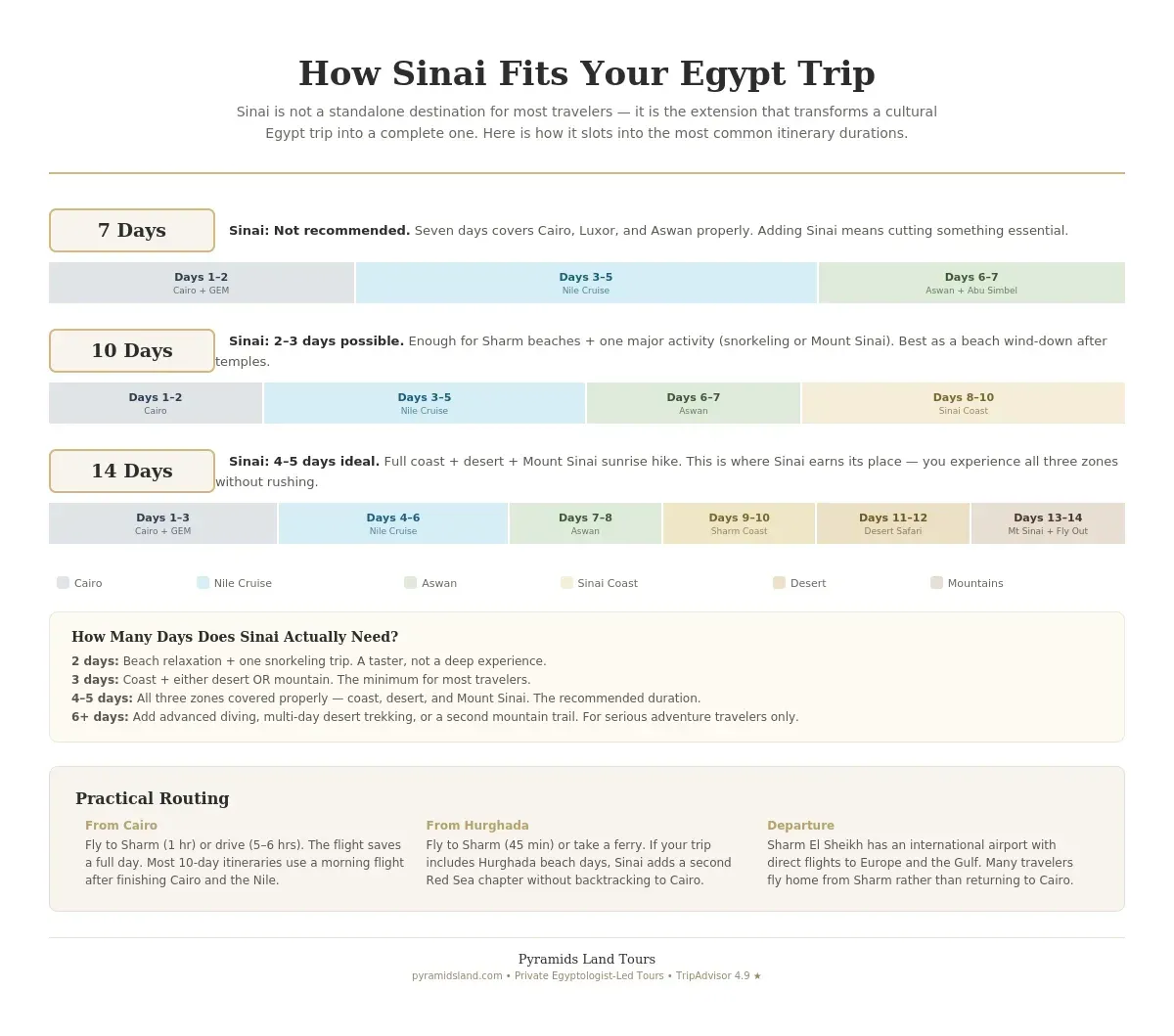
7 days in Egypt: No Sinai. Spend them on Cairo, the Nile, and Aswan. → 7-Day Egypt Itinerary
10 days: Sinai viable — 2–3 nights in Sharm as beach wind-down after temples. The most common way our clients add Sinai. → 10-Day Egypt Itinerary
14 days: Sinai earns full value. 4–5 days across all three zones without cutting anything from the main Egypt circuit. → 14-Day Egypt Itinerary
Broader view: How Many Days in Egypt.
3 Days in Sinai (the minimum)
Day 1: Arrive Sharm, marina walk, seafood dinner. Day 2: Guided snorkeling at Ras Mohammed or Tiran boat trip ($50–80). Afternoon at the Old Market. Day 3: Quad biking ($30–50) or Bedouin village visit ($15–25); depart. Covers coast + desert taste. Mount Sinai is not realistic unless you skip the coast entirely.
5 Days in Sinai (the full experience)
Adds a full desert day — jeep safari through canyon systems, Bedouin camp lunch, sunset photography — and the Mount Sinai sunrise hike with a morning visit to Saint Catherine's Monastery (entry $5). All three zones covered. Final beach day before departure.
7 Days in Sinai (for enthusiasts)
Adds advanced diving at specific reef sites, a second mountain trail (Mount Catherine or Wadi Arbain), boat days to remote spots, and genuine rest days on private beaches ($10–25 entry).
What Is the Best Time to Visit Sinai?
The best time to visit Sinai is October through April. October–November is the sweet spot: water temperatures are warm for diving (26–28°C), air temperatures are comfortable for desert and mountain activities (25–30°C), and peak-season crowds have not yet arrived.
October–November: Ideal. Warm water, comfortable air, pre-peak crowds.
December–February: Peak season. Air 18–26°C. Perfect for hiking and desert exploration. Resorts are busiest, prices are highest. Book well in advance. Ramadan dates shift annually. In 2026, it falls approximately from February 18 to March 19. In 2027, it falls approximately February 8 – March 9. During Ramadan, some restaurants outside hotels close during daylight hours, and the pace of daily life slows. Hotel restaurants and resort dining operate normally. The Mount Sinai hike is unaffected. If your trip overlaps with Ramadan, plan meals through your hotel and carry snacks for daytime excursions.
March–April: Spring shoulder. 25–32°C. Moderate crowds. Occasional khamsin winds in March can disrupt desert activities for a day or two. Easter brings pilgrimage crowds to Saint Catherine's Monastery and the Mount Sinai summit. Expect the sunrise hike to be significantly busier during Easter week — both Western and Orthodox Easter dates. Book Bedouin guides and accommodation well in advance for these periods. Khamsin winds — hot, sand-carrying winds from the Sahara — can hit in March and occasionally early April. They typically last 1–2 days and disrupt desert activities, reduce visibility, and make outdoor dining unpleasant. The coast is less affected.
May–September: Summer. The coast is pleasant for swimming and diving. Desert and mountain activities limited to early morning — afternoon temperatures exceed 38°C inland. Budget travelers benefit from significantly lower hotel rates.
Broader guidance: Best Time to Visit Egypt.
Is Sinai Safe for Tourists?
South Sinai — including Sharm El Sheikh, Dahab, and Saint Catherine — is safe for tourists and has operated with continuous daily tourist traffic for decades. The UK FCDO, the US State Department, and Australian Smartraveller all confirm that South Sinai's tourist areas are accessible. The US State Department notes that even its own embassy personnel are authorized to travel to South Sinai with a professionally licensed tour company. Travel advisories for North Sinai refer to a separate military zone that tourists do not visit and tour operators do not serve.
Standard precautions apply: watch your personal belongings in crowded markets, use licensed taxis or ride-sharing apps, and avoid street-side operators offering unofficial tours at steep discounts. If someone approaches you near an attraction claiming to be a guide without identification, they are not a licensed guide.
Is Sinai Safe for Solo Female Travelers?
South Sinai is one of the more comfortable regions in Egypt for solo female travelers. Sharm El Sheikh's resort infrastructure means you are rarely in uncontrolled environments. Dahab's backpacker culture has a long history of welcoming solo women — many of whom stay for weeks or months.
Practical advice: dress modestly outside resort areas (cover shoulders and knees). In Bedouin communities, conservative dress is not optional — it is a sign of respect that directly affects how warmly you are received. Avoid walking alone in poorly lit areas after midnight, as you would anywhere.
If you want a female guide, we can arrange it. Zenab is a licensed Egyptologist who leads Luxor and Sinai trips specifically for solo women and all-female groups. She handles logistics, cultural navigation, and the small daily frictions that a male guide may not anticipate. Request her by name when booking.
The Mount Sinai sunrise hike is done in groups — you will never be alone on the trail. Desert camping is arranged through licensed operators with established camp infrastructure. In resort areas and established tourism corridors, the risk profile for solo female travelers in South Sinai is comparable to Southern Europe — normal precautions, no unusual danger.
Emergency Contacts
Sharm El Sheikh International Hospital: 24/7, Tel 069 3600000. Police: 122. Tourist police available at main resorts. Ambulance: 123. Private services $100–200 per transport. Embassy: Keep your embassy number saved.
Local Customs
Dress: Light cotton for heat. Modest attire in villages and religious sites. Cover shoulders and knees at mosques and Saint Catherine's Monastery. Resort and beach areas are relaxed.
Tipping: $5–10/day for guides, $3–5 for drivers, $2–5 for boat/desert staff. For Mount Sinai Bedouin guides specifically: $10–20 per person — their government-set fee does not reflect the physical demands of the work.
Language: Arabic primary. English is understood in hotels, resorts, and tourist areas. Basic Arabic greetings appreciated and warmly received.
Connectivity and Packing
SIM cards: $10–20 with data. Coverage is strong on the coast, intermittent in the mountains, and nonexistent in the deep desert. Download offline maps before heading inland. → Egypt SIM Card and Internet Guide
Currency: Egyptian pound. Exchange at banks or official counters. Keep small bills for taxis and tips.
Health: Bottled water only. Sunscreen and a hat are essential. A first aid kit is recommended for desert and mountain trips.
Packing: Light cotton clothing, sunglasses, sunscreen, swimsuit. Walking shoes (not sandals) for hiking. Small backpack for water and camera.
Headlamp essential for pre-dawn Mount Sinai ascent. Bring layers — the temperature difference between the base and the summit can be 15°C.
Planning Sinai Into Your Egypt Trip
Sinai works best when planned as part of a wider Egypt itinerary — not bolted on at the last minute. The flight connections, hotel sequencing, and activity timing all benefit from being coordinated in advance. The difference between a Sinai extension that feels seamless and one that feels like a logistical scramble is almost always the planning.
If you are building an Egypt trip that includes Sinai, we can help you decide how many days to allocate, which zone fits your travel style, and how to route the logistics so nothing is wasted. Every itinerary we build is private, guided, and designed around your specific dates and interests.
Frequently Asked Questions
How many days do you need in Sinai?
Minimum 3 days for the coast and a desert taste. 5 days to cover all three zones (coast, desert, Mount Sinai). 7 days for advanced diving and multiple mountain trails. Most travelers adding Sinai to a broader Egypt trip allocate 3–5 days.
Is Sinai safe for tourists in 2026?
South Sinai — Sharm El Sheikh, Dahab, Saint Catherine — is safe and operates daily tourist traffic. North Sinai is a separate, restricted military zone that tourists do not visit. The UK FCDO, US State Department, and Australian Smartraveller all confirm South Sinai's tourist areas as accessible.
Do I need a visa for Sharm El Sheikh?
If you are staying in South Sinai only (Sharm, Dahab, Nuweiba, Taba) for up to 15 days, you can enter with a free Sinai-Only stamp. If you plan to visit Cairo, Luxor, or anywhere outside the Sinai Peninsula, you need the full 30-day tourist visa ($30 USD). The Sinai stamp does not cover boat trips to some offshore dive sites or the SS Thistlegorm wreck.
What is the best time to visit Sinai?
October through April. The coast is comfortable year-round. Desert and mountain activities are best November through March when temperatures are moderate. Summer (June–September) works for diving but desert temperatures exceed 38°C and mountain hikes should be limited to early morning.
How much does a Sinai trip cost per day?
Budget: $50–90/day. Mid-range: $120–200/day. High comfort: $250–450+/day. All per person. The biggest variable is transport — a Cairo-to-Sharm flight ($90–140) saves a full day compared to the bus ($15–25).
Is the Mount Sinai hike difficult?
Moderately difficult. The Camel Path is a gradual gravel track; the final 750 Steps of Penitence are steep. Total ascent takes 2–2.5 hours. A Bedouin guide is mandatory. Bring warm layers (summit is freezing before dawn), water, headlamp, and snacks. The sunrise summit is crowded; the sunset alternative is quieter but requires descending in darkness.
Can I visit Sinai independently without a tour?
Yes. Many travelers do, especially in Dahab. But the consistent pattern from travel forums is that experienced independent travelers who visited Sinai without a guide wish they had one — not because they could not manage, but because a guide opened access to desert routes, Bedouin communities, and timing knowledge that independent travelers miss.
What is the Colored Canyon and how do I avoid scams?
The Colored Canyon is a spectacular slot canyon near Nuweiba with naturally striped sandstone walls. Some Dahab operators advertise it using photos of Arizona's Antelope Canyon, then take tourists to the smaller Salama Canyon instead. Use a licensed operator, confirm the specific canyon by name, and verify the route before departure.
Can I visit Cairo with a Sinai-only visa stamp?
No. The free Sinai-Only stamp restricts you entirely to South Sinai — Sharm El Sheikh, Dahab, Nuweiba, Taba, and the Saint Catherine area. If you attempt to board a domestic flight to Cairo, cross the Suez Canal checkpoint, or travel to Luxor or Hurghada, you will be turned back. If your Egypt trip includes any destination outside the Sinai Peninsula, purchase the full 30-day tourist visa ($30 USD) on arrival at the airport. Do not accept the free stamp at the immigration counter if you have plans beyond Sinai — switching from the free stamp to a full visa inside the country is unreliable and not guaranteed.
Ashraf Fares