
Ancient Egyptian Temples: A Guide to the Ones Worth Your Time
***Edited July 23, 2026
Quick answer: Ancient Egyptian temples were houses for gods, not places of public worship — machines for keeping the universe running, staffed by priests who tended a god's statue daily. They follow a fixed layout: pylon → open court → hypostyle hall → sanctuary, with the floor rising, the ceiling lowering, and the light fading as you move inward. The major temples are Karnak (scale), Abu Simbel (drama), Philae (setting), Edfu (preservation), Hatshepsut's (silhouette), and Luxor Temple (the night visit). The cure for "temple fatigue" is learning to read one. Verified June 2026.
Egypt has more standing temples than any country on Earth, the major ones cluster within a few hours of each other along the Nile, and by day three they begin to blur into one long corridor of columns and kings. Travelers have a name for it: temple fatigue. This guide prevents it — first by teaching you to read any temple so they stop looking alike, then by telling you honestly which ones earn your limited time.
The Real Cure for Temple Fatigue: Learn to Read One Temple
The cure for temple fatigue is not seeing fewer temples — it is learning to read one, because a temple you can read is a story and a temple you can't is a pile of impressive rocks. The traveler who is "templed out" by day three is almost never tired of temples; they are tired of not understanding them.
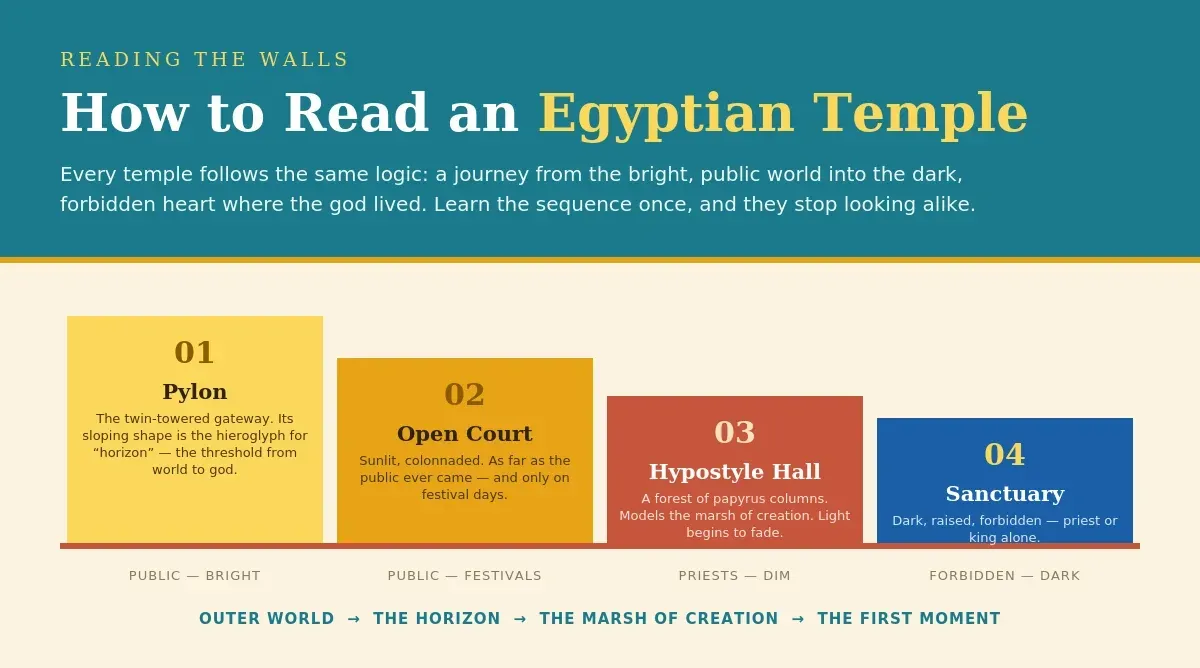
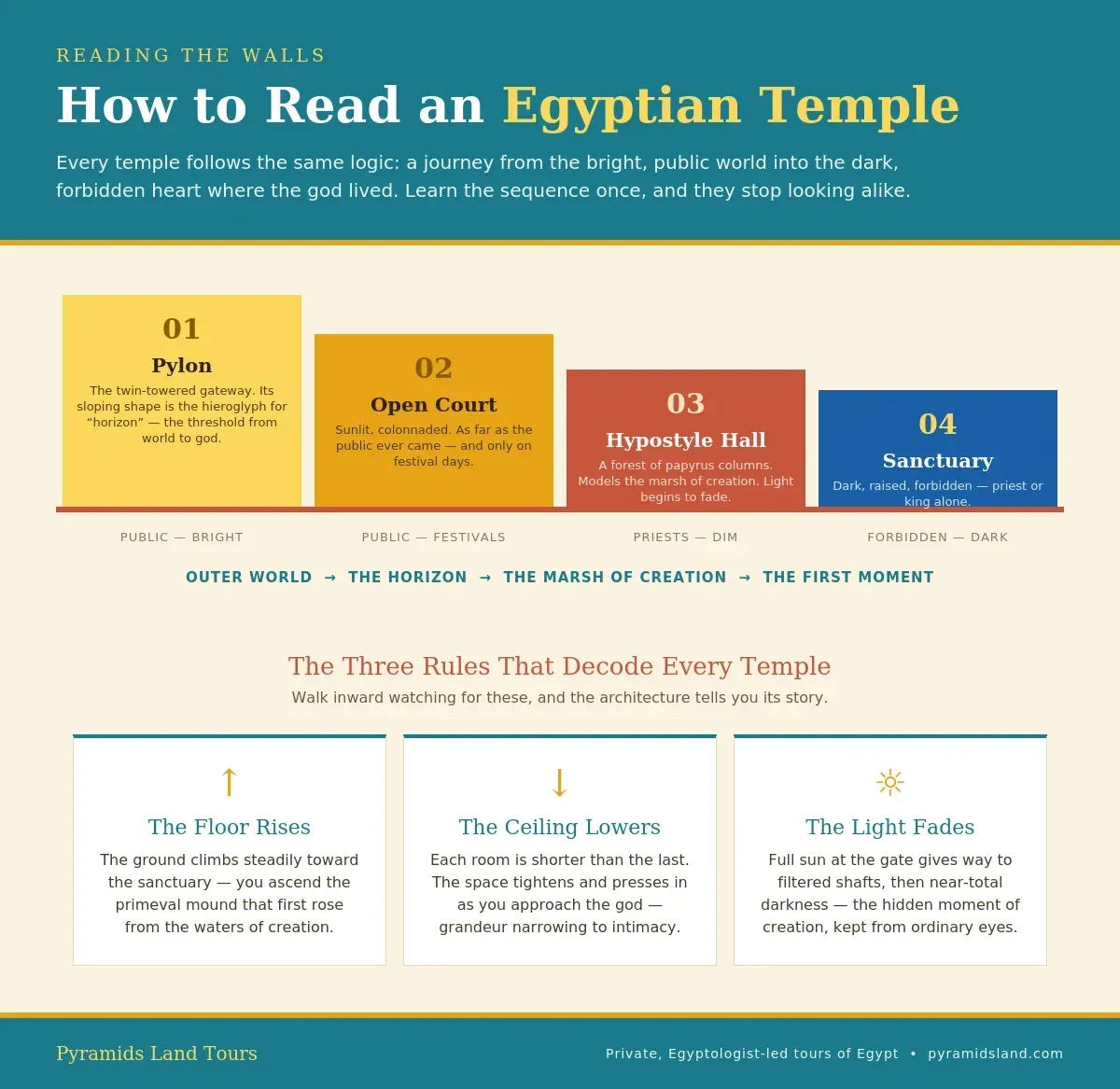
Egyptian temples were built according to a shared logic. Learn it once, and it unlocks all of them, because the same grammar runs from Karnak to Philae. The standard cult temple is a journey from light into darkness, from public into forbidden, in a fixed sequence:
The avenue and the pylon. You approach along a processional way, often lined with sphinxes, to massive trapezoidal towers — the pylon, whose sloping shape is the hieroglyph for "horizon." Its outer face almost always shows the pharaoh smiting Egypt's enemies: a "no entry to chaos" sign at monumental scale. The open court. A sunlit colonnaded courtyard — as far as the public ever came, and only on festival days. The hypostyle hall. A forest of papyrus columns holding a stone roof, the central aisle raised so clerestory windows drop shafts of light into deepening gloom. The temple is modeling the marsh of creation. The sanctuary. The innermost room: small, dark, the floor risen, the ceiling lowered, the god's statue in a shrine — pharaoh or high priest only.
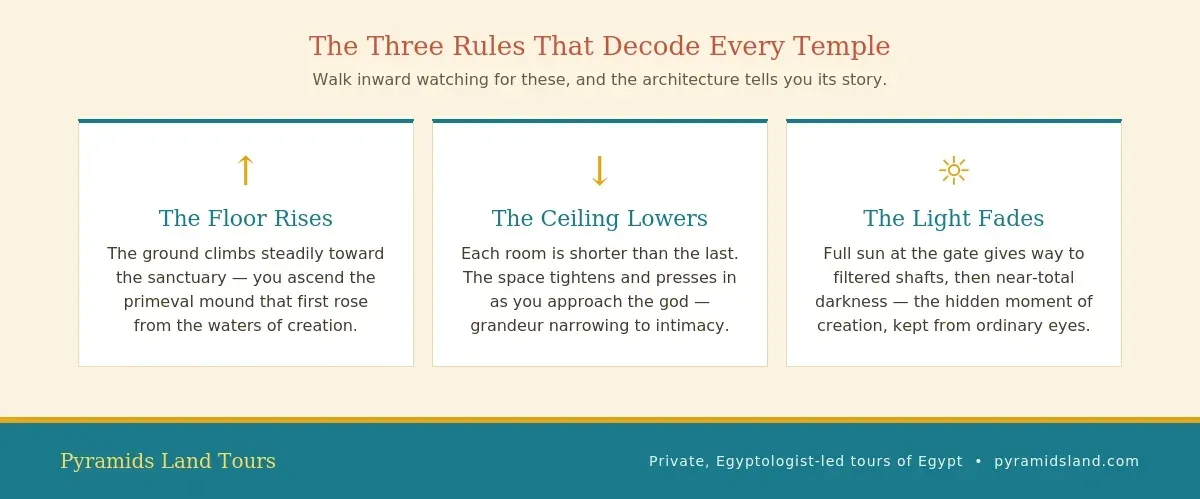
Three features encode the whole theology: the floor rises, the ceiling lowers, and the light fades as you move inward, recreating the primeval mound emerging from darkness. Walk any temple, watching for those three things, and it tells you its story. → Ancient Egyptian Religion — the belief system every temple was built to serve
One thing photographs rarely prepare you for: these temples were not bare sandstone. Every wall was painted in vivid color — blues, reds, golds, greens — and in shaded spots (ceilings at Karnak and Dendera, the Hatshepsut chapels) the original pigment still survives, 3,000 years on.
This is exactly what a private Egyptologist changes about your trip. Reading the walls back into the sentences they were carved to be is the difference between sightseeing and understanding — and the reason our guests don't get "templed out." → Message us on WhatsApp · Browse private Egypt tours
A Quick Vocabulary for Reading Any Temple
Five terms decode any Egyptian temple: pylon (the gateway), hypostyle hall (the columned hall), sanctuary (the inner shrine), cartouche (the oval enclosing a royal name), and the cult-vs-mortuary distinction.
Pylon — the monumental twin-towered gateway- symbolizes the horizon. Hypostyle hall — a roofed hall packed with columns; models the marsh of creation. Sanctuary — the dark innermost shrine that housed the god's statue. Cartouche — the oval loop enclosing a royal name; find these to identify who built a wall. Cult vs. mortuary temple — a cult temple housed a living god (Karnak, Edfu); a mortuary temple served a dead, deified king (Hatshepsut's Deir el-Bahari, the Ramesseum, Medinet Habu).
The Major Temples, Ranked by What You Actually Care About
There is no single "most famous" Egyptian temple — Karnak wins for scale, Abu Simbel for drama, Philae for setting, Edfu for preservation, and Hatshepsut's for its silhouette. They don't compete on a single scale, so here is the honest version, matched to what you came for.
| Temple | Location | Best for | Time |
|---|---|---|---|
| Karnak | Luxor, East Bank | Sheer scale — the largest ancient religious complex on Earth | 2–3 hrs |
| Abu Simbel | 280 km S of Aswan | Drama; the solar alignment (Feb 22 & Oct 22) | 2 hrs |
| Philae | Aswan, by boat | Most beautiful setting; island temple of Isis | 1.5 hrs |
| Edfu | Luxor–Aswan | Best preserved; shows what a complete temple looked like | 1.5 hrs |
| Kom Ombo | N of Aswan | The strange "double temple" of two gods | 1 hr |
| Hatshepsut (Deir el-Bahari) | Luxor, West Bank | The terraced silhouette; female pharaoh | 1.5 hrs |
| Luxor Temple | Luxor, East Bank | The night visit — lit columns after dark | 1–1.5 hrs (evening) |
For sheer scale: Karnak
The largest religious complex of the ancient world.→ Karnak is not one temple but a precinct grown over 2,000 years, dedicated chiefly to Amun-Re. Its Great Hypostyle Hall — 134 columns over nearly an acre, the central twelve rising 21 meters — is the single most overwhelming space in Egypt. Do not attempt it on the same day as another major temple. And when the central aisle is shoulder to shoulder, step off the main axis — most visitors never leave it, and whole courts sit empty a short walk away. For travelers who want the Hypostyle Hall before the first bus arrives, we can arrange pre-opening access by special permit — booked well in advance, never guaranteed, and worth every form. Karnak and Luxor Temple were once joined by the Avenue of Sphinxes — a near-3-km processional road lined with hundreds of ram- and human-headed sphinxes, used for the annual Opet festival. It was excavated and ceremonially reopened in 2021, and you can now walk stretches of it between the two temples.
For drama: Abu Simbel
Four 20-meter Ramesses II colossi carved into a Nubian cliff — built as propaganda, not worship. On roughly 22 February and 22 October, the rising sun reaches the sanctuary. → Abu Simbel was cut apart and moved uphill in the 1960s to escape Lake Nasser; it is the hardest-to-reach major site and the one nobody regrets.
For setting: Philae
The temple of Isis on an island, reachable only by boat. Relocated stone by stone to save it from the dam. Among the last working temples of the old religion, with Christian crosses carved beside the pharaonic reliefs — and the best evening sound-and-light show in Egypt. → Aswan Travel Guide — Philae, the High Dam, and the Nubian south
For preservation: Edfu
The best-preserved major temple — roof on, pylon standing, walls complete — so it shows what the ruined giants once were. Dedicated to the falcon god Horus, built in the Ptolemaic period in fully Egyptian style.
For something strange: Kom Ombo
The "double temple": perfectly symmetrical with two entrances and two sanctuaries, because it served two gods at once — Sobek the crocodile god and Horus the elder. A mummified crocodile museum sits beside it. → Kom Ombo Temple Guide
For the silhouette: Hatshepsut's Temple
The terraced mortuary temple of Egypt's most successful female pharaoh, rising in colonnaded tiers against a cliff — strikingly modern, 3,500 years old, with a → chapel to Anubis whose paint still survives.
For the night visit: Luxor Temple
The temple most travelers see wrong. By day it sits in the middle of a working city, hot and hemmed in; after dark — it stays open well into the evening — the great colonnade of Amenhotep III is lit from below and the crowds thin to a murmur. Luxor Temple's business was kingship: this is where the Opet festival renewed the pharaoh's divine ka each year, the procession arriving from Karnak along the Avenue of Sphinxes. And the worship never really stopped. A Roman legion camped inside its walls, Coptic churches were built into its courts, and the 13th-century Abu Haggag mosque still holds Friday prayers there today — some 3,400 years of devotion layered on the same ground. One obelisk still flanks the gate; its twin has stood in Paris's Place de la Concorde since 1836.
The honest "you can skip it" note
If temple fatigue is setting in on a land-based itinerary, Kom Ombo is the one to drop — its double-temple novelty is genuine but brief — while Edfu earns its slot for anyone who has never stood inside a temple with its roof still on. On a cruise, the question answers itself: the boat docks at both, and each costs you an hour, not a day. Luxor Temple is best saved for after dark. A temple seen through exhaustion teaches you nothing — give yourself a felucca afternoon instead, no guilt.
The temples the cruise ships never see
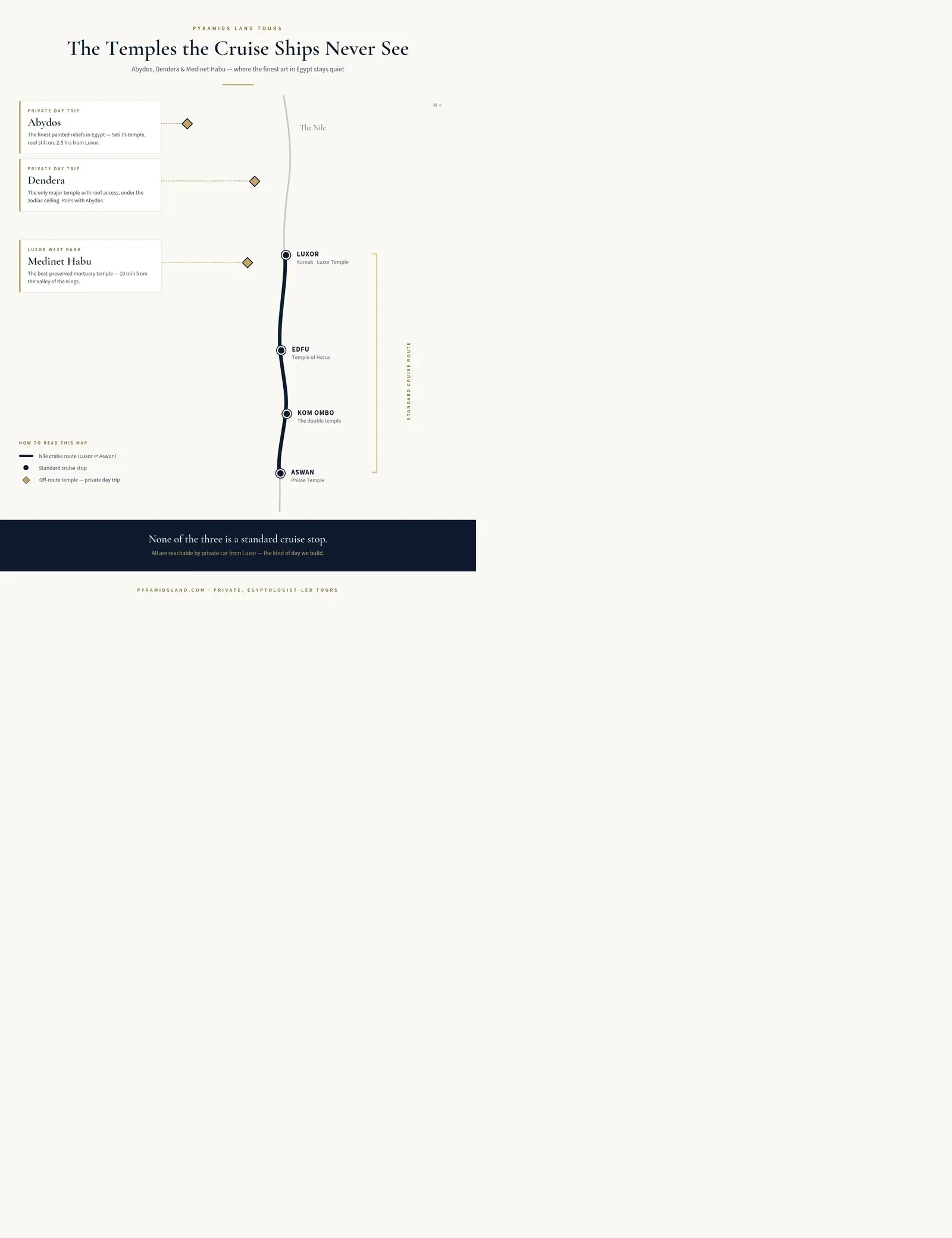
The three temples experienced travelers rate highest — Abydos, Dendera, and Medinet Habu — are not standard cruise stops, which is exactly why they reward the travelers who make the effort. Ask the people who return to Egypt year after year which temple they would keep above all others, and these names come up more often than any in the table above.
Abydos holds what many Egyptologists consider the finest painted reliefs in Egypt — the temple of Seti I, one of the very few with its roof still on, which is why so much survives inside. This was ancient Egypt's great pilgrimage ground, the place Egyptians believed Osiris himself was buried. It sits about 2.5 hours north of Luxor by road, so you often share it with a handful of visitors rather than a fleet of buses. Your ticket also covers the nearby temple of Ramesses II — a ten-minute walk across the desert that almost nobody takes.
Behind the Seti temple lies the Osireion (often spelled Osirion) — a half-sunken hall of massive granite piers so unlike everything around it that it has fed a century of speculation. Mainstream Egyptology dates it to Seti I's reign, a symbolic tomb of Osiris built to sit in the groundwater like the mound of creation rising from the primeval flood. Most visitors only ever see it from the rim above. Entry into the structure itself requires a special permit from the Ministry of Tourism and Antiquities — [ASHRAF-CONFIRM: "we arrange this for travelers who ask, with (X weeks) notice, in the months when the water level allows it." Replace with your actual terms, or cut the sentence if not reliably deliverable.]
Dendera is the only major temple where visitors can climb to the roof (a small extra ticket), up the same staircases that carried the New Year procession of Hathor's priests. Its astronomical ceiling, cleaned of centuries of soot in recent years, blazes with color that looks decades old, not thousands. The famous circular zodiac on display is a copy — the original was carved out in 1821 and hangs in the Louvre. Dendera pairs naturally with Abydos on a single day trip from Luxor.
Medinet Habu, the mortuary temple of Ramesses III on Luxor's West Bank, is the best preserved of the great mortuary temples — reliefs cut so deep they hold shadows at noon, more surviving paint than anywhere on the East Bank, and a fraction of the crowds ten minutes away at the Valley of the Kings. Arrive early, and the hot-air balloons drift silently overhead.
For me, Abydos blows every other site out of the water because the sheer quality of the craftsmanship breaks your brain. The raised limestone carvings in the Temple of Seti I are so impossibly delicate you can still see the original, 3,300-year-old red sketch lines the master artists drew before the master stonemasons ever touched a chisel. You stand in those dim, cool halls practically by yourself, looking at painted pigments so vivid they make the heavily trampled monuments in Luxor look like washed-out photocopies.
None of the three is on the standard cruise route. Reaching them takes a private car, a driver who knows the roads, and a day built around them — which is the kind of day we build.
→ Luxor Day Tours — Dendera, Abydos, and Medinet Habu by private car
How Many Temples Is Too Many?
Never schedule two major temples in the same half-day, and break temple days with something other than a temple. Travelers who see eight temples over five days, paced with a felucca sail, a museum, or a long lunch, come home raving; those who cram three into one day come home "templed out" after the first trip.
A workable rhythm for a Luxor–Aswan week: one major site in the cool morning, something restful in the afternoon, alternating temples with tombs (the → Valley of the Kings is a complete change of register). The goal is not to see everything — it is to remember what you saw.
Most of these sit on a standard Luxor–Aswan Nile cruise (Karnak, Luxor, Edfu, Kom Ombo, often Philae and Abu Simbel). A few of Egypt's finest — Dendera, Abydos, and Medinet Habu — are NOT standard cruise stops and need a deliberate side trip from Luxor, which is exactly why they stay blessedly uncrowded.
The right itinerary is built around how you travel — your pace, interests, and stamina. Tell us what pulls you to Egypt, and we'll build a private, Egyptologist-led route that front-loads what you'll love and protects you from the burnout that ruins most temple trips.
TripAdvisor 4.9★ across 2,600+ reviews — every tour private.
A Brief History: Why Egypt Has So Many Temples
Egypt has so many temples because they were the country's most durable institution and its economy — a cathedral, bank, granary, and university at once — and pharaohs broadcast power by building them. The grandest survivors date to the New Kingdom (c. 1550–1070 BCE); a second great wave came under the Greek Ptolemies, which is why the best-preserved temples (Edfu, Kom Ombo, Dendera, Philae) are often the latest. The tradition ended when Christianity replaced the old gods — the last hieroglyphic inscription was carved at Philae in 394 CE. For the full sweep, see our → guide to ancient Egyptian history.
A practical note: temple guards will often beckon you toward a hidden relief or unlock a side chamber, then expect a small tip (baksheesh) — 20–50 EGP is plenty. It's optional, and you can decline politely, but a few small notes in your pocket smooth the experience. On a private tour, your guide handles this for you.
Frequently Asked Questions
What is the most famous ancient Egyptian temple?
There is no single answer: Karnak is the largest and most significant, Abu Simbel the most dramatic, Philae the most beautifully sited, and Edfu the best preserved. "Most famous" depends on what you value, which is why this guide ranks them by category.
What were ancient Egyptian temples used for?
A temple was the house of a god, not a place of public worship. Priests performed daily rituals to maintain cosmic order, and ordinary people were excluded from the interior, gathering only in the outer court on festival days. Temples were also major economic centres owning land, grain, and labour.
What is the difference between a cult temple and a mortuary temple?
A cult temple housed a living god's statue and ran his daily worship (Karnak, Edfu, Philae). A mortuary or "memorial" temple sustained the cult of a dead, deified pharaoh (Hatshepsut's temple, the Ramesseum, Medinet Habu).
How are Egyptian temples laid out?
In a fixed sequence along one axis: processional avenue, pylon gateway, open court, columned hypostyle hall, and the dark inner sanctuary. As you move inward the floor rises, the ceiling lowers, and the light fades — recreating the primeval mound of creation.
How do I avoid temple fatigue?
Learn to read a temple's layout so they stop looking identical, and never schedule two major temples in the same half-day. Break temple days with a felucca sail, museum, tomb, or long lunch. A good Egyptologist guide is the most effective cure, because context makes each temple distinct.
Which Egyptian temples are on a Nile cruise?
Standard Luxor–Aswan cruises stop at Karnak and Luxor Temple (Luxor), Edfu (Horus), and Kom Ombo (Sobek), with Philae and often Abu Simbel added at the Aswan end. The West Bank mortuary temples and Valley of the Kings are usually done from Luxor.
When were most Egyptian temples built?
The grandest date to the New Kingdom (c. 1550–1070 BCE). A second, exceptionally well-preserved wave was built by the Greek Ptolemaic dynasty (c. 300–30 BCE) in traditional Egyptian style. The last temple inscriptions were carved at Philae around 394 CE.
How much time should I spend at each temple?
Karnak needs 2–3 hours, Abu Simbel about 2, most others 1–2. The limiting factor is attention, not opening hours — far better to see fewer temples well, with context, than to rush through many.
Which Egyptian temples do most tourists miss?
The three temples experienced travelers rate highest — Abydos (the finest painted reliefs in Egypt), Dendera (the only major temple with roof access), and Medinet Habu (the best-preserved mortuary temple) — are not standard Nile-cruise stops. All three are reachable as day trips from Luxor by private car, and they stay quiet precisely because the cruise route skips them.
Can you go inside the Osireion at Abydos?
Not on a standard visit — the Osireion is normally viewed from above. Interior access requires a special permit from Egypt's Ministry of Tourism and Antiquities, arranged well in advance, and depends on the seasonal groundwater level. Contact us for more details.
Ashraf Fares