
Tutankhamun: The Boy King, His Tomb, and What You'll See in Egypt Today
In a small painted chamber on the west bank of Luxor, behind a pane of glass, lies the body of a boy who became a god, was forgotten for three thousand years, and is now the most famous Egyptian who ever lived. He is the only pharaoh you can still visit in his own tomb.
What makes that strange is how little he mattered in his own time. Tutankhamun ruled for roughly ten years and died at about nineteen. He left no major military campaigns on the record. The building work done in his reign was largely taken over and re-inscribed by his successor, Horemheb — Tutankhamun's name chiseled out, Horemheb's substituted. His successors struck him from the official king lists altogether, alongside his father Akhenaten, as if neither had existed.
His global fame came from an accident of preservation: a small tomb buried under debris from a later construction project, hidden from the grave robbers who systematically emptied every other royal burial in the Valley of the Kings. When Howard Carter broke through the sealed doorway on 26 November 1922 and held a candle to the opening, the ancient world met the modern one.
The contents of that tomb — roughly 5,400 objects, including the golden death mask that became the single most recognized image of the ancient world — rewrote what the modern world understood about ancient Egypt. For many travelers, Tutankhamun is where Egypt begins.
This is his full story. And this is where, in 2026, you can stand in front of the evidence.
Tutankhamun: The Short Answer
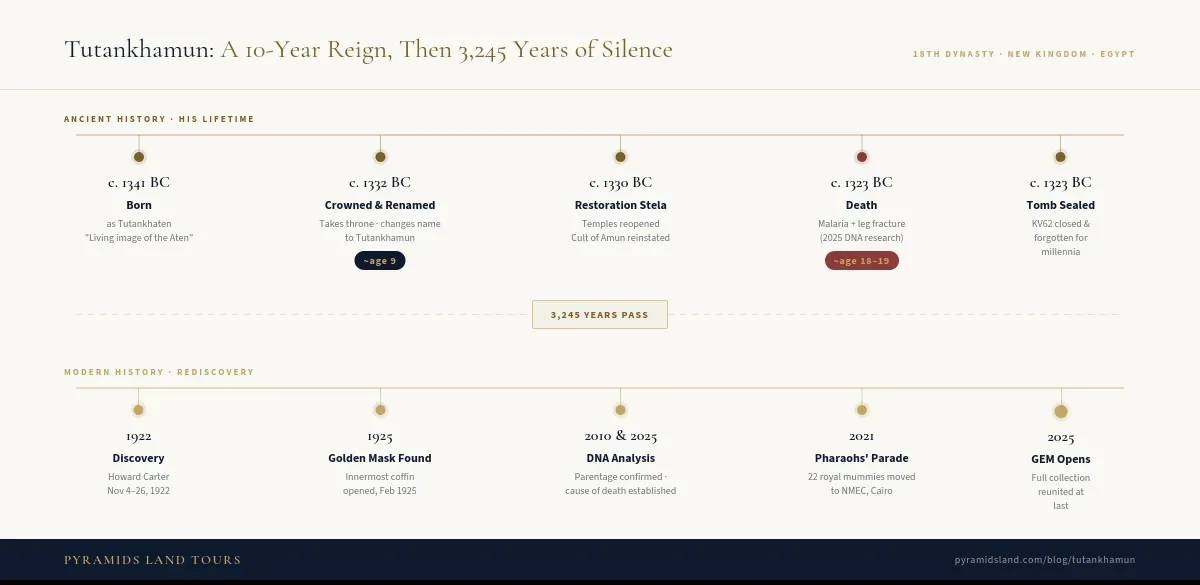
Tutankhamun (c. 1341–1323 BC) was an 18th Dynasty Egyptian pharaoh who took the throne around age nine and died at about eighteen or nineteen. His historical importance is twofold. In his own time, he reversed his father Akhenaten's religious revolution, restoring Egypt's traditional gods. In modern times, he became the most famous pharaoh in the world after Howard Carter discovered his nearly intact tomb (KV62) in 1922, containing roughly 5,400 objects, including the golden death mask.
Today, his mummy remains in his tomb in the Valley of the Kings, Luxor, while his treasures are displayed at the Grand Egyptian Museum near the Giza Pyramids in Cairo — two different cities. The most probable cause of his death, based on DNA and CT analysis, is a combination of malaria, a bone condition in the left foot, and a leg fracture, though the question is still debated.
Who Were Tutankhamun's Parents and Family?
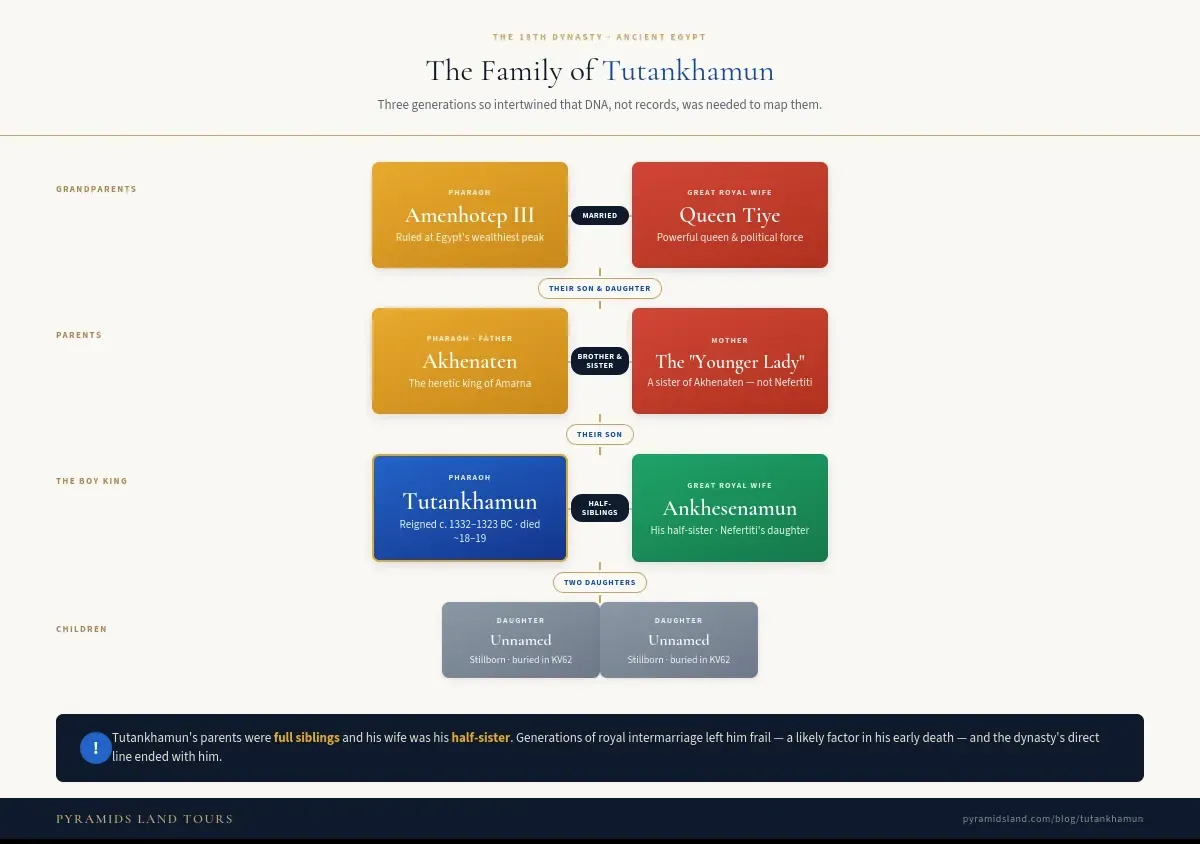
Tutankhamun's father was the pharaoh Akhenaten and his mother was a secondary wife known as the "Younger Lady" — not Nefertiti. His grandparents were Amenhotep III and Queen Tiye, and his wife Ankhesenamun was his own half-sister. This parentage is established through DNA analysis of the royal mummies.
Tutankhamun was born around 1341 BC into the most turbulent dynasty in Egyptian history. His father — confirmed by DNA analysis — was almost certainly Akhenaten: the pharaoh who dismantled Egypt's religion, abandoned its capital, replaced its gods with a single solar deity, and is regarded by Egyptologists as the most disruptive ruler in 3,000 years of pharaonic civilization.
Akhenaten had replaced Egypt's polytheistic pantheon with the worship of the Aten — the physical sun disk — abandoned Thebes, built a new capital at Amarna in the desert, and spent his reign dismantling the institutional power of the priesthood of Amun. By the time Tutankhamun was born, the accumulated damage to Egypt's stability was real.
His parentage is now largely confirmed by DNA analysis of the royal mummies. His father: the mummy from KV55 (Kings' Valley, tomb 55), identified by most Egyptologists as Akhenaten. His mother: the mummy known as the "Younger Lady" from KV35 — a secondary wife of Akhenaten, not Nefertiti. His grandparents: Amenhotep III and Queen Tiye — one of the most politically consequential queens in Egyptian history; her mummy is at the NMEC in Cairo. The same DNA work found malaria in Amenhotep III, Tiye, and Tutankhamun himself — a sign of how widespread the disease was in the royal family, and one of the threads in the debate over what ultimately killed the young king.
He was not born "Tutankhamun." His original name was Tutankhaten — "Living image of the Aten" — referencing his father's god. The change to Tutankhamun ("Living image of Amun") was one of his first acts as pharaoh. His wife made the same change: from Ankhesenpaaten to Ankhesenamun. They changed their names together. The act was a declaration: the experiment was finished.
Note: both "Tutankhamun" and the older English spelling "Tutankhamen" refer to the same person. "Tutankhamun" is the current standard transliteration.
→ Akhenaten — the Amarna revolution and the faith Tutankhamun reversed
What Did Tutankhamun Accomplish as Pharaoh?
Tutankhamun's main accomplishment was reversing his father Akhenaten's religious revolution. Through the Restoration Stela, his court reopened Egypt's traditional temples, reinstated the priesthood of Amun, and abandoned the heretical capital at Amarna. Because he took the throne as a young child, these decisions were largely directed by two officials, Ay and Horemheb, who each succeeded him in turn.
When the Amarna period ended, and Tutankhamun came to the throne at approximately nine years old, his court had a single mandate: undo the previous seventeen years. He was a child. The substantive decisions of his reign were guided by two powerful officials: Ay, a senior courtier possibly related to the royal family, who would succeed him as pharaoh; and Horemheb, general of the Egyptian army, who succeeded Ay.
What they accomplished under the child pharaoh's name:
The Restoration Stela, issued in Tutankhamun's name, formally reversed Akhenaten's decrees. It describes Egypt in disarray — temples shuttered, gods ignored, armies failing in the field. Under Tutankhamun, temples were reopened and restaffed. The priesthood of Amun, stripped of institutional power under Akhenaten, was reinstated. The city of Amarna was abandoned — and eventually dismantled, its carved blocks used as rubble fill in later construction. Tutankhamun's own name and Akhenaten's were subsequently removed from official king lists by Horemheb, which is why archaeologists had no idea who built Amarna when they found its ruins in the 19th century.
Tutankhamun also began work at Karnak Temple — additions that his successor Horemheb later usurped under his own name. He added a colonnade at Luxor Temple, similarly re-attributed. Physically, little survives of his original cartouche.
The paradox is genuine: Tutankhamun's most historically significant achievement was undoing his father's most historically significant achievement. He is remembered for what he reversed.
How Did Tutankhamun Die?
The most probable cause of Tutankhamun's death, based on DNA and CT analysis, is a combination of malaria, Köhler disease II (bone necrosis in the left foot), and a leg fracture sustained shortly before death, in a body weakened by inbreeding. He died around 1323 BC, at approximately 18 or 19 years old. The murder and chariot-accident theories have lost support, though the explanation remains debated rather than settled.
For most of the last century, the honest answer to "how did he die?" was: we don't know. We now know considerably more, though "case closed" overstates it — the leading explanation is well-supported but still debated.
The major scientific work began with a 2009–2010 study led by Zahi Hawass, which paired DNA analysis with CT scanning of the mummy and several of his relatives. Later analyses, including findings discussed publicly around 2025, have reinforced and refined that picture. Together, they point to a convergence of conditions rather than a single dramatic cause:
Malaria. The DNA work identified Plasmodium falciparum — the most lethal malaria strain — in Tutankhamun's tissue and in several of his relatives. Malaria was endemic in the Nile Valley; a positive result does not prove it was the cause of death, but in combination with his other conditions, it is widely regarded as a likely contributing factor.
Köhler disease II and avascular bone necrosis — the JAMA study diagnosed Köhler disease II alongside avascular necrosis (loss of blood supply to the bone) in the left foot, with lesions in the metatarsal bones and a shortened second toe. This altered the structure of the foot and made walking painful and unstable — the most likely explanation for the canes buried with him.
Over 130 walking sticks and canes were found in the tomb. Long assumed to be ceremonial, they are now generally read as functional, alongside what some researchers have called an "afterlife pharmacy" of medical supplies — consistent with a king who had genuine mobility problems.
A fracture of the left leg with no signs of healing, sustained shortly before death. Some specialists read it as a peri-mortem injury that turned fatal through infection; others caution it may have been damage caused during Carter's excavation. The pre-antibiotic scenario — a serious fracture in a body already weakened by malaria and a chronic foot condition — remains the most cited explanation.
The murder theory and the chariot-accident theory have both lost ground: the rib and chest damage once cited as evidence is now widely attributed to post-excavation handling. What replaced them is less dramatic and better documented: a physically frail young man, walking with a cane, who did not survive the combination of conditions his own body and his family's intermarriage had handed him.
He was approximately eighteen or nineteen years old.
Who Discovered Tutankhamun's Tomb, and When?
British archaeologist Howard Carter discovered Tutankhamun's tomb (KV62) in the Valley of the Kings on 4 November 1922, with funding from Lord Carnarvon. Carter first entered the antechamber on 26 November 1922, describing what he saw as "wonderful things." It was the most complete royal tomb ever found in Egypt, and Carter spent ten years cataloging its roughly 5,400 objects.
Carter had been searching for the tomb for five years, funded by Lord Carnarvon, when, on November 4, 1922, a boy who carried water for the excavation team stumbled upon a stone step beneath the sand. Carter sent a telegram. He waited for Carnarvon to travel from England before proceeding.
On November 26, 1922, Carter made a small breach in the upper left corner of the sealed doorway, inserted a candle, and looked through. In the account he later published, when Carnarvon asked whether he could see anything, Carter replied: "Yes, wonderful things."
What he saw: gold, everywhere. Gilded beds in the shapes of animals. Chariots. Hundreds of objects stacked in apparent haste, sealed from the outside world since the 1320s BC.
Carter worked on the tomb for ten years. The cataloging of approximately 5,400 objects — each photographed, numbered, and individually recorded — was one of the most systematic documentation efforts in the history of archaeology. The golden death mask was not found until February 1925, when Carter finally opened the innermost coffin.
Lord Carnarvon died on April 5, 1923, of a blood infection from a mosquito bite. The British press constructed the "Curse of the Pharaohs." Carter himself — the person the curse should have struck first — died in 1939, sixteen years after opening the tomb.
The discovery unfolded under British colonial administration, and the politics were real: Egyptian nationalists protested foreign control over the objects, and conflict between Carter, Carnarvon's estate, and the French-led Egyptian Antiquities Service ran throughout the excavation years. Those approximately 5,400 objects are now permanently in Egypt, at the Grand Egyptian Museum, under Egyptian custodianship. The colonial chapter of their story is closed.
What Is Inside Tutankhamun's Tomb (KV62) Today?
Tutankhamun's tomb (KV62) is the smallest royal tomb in the Valley of the Kings. Today, visitors can see his mummy in a climate-controlled glass case, the stone quartzite sarcophagus, and four painted burial-chamber walls. The treasures that once filled it are now at the Grand Egyptian Museum in Cairo. A separate 700 EGP ticket is required to enter, and the burial chamber is the only room open to visitors.
KV62 stands for Kings' Valley, sixty-second tomb cataloged — the numbering indicates the order of discovery, not the sequence in which tombs were built. It is the smallest royal burial in the Valley of the Kings. The burial chamber measures approximately six by four meters: smaller than most living rooms.
This is not an insult to Tutankhamun. It is a direct consequence of his death. Royal tombs in the Valley were cut during a pharaoh's lifetime — decades of work, expanding as the reign lengthened. At nineteen, he had been on the throne for ten years and had no time for a proper tomb. The tomb was almost certainly intended for a non-royal official and repurposed in haste. Nicholas Reeves has argued it was originally an outer chamber of Nefertiti's larger tomb. Whatever its origin, the cramped scale is inseparable from his story.
What you see inside KV62:
The entrance corridor leads down to a small antechamber — the first room Carter cleared, packed when he found it with dismantled chariots, gilded couches, chests, and hundreds of objects stacked against the walls. It is now empty. Completely empty. One reviewer described it accurately as "a large empty room where the treasures were." Without a guide to stand in that antechamber and describe what Carter saw in 1922 — the animal-shaped funerary couches, the chariot wheels, the alabaster vessels, the two life-sized guardian statues of the king flanking a sealed doorway — it is just a corridor. With that context, it is one of the most significant rooms in the history of archaeology.
The burial chamber is the only decorated room accessible to visitors. Four painted walls, executed in a warm amber tone distinctive from the blue-white palette of larger royal tombs:
- West wall: twelve baboon figures from the Amduat — the Book of What Is in the Underworld — representing the twelve hours of night through which the pharaoh must travel to reach the afterlife.
- North wall: Tutankhamun with the goddess Nut and Osiris — the Opening of the Mouth ceremony, performed on his mummy before burial.
- East wall: the funerary procession — courtiers pulling the mummy on a sled toward the tomb.
- South wall: Tutankhamun with Anubis and Hathor, receiving the welcome of the gods.
The stone quartzite outer sarcophagus sits in the center of the burial chamber, its lid removed. The mummy of Tutankhamun rests in a climate-controlled glass case beside it — not inside it. The three nested coffins that originally enclosed the mummy (two gilded wood, one solid gold) have been removed to the Grand Egyptian Museum. You are standing a meter from the actual body of a pharaoh who died 3,300 years ago, with nothing between you and that fact except a glass panel.
The treasury and annex — the other two rooms of the tomb — are closed to visitors.
From Ashraf Fares, Egyptologist — 20 years guiding private tours through the Valley of the Kings:
"I lower my voice and tell clients: 'This tiny chamber was never meant for a king — it was probably intended for someone far less important, but when Tut died suddenly they rushed him in here.'
You'll see the big stone sarcophagus, but the mummy itself rests in a climate-controlled glass case just beside it. Standing that close to a real pharaoh who died over 3,300 years ago always creates a profound, almost reverent silence in the group."
On standard group tours, guides wait outside the Valley of the Kings while visitors enter the tombs alone. On a private Egyptologist-led tour, your guide accompanies you inside — including into KV62. The difference is not logistical. It is the difference between standing in that antechamber alone, in front of an empty room, and standing there while someone who has done it hundreds of times tells you what was in every corner.
Practical visiting information:
The standard Valley of the Kings ticket (600 EGP) covers three tombs from the open rotation. KV62 is not included — it requires a separate ticket: 700 EGP for foreign adults, 350 EGP for students with valid ID. Both were purchased at the valley ticket office before entering. Note: the Luxor Pass (Standard or Premium) includes KV62 and is worth considering for a multi-day Luxor visit.
Photography and mobile phones are not permitted inside KV62. The rule is enforced by the tomb guard.
KV62 can close temporarily for conservation — confirm current access status before your visit.
Worth knowing: The Howard Carter House, on the roundabout just before the valley entrance, contains a full-scale replica of KV62 built using 3D scanning by Madrid's Factum Foundation. The replica includes a reconstruction of a wall section that was removed during the original excavation and is no longer visible in the actual tomb. It is included in the Carter House ticket, is fully accessible for visitors with limited mobility, and allows unhurried examination of the burial chamber paintings. Worth thirty minutes before or after the valley.
Is the KV62 ticket worth 700 EGP?
In twenty years, I have never had a client regret it. It is the only tomb in the Valley where the king himself is still present — you stand a meter from the body of the most famous pharaoh who ever lived. No other ticket in Egypt buys you that.
The one condition: see the Grand Egyptian Museum first. The objects there and the room here are two halves of one story, and they only work in that order.
Pyramids Land Tours · 4.9★ TripAdvisor · 2,600+ reviews · Viator Top 1%
Private Luxor tours — Valley of the Kings with a licensed Egyptologist → · WhatsApp us directly
Are There Hidden Chambers in Tutankhamun's Tomb?
Probably not. The theory that hidden chambers — possibly holding Nefertiti's burial — lie behind Tutankhamun's tomb walls, proposed by Nicholas Reeves in 2015, has not been confirmed. The most rigorous ground-penetrating radar surveys found no evidence of chambers, and most Egyptologists now lean against the theory, though it is not definitively closed.
In 2015, Nicholas Reeves (Egyptologist, University of Arizona) proposed — based on high-resolution infrared scans of KV62's walls — that the tomb contains two hidden doorways. Behind the northern wall: Nefertiti's original burial chamber, with Tutankhamun interred in her
outer room after his sudden death. Egypt's antiquities minister announced "90 percent certainty."
Multiple ground-penetrating radar surveys followed:
- 2015: contradictory results between two teams
- 2017, Porcelli (Polytechnic University of Turin): no chambers found — earlier anomalies attributed to "ghost signals" from the decorated plaster conducting radar along wall surfaces rather than through them
- 2018: inconclusive
- 2020: a new team identified a corridor-like anomaly near the tomb — debate reignited
Current status: the most technically rigorous work found no evidence of chambers and offered a convincing explanation for why earlier scans seemed to show them. The majority of working Egyptologists are skeptical of the existence of hidden chambers. The question is not definitively settled.
If Reeves is right and Nefertiti's original burial lies behind that north wall, it is the most significant Egyptological discovery since 1922. If he is wrong, it remains one of the more contested debates in the field. The honest answer for 2026: probably not there. But worth understanding before you stand in that burial chamber.
Where Are Tutankhamun's Treasures and Golden Mask?
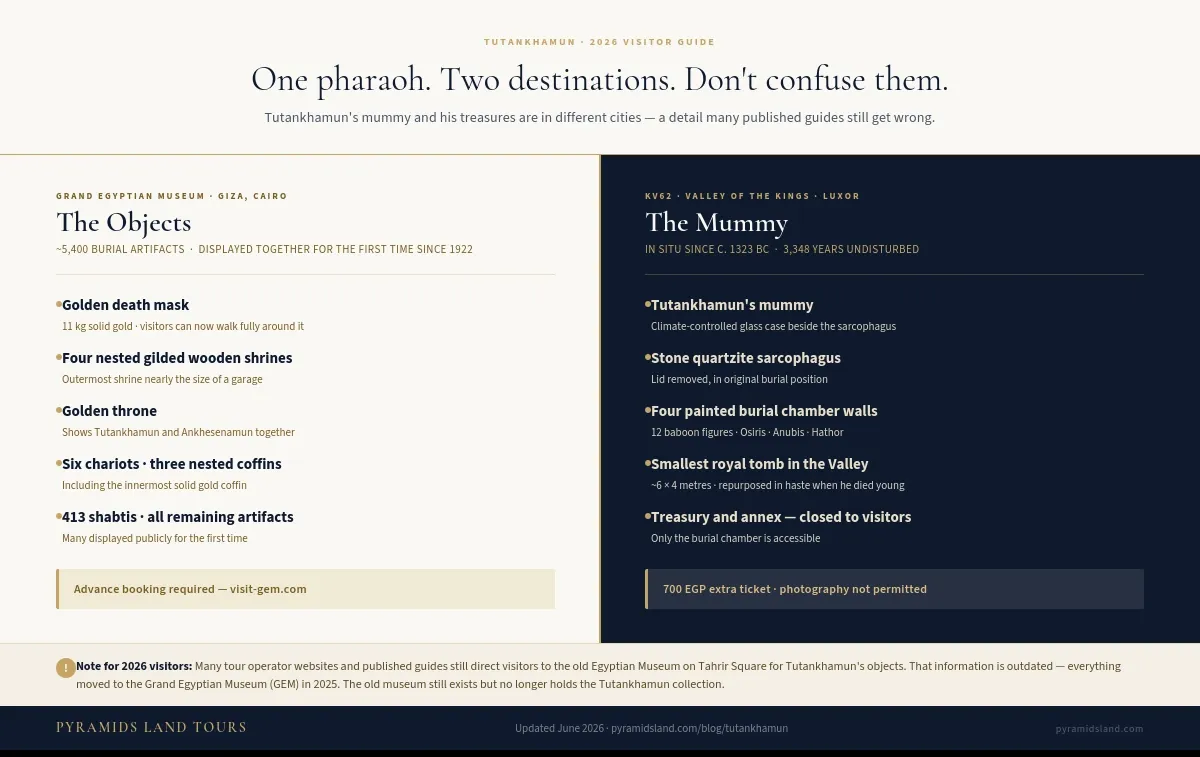
Tutankhamun's treasures, including the golden death mask, are at the Grand Egyptian Museum (GEM) in Giza, near the Pyramids. Since November 2025, the full collection of roughly 5,400 objects has been displayed together for the first time since the tomb was discovered in 1922. The mask, the nested coffins and shrines, the golden throne, six chariots, and 413 shabtis are all here — but the mummy itself remains in the tomb in Luxor. The GEM requires advance booking at visit-gem.com.
For over a century, Tutankhamun's approximately 5,400 burial objects were distributed across storage facilities and cases at the old Egyptian Museum on Tahrir Square — seen in fragments, never as a coherent whole. Many had never been publicly displayed.
In November 2025, the Grand Egyptian Museum opened fully, with the most complete assembly of Tutankhamun's burial objects ever displayed together — all of it in a single purpose-built narrative sequence, for the first time since Carter sealed the tomb again in 1932.
What not to miss:
The golden death mask — approximately 11 kg of solid gold, inlaid with lapis lazuli, obsidian, carnelian, and semi-precious stones, with protective spells engraved on the reverse. The GEM display allows visitors to walk fully around it — the reverse spells were never accessible in the Tahrir installation. When your guide reads those spells aloud — words written to protect a specific nineteen-year-old 3,300 years ago — the mask stops being an object and becomes evidence of grief.
The four nested gilded wooden shrines were displayed sequentially to illustrate how they fit inside one another around the sarcophagus. The outermost shrine alone is nearly the size of a single-car garage; the innermost held the stone sarcophagus, which in turn held three nested coffins. Seeing the shrines lined up in sequence, the engineering and the devotion behind the burial become tangible.
The three nested coffins — the outer two of gilded wood, and the innermost of solid gold, weighing around 110 kg. The gold coffin is among the most recognizable objects ever recovered from Egypt, and it is the one that held the mummy and the death mask.
The golden throne: Tutankhamun and Ankhesenamun depicted together — she is applying perfume to his collar in one of the most intimate scenes in 3,000 years of Egyptian royal art. Made early in the reign, when the couple still used their Aten-based names (partially altered later on the throne's back panel). The affection in the scene was not altered.
The six chariots — disassembled for burial. Lion-head decorations, gilded panels, leather partially preserved after 3,300 years.
The 413 shabtis — servant figurines made to work on the king's behalf in the afterlife, one for each day of the year plus overseers.
Critical note for itinerary planning: Tutankhamun's mummy is not at the GEM. It remains in KV62 in the Valley of the Kings, where it has been since approximately 1323 BC. His objects are in Cairo. His mummy is in Luxor. These are different cities. Do not conflate them — many published tour descriptions still do.
---
**Planning to see both?**
Tutankhamun is split across two cities — the mummy in Luxor, the treasures in Cairo. Seeing both means coordinating a domestic flight, two guides, and the right order (Cairo first — always). Most travelers underestimate this until they are mid-trip.
We build the whole sequence as one private itinerary: GEM and the Giza Pyramids in Cairo, then the Valley of the Kings in Luxor, timed so the tomb lands the way it should.
[See our Cairo & Luxor private itineraries →](/egypt-tours-packages) · [Or plan it with us on WhatsApp](https://wa.me/201223624703)
---
GEM requires advance booking: visit-gem.com. No walk-up tickets as of 2025.
What Happened to Ankhesenamun, Tutankhamun's Wife?
After Tutankhamun died without an heir, his widow Ankhesenamun secretly wrote to the Hittite king asking him to send a son to marry her — an unprecedented act for an Egyptian queen. The Hittite prince was murdered en route to Egypt. Ankhesenamun then married the official Ay and soon vanished from the historical record; her fate is unknown.
Tutankhamun's wife Ankhesenamun — Akhenaten and Nefertiti's third daughter, and by blood his half-sister — bore two children with him, both daughters, both stillborn or dying shortly after birth. Their small mummies were buried with him in KV62 and are now at the GEM.
After Tutankhamun died, she was alone in a court controlled entirely by Ay and Horemheb, neither of whom had any interest in a rival for power.
What she did next has no precedent in the ancient record.
She wrote secretly to Suppiluliuma I, king of the Hittites — Egypt's great military rival — and asked him to send one of his sons to marry her. The letter was found in the Hittite royal archive at Hattusa and survives: "My husband has died, and I have no son. They say you have many sons. You might give me one of your sons to become my husband. I would not wish to take one of my subjects as a husband."
She added: "I am afraid."
Suppiluliuma did not believe it was genuine — a queen of Egypt writing to her enemy for a husband was without precedent. He sent envoys to verify. She wrote again, more urgently. He sent a son: a prince named Zannanza.
The prince was murdered in Egypt before he could arrive. Almost certainly on the orders of Ay or Horemheb. Suppiluliuma declared war
On Egypt in retaliation.
Ankhesenamun then married Ay — the elderly official who succeeded Tutankhamun. She disappears from the record shortly afterward. Her fate is unknown.
The letter is real, authenticated from the Hittite archive at Hattusa. The prince's murder is in the Hittite records. A young queen — alone after the death of a pharaoh who was himself a child — making an unprecedented political gamble across enemy lines, and losing.
At the GEM, your guide can show you the Amarna-period artifacts and place this story in its context.
→ Women in Ancient Egypt — queens, rights, and the evidence at the sites
Should You Visit the GEM or the Valley of the Kings First?
Visit the Grand Egyptian Museum in Cairo first, then the Valley of the Kings in Luxor. Seeing Tutankhamun's treasures and life story at the GEM gives essential context, so the tomb itself — small and stripped of its objects — carries far more emotional weight when you reach it. Reversing the order leaves many visitors underwhelmed by the bare tomb.
From Ashraf Fares, Egyptologist:
"I always do the Grand Egyptian Museum first, then the Valley of the Kings the next morning — never the other way around. At the GEM, they see the treasures, the mask, the whole life laid out. By the time they reach the actual tomb the next day, they understand exactly what they're looking at and what's missing from the room. Reverse the order, and people walk into the tomb cold, see a small space, and leave underwhelmed. In twenty years, this sequence has never let me down."
Day 1 — Grand Egyptian Museum, Cairo
Full morning minimum: three to four hours for the Tutankhamun galleries alone. Book tickets in advance at visit-gem.com before arriving — no walk-up sales. The GEM is adjacent to the Giza Pyramids; many clients combine both on the same Cairo day.
Day 2 or later — Valley of the Kings, Luxor
Depart from Luxor hotels by 5:00–5:30 am in summer to reach the valley for opening. Buy the standard ticket (600 EGP, three tombs) and the KV62 premium ticket (700 EGP) at the ticket office before entering. For comparison of scale: KV9 (Ramesses V/VI, 220 EGP premium) has the most spectacular astronomical ceiling in the Valley and demonstrates what a pharaoh with a full reign could commission. KV17 (Seti I, 2,000 EGP premium, check current access) is the finest painted tomb in Egypt, if open. The Carter House replica: thirty minutes before or after the valley.
On other royal mummies: Tutankhamun's mummy stays in the tomb. The mummies of Ramesses II, Seti I, Thutmose III, Hatshepsut, and others — 22 kings and queens relocated in the 2021 Pharaohs' Golden Parade — are at the National Museum of Egyptian Civilization (NMEC) in Fustat, Old Cairo, a separate visit from both the GEM and the Valley of the Kings.
→ Egypt's Royal Mummies at NMEC — Ramesses II, Seti I, and others → Luxor Day Tours — private Valley of the Kings tours → Build your full itinerary — contact us directly
Frequently Asked Questions
Who was Tutankhamun?
Tutankhamun was an 18th Dynasty Egyptian pharaoh (reigned c. 1332–1323 BC) who took the throne around age nine and died at about eighteen or nineteen. He reversed his father Akhenaten's religious revolution, restoring Egypt's traditional gods. He is world-famous today because Howard Carter discovered his nearly intact tomb in 1922.
When did Tutankhamun die?
Around 1323 BC, aged approximately eighteen or nineteen. The leading explanation, supported by DNA and CT analysis from 2010 onward, is a convergence of conditions rather than a single cause: malaria, Köhler disease II (bone necrosis in the left foot), and a leg fracture shortly before death, in a body weakened by inbreeding. It is well-supported but still debated — not a closed case.
What was Tutankhamun known for?
In his own time: reversing Akhenaten's reforms and stabilising Egypt after the Amarna period's institutional damage. In modern times: the 1922 discovery of his intact tomb and the approximately 5,400 objects it contained, especially the golden death mask that became the defining image of ancient Egypt.
Where is Tutankhamun's mummy?
Tutankhamun's mummy is in his original tomb (KV62) in the Valley of the Kings, Luxor, resting in a climate-controlled glass case beside the stone sarcophagus. His treasures — the golden mask, coffins, and all other tomb contents — are at the Grand Egyptian Museum in Cairo. The mummy is NOT at the GEM or the NMEC.
Is Tutankhamun's tomb worth the extra ticket (700 EGP)?
Yes. The tomb is small — that smallness is part of its meaning. The burial chamber has four painted walls, the stone sarcophagus, and the mummy in a glass case beside it. The physical visit takes fifteen to twenty minutes. What it gives you depends on the context you bring: with a guide who can tell you what filled these now-empty rooms in 1922, it is one of the most charged spaces in Egypt. Walked cold, it can feel like a small painted room. Visit the GEM first.
What caused Tutankhamun's death?
The most cited explanation, from DNA and CT analysis, is a convergence of malaria, Köhler disease II (bone necrosis in the left foot), and a leg fracture shortly before death, in a body weakened by inbreeding. The murder and chariot-accident theories have lost support. The explanation is well-supported but still debated.
Who were Tutankhamun's parents?
His father was almost certainly Akhenaten, confirmed by DNA analysis of the KV55 mummy. His mother was the "Younger Lady" from KV35 — a secondary wife of Akhenaten, not Nefertiti. His grandparents were Amenhotep III and Queen Tiye.
Did Tutankhamun have children?
Two daughters, both buried with him in KV62. Both were stillborn or died shortly after birth. Their mummies are now at the GEM. Tutankhamun and Ankhesenamun left no surviving heir — the direct cause of the succession crisis that brought Ay and then Horemheb to power, both of whom continued dismantling the Amarna legacy.
Can you see King Tut's mummy?
Yes. Tutankhamun's mummy is on display in his tomb (KV62) in the Valley of the Kings, Luxor, inside a climate-controlled glass case beside the stone sarcophagus. It is the only royal mummy in Egypt still resting in its original burial chamber — every other pharaoh's mummy was moved to museums in Cairo.
an you take photos inside King Tut's tomb?
The rules changed recently and reporting is inconsistent. For years, photography was banned inside KV62 specifically; in 2025–2026 several sources report phone photography (no flash) is now allowed, while others still list KV62 as restricted. Flash is prohibited everywhere. Confirm the current rule at the gate on the day.
Why is Tutankhamun's tomb so small?
Because he died young and unexpectedly, around age nineteen, with no time to build a proper royal tomb — those took decades. KV62 was almost certainly intended for a non-royal official and adapted in haste for the king's burial. Its cramped four-room layout is a direct result of his sudden death.
Related Guides
- The Most Famous Pharaohs of Ancient Egypt
- Ancient Egyptian History — the timeline that makes the temples make sense
- Akhenaten — the heretic pharaoh whose son reversed everything
- Ramesses II — Egypt's greatest pharaoh
- Women in Ancient Egypt — queens, rights, and the evidence at the sites
- Valley of the Kings — complete visitor guide
- Grand Egyptian Museum guide
- Egypt's Royal Mummies — Ramesses II, Seti I, Hatshepsut at NMEC
Ashraf Fares