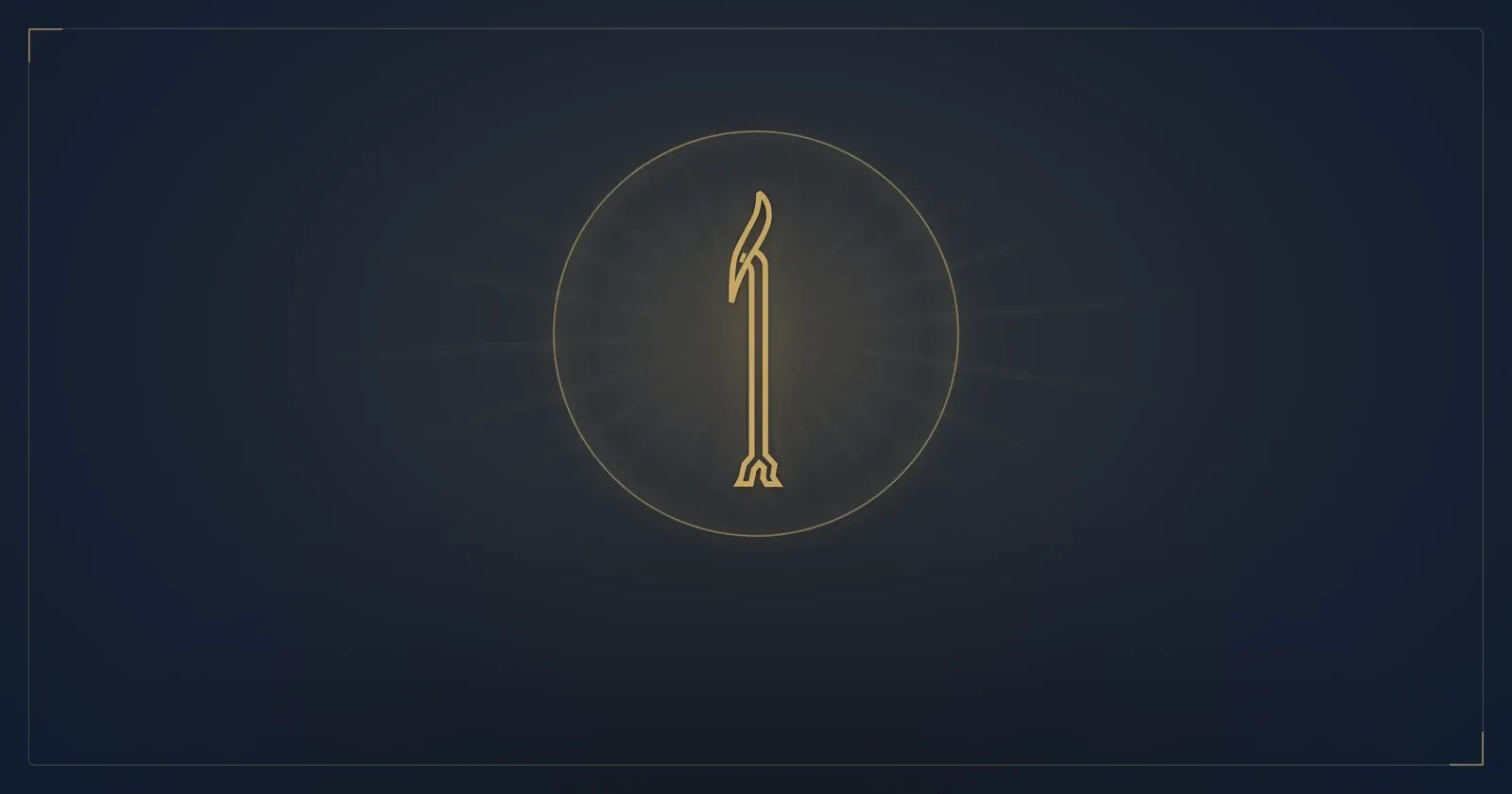

The Djed Pillar: Meaning, the Backbone of Osiris & the Symbol of Stability
The short answer: The djed pillar is an ancient Egyptian symbol of stability and endurance, shown as a column with four stacked crossbars near the top. It came to represent the backbone of the god Osiris, and so also stood for resurrection — the promise that what falls can be raised again.
Some Egyptian symbols shout — the crowns, the falcon, the cobra. The djed is not one of them. It is a quiet, upright little column with a stack of bars at the top, and it is one of the oldest symbols in Egypt. Its message is equally quiet and equally powerful: stay standing. Stability, endurance, the strength to hold — and, in time, the strength to rise from death itself.
At a glance
Key Facts
- Symbol of: stability, endurance, and (through Osiris) resurrection
- Shape: a column with four stacked horizontal crossbars
- Word: djed (ḏd) means “stable” or “enduring”
- Backbone of Osiris: a later meaning — the sign began as a fetish of the god Ptah
- Great ritual: the Raising of the Djed, re-erecting the god’s spine for renewal
- Amulet: placed on the mummy’s spine with Book of the Dead Spell 155
- Best place to see it: the Raising-of-the-Djed reliefs at the Temple of Seti I, Abydos
What is the djed pillar?
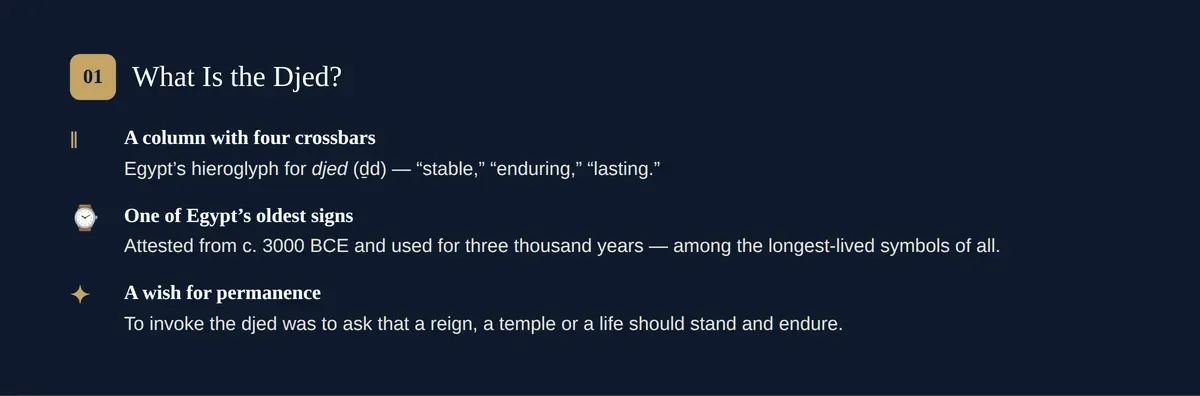
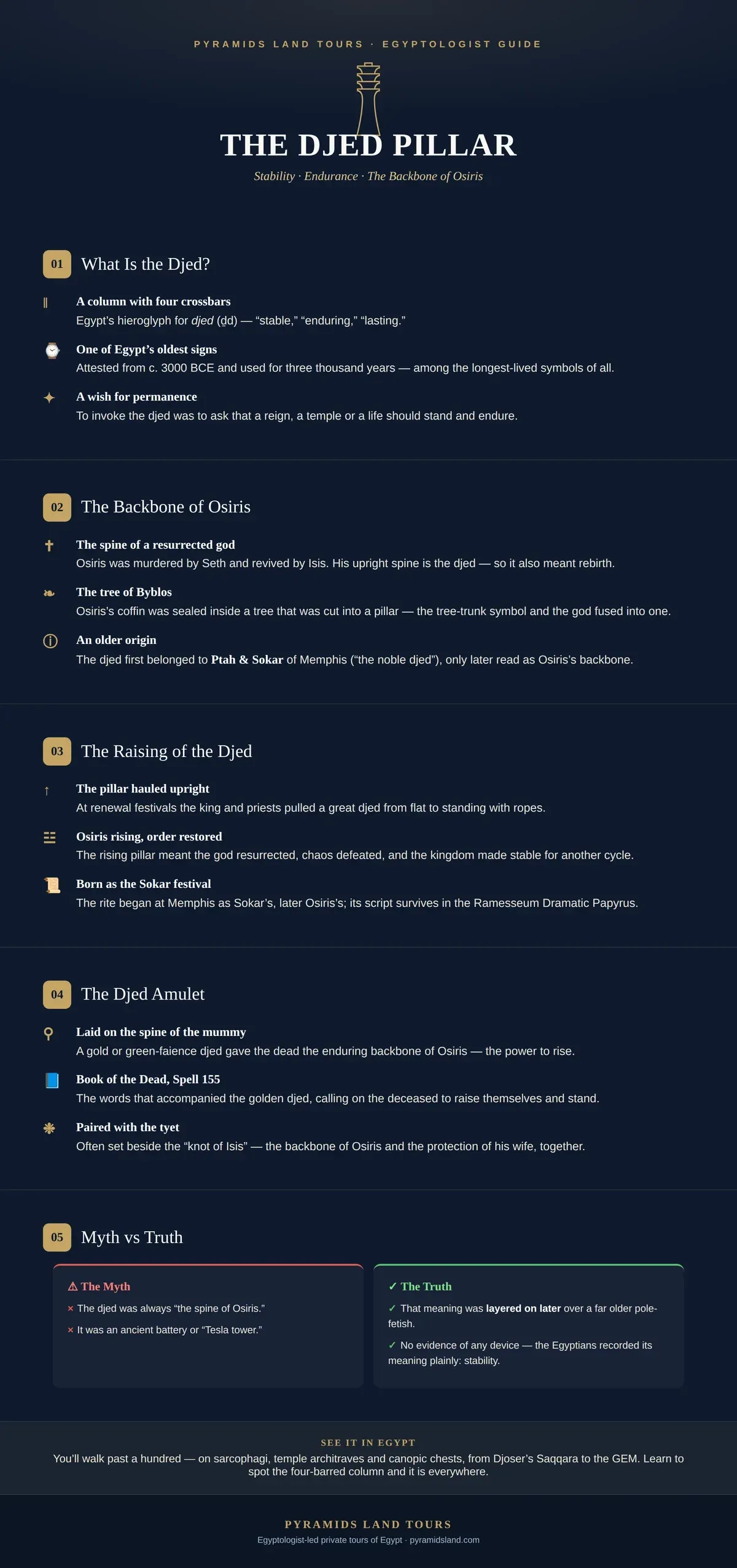
The djed pillar symbolizes stability and endurance — and, through the god Osiris, resurrection. The djed is a column topped by four horizontal crossbars, like a pillar with its capital stacked in tiers. The Egyptian word djed (ḏd, written with the pillar sign cataloged as Gardiner R11) means "stable," "enduring," "lasting" — and the sign wrote exactly that idea. To wish someone stability, to ask that a reign or a temple or a life should endure, you reached for the djed. It is Egypt's hieroglyph for permanence. The word even stamped itself on the map: Osiris's Delta cult city was Djedu — Busiris to the Greeks — built on the very same djed root.
The djed is genuinely ancient: it appears already in the Early Dynastic Period, around 3000 BCE — the oldest examples you can actually point to are two small ivory djed pillars from a First-Dynasty tomb at Helwan, near Saqqara — and it stayed in use for the next three thousand years, one of the longest-lived symbols Egypt ever produced. Where the shape came from is still genuinely debated. Scholars have read it as a tree trunk with its branches lopped off, a bundle of reeds or a sheaf of grain hoisted on a harvest pole at season's end, a stylized human spine, even a pillar propping up the sky — and they have never fully agreed. What is certain is what it became.
How to spot a djed in seconds
- A vertical column with a broad base.
- Four horizontal crossbars stacked near the top.
- Runs in repeating friezes along walls and architraves.
- Often stands beside the ankh and the Was scepter.
- Extremely common on coffins, sarcophagi, and canopic chests.
Why is the djed the backbone of Osiris?
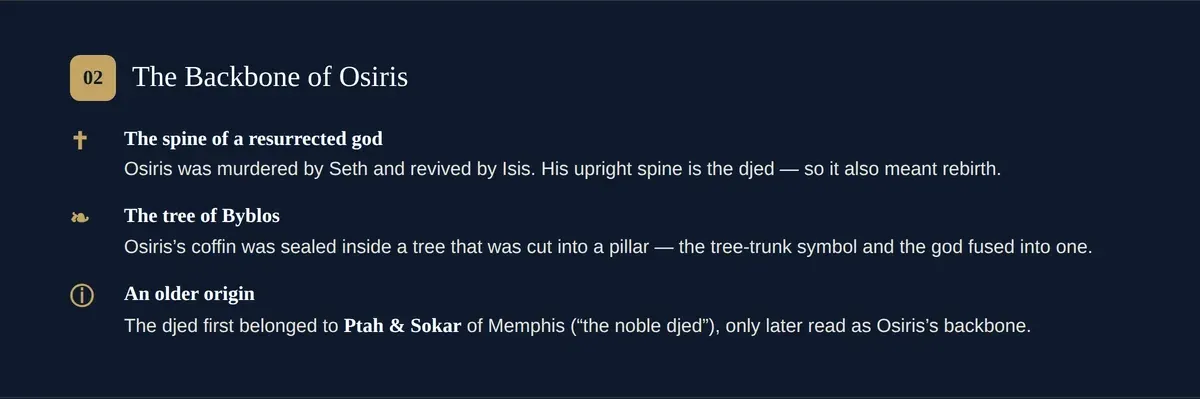
The djed is read as Osiris's backbone because his spine, restored after Isis revived him, became the emblem of his resurrection. Above all, the djed came to be read as the backbone of Osiris, the god of death and rebirth. In the myth, Osiris is murdered and dismembered by his brother Seth, then reassembled and revived by his wife Isis — the first being to conquer death and rule the afterlife. His spine, upright and whole again, is the djed. To raise the djed was to re-erect the very body of the resurrected god.
There is a myth that directly links the tree's origin to Osiris. In the story, Osiris's coffin drifts to Byblos, where a tamarisk tree grows around it and encloses it; the local king cuts the tree into a pillar for his palace, and Isis, searching, finds her husband's body sealed inside it. The pillar that held Osiris became bound up with the djed — the tree-trunk symbol and the resurrected god fused into one.
One honest nuance, because it gets flattened everywhere: the djed did not start as Osiris's spine. In its earliest life, it belonged to the Memphite gods Ptah and Sokar — Ptah, the creator, bore the epithet "the noble djed." Only later, as the Osiris cult rose to dominate Egyptian ideas of death and rebirth, was the old pillar absorbed into his story and reinterpreted as his backbone. The symbol is genuinely ancient; the famous "spine of Osiris" meaning is the layer that stuck.
What was the "Raising of the Djed" ceremony?
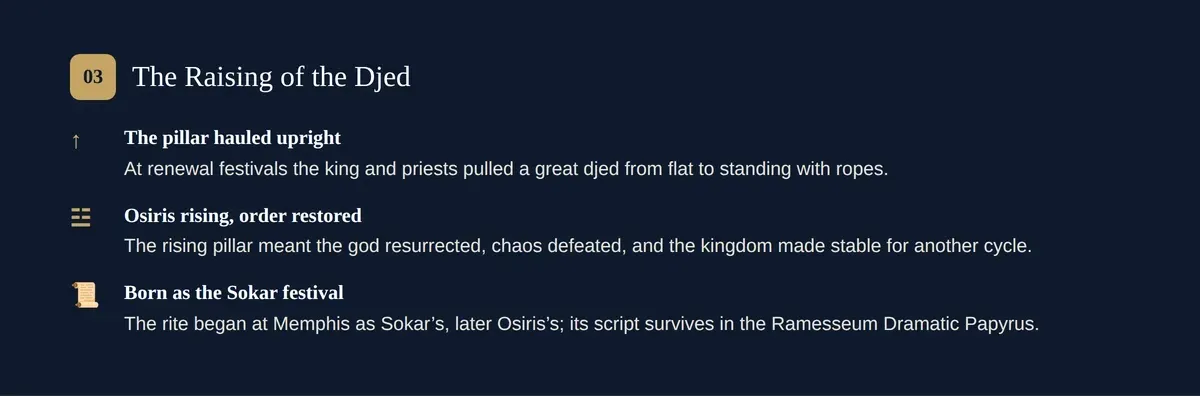
This is the part most guides skip, and it is the best of the story. Egyptians did not just draw the djed — they stood it up, in one of the great rituals of the calendar. In the Raising of the Djed, performed at renewal festivals and royal jubilees, the king and his priests used ropes to haul a large djed pillar from a lying-flat position to a fully upright position.
The act was pure theatre of meaning. The pillar rising from horizontal to vertical was Osiris rising from death; it was order (maat) triumphing over chaos; it was the land, the harvest, and the king's own rule renewed and made stable for another cycle. Fittingly, the rite belonged to the great Khoiak festival — the midwinter Memphite mysteries of Sokar-Osiris, days of the god's death and renewal — first a resurrection of Sokar, only later of Osiris. Its script survives in the Ramesseum Dramatic Papyrus, a rare stage direction for an Egyptian ritual. By the New Kingdom, the pillar could even come alive: in the raising scene in the tomb of Kheruef at Thebes, the djed has grown a human body, its eyes the protective udjat, its hands gripping the crook and flail of Osiris — the symbol becoming the god.
The djed as an amulet
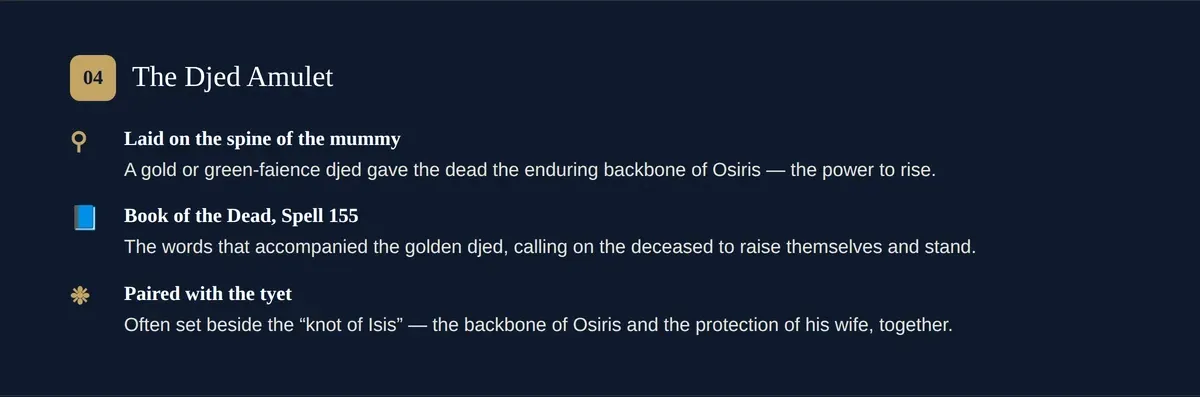
Because it promised the backbone to stand again, the djed became one of the most important funerary amulets. A djed, often in gold or green faience, was placed on the spine or throat of the mummy to give the dead the enduring backbone of Osiris and the power to rise. Color did theological work here: green faience for sprouting crops and Osiris's green skin, blood-red carnelian for that same promise of new life, and cheap yellow glaze standing in for the prescribed gold.
The Book of the Dead even supplies the words — Spell 155, spoken over a golden djed strung on sycamore fiber and pressed to the mummy's throat, is a jolt of a line: a command to the weary god to raise himself, his backbone and his vertebrae restored to him. Tutankhamun was buried with fine gold djed amulets among his wrappings.
The djed was often paired with the tyet, the "knot of Isis" — cut from carnelian or red jasper, the color of blood, carrying its own Spell 156 and the protective power of Isis's own blood. The two together unite the backbone of Osiris with the protection of his wife, the god and goddess guarding the sleeper from both sides. In royal art, the djed often joined the ankh and the was scepter in a standard trio — life, stability, and dominion — the three gifts every reign hoped to hold. It sits naturally alongside the scarab and the ankh in the great cluster of Egyptian rebirth symbols. As a modern keepsake, the djed — sometimes combined with the ankh as a "djed-ankh" — is still worn as a charm for stability and strength.
The djed among Egypt's symbols
Each of the great symbols carries one core idea, and reading them together is half of reading a temple wall:
Myth-check
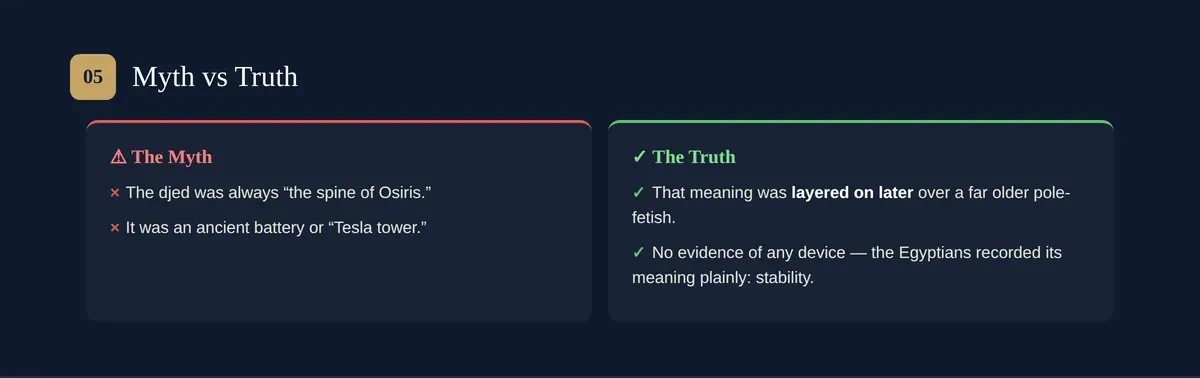
Two things worth correcting. First, as above: the djed is often presented as originally the spine of Osiris, when in truth that meaning was layered on later over a much older pole-fetish. Both facts are true; the order matters.
Second, you will find corners of the internet insisting the djed was an ancient electrical device — a "Tesla tower," an insulator, a battery. It was not. There is no evidence of anything of the kind, and the reading rests on forcing a modern shape onto an ancient symbol whose meaning the Egyptians themselves recorded plainly: stability and the backbone of a resurrected god. The real story needs no invented technology.
Where to see the djed in Egypt
Here is the secret about the djed: you will not make a special trip to see one, because you will walk past a hundred without noticing. It is so common that it hides in plain sight — running in friezes along temple architraves, stacked down the sides of sarcophagi, carved on tomb walls, and ringing the canopic chests that held the organs of the dead. It appears as early as the Old Kingdom in the Step Pyramid complex of Djoser at Saqqara, and it never stops. The best thing a guide can do is teach you to spot it: once you can, Karnak, Philae, Dendera, and every museum case quietly fill with little four-barred columns. As for the amulets themselves, the Egyptian Museum and the Grand Egyptian Museum display rows of them, including Tutankhamun's. And if you want the djed wrapped in its full Osiris story, the temple of Seti I at Abydos — his holiest cult center, about three hours north of Luxor and usually paired with Dendera — is the place to feel it. Most visitors never make the trip; those who do often rate its painted reliefs among the finest they see anywhere in Egypt.
Did you know?
- The djed is older than the pyramids — the earliest examples date to around 3000 BCE, before Djoser's Step Pyramid.
- It predates its link to Osiris — it began as a fetish of the Memphite gods Ptah and Sokar.
- Tutankhamun was buried with gold djed amulets among his wrappings.
- It runs in friezes across temples the length of Egypt — so common most visitors walk past it unnoticed.
Frequently Asked Questions
What does the djed pillar symbolize?
Stability, endurance and the strength to hold — and, through its link to Osiris, resurrection: the promise that what falls can be raised again. Its name, djed, simply means "stable" or "enduring."
Why is the djed the backbone of Osiris?
In the myth, Osiris is murdered and dismembered by Seth, then made whole and revived by Isis; his restored, upright spine is read as the djed. But this is a layered meaning — the djed began as a much older fetish of the Memphite gods Ptah and Sokar, and was only later absorbed into the Osiris story as his backbone.
What was the "Raising of the Djed" ceremony?
A ritual in which the king and his priests hauled a large djed pillar upright with ropes. The pillar rising from flat to vertical enacted Osiris rising from death, order triumphing over chaos, and the land and the king's rule renewed for another cycle. It belonged to the Khoiak festival at Memphis, the midwinter mysteries of Sokar-Osiris.
Is the djed pillar an ancient battery or electrical device?
No. The idea that the djed was a "Tesla tower," an insulator or a battery has no evidence behind it — it forces a modern shape onto an ancient symbol whose meaning the Egyptians recorded plainly: stability, and the backbone of a resurrected god.
What is the djed amulet for?
Placed on the spine or throat of the mummy, usually in gold or green faience, it gave the dead the enduring backbone of Osiris and the power to rise. Book of the Dead Spell 155 supplies the words, and Tutankhamun was buried with fine gold djed amulets.
Where can I see the djed in Egypt?
Everywhere, once you know to look — along temple architraves, down the sides of sarcophagi, on tomb walls and canopic chests. The richest single spot is the Temple of Seti I at Abydos (about three hours north of Luxor, usually paired with Dendera), which even shows Seti worshipping the djed column. You will also spot it at Karnak, Philae and Dendera, and the amulets fill the cases at the Egyptian Museum and the Grand Egyptian Museum, Tutankhamun's among them.
Want an Egyptologist to walk you along the Abydos reliefs and read the djed and the rest straight off the wall? Every Pyramids Land tour is private and guide-led, built around exactly what you want to see. Plan your private tour on WhatsApp →
Ashraf Fares