
Egypt Itinerary: How to Build One That Actually Works
The short answer: For a first trip to Egypt, plan ten nights. By land, that is three nights in Cairo, three in Luxor, three in Aswan with a day trip to Abu Simbel, and your last night back in Cairo. With a Nile cruise, it is three nights in Cairo, a four-night cruise from Luxor to Aswan, two nights in Aswan with Abu Simbel, and the last night in Cairo. Seven nights works if you accept a tighter route. With five or six nights, choose Cairo and Luxor and leave Aswan for another trip. Then test your plan the way this article does: count usable days, not nights. Ten nights gives about seven and a half to eight days of real sightseeing.
Egypt itinerary at a glance
7 nights by land: Cairo 2, Luxor 2, Aswan 2, Cairo 1. About 4½ usable days
7 nights with a Nile cruise: Cairo 2, cruise Luxor to Aswan 4, Cairo 1. About 5 usable days
10 nights by land: Cairo 3, Luxor 3, Aswan 3 with Abu Simbel, Cairo 1. About 7½ usable days
10 nights with a Nile cruise: Cairo 3, cruise Luxor to Aswan 4, Aswan 2 with Abu Simbel, Cairo 1. About 8 usable days
14 nights by land: Cairo 3, Luxor 3, Aswan 3, then 4 nights on the Red Sea, in Alexandria or in Siwa, Cairo 1. About 11 usable days
14 nights with a Nile cruise: Cairo 3, cruise Luxor to Aswan 4, Aswan 2, then 4 nights on the Red Sea, in Alexandria or in Siwa, Cairo 1. About 11½ usable days
Nile cruise length: 4 nights sailing from Luxor to Aswan, 3 nights from Aswan to Luxor
Luxor to Aswan by road: no scheduled flight. About 4 hours, stopping at Esna, Edfu and Kom Ombo, and only in daylight
Abu Simbel by road: pickup 3:30 to 4:30 a.m., the road opens at 5:00 a.m., and you reach the temples around 8:00 a.m.
Book ahead: internal flights, and the Grand Egyptian Museum at tickets.gem.eg
Sleep your last night in Cairo. Never connect a domestic flight to an international one on the same day
Spend an hour on any Egypt travel forum, and you will notice that almost nobody is asking what to see.
They already know. Pyramids, Karnak, Valley of the Kings, Abu Simbel. The list has been the same for two hundred years. What they are asking, over and over, in slightly different words, is this:
Is what I have planned too much?
Most online Egypt itineraries are a record of one person's holiday, not a test of whether the plan will work for you. So this is not another itinerary. It is the reasoning underneath all of them: the arithmetic that catches people out, the four decisions that shape every trip, the plans I would talk you out of, and three routes that hold up.
How do you count the days in an Egypt itinerary?
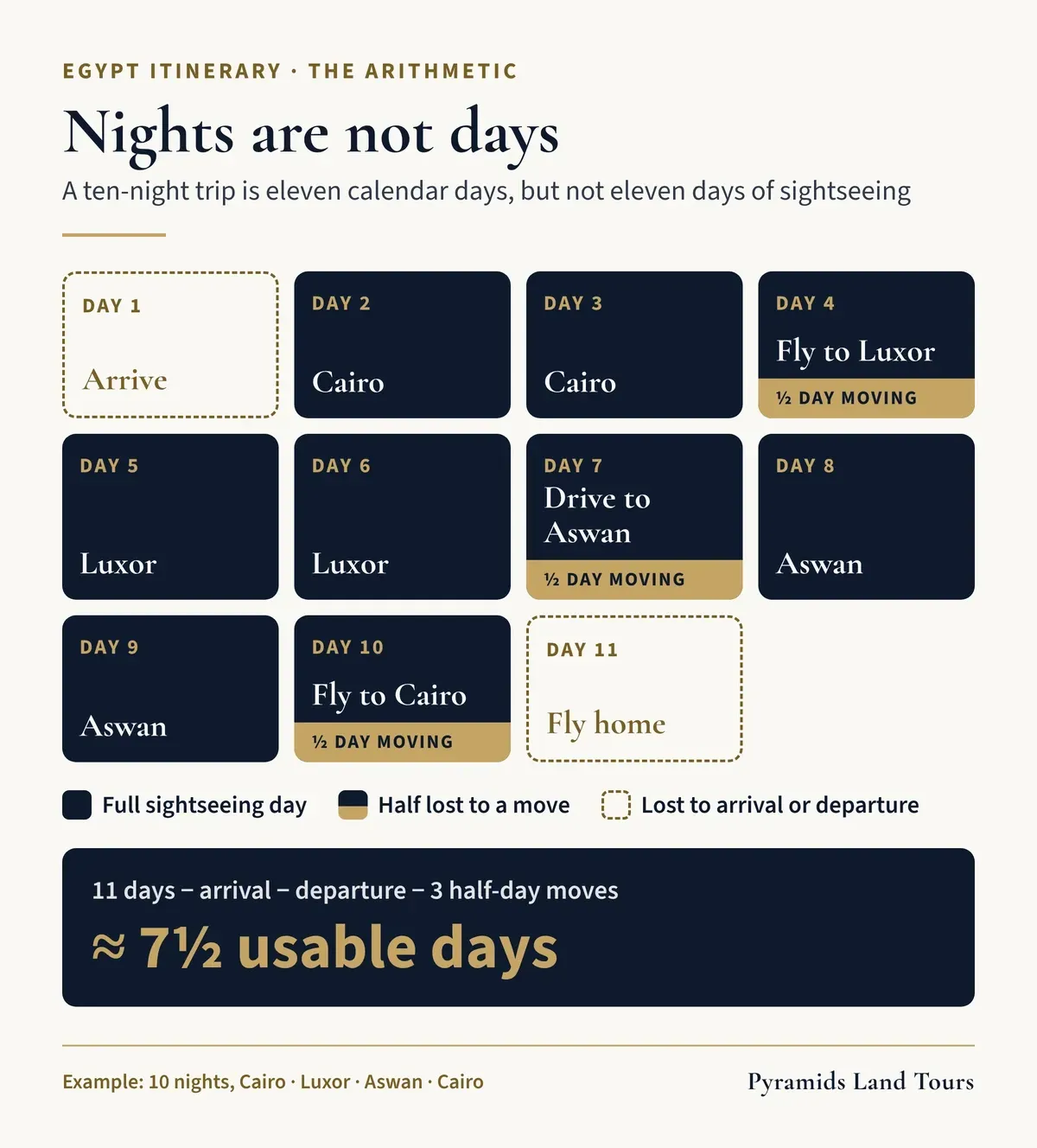
Count usable days, not nights. A ten-night Egypt trip has about seven and a half days of real sightseeing once you exclude the arrival and departure days and half a day for each internal transfer.
Here is the single most common planning error, and it has nothing to do with Egypt: nights are not days.
Three nights in Cairo is not three days in Cairo. If you land at 2 a.m. and fly out at 11 a.m. on the fourth morning, three nights has bought you two usable days and a fragment. Stretch that across four cities, and a fourteen-night trip quietly loses three or four days to arrivals, departures and moves.
So start with calendar days, then subtract:
- Arrival day. Most flights from Europe and North America land late evening or in the small hours. That day is gone.
- Departure day. Anything before noon takes the morning with it.
- Each internal move. A domestic flight takes roughly half a day once you count the drive to the airport, check-in, and the trip to your hotel at the other end.
Ten nights is eleven calendar days. Take off the arrival day, the departure day, and three half-day moves, and you have about 7.5 days of sightseeing. Keep one of those slow, which you will want to, and you are planning around six or seven. That is not pessimism. That is the number to plan against, and it is why itineraries that look generous on paper feel frantic on the ground.
Treat it as a floor, not a law. An early Cairo–Luxor flight can give you most of an afternoon back. A delayed one can take the whole day.
What are the four decisions that shape an Egypt itinerary?
Trip length, cruise or land, whether to include Abu Simbel, and which direction you travel. Settle those four and the days arrange themselves.
Two things come before them: when you are traveling, and what level of hotels and transport you want. The season affects how many hours a day you can spend outside. Comfort level decides whether you fly, take the train, drive, or sail.
How many nights do you need for a first trip to Egypt?
Seven to ten nights is ideal for a first trip to Egypt. Beyond fourteen, you are adding the Red Sea, Alexandria, or the oases rather than deepening the classic route.
For fewer than seven nights, you are choosing between Cairo and Upper Egypt rather than doing both properly. With five or six nights, the shape that works is Cairo for two or three nights, a flight to Luxor for two, and a last night back in Cairo. Aswan waits for the next trip.
Is a Nile cruise or a land trip better between Luxor and Aswan?
A Nile cruise is a river decision, not mainly a sightseeing one. The three major temples between Luxor and Aswan, Esna, Edfu and Kom Ombo, can all be seen by road in one day.
What a cruise buys you is the river itself: three or four nights of moving landscape, no packing and unpacking, and dinner on deck. A cruise from Luxor to Aswan takes four nights; from Aswan to Luxor, three. What a cruise costs you is control. You arrive at sites when the ship arrives, which is often when the other big ships arrive too.
The experienced travelers on the Egypt forums are blunt about this. Several of them recommend skipping the cruise precisely because it means reaching the sites at their most crowded. They are not wrong. But they are describing a standard cruise ship carrying 150 passengers, and that is not the only option.
A dahabiya, a small sailing boat with a handful of cabins, solves most of it. Fewer people, moorings the large ships cannot use, and a schedule that bends. It costs more.
Is Abu Simbel worth adding to an Egypt itinerary?
Usually, yes, on ten nights or more. Abu Simbel is 280 kilometers south of Aswan, about three hours each way by road, and a day trip by road gives you roughly two hours at the temples.
Abu Simbel is also, for a great many travelers, the moment of the trip. Both of those things are true at once, and that is what makes it hard. By air it is about forty-five minutes' flying time from Aswan, which turns a full day into a long morning, at real expense. On a seven-night trip it takes a big share of your remaining time.
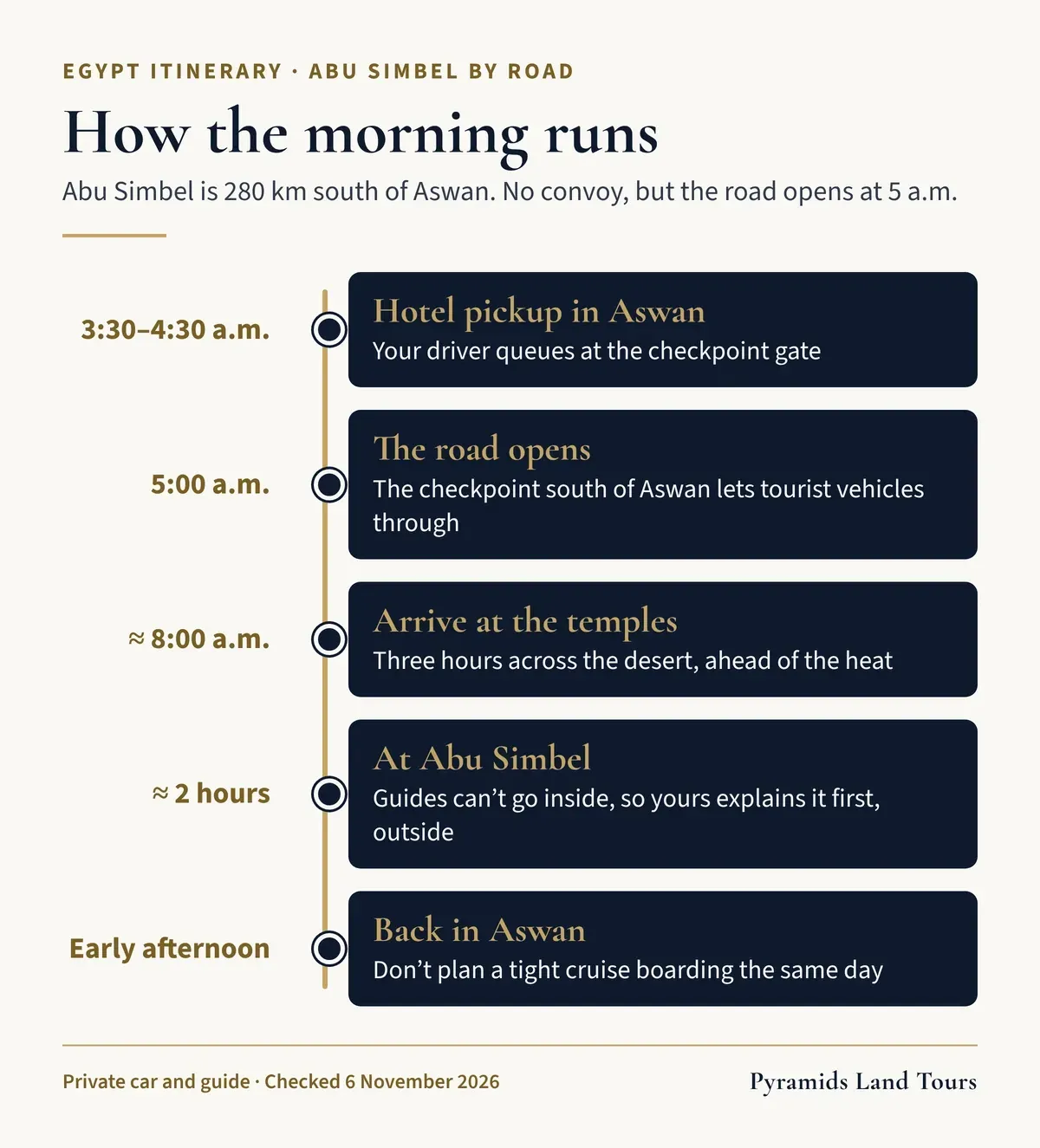
If you go by road, here is how the morning actually runs. The police convoy was abolished years ago, so you are not lining up behind two hundred buses. What has not changed as of November 2026 is the checkpoint on the southern edge of Aswan, which does not allow tourist vehicles onto the Abu Simbel road before 5 a.m. So we pick you up at your hotel between 3:30 and 4:30. Your driver queues at the gate, and after three hours across the desert, you pull up at the temples around 8. You are inside before the heat builds, and back in Aswan by early afternoon. Just don't plan a tight cruise boarding for that same afternoon.
One thing reviews rarely mention: guides are not allowed inside the Abu Simbel temples. A good guide explains the temple outside, before you go in, so the two hours count.
Two dates change the calculation. On 22 February and 22 October, the rising sun reaches sixty meters into the Great Temple and lights three of the four statues in the sanctuary. Those dates draw crowds from around the world, and accommodation fills up months in advance. If you want to see the alignment, plan the whole trip around it. If you would rather have a quieter temple, pick other dates.
(Most guides still print 21 February and 21 October. The alignment shifted by a day when UNESCO moved the temples in the 1960s.)
Should you start an Egypt trip in Cairo or Luxor?
Start in Cairo for most first trips, then travel south. You take on the largest, loudest, most demanding city while you still have energy, and you finish on the Nile at Aswan, where Egypt slows down.
Reversing it, Aswan first and Cairo last, works if you want the crescendo at Giza rather than the calm. Either way, sleep your last night in Cairo before an international flight (more on that below).
Not sure whether your plan holds together?
Send us the dates and the outline you have. We will look at the real travel time between your stops, not the distance on a map, and tell you honestly what works, what we would cut, and what we would move — whether or not you book with us. Message us on WhatsApp →
How long does it take to travel between Egypt's main sites?
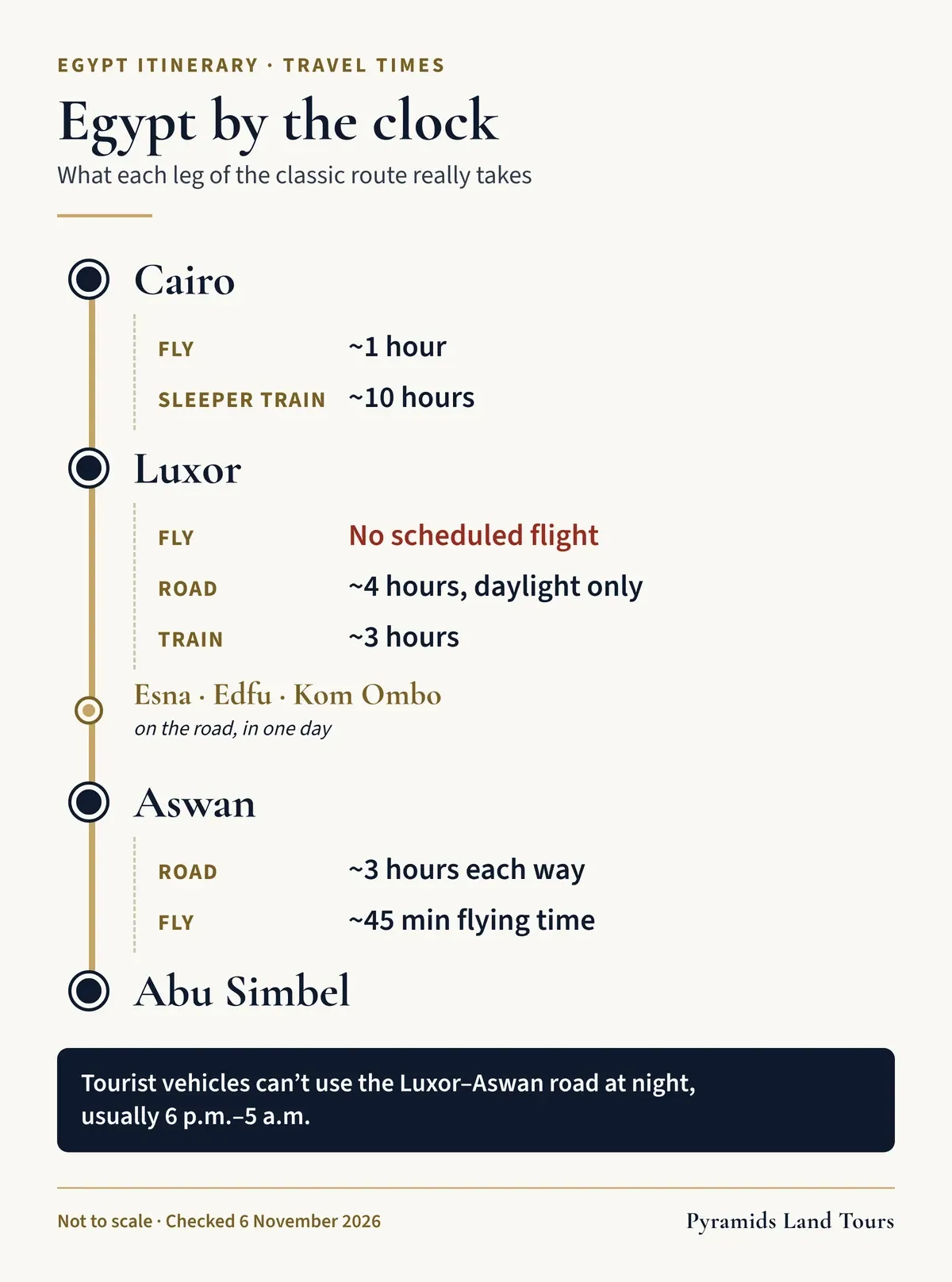
About an hour to fly Cairo–Luxor, about four hours to drive Luxor–Aswan (there is no scheduled flight), and about three hours each way to drive Aswan–Abu Simbel.
Egypt is long. It is roughly 1,000 kilometers from the Mediterranean to Abu Simbel, and almost everything you want to see is strung along that route.
| Leg | By air | By road / rail |
|---|---|---|
| Cairo → Luxor | ~1 hour | ~10 hours by overnight sleeper train |
| Luxor → Aswan | no scheduled flight | ~4 hours by car, ~3 by train |
| Aswan → Abu Simbel | ~45 min flying time | ~3 hours each way by road |
| Cairo → Alexandria | — | ~3 hours by road, traffic permitting |
Four things travelers routinely get wrong here.
There is no useful scheduled flight between Luxor and Aswan. A surprising number of published itineraries include one. Plan the overland leg, and if you drive it, Esna, Edfu and Kom Ombo are on the way. That turns a transfer into a day of touring.
Road travel between Luxor and Aswan stops at dark. As of November 2026, tourist vehicles are not allowed on the highway after dark, typically from 6 p.m. to 5 a.m., and the Tourism Police checkpoints enforce this restriction. If a driver offers to take you from Luxor to Aswan at 8 p.m., either he plans to use unpaved farm roads he should not be on, or you will be turned back at the first checkpoint outside the city. A long road transfer must be completed before sunset. If it can't, take the train or stay the night.
Internal flights fill up in peak season. Book them as soon as your dates are fixed. Forum regulars report trips rearranged because the flight, and then the sleeper train, was full.
Do not fly domestic and international on the same day. The regulars on the Egypt forum are adamant about this, and they are right. If your Luxor–Cairo flight is delayed and your transatlantic flight leaves that evening, you have no way to recover. Sleep in Cairo the night before you fly home. It costs one night and removes the single largest risk in the whole trip.
Which Egypt itinerary plans don't work?
Plans that treat Egypt like a country where things are close together. These five come up constantly.
Luxor as a day trip from Cairo. It is possible by air, and it is a poor use of a day. You spend more time in transit and security than at the sites, and you reach the Valley of the Kings at the worst part of the morning. Luxor easily fills three days.
Five sites in one Cairo day. Giza, Saqqara, the Egyptian Museum, the Citadel and Khan el-Khalili is a plan I see written down regularly. In Cairo traffic, it is four hours of driving and a blur. Two major sites in a day, three at most.
Two pre-dawn starts in a row. Abu Simbel by road one morning and a Luxor balloon flight the next means two alarms before 5 a.m., back-to-back. Put a normal morning between them.
Aswan with no time for Abu Simbel. Aswan has Philae, the river and the Nubian villages, and it is worth a night on its own. But if you have come that far south, Abu Simbel is usually worth the extra time. If you won't give it that time, ask whether Aswan is earning its place against another day in Luxor.
A cruise chosen only on price. The gap between the best and worst ships on the same stretch of river is enormous, and the price often does not tell you which is which. Ask how many passengers the ship carries, when it was last refurbished, and whether your guide is yours or shared with the whole boat.
Which Egypt itinerary routes work for 7, 10 and 14 nights?
Seven nights gives about four and a half usable days on land, or five with a Nile cruise; ten nights, about seven and a half or eight; and fourteen nights, about eleven. Each route below comes in a land version and a cruise version, and every one ends with a night in Cairo.
Each of these is a shape, not a schedule. The cruise versions sail south from Luxor to Aswan, four nights, and you board on the day you land in Luxor; the cruise covers Luxor's sights before it sails. Prefer to finish in Luxor? Fly from Cairo to Aswan and sail north instead, which takes three nights.

7-night Egypt itinerary: the classic, compressed
Cairo (2) → Luxor (2) → Aswan (2) → Cairo (1)
About four and a half usable days. Giza and the Grand Egyptian Museum, then south. Luxor's west bank one morning, Karnak the next. Drive to Aswan via Esna, Edfu, and Kom Ombo, making it a full day of sightseeing. Philae and the river in Aswan, then fly back to Cairo. Skip Abu Simbel on this length unless it matters more to you than anything else on the list.
With a Nile cruise: Cairo (2) → cruise Luxor to Aswan (4) → Cairo (1). About five usable days, because the boat does the moving for you. Fly from Aswan back to Cairo the morning you leave the ship.
This is the shortest trip that gives Upper Egypt a fair hearing. Any shorter and Luxor becomes a checklist.
10-night Egypt itinerary: the one most first-timers should book
Cairo (3) → Luxor (3) → Aswan (3) → Cairo (1)
About seven and a half usable days, with room for one slow day. Luxor gets the time it deserves, Abu Simbel becomes an early-start trip from Aswan rather than a sacrifice, and there is space to rest, which matters more than another site.
With a Nile cruise: Cairo (3) → cruise Luxor to Aswan (4) → Aswan (2) → Cairo (1). About eight usable days. The two Aswan nights after the ship give you Abu Simbel without rushing.
14-night Egypt itinerary: the classic, unhurried, plus one more region
Cairo (3) → Luxor (3) → Aswan (3) → Red Sea, Alexandria or Siwa (4) → Cairo (1)
About eleven usable days. At this length, the question changes from what can I fit to what else do I want. The Red Sea if you want a genuine rest before flying home, Alexandria for a completely different Egypt, Siwa if you want to be somewhere very few visitors reach.
With a Nile cruise: Cairo (3) → cruise Luxor to Aswan (4) → Aswan (2) → Red Sea, Alexandria or Siwa (4) → Cairo (1). About 11.5 usable days.
What time of day should you visit Egypt's main sites?
Outdoor sites first thing in the morning, museums and the river in the afternoon. The same plan can be a good day or a bad one depending on the hours.
Giza opens at 7 a.m. most of the year. The first coaches from Cairo hotels reach the plateau closer to 9. That two-hour window is the difference between the photographs you imagined and the ones you will actually take.
Go to Karnak early. You beat the heat, and the coach groups, and you get time in the Hypostyle Hall before it fills.
Do the Valley of the Kings first thing. By late morning in the shoulder season, the tombs are both crowded and airless.
Afternoons belong indoors or on the water. Museums, the GEM, a felucca, or nothing at all. A rest in the middle of the day is not a wasted afternoon. It is what makes the next morning work.
What should you book or check before an Egypt trip?
Book the Grand Egyptian Museum and internal flights early, and check visa rules and site closures for dates near your travel dates.
Book the Grand Egyptian Museum online in advance, on the official ticket site, tickets.gem.eg. Don't count on buying at the door, and allow at least three hours inside.
The royal mummies are at NMEC in Fustat, not at the Egyptian Museum on Tahrir. Many itineraries still send people to the wrong building.
Nefertari's tomb in the Valley of the Queens has been closed for conservation since 2024. It has reopened and closed several times over the years. If it is open during your dates, it is worth rearranging a morning for it, so check rather than assume.
The single-entry visa fee went up to $30 in 2026. Check the current rules before you fly.
→ Egypt visa and entry requirements → What to expect on arrival at Cairo airport
When does a private guide change an Egypt itinerary?
When the plan has to change on the day. A private guide can move, cut, or stretch a site when the heat, the crowds, or your energy say so; a fixed group departure can't.
Everything above assumes you are optimizing something that is genuinely hard to optimize from another continent: the way opening hours, traffic, heat, ticket systems and your own energy interact.
That is the actual argument for a private trip, and it is not about luxury. A fixed group departure cannot start at 6:30 because two people want the light at Giza. It cannot cut a site because the group is flagging. It cannot wait an extra thirty minutes in the Hypostyle Hall. A plan is only half the job. The other half is changing it on the day.
Last August I had a couple from London at Karnak who were completely cooked by 10:30 in the morning. The husband was pale and sweating straight through his shirt, and his wife was sitting on a fallen block near the Sacred Lake, close to tears. I canceled the afternoon at Luxor Temple on the spot, got them into Mahmoud's cold van, and took them to a quiet garden by the Nile for cold lemon-mint juice and a four-hour rest through the middle of the day. We went back to Luxor Temple at 7:30 that evening, under the floodlights, in 28°C air, and walked the hall in near silence. Over dinner, the husband looked at me and said, "If you had forced us through that stone courtyard at noon, I would have hated this city for the rest of my life."
We have been building these routes from Cairo for 25 years, every trip private, and the itinerary is written after the conversation rather than before it.
Facts checked on 6 November 2026
- No scheduled passenger flight runs between Luxor and Aswan.
- Tourist vehicles may not use the Luxor–Aswan highway after dark, usually 6 p.m. to 5 a.m.
- The Aswan checkpoint opens the Abu Simbel road to tourist vehicles at 5 a.m.; the drive takes about three hours.
- The Abu Simbel sun alignment falls on 22 February and 22 October.
- The royal mummies are at the National Museum of Egyptian Civilization (NMEC) in Fustat.
- Grand Egyptian Museum tickets are booked online at tickets.gem.eg.
- Nefertari’s tomb (QV66) has been closed since 2024.
- Egypt’s single-entry visa fee is $30.
Quick answers
How many days is enough to visit Egypt?
Seven nights is the practical minimum for Cairo and Upper Egypt together. Ten nights is a good length for most first trips: three in Cairo, three in Luxor, three in Aswan, and the last night back in Cairo. It gives Luxor the time it deserves and makes Abu Simbel an early-start trip rather than a sacrifice.
Is 5 days enough for Egypt?
Enough for Cairo and Luxor, not for Aswan as well. Spend two or three nights in Cairo, fly to Luxor for two, and sleep your last night back in Cairo before flying home.
Is my Egypt itinerary too much?
Count usable days, not nights. Take your calendar days, subtract the arrival day, the departure day, and about half a day for each internal move. Ten nights with three moves gives about seven and a half usable days. If any of those days has more than two or three major sites, it is too much.
What is the best month to travel to Egypt?
October to April, with February–March and October–November the strongest. Summer in Upper Egypt regularly passes 40°C, which limits what you can do at exposed sites like Karnak and the Valley of the Kings.
Should I do a Nile cruise or stay on land?
A cruise is a river decision more than a sightseeing decision. The three main temples between Luxor and Aswan, Esna, Edfu and Kom Ombo, can all be seen in one day by road. Choose a cruise for the river and for unpacking once. Choose land, or a small dahabiya, if you want control over when you reach each site.
Do I need to include Abu Simbel?
On ten nights or more, it fits without squeezing the rest of the trip. On seven, it takes a big share of your time, so include it only if it matters to you more than anything else. It is 280 kilometers south of Aswan, about three hours each way by road or roughly forty-five minutes by air.
What time do Abu Simbel day trips leave Aswan?
By road, hotel pickup is usually between 3:30 and 4:30 a.m. The checkpoint south of Aswan opens the road to tourist vehicles at 5 a.m., and the drive takes about three hours, so you reach the temples around 8 a.m.
Can I drive from Luxor to Aswan at night?
No. Tourist vehicles are not allowed on the Luxor–Aswan highway after dark, usually from 6 p.m. to 5 a.m. Finish the drive before sunset, or take the train.
Can I visit Luxor as a day trip from Cairo?
It is possible by air, and it is not a good use of a day. Transit and airport time take most of it, and you reach the Valley of the Kings at the worst hour. Luxor easily fills three days.
Should I fly domestic and international on the same day?
No. If the domestic flight is delayed, an international departure the same evening leaves no way to recover. Spend the final night in Cairo.

Ashraf Fares