
Temple of Hatshepsut: What to See at Deir el-Bahri, and How to Visit It Well
The short answer: The Temple of Hatshepsut — also called Djeser-Djeseru or the Mortuary Temple of Hatshepsut — stands at Deir el-Bahri on Luxor's West Bank, on the other side of the cliff from the Valley of the Kings. Foreign adults pay EGP 440 (students EGP 220). The site opens at 6:00 a.m.; last entry is 5:00 p.m. in summer and 4:00 p.m. in winter and Ramadan. An electric tram covers the exposed walk from the ticket office for about EGP 20. With a guide, allow about 90 minutes. Come in the morning, and climb to the top. The middle and upper terraces hold the best of the temple, and they are the two that coach groups most often rush.
Most people have seen Hatshepsut's temple before they arrive, on a guidebook cover or a poster. It is three long terraces of pale colonnades stacked against a cliff wall, so clean and horizontal that first-time visitors regularly tell us it looks modern. They are half right. The design is about 3,500 years old. Hatshepsut held power for some 21 years: first as regent for the young Thutmose III from about 1479 BC, then as king from about 1473 BC until her death around 1458 BC. But a great deal of what you walk past was rebuilt in the last sixty years. Once you know which parts are which, you can read the building rather than just photograph it.
How Much Are Tickets, and When Is the Temple Open?
Tickets to the Temple of Hatshepsut cost EGP 440 for foreign adults in 2026, and the site is open daily from 6:00 a.m. Last entry depends on the season. Here are the details that catch visitors out.
Tickets. Foreign adults pay EGP 440 and students with a valid ID pay EGP 220, according to the Ministry of Tourism and Antiquities' listing for the temple and the official ticket platform. Egyptian adults pay EGP 40. Children under 6 enter free. You can buy at the ticket office on arrival, or in advance on egymonuments.com. (One older ministry page for the wider Deir el-Bahri site still shows EGP 360. The temple's own listing and the ticket platform both show 440.)
Paying. Since 2023, the ministry has moved Luxor's ticket offices, including this one, to card payments. Foreign cards are sometimes declined, so carry a second card, or buy online the night before and skip the question entirely.
The Luxor Pass. If you are spending several days in Luxor, the Standard Luxor Pass ($130, or $70 for students) covers this temple and nearly every other site on both banks for five consecutive days. You buy it in person at a major ticket office with your passport, not online. It has been sold for cash in US dollars or euros, so bring both a card and cash that day. It only pays for itself if you see most of Luxor's paid sites in those five days. For one or two West Bank mornings, individual tickets usually work out cheaper.
Hours. The temple opens at 6:00 a.m. The official ticket platform gives last entry as 5:00 p.m. in summer and 4:00 p.m. in winter and during Ramadan. In November, that means arriving by 4:00 at the latest. In practice, arrive well before last entry if you want time on all three terraces.
The tram. The ticket office and car park sit about 400 meters below the temple, along a paved path with no shade at all. A small electric tram runs the stretch for about EGP 20; confirm the fare when you buy your ticket. Take it in the hotter months, or if heat or a long walk is a concern. Some drivers ask for a tip on top of the fare. It is entirely your choice.
Photography. Photography with a phone is free, according to the official ticketing platform. Flash is not allowed inside the chapels. For larger camera setups, ask at the ticket office. Flying a drone anywhere in Egypt needs a government permit.
Mobility. The terraces are connected by ramps rather than stairs, which makes this one of the easier major temples for visitors who walk slowly. The ramp to the upper terrace is long, steep, and fully exposed. In our experience, wheelchair users can reach the lower and middle levels with help; the upper ramp is hard work even with a companion pushing. The tram is the easiest way up from the car park.
What to bring. Water, a hat and sunscreen, even in winter. There is no shade between the terraces.
Facilities. There is a café near the lower area. On the way out, the exit path runs through a souvenir bazaar. A firm "la, shukran" (no, thank you) is enough, and you don't need to stop.
How Do You Get to the Temple of Hatshepsut?
The temple is on Luxor's West Bank, so most visitors arrive by private car or taxi. It sits a short drive from the Valley of the Kings. That's why the two are usually visited together.
From hotels on the East Bank, the road crosses the Nile by the bridge south of the city. Allow roughly 30 to 45 minutes, depending on where you start and on traffic. The alternative is the public ferry or a motorboat across the river from the Corniche, then a taxi from the West Bank landing, about 15 minutes. From the Valley of the Kings, it's a short drive back around the cliff. From Luxor Airport, allow around 45 minutes to an hour.
A taxi works for a single visit, but agree the price and the waiting time before you get in. A private car with a driver is simpler if you are combining the temple with the Valley of the Kings, the Colossi of Memnon, or Medinet Habu in a single morning.
What Is the Best Time to Visit Hatshepsut's Temple?
The best time to visit is early morning, at the 6:00 a.m. opening. Around 10:00, after the Valley of the Kings, also works outside the peak weeks. Midday is the hardest time to visit. Deir el-Bahri is a natural suntrap: the temple faces east into the morning sun, the cliff bay traps the heat, and there is no shade on the ramps between terraces. The two complaints we hear most from visitors who came on their own are the heat and the crowds.
The crowds come in waves, because most West Bank itineraries include this temple: cruise groups, coach tours, and day-trippers driven in from Hurghada. For most of the year, our standard order is to take clients into the Valley of the Kings at opening, while the tombs are cool and quiet. We cross to Hatshepsut around 10:00, once the first wave of groups has moved on, and you are back across the river before the worst of the afternoon heat. That only works outside the peak weeks. At Christmas, New Year and in February, 10:00 is exactly when the Red Sea coaches arrive, so we turn the morning around.
Ashraf Fares · Egyptologist
"During the Christmas and February peak weeks, when fifty-bus convoys from Hurghada start swarming the temple's open courtyards around 10:00 AM, we completely flip the script and hit Hatshepsut at 6:00 AM sharp when the gates open. Standing on that lower terrace in the cool dawn air, watching the rising sun turn the cliff face into a glowing sheet of amber without a single tour group in sight, isn't just a scheduling tweak. It's the only way to experience the sheer architectural drama of the site without getting trampled in a sun-drenched bottleneck."
If Hatshepsut's temple is the only thing you are seeing on the West Bank, come at opening at any time of year. The upper terrace is at its quietest then.
→ See Hatshepsut's temple at the right hour. We plan private West Bank mornings with an Egyptologist guide: the tombs at opening, then the temple before the coaches. See our private Luxor day tours

Who Built It, and Why Does It Look So Modern?
Hatshepset built the temple as her mortuary temple, to a design attributed to her steward, Senenmut. It looks modern partly because of its clean terraced design, and partly because much of its outer structure was rebuilt after 1961. Stop before you reach the first ramp. From here you see the whole composition: three terraces, the colonnades, and the cliff rising behind them like a theater wall. The site was not chosen at random. This bay of cliffs had been sacred to Hathor, chief goddess of the Theban necropolis, since at least the Middle Kingdom. The temple's main axis runs east, across the Nile, broadly toward Karnak and its great temple of Amun. During the annual Beautiful Festival of the Valley, Amun's sacred boat was carried across the river and up this axis to rest in the sanctuary cut into the rock at the very back.
The Egyptians called the building Djeser-Djeseru, "Holy of Holies," or more literally "Sacred of Sacreds." The man credited with it is Senenmut: chief steward of Amun, overseer of works, and the official most closely tied to her reign. Egyptian had no single title matching our "architect"; "overseer of works" is the nearest equivalent. Building started around her seventh year and took roughly 15 years, with the plan changing several times along the way.
What you see first was not the original approach. A causeway lined with Hatshepsut's sphinxes once ran up from a valley temple near the fields, about a kilometer away, and little of either survives. Hatshepsut called the temple "a garden for my father Amun": the forecourt in front of you was planted with trees, with pools of papyrus.
Late in her successor's reign, her statues were smashed and dumped in pits. Rockfalls did further damage. In the 7th century AD, a Coptic monastery was built in the ruins, which is where the Arabic name comes from: "Deir el-Bahri" means "the monastery of the north." By the time archaeologists cleared the site in the 1890s, much of it lay in pieces.
Since 1961, a Polish-Egyptian mission has been reassembling the temple. Its team has rebuilt more than twenty statues from fragments. It has also reopened sections that had been closed for decades: the Solar Cult Complex in 2015 and the Main Sanctuary of Amun in 2017.
So when a reviewer writes that the temple looks "over-restored," they are not wrong about what they saw. The ramps and colonnade fronts include a lot of new stone. But the reliefs, which are the reason to come, are largely original, and the best of them still carry 3,500-year-old paint.
What to See on the Lower Terrace
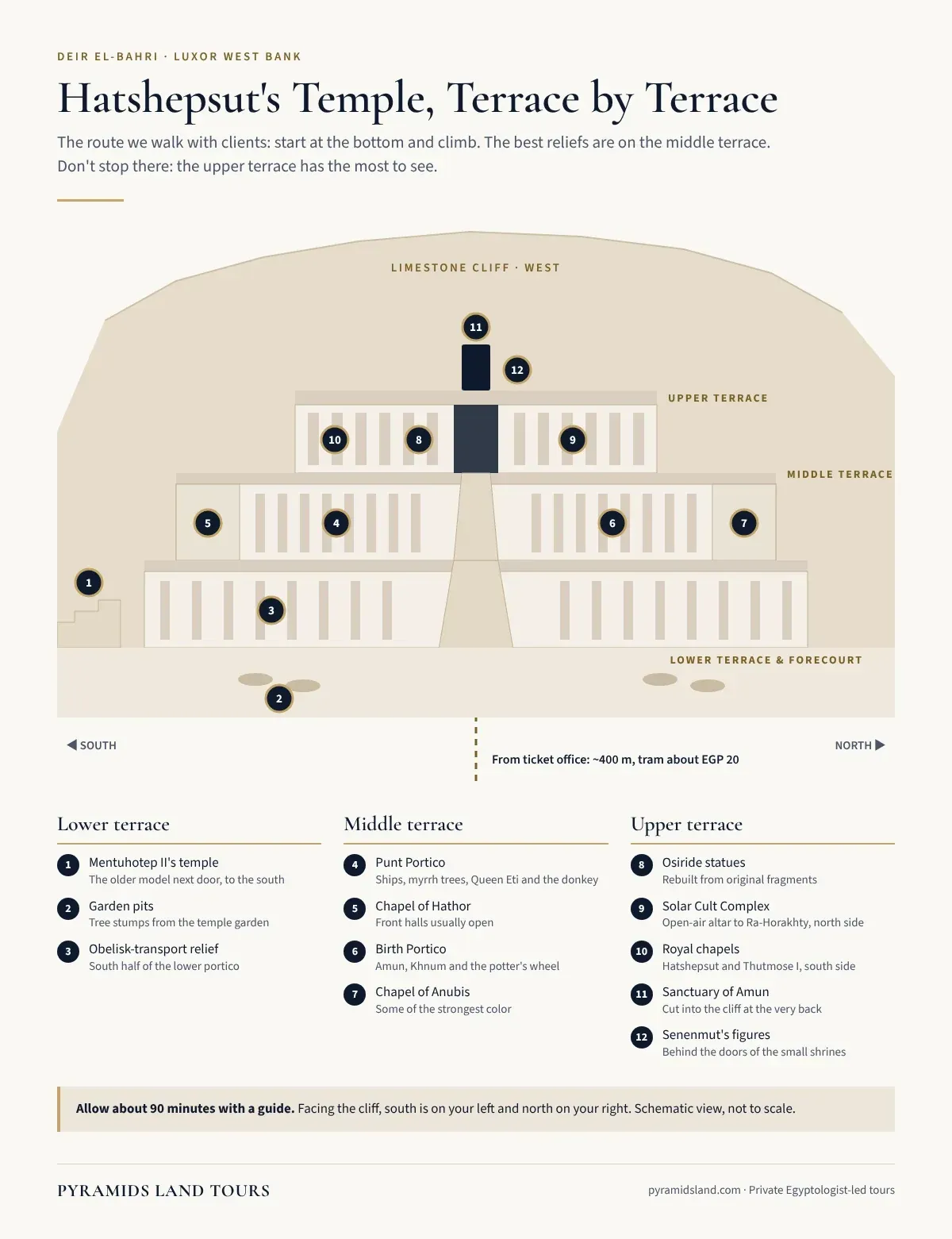
The lower terrace holds the remains of the temple garden, the obelisk-transport reliefs, and the best view of Mentuhotep II's older temple next door. Look left. The ruined terraced temple immediately to the south is that of Mentuhotep II, the king who reunified Egypt. He built it more than 500 years before Hatshepsut, and it was the earliest major temple in this bay. Her architects drew on its terraces and colonnades, pushing the idea much further. Building beside him was a statement: it tied her reign to the founder of the Middle Kingdom.
Look down in the forecourt. You'll see fenced-off pits, some still holding ancient tree stumps. They are the remains of the temple garden. Guides like to call them the myrrh trees from Punt. Excavators identified some of the surviving stumps as persea trees, so not every stump you see is a Punt tree.
Look at the lower portico. It is mostly reconstructed, and many visitors walk straight past it. Its south half carries one of the great engineering scenes of ancient Egypt: two granite obelisks being brought down the Nile from Aswan on a single enormous barge, towed by rows of boats. Which pair of obelisks it shows is still debated. Her one standing obelisk at Karnak is close to 30 meters tall; see it on the same trip, and you'll understand the scale of what this wall records.
Beneath your feet. Senenmut cut a second tomb for himself, TT353, whose corridors run under the temple's forecourt. Its ceiling is the earliest known astronomical ceiling, a map of the night sky. It is not open to visitors.
What to See on the Middle Terrace
The middle terrace holds the temple's two famous relief cycles, the expedition to Punt and Hatshepsut's divine birth, plus the chapels of Hathor and Anubis. It is the level that most rewards a guide, and the one where you should spend most of your time.
The Punt Portico (left, as you face the cliff). Around her ninth year, Hatshepsut sent five ships to the land of Punt, and the expedition is carved here like a documentary. Punt lay somewhere on the southern Red Sea coast of Africa. Many scholars now favor Eritrea and eastern Sudan over Somalia, though the question remains unsettled. You will see the ships under sail, and Puntite houses raised on poles and reached by ladders. Myrrh trees are dug up and carried aboard in pots, thirty-one of them by the inscription's count, with baboons among the cargo. The cargo list reads like a catalog of everything Egypt couldn't grow: ebony, ivory, gold, myrrh, eye-paint, panther skins. "Never was brought the like of this for any king," the text boasts.
Then look for the chief of Punt, Perehu, and behind him his wife, Eti (often written Ati). She is drawn with a heavy, curving body, so specifically that she reads like a portrait rather than a type. Behind her is a small donkey, captioned "The ass which bears his wife." The block with her figure on the wall is a copy. Only that one block was replaced, not the whole scene. The original block was removed in the 19th century and is held by the Egyptian Museum in Cairo. If you are in Cairo, ask whether it is on display.
Ashraf Fares · Egyptologist
"I always take clients straight past the grand inscriptions to a small panel in the Punt arcade showing Red Sea fish swimming under Egyptian trade galleys, carved accurately enough that specialists can identify many of the species, from stingrays to pufferfish. What stops people cold, though, is the relief of Queen Ati of Punt herself, drawn with ruthless physical realism alongside her tiny, visibly struggling donkey. My lead guide Tareq loves to pause right there and have clients contrast that unvarnished, observational detail with the eternally young, hyper-idealized statues of Hatshepsut on the terrace above."
The Birth Portico (right). The north side tells the story Hatshepsut used to justify her kingship. The god Amun takes the form of her father, Thutmose I, and visits her mother, Queen Ahmose. The text says the palace filled with his fragrance, and that all his odors were those of Punt. Further along, the ram-headed god Khnum shapes the child and her spirit double, her ka, on a potter's wheel. Look closely: both little figures are shown as boys. The pronouns in the text are feminine, but the image of a king was conventionally male. This is royal propaganda in stone, and despite later damage it is still clearly readable. The nearby coronation texts placed a warning in her father's mouth: "he who shall speak evil in blasphemy of her majesty shall die."
The Chapel of Hathor (far left). It sits at the south end of the terrace and originally had its own ramp and entrance. Look for the pillars topped with Hathor's face and her cow's ears. Inside, the reliefs show the goddess, in the form of a cow, suckling Hatshepsut: nursing the king. On the north wall of the columned hall, look for the soldiers marching in a festival procession. On our visits, the front halls are usually open, and the inner rooms cut into the rock are usually closed.
The Chapel of Anubis (far right). It is smaller and often quieter, and its offering scenes keep some of the strongest color we see in the temple: deep blues, reds, and yellows. It is part of your standard ticket. Everything here is covered by that ticket, so politely decline any offer of a paid extra look.
What to See on the Upper Terrace
The upper terrace holds the Osiride statues of Hatshepsut, the open-air sun court, the Sanctuary of Amun, and Senenmut's hidden portraits. The last ramp is the longest and the hottest. Some visitors are told there is not much at the top. That is wrong: this terrace has the most to see.
The Osiride statues. The figures lining the portico depict Hatshepsut as Osiris, the god of the dead, with arms crossed and holding the crook and flail. Most were broken in antiquity, by the later campaign against her and by rockfalls. What you see are the Polish team's reconstructions, with original fragments fitted into new stone.
The upper courtyard. Pass through the granite doorway into the open court. On the right (north) is the Solar Cult Complex, built around an open-air altar to the sun god Ra-Horakhty. On the left (south) are the offering chapels of Hatshepsut and her father, Thutmose I. Later royal temples on the West Bank repeated this layout: sun to the north, Amun at the back, the royal cult to the south. This is one of the earliest places it survives this completely.
The Sanctuary of Amun. At the very back, cut into the cliff, is the room where Amun's boat rested during the festival. More than a thousand years later, under Ptolemy VIII in the 2nd century BC, a new innermost room was cut beyond it. The sanctuary became associated with two deified wise men, Imhotep and Amenhotep son of Hapu, and the upper terrace seems to have become a place where the sick came seeking cures. There is often a queue to look inside, and the space is small. Be patient: this room was the destination of the whole festival route.
Look behind the doors. Senenmut had small kneeling figures of himself carved behind the doors of the small shrines on this terrace and in other recesses. They sat where the open door would leave them covered. They are sometimes called his secret signature, but most Egyptologists think they were made with the queen's permission. Some were later chiseled out, but several survive. Ask your guide to show you one.
Ashraf Fares · Egyptologist
"The second clients reach the upper terrace, turn around, and look out over the green Nile valley toward Karnak, you can watch the lightbulb go off behind their eyes. They realize in an instant that these weren't isolated monuments dropped in the sand, but a deliberate sacred axis spanning across the river for the Beautiful Festival of the Valley. They usually stand there at the railing in total silence for a few seconds before turning to me and whispering, 'It isn't just a temple layout—they re-engineered the whole landscape into a physical theater.'"
Why Were Hatshepsut's Images Erased?
Hatshepset's figures and names were cut out late in the reign of her successor, Thutmose III, some twenty years or more after her death. Egyptologists still debate why. A leading explanation is that it cleared the way for Thutmose III's son, Amenhotep II, to succeed him. You can still see the damage all over the temple. Her figures are roughened away, sometimes with a new figure carved over them. Her cartouches are gouged out or recut with the names of Thutmose I or Thutmose II, while the surrounding hieroglyphs remain untouched. The campaign was selective, not total, which is why so much of her survives. Once your eye is trained on two or three examples, you start seeing them everywhere.
Not every scar is part of her erasure. About a century after her death, under Akhenaten, the figures and names of Amun were hacked out across the temple; later kings, Ramesses II among them, restored some of them. Christian monks living here in the monastery period defaced figures of the old gods for reasons of their own. These phases sometimes overlap on the same wall, and even specialists don't always agree on which damage is whose.
The full story of why her successor did it, and why it failed, is in our biography of Queen Hatshepsut.
Where Is Hatshepsut Buried?
Hatshepset was buried in tomb KV20 in the Valley of the Kings, not in this temple. A mummy that Egyptian authorities identified as hers in 2007 is now in the National Museum of Egyptian Civilization in Cairo. A mortuary temple was a place of worship and offerings; the body lay elsewhere. In fact, Hatshepsut prepared two tombs.
As queen, before she took the throne, she had a tomb cut high in the cliff face of a remote desert valley west of Luxor. The quartzite sarcophagus from that earlier tomb, inscribed for her as "great royal wife," is now in the Egyptian Museum in Cairo.
As king, she was buried in KV20, in the Valley of the Kings on the far side of the cliff behind you. Its corridors twist for more than 200 meters and curve back toward Deir el-Bahri; whether that curve was aimed at her temple or forced by bad rock is debated. She also had her father, Thutmose I, reburied there with her. KV20 is not open to visitors.
Her mummy was not found there. In 2007, Egyptian authorities identified a mummy from KV60, a small undecorated tomb, as Hatshepsut's. The identification rests chiefly on a loose molar, kept in a box inscribed with her name, that fits a gap in the mummy's jaw. It is widely accepted, though some specialists still treat it with caution. The box came from the royal mummy cache, hidden in antiquity in the cliffs just south of this temple. Today she lies in the Royal Mummies Hall at the National Museum of Egyptian Civilization (NMEC) in Cairo, not the Grand Egyptian Museum.
What Mistakes Do Visitors Make at Hatshepsut's Temple?
The most common mistakes are arriving at midday, treating the temple as a 30-minute photo stop, skipping the upper terrace, paying for things that are already included, and coming without the story.
Leaving it to the end of a long day. Visitors who arrive at 1:00 p.m. after a full-tomb morning tend to stand at the bottom ramp, take a photograph, and leave.
Thirty minutes on a coach stop. Day tours from the Red Sea often allow half an hour. That is barely enough to reach the middle terrace and back, and never enough for the Punt reliefs.
Skipping the upper terrace. The Osiride statues, the solar court, the sanctuary and Senenmut's figures are all up there, and so is one of the best views on the West Bank.
Paying for things that are free. The chapels, the sanctuary, and photographs with your phone are all included in your ticket. Men offering to take your picture "from the best spot" at the top will expect payment.
Coming without the story. There is almost no signage here. Read up the night before, or come with someone who can read the walls to you.
Is Hatshepsut's Temple Worth Visiting If You've Seen Karnak?
Yes, for different reasons. Karnak overwhelms you with scale and density; this temple works through setting, proportion, and one extraordinary personal story. If you have only one morning on the West Bank, the Valley of the Kings and Hatshepsut's temple together are the classic pairing, a short drive apart.
The temple you are looking at was built by a woman who ruled as king. Her successor tried to erase her from it, and her statues ended up in a quarry pit. Monks lived in its ruins, and the cliff fell on it. Then it was pieced back together over more than sixty years of patient work. Walk it slowly, and it tells you all of that.
Hatshepsut's Temple: Quick Answers
How much is the ticket to Hatshepsut's temple?
EGP 440 for foreign adults and EGP 220 for foreign students in 2026. Egyptians pay EGP 40, and children under 6 enter free. Pay by bank card at the ticket office or buy online at egymonuments.com.
What are the opening hours of the Temple of Hatshepsut?
The temple opens at 6:00 a.m. Last entry is 5:00 p.m. in summer and 4:00 p.m. in winter and during Ramadan.
What is the best time to visit Hatshepsut's temple?
At the 6:00 a.m. opening. Outside the peak weeks, around 10:00 after the Valley of the Kings also works. Avoid midday, when the site is hottest and has no shade.
How long do you need at Hatshepsut's temple?
About 90 minutes with a guide, enough for all three terraces and the Punt reliefs. Visiting alone, allow at least an hour.
Who built the Temple of Hatshepsut?
Hatshepsut built it as her mortuary temple, to a design credited to her steward Senenmut. Construction began around her seventh year and took about fifteen years.
Is Hatshepsut buried in her temple?
No. Her royal tomb, KV20, is in the Valley of the Kings and is closed to visitors. A mummy identified as hers in 2007 is in the National Museum of Egyptian Civilization in Cairo.
How much of Hatshepsut's temple is original?
The design and most of the reliefs are original. Much of the outer structure and the Osiride statues were rebuilt by a Polish-Egyptian mission working at the site since 1961.
Want us to plan your West Bank morning? Tell us your travel dates and how much time you have in Luxor. We'll set it up: the tombs at opening, Hatshepsut's temple at the right hour, and an Egyptologist who reads the walls with you. Message us on WhatsApp
Sources
- Tickets and hours: Ministry of Tourism and Antiquities, Hatshepsut Temple and the official ticket platform, checked 1 November 2026.
- Card payment at Luxor ticket offices: Egypt Independent, 2023.
- Tram fare and the Luxor Pass: Explore Luxor.
- Restoration, the Queen of Punt block, the Solar Cult Complex: Polish-Egyptian Archaeological and Conservation Expedition, University of Warsaw and PCMA, 2015.
- The erasure: The afterlife of Hatshepsut's statuary, Antiquity.
- Inscriptions (Punt, divine birth, coronation): Breasted, Ancient Records of Egypt II (1906).
- History and architecture: Wilkinson, The Complete Temples of Ancient Egypt; Bard (ed.), Encyclopedia of the Archaeology of Ancient Egypt; Shaw (ed.), The Oxford History of Ancient Egypt; Reeves & Wilkinson, The Complete Valley of the Kings; Graves-Brown, Dancing for Hathor.
Ashraf Fares