
Best Time to Visit Egypt (2026/2027): Month by Month, From a Cairo Operator
Last updated: July 16, 2026 — after another season of running private tours through every month on this page.
Short answer: Visit Egypt between October and April. The sweet spots are February–March and October–November — peak weather without the December crowds. November is the single best month. June–August is 30–50% cheaper, but Luxor hits 42°C.
The best time to visit Egypt is October through April, when daytime temperatures are comfortable across the whole country. Within that window, the sweet spots are February–March and October–November — peak-quality weather without the December crush. The cheapest months are June through August, and the busiest two weeks of the year run from December 20 to January 5.
That's the short answer. The honest answer is longer, because "best" depends on what you're doing. The best month for a Nile cruise is not the best month for diving, and the best month for perfect weather is not the best month for your budget. What follows is the guidance we give our own guests — including the parts most travel sites leave out.
- ◆ Best overall window: October–April
- ◆ Sweet spots: February–March and October–November — warm days, thinner crowds, fairer prices
- ◆ Best single month: November — winter weather, full cruise season, pre-Christmas prices
- ◆ Cheapest months: June–August, 30–50% below peak — but 42°C afternoons in Luxor and Aswan
- ◆ Busiest: December 20 – January 5, then Easter week
- ◆ Rain: essentially none — a few brief winter showers in Cairo and Alexandria
- ◆ Ramadan 2027: expected ~February 8 – March 9 — inside peak season; sites stay open
- ◆ Luxor balloons: suspended until August 31, 2026 — flights resume September 1
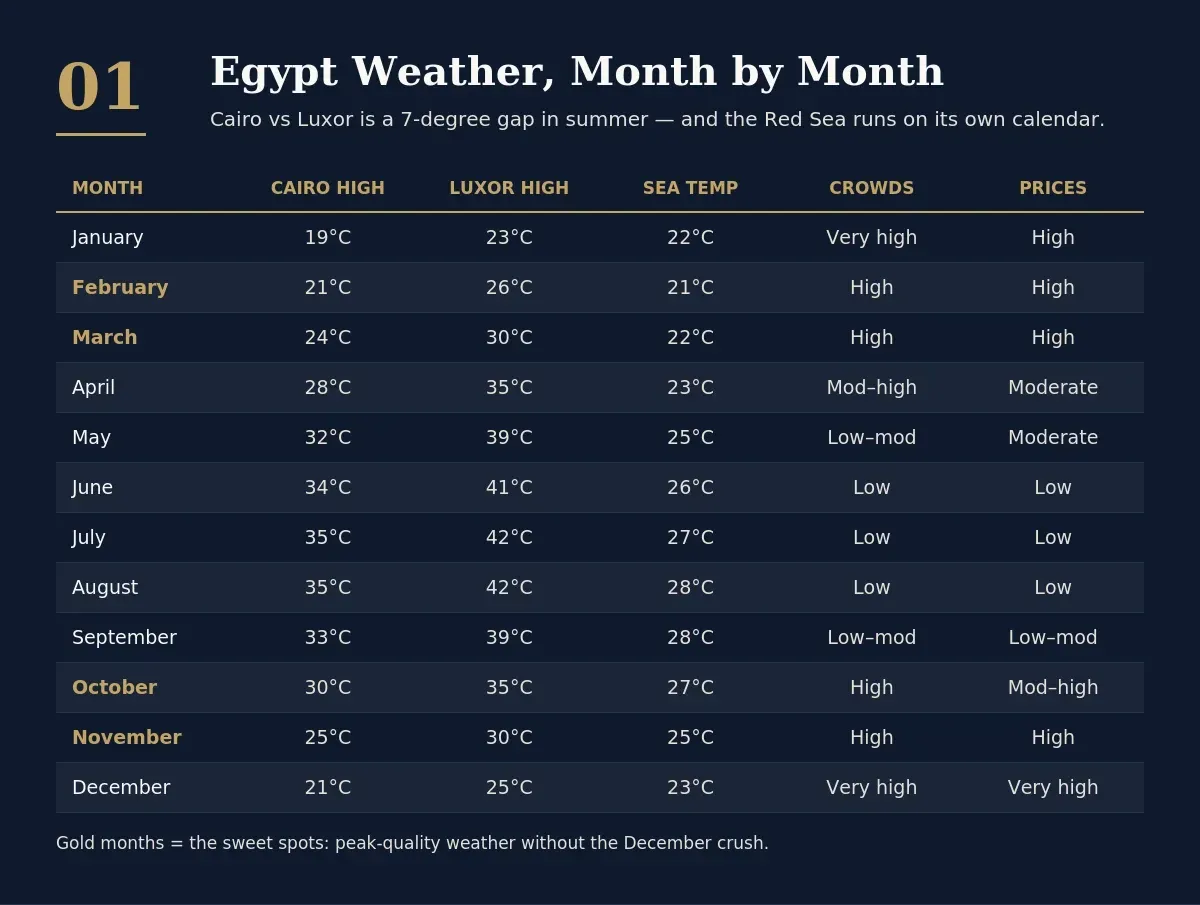
Egypt Weather by Month
| Month | Cairo high / low | Luxor high | Sea temp | Crowds | Prices | Verdict |
|---|---|---|---|---|---|---|
| January | 19° / 10°C | 23°C | 22°C | Very high | High | Excellent — pack layers |
| February | 21° / 11°C | 26°C | 21°C | High | High | Excellent |
| March | 24° / 13°C | 30°C | 22°C | High | High | Excellent |
| April | 28° / 16°C | 35°C | 23°C | Mod–high | Moderate | Very good |
| May | 32° / 19°C | 39°C | 25°C | Low–mod | Moderate | Good value |
| June | 34° / 22°C | 41°C | 26°C | Low | Low | Budget & divers |
| July | 35° / 23°C | 42°C | 27°C | Low | Low | Budget & divers |
| August | 35° / 23°C | 42°C | 28°C | Low | Low | Budget & divers |
| September | 33° / 22°C | 39°C | 28°C | Low–mod | Low–mod | Good value |
| October | 30° / 19°C | 35°C | 27°C | High | Mod–high | Excellent |
| November | 25° / 15°C | 30°C | 25°C | High | High | Best overall |
| December | 21° / 11°C | 25°C | 23°C | Very high | Very high | Excellent — priciest |

Egypt Weather by Month: The Whole Decision in One Table
Two things this table says that most guides don't say plainly. First, Luxor is not Cairo — in summer, there's a 7-degree gap between them, and the sites that define an Egypt trip are all in the hot south. Second, the Red Sea runs on its own calendar: the water is warmest exactly when the rest of Egypt is at its most punishing. Humidity, for the record, is a non-issue in Upper Egypt — the heat is bone-dry — with three exceptions covered below: Cairo's humid winter mornings, Cairo's muggy midsummer evenings near the Nile, and the inside of the tombs.
Best Months by Region
Egypt isn't one destination. The same week can be perfect on one coast and punishing up the Nile.
Best Months by Region
| Region | Best months | Note |
|---|---|---|
| Cairo & Giza | October – April | Watch winter morning fog (covered below) |
| Luxor & Aswan | October – March | The heat arrives here first and leaves last |
| Alexandria & the Med coast | May – October | Egypt’s summer escape; winters are wet, windy, and grey |
| Sinai & Sharm El Sheikh | Year-round | March–May and Sept–Nov ideal for Mount Sinai |
| Hurghada & Marsa Alam | Year-round | Warmest water June–September |
| Siwa & the White Desert | Oct–Nov & Feb–Mar | Mid-winter desert nights approach freezing; summer is off the table |
Egypt Month by Month
January
The heart of peak season. Days of 19–23°C, guaranteed sun, and the year's biggest crowds through January 5 — after which a genuine lull opens until Easter bookings begin. Coptic Christmas on January 7 makes Old Cairo especially atmospheric. Nights are cold: 10°C in Cairo, colder in the desert and on a cruise sundeck. Verdict: excellent, if you pack like it's two seasons.
February
Identical weather to January, with the New Year crowd gone home — one of the two smartest months on this page. The Abu Simbel Sun Festival falls on February 22 (read the honest note below before you plan around it). Ramadan begins in early February 2027; see the Ramadan section — it changes less than you think. Verdict: excellent.
March
Warming nicely — Cairo at 24°C, Luxor at 30°C — with crowds easing week by week. First khamsin wind episodes are possible from mid-month. Verdict: excellent, with a flexible itinerary for dust days.
April
Warm rather than hot, and the last comfortable month in Upper Egypt. Easter week spikes crowds and prices; Sham El Nessim, the day after Coptic Easter, is Egypt's national picnic — a lovely local scene. Verdict: very good; book around Easter, not into it.
May
Luxor hits 39°C, but mornings still work, and cruise prices soften noticeably. The Red Sea is warming toward its summer best — though resorts fill with domestic travelers over the Eid al-Adha holiday (mid-May in 2027). Verdict: good value for heat-tolerant travelers.
June
Summer proper. Sites are empty, prices are low, and the sea is 26°C. Upper Egypt sightseeing becomes a dawn-only exercise. Verdict: budget trips and divers.
July
The hottest month is July — 42°C in Luxor. Doable with the summer rhythm described below, and the Valley of the Kings at 6 AM is genuinely special: soft light, no buses. Verdict: only with a redesigned itinerary.
August
As July, with the warmest sea of the year (28°C) and peak visibility for divers. Gulf-region summer holidays keep Red Sea resorts lively even while the ancient sites stand empty. Balloon flights over Luxor resume September 1, so August is the last month without them. Verdict: Red Sea first, temples at dawn.
September
Summer's echo — still hot in the south, but the crowds haven't returned, and neither have peak prices. The single best month to combine low costs with the warmest sea. Verdict: the smart shoulder month nobody books.
October
Everything aligns: Luxor back to 35°C and falling, cruise season fully open, the second Sun Festival on October 22. Crowds and prices climb through the month. Verdict: excellent — book by August.
November
Our answer to "if you could pick any month." Winter-quality weather, every boat sailing, and prices a notch below December. The good dahabiyas go first. Verdict: the best all-around month of the year.
December
The weather in Egypt is famous for its prices to match. Before December 20 is civilized; December 20 to January 5 is the annual crush — queues at the Valley of the Kings before 8 AM, cabins sold out months ahead. Verdict: excellent, booked 4–6 months out.
Winter (December–February): The Peak, and Two Things Nobody Warns You About
The season itself needs little selling: days of 20–26°C, endless blue sky, cool evenings — perfect for standing in front of a temple wall for an hour while your guide reads it to you.
The first thing nobody warns you about is Giza's winter morning fog. From late December through early February, humidity off the Nile meets cold desert nights, producing thick radiation fog over Cairo and the plateau. Arrive at 8 AM on a foggy morning, and the Great Pyramid is a grey wall of mist. Be suspicious of any operator who locks your Giza visit to 8 AM sharp in this window. On foggy mornings, we flip the day: the Grand Egyptian Museum's indoor galleries first, the plateau at 10:30 when the sun has burned through, and the pyramids stand in sharp winter light. That flexibility is a private-tour advantage no group coach can offer.
The second is the cold itself. January desert nights drop to 9–10°C, and the wind on a Nile cruise sundeck after dark is colder than anyone expects. Pack a real jacket — our full guidance is on what to wear in Egypt.
Thinking about a winter trip? Tell us your dates and we'll tell you honestly what they'll be like — including whether to dodge the December 20 wave. Message us on WhatsApp →
Spring (March–May): The Underrated Window — With One Honest Warning
March and early April might be the smartest time to book on this page: warm rather than hot, crowds thinning, prices softening. The warning is the khamsin — hot, dust-carrying winds that can blow through between March and May. Not constant; a handful of episodes a season, each a day or two. When one hits, the sky turns orange, and outdoor photography is done. We watch the forecast and flip the itinerary — museum day forward, plateau day back — which is, again, the quiet advantage of a private schedule over a fixed group one.
By May, Luxor is pushing 39°C. Still workable with early starts, and May cruise prices are kinder — but if heat worries you at all, stay inside October–April.
Summer (June–August): The Truth About 42°C
Most guides say "avoid summer" and move on. Here's what it actually means, because plenty of people can only travel in July and August, and pretending they shouldn't come helps nobody.
At 42°C in Luxor, stone radiates heat and midday sightseeing is off the table, full stop. What works is the rhythm we run every July: Valley of the Kings at 6 AM when the gates open — soft light, no buses, a civilized 28°C — sites done by 10:30, pool or air-conditioned museum through the afternoon, temples again toward sunset. A different rhythm, not a ruined trip. UV is extreme from late morning; hat, high-SPF, and a liter of water per person in the vehicle are non-negotiable.
One warning within the warning: the tombs flip the climate. Luxor's heat is bone-dry, but deep, rock-cut tombs have no airflow, so moisture from hundreds of visitors gets trapped. Step into KV62 or Seti I in July, and you hit a wall of tropical humidity that exhausts older travelers and anyone with breathing trouble far faster than the dry heat outside. Take the tombs slowly, rest in the shaded areas between descents, and don't stack more than three in a row.
Summer's genuine upside: the year's lowest prices, empty sites, and the Red Sea at its absolute best — 27–28°C water, calm seas, the visibility serious divers plan around. If summer is your only window, invert the itinerary: base yourself on the Red Sea or the Sinai coast, with ancient sites in short dawn doses.
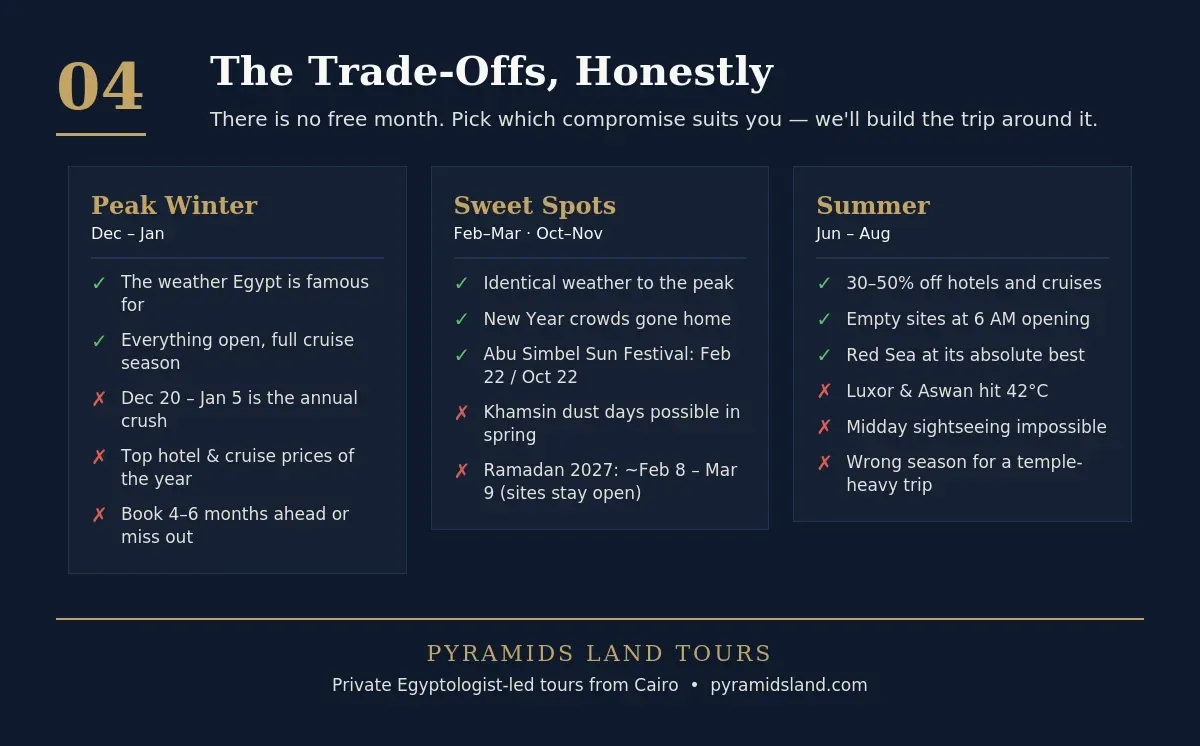
Locked into July or August? Send us your dates — we'll tell you straight whether your must-see list survives the heat, and how we'd restructure it if not. Message us on WhatsApp →
Autumn (September–November): The Sweet Spot Most People Miss
September is summer's echo — hot in the south, but prices haven't risen, and the sea is at its warmest. By October, everything aligns, and November is our pick for the single best month of the year: winter weather at slightly-less-than-winter prices, before the December wave. If we could choose any two weeks for a first-time guest, it would be late October into November. Book by August.
Best Time by What You're Actually Doing
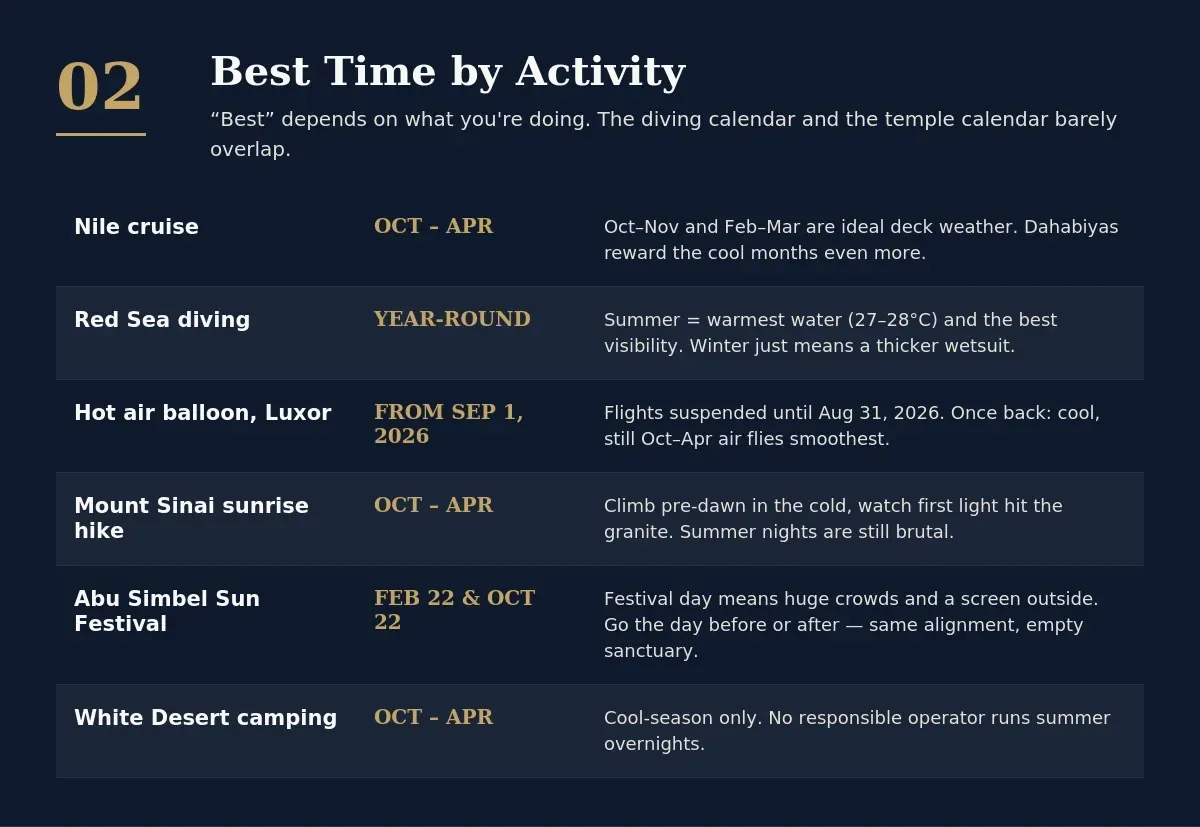
Nile cruise: October–April, with October–November and February–March ideal. Summer cruising exists and is cheap, but shore excursions at Edfu and Kom Ombo in 41°C test anyone's enthusiasm. Weighing boat types? See the dahabiya vs Nile cruise comparison — open-deck dahabiyas reward the cool months even more. Browse current departures on our Nile cruises page.
Red Sea diving and snorkeling: Year-round, genuinely. Summer brings the warmest water and best visibility; winter water at 21–22°C just means a thicker wetsuit. Site-by-site detail in the Red Sea diving guide, and for the quiet southern option, Marsa Alam.
Hot air balloon over Luxor: Flights are suspended until August 31, 2026, and resume on September 1, 2026. Once back, the cool, still air of October–April flies smoothest. Everything else is in the Luxor balloon guide.
Climbing Mount Sinai: October–April for the classic pre-dawn summit — climb in the cold, watch first light hit the granite. Full picture in the Sinai travel guide.
Abu Simbel Sun Festival — the honest version: The alignment on February 22 and October 22 is real; the festival-day experience mostly isn't. The inner sanctuary holds perhaps 30–40 people at a time, and thousands arrive. Unless you queue from the small hours in freezing desert dark, you'll watch the moment on a projection screen outside. Our advice after years of running this route: go the day before or the day after. The sun's position is virtually identical, the sanctuary is calm, and you'll actually stand inside it. Logistics in the Abu Simbel guide.
White Desert camping: October–November and February–March are ideal. Midwinter calls for serious cold-weather gear — desert nights can approach freezing — and summer is off the table.
Best Time by Who's Traveling
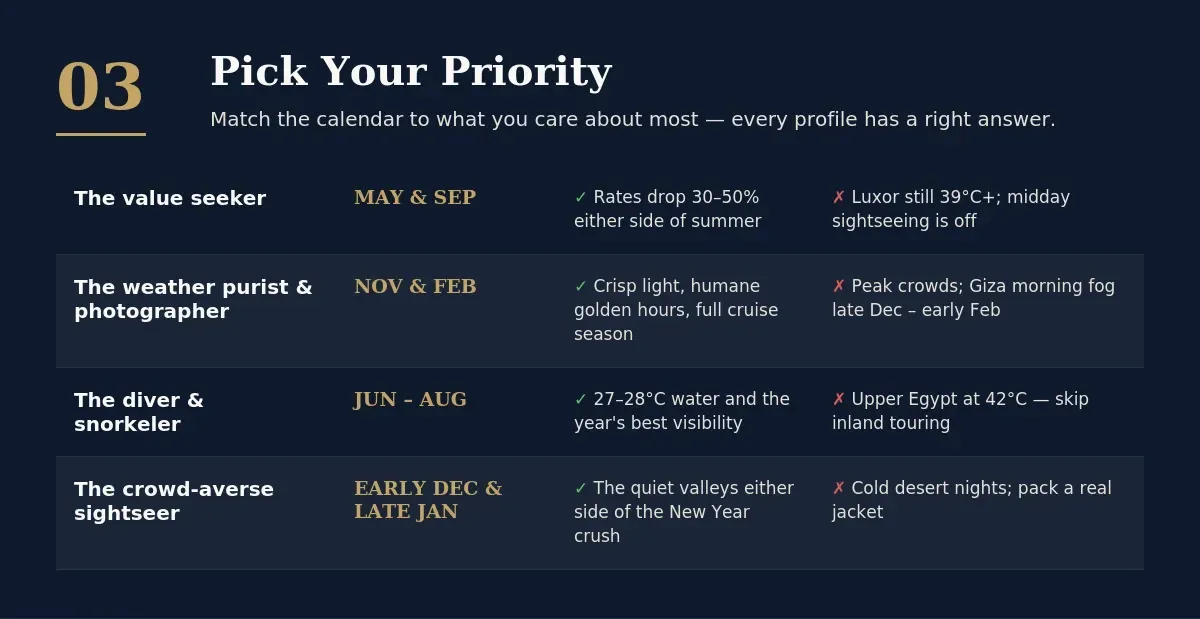
Cheapest time to visit Egypt: June–August, 30–50% below peak — with the dawn rhythm above. September offers most of the savings with less heat. Full numbers in our Egypt travel costs guide.
Families with school-age kids: Christmas and Easter are your realistic windows; both are peak, so book 4–6 months out. Between them, Easter usually means warmer swimming and slightly softer prices. Half-terms in October land in the sweet spot if your school calendar allows.
Honeymooners: October–November or February–March — dahabiya season at its best. Our honeymoon itinerary is built around exactly these windows.
Photographers: November–February for the light: low golden sun for most of the morning, crisp air after any fog burns off, and 5 PM sunsets that put golden hour at a humane hour. Days are short — plan two shoots a day, not three. Watch the Giza fog window above; it ruins dawn shots and gifts you 10:30 clarity instead.
Seniors and anyone managing mobility or heat: October–April, no exceptions, we'd recommend — and note the tomb-humidity warning above, which matters more than the headline temperature. Site-by-site accessibility is in Egypt for seniors.
First-time visitors: February–March or October–November. You get the weather the brochures promise without the December logistics. Start with how many days you need.
Which Months Sell Out First
From our own booking calendar, in order: dahabiyas for October–November go first — the small boats have a handful of cabins and no flexibility. Christmas and New Year private guides go next; by September, the good ones are assigned. February fills earlier than people expect, pulled forward by the Sun Festival and half-term traffic. If your dates sit in any of those three windows, the difference between booking five months out and two is the difference between choosing and taking what's left.
Ramadan 2027 Falls Inside Peak Season — Here's What Actually Changes
Almost no travel site flags this: Ramadan 2027 is expected to run from around 8 February to 9 March 2027 (final dates follow the moon sighting). That's squarely inside Egypt's peak season.
For most visitors on an organized trip, remarkably little changes. Sites, museums, and tombs stay open — some on slightly shortened hours your itinerary simply plans around. Hotels and tourist restaurants serve food all day. Your guide and driver may be fasting; ours will never make it your problem. Be discreet — don't eat or drink openly on the street in daylight — and experience an iftar at least once: the moment the sunset cannon fires and the whole city exhales into dinner is one of the most atmospheric things you can witness in Cairo. Independent travelers feel Ramadan more — daytime restaurant closures, thin transport at iftar — and it rewards structure. More in our Ramadan in Egypt guide.
When We'd Honestly Tell You Not to Come
If your dream itinerary is temple-heavy — Luxor, Aswan, Abu Simbel, long mornings on foot — your only window is July or August, and you can't or won't do 5 AM starts, we'd rather say it now: you won't enjoy it, and no operator who claims otherwise is being straight with you. Move the trip to October if you possibly can.
If you can't move it, redesign it instead of forcing it: Red Sea base, dawn-only site visits, the air-conditioned Grand Egyptian Museum in the afternoons, a Nile cruise for the breeze. That trip works in August. The standard trip doesn't.
FAQ
What is the best month to visit Egypt?
November. It combines comfortable temperatures, full Nile cruise operations, manageable crowds, and prices below the Christmas peak. February and March are the equal choice on the other side of the peak.
What is the worst time to visit Egypt?
July and August for a classic sightseeing itinerary — Luxor and Aswan reach 42°C. They're the best months only for Red Sea trips, where summer brings the warmest water and finest visibility.
Can you visit Egypt in July?
Yes, with a redesigned trip: sites at 6 AM, midday indoors, a Red Sea or cruise base. Expect 42°C in Luxor and 30–50% savings for tolerating it.
Is Egypt cold in winter?
Days are warm (19–26°C); nights are genuinely cold — around 10°C in Cairo and colder in the desert. Pack a proper jacket for evenings and cruise decks.
Can you swim in Egypt in December?
Yes — the Red Sea holds about 23°C in December, comfortable for most swimmers and fine for snorkeling. The Mediterranean at Alexandria is too cold by then.
When are the pyramids least crowded?
At opening time, in the low months of May–September — and in winter, mid-morning on fog days, right after the mist clears. Weekday mornings always beat Fridays and Saturdays.
When is the best time for a Nile cruise?
October through April. October–November and February–March are the sweet spots: ideal deck weather without the December price peak. Summer cruises run cheap, but 41°C shore excursions are hard work.
Does it rain in Egypt?
Almost never. Cairo sees a few brief rainy days per year, all in winter; Luxor and Aswan can go years without meaningful rain. Heat management is the only weather variable that matters.
Is it OK to visit Egypt during Ramadan?
Yes. Tourist sites and hotels run normally or on slightly shortened hours, and the evenings are genuinely special. Ramadan 2027 is expected around 8 February – 9 March. Be discreet about eating in public during daylight.
How far in advance should I book an Egypt trip?
For Christmas and New Year: 4–6 months. For the February–March and October–November sweet spots: 2–3 months, earlier for dahabiyas. Summer trips can be arranged within weeks.
Is Sharm El Sheikh too hot in July?
No — days reach the high 30s, but the trip runs on water: snorkeling, diving, and boat days keep you cool, and resorts are built for the season. Hurghada feels slightly easier thanks to constant coastal wind.
Is Egypt humid?
Mostly no — Upper Egypt's heat is bone-dry. The exceptions: Cairo's muggy midsummer evenings near the Nile, its foggy winter mornings, and the trapped humidity inside the Valley of the Kings tombs.
What is the cheapest month to visit Egypt?
June, July, or August, at 30–50% below peak rates. September is the smarter buy: most of the saving, the warmest sea of the year, and slightly less heat.
What is the best month for an Egypt honeymoon?
October–November or February–March — dahabiya season at its best, warm days, and evenings cool enough for a sundeck dinner. Avoid the December 20 – January 5 crush unless you enjoy company.
Continue Planning Your Trip
How many days do you need in Egypt? · Egypt for first-time visitors · What an Egypt trip costs · Egypt without a Nile cruise · Dahabiya vs Nile cruise · What to wear in Egypt · Cairo airport arrival guide
Whenever you decide to come, we'll build the trip around the season — early starts in the heat, festival timing in the cool, a plan B for fog and khamsin days. Not sure which month fits? Tell us your dates and we'll tell you honestly whether we'd recommend them. Plan your trip on WhatsApp →

Ashraf Fares