6 Days Classic Egypt Tours to Cairo Alexandria & Luxor Tour

A private experience shaped around your time and interests.


★ 4.9 · 2,678 reviews on TripAdvisor · Licensed since 2001 · Free Cancellation
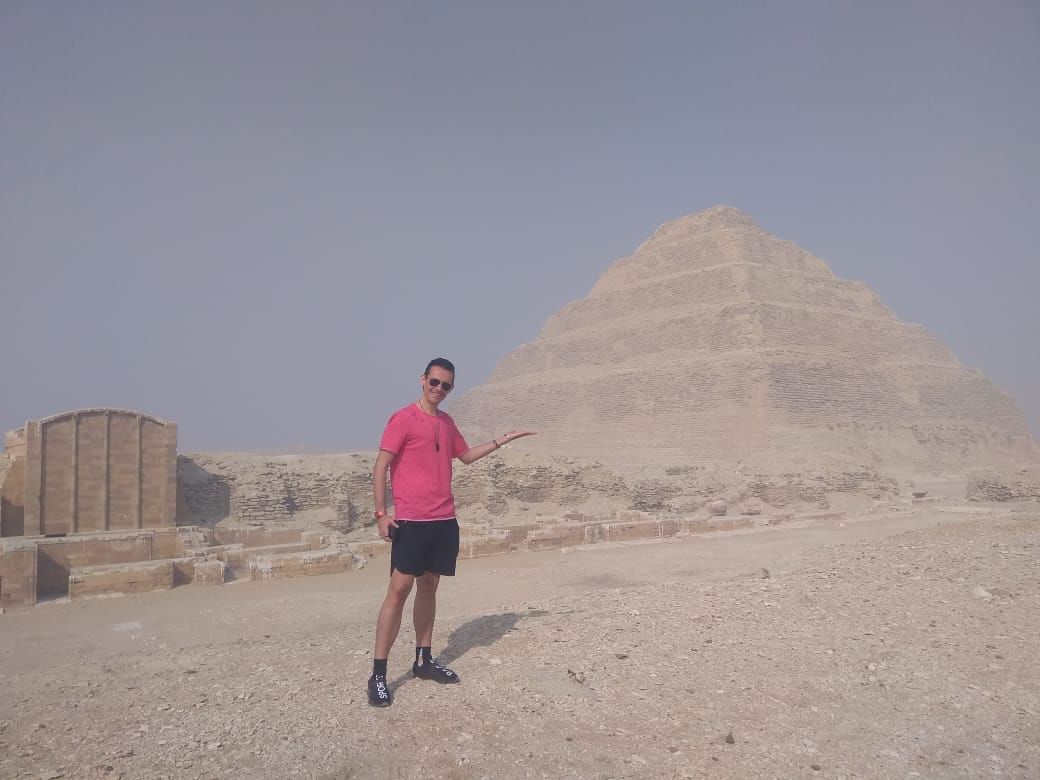
8-Hour Private Tour of the Pyramids, Sphinx, Grand Egyptian Museum

6 days

Moderate


Egypt's two coasts — ancient Nile and Mediterranean.

Most Egypt itineraries run north to south: Cairo, then Luxor. This six-day tour adds Alexandria — Egypt's second city, the ancient seat of Greek and Roman culture, and a completely different Egypt from the pharaonic sites in the south: three cities, three distinct historical registers, six days.

The structure is designed so you see the most concentrated sites at each destination without rushing. Two days in Cairo for the Grand Egyptian Museum and Giza, one day in Alexandria for the waterfront and its Greco-Roman monuments, two days in Luxor for the East and West Banks. The sixth day is the departure from Luxor.

Highlights

  • Grand Egyptian Museum — full morning session with a private Egyptologist, Tutankhamun collection in depth
  • Giza Plateau — three pyramids and the Sphinx in morning light
  • Bibliotheca Alexandrina — the modern library built on the site of the ancient Library of Alexandria
  • Citadel of Qaitbay — 15th-century fort built on the site of the ancient Lighthouse of Alexandria
  • Karnak Temple and Luxor Temple — East Bank Luxor with your Egyptologist
  • Valley of the Kings, Hatshepsut Temple — full Luxor West Bank

Who This Tour Is For

  • First-time visitors to Egypt who want the pharaonic sites but also want to see a different Egypt — coastal, Mediterranean, Greco-Roman — that the standard Cairo-Luxor itinerary misses
  • Travelers with a specific interest in Alexandria: the ancient library, the Greek and Roman history, and the coastal character
  • Those who want six days structured as a genuine circuit rather than back-and-forth on the same route

What Makes This Tour Different

  • Alexandria as a full day, not a side trip — one complete day in Alexandria gives you the Bibliotheca, the Citadel, Pompey's Pillar, and the atmospheric Mediterranean waterfront. A day trip from Cairo shortchanges the city; this itinerary gives it the time it deserves.
  • Three historically distinct cities in six days — Cairo is Ottoman and ancient Egyptian; Alexandria is Greco-Roman and Mediterranean; Luxor is the heart of the New Kingdom. Each requires a different interpretive frame, and your Egyptologist bridges all three.
  • Domestic flight Cairo–Luxor — no bus, no lost half-days in transit. Luxor gets two full days of touring because the flight connection is efficient.

What You'll Experience

Day 1 — Arrive in Cairo 

Private airport transfer to your hotel. Your Egyptologist meets you in the evening to confirm the Day 2 start time and brief you on the itinerary. First evening at leisure — dinner recommendation provided.

Day 2 — Cairo: Grand Egyptian Museum & Giza Plateau 

Grand Egyptian Museum in the morning — your Egyptologist structures the session around the Tutankhamun collection: four thousand objects from a single tomb, the golden death mask, the gilded shrine, the canopic chest. The context for everything you will see in Luxor is built here—Giza Plateau in the afternoon: the three pyramid complexes and the Sphinx. Your guide explains the construction as an engineering problem — how 20,000 people quarried, transported, and placed two million stones in twenty years. The Solar Boat Museum, if time permits.

Day 3 — Alexandria 

Private vehicle to Alexandria — approximately 2.5 hours from Cairo along the Desert Road. The Bibliotheca Alexandrina: the modern library built on the site of the ancient Library of Alexandria, one of the most striking pieces of contemporary architecture in Egypt. The Citadel of Qaitbay, a 15th-century fort built on the site of the ancient Lighthouse of Alexandria, is one of the Seven Wonders of the Ancient World. Pompey's Pillar is the single largest standing ancient column in Egypt. The Roman amphitheatre at Kom el-Dikka is the only such structure found in Egypt. Lunch at a waterfront restaurant in Alexandria — the Mediterranean setting is as much a part of the day as the monuments. Return to Cairo in the evening.

Day 4 — Fly to Luxor · East Bank Temples. 

Morning domestic flight to Luxor. Karnak Temple in the afternoon: the largest religious complex ever built, added to by thirty pharaohs across 2,000 years. Your Egyptologist explains the political sequence — who built which pylon and why, turning the bewildering accumulation of columns into a legible political document. Luxor Temple at dusk: the sandstone turns amber in the fading light. The recently uncovered Avenue of Sphinxes. Dinner by the Nile.

Day 5 — Luxor: West Bank in Full 

The Valley of the Kings in the morning — three tombs chosen by your Egyptologist. The painted chamber walls here continue the iconography created at the GEM three days ago; by now, the religious logic is legible rather than abstract. Hatshepsut's Temple at Deir el-Bahari: the colonnaded terrace cut into the cliff face, the explanation of why her successor systematically erased her cartouches — and why the erasure ultimately failed. The Colossi of Memnon on the return. Afternoon at leisure in Luxor.

Day 6 — Luxor, then departure. 

Morning at leisure. Optional: Luxor Museum, a compact and excellent collection that complements the GEM. Private transfer to Luxor Airport for your international departure or Cairo connection flight.

Frequently Asked Questions

Is Alexandria far from Cairo? 

Approximately 220 kilometres — about 2.5 hours by private vehicle via the Desert Road, or 2 hours via the Cairo–Alexandria Desert Road with clear traffic. We depart early on Day 3 to maximise time in Alexandria. The return arrives in Cairo in the early evening, giving you a final comfortable night before the Day 4 Luxor flight.

Can we stay overnight in Alexandria instead of returning to Cairo? 

Yes — adding one night in Alexandria converts the tour to 7 days and removes the early return to Cairo. You fly directly from Alexandria to Luxor on Day 4 instead. This is the more relaxed option for travelers who want to experience Alexandria without a same-day return. Ask us to build the 7- day version when you enquire.

Does this tour include a Nile cruise? 

No. The 6-day structure takes you overland through Cairo, Alexandria, and Luxor. The Nile cruise requires a separate Luxor–Aswan segment, which adds 3–4 days. If you want to include the Nile cruise, the 7-Day Classic Tour (Cairo + Luxor + Aswan without Alexandria) or the 9-Day Classic Tour (Cairo + Luxor + Nile cruise + Aswan + Abu Simbel) are the relevant options.


What's included?
    • 5 nights accommodation (Cairo 3N, Luxor 2N — 5-star) on  BB basis
    • Cairo–Luxor-Cairo domestic flights
    • Private licensed Egyptologist for all touring days
    • Lunches
    • All transfers, including Cairo–Alexandria–Cairo private vehicle
    • All entrance fees
    Exclusions
      • Egypt visa - We can help you get your visa upon arrival
      • Extras not listed in our itinerary
      • Any Tips that you might receive during your tour

      Optional Visits

      • 2-hour Nile Cruise dinner and Folkdance show
      • Pyramids at night, Sound & Light show
      • Hot Air Ballooning (approx. 30-45 minutes
      Please note

        Before You Arrive We send your final itinerary — with confirmed hotel names, flight times, guide contact details, and daily schedule — at least 7 days before your trip. Review it and contact us with any questions via WhatsApp or email. Your guide's WhatsApp number is included — you can message them directly before arrival.

        Visa Most nationalities can obtain an Egypt entry visa on arrival at the airport ($25 USD, paid by card or cash). Eligible nationalities include USA, Canada, EU, UK, Australia, and New Zealand. The process takes approximately 15–30 minutes. Your airport meet & greet assistant helps you through the visa queue on arrival. Check your specific nationality's requirements before travel at the Egyptian e-Visa portal (visa2egypt.gov.eg) — some nationalities must apply in advance.

        Airport Arrival Your driver meets you in the arrivals hall holding a sign with your name. They assist with luggage and escort you directly to your vehicle. If your flight is delayed, we track it — your driver adjusts. If you cannot find your driver, contact us on WhatsApp immediately (our support line is monitored 24/7 during your trip).

        Hotels You will stay in 5-star hotels throughout. Specific properties are confirmed in your final itinerary. If you have a preference for a particular hotel or hotel chain, tell us when booking and we'll accommodate where possible. Check-in is typically from 2:00 PM; early check-in is arranged when available but cannot be guaranteed for early-morning arrivals. We always arrange luggage storage if your room is not ready.

        Domestic Flights All domestic flights listed in your itinerary are included and booked by us. You receive e-tickets in your final itinerary. Domestic flights in Egypt require a valid passport. Arrive at the domestic terminal approximately 90 minutes before departure — your driver handles the timing.

        What You'll Pay On-Site All entry fees listed in the itinerary are included and handled by your guide. Optional upgrades — such as the Tutankhamun tomb ($15), the Seti I tomb ($45), the Great Pyramid interior ($31), or Sound & Light shows — are paid on-site by credit or debit card. Your guide advises whether each upgrade is worthwhile before you decide. Cash is no longer accepted at most major sites.

        Meals Breakfast is included daily at your hotel. Lunch is included on all touring days. Dinners are not included (except on Nile cruise nights — see ⛵ below). Your guide recommends restaurants each evening based on your preferences and location. Expect $15–30 per person for a good dinner in Cairo, Luxor, or Aswan.

        If your package includes a Nile cruise: All meals on board (breakfast, lunch, dinner) are included. Alcoholic beverages on the cruise are not included and are purchased separately from the ship's bar.

        Weather & Sun Egypt is hot and dry for most of the year. Peak season (October–April) is the most comfortable: 18–28°C (65–82°F) during the day, cool evenings. Low season (May–September) brings intense heat: 35–45°C (95–113°F) at open-air sites. Aswan and Luxor are consistently hotter than Cairo. Your guide adjusts timing to avoid the worst midday heat. Sun protection is essential year-round.

        Dress Code Dress comfortably and modestly. At mosques, shoulders and knees must be covered (all genders). At archaeological sites, there is no formal dress code, but lightweight long sleeves and long trousers are practical for both sun protection and cultural respect. Comfortable closed-toe shoes with good grip are essential — you will walk on sand, uneven stone, and rough terrain across multiple sites.

        Photography Photography is permitted at most outdoor sites. Inside tombs, photography is generally prohibited unless you purchase a photography ticket. Inside the Grand Egyptian Museum, rules vary by gallery. Drone photography requires permits that are extremely difficult to obtain — do not fly a drone without confirmed authorization.

        Payments & Currency Egypt's currency is the Egyptian Pound (EGP). Credit/debit cards are widely accepted at hotels, museums, and restaurants. ATMs are available in all cities on your itinerary. Your guide and driver accept tips in EGP, USD, or EUR. Recommended tipping: $10–15 per person per day for your guide, $5 per day for your driver.

        Health & Safety Drink only bottled water (provided daily on your tour). Tap water is not safe for tourists. Bring any personal medications — pharmacies exist but may not stock your specific brands. Sunscreen, a refillable water bottle, and a small daypack are your most useful daily items. Travel insurance is required and not provided by Pyramids Land — we recommend coverage for trip cancellation, medical emergencies, and evacuation.

        Communication Your guide is reachable by WhatsApp throughout your trip. Our support line is monitored 24/7 during your travel dates. Wi-Fi is available at all hotels and on Nile cruise ships. If you need a local SIM card or eSIM, your guide can help you arrange one on arrival — Egyptian eSIMs cost approximately $10–15 for a week of data.

        Cultural Notes Egyptians are genuinely welcoming. Basic Arabic — "Shukran" (thank you), "Salaam alaikum" (peace be upon you) — is appreciated. At tourist sites, you may be approached by vendors or people offering unsolicited assistance. Your guide manages these interactions. Bargaining is expected at markets (Khan el-Khalili, Aswan souk) but not at shops with fixed prices. Your guide advises.

        What to bring

          Daily essentials (carry with you each touring day):

          • Comfortable closed-toe shoes with good grip — you will walk on sand, stone, and uneven surfaces daily
          • Hat with a brim
          • Sunscreen (SPF 30+ minimum — reapply every 2 hours at outdoor sites)
          • Sunglasses
          • Camera or smartphone (plus charger — charge every night at your hotel)
          • Light scarf or shawl for mosque visits
          • Small daypack for water, camera, sunscreen, and a light layer
          • Any personal medications

          For the trip:

          • Passport (valid for at least 6 months from entry date) — required for domestic flights, hotel check-ins, and visa on arrival
          • Travel insurance documents (digital or printed)
          • Comfortable evening clothes for dinners (smart casual — no dress code at most Egyptian restaurants)
          • A light jacket or sweater for air-conditioned vehicles, hotels, and cool evenings (October–March)
          • Layers for early morning departures (Abu Simbel at 3 AM can be cold even in Egypt)
          • Swimwear if your package includes Hurghada, Sharm, or a Nile cruise with a sundeck pool
          • Power adapter — Egypt uses Type C (European 2-pin) outlets, 220V. Most hotels have universal outlets, but carry an adapter as backup.

          We provide bottled water daily throughout your trip. You do not need to bring your own.

          Explore the tours above. Read the details. Ask questions if needed. Book only when it feels right.

          How pricing works

          Prices are based on:

          • Group size
          • Duration
          • Inclusions listed on the tour page

          You will always know what is included before booking. There are no surprise additions.
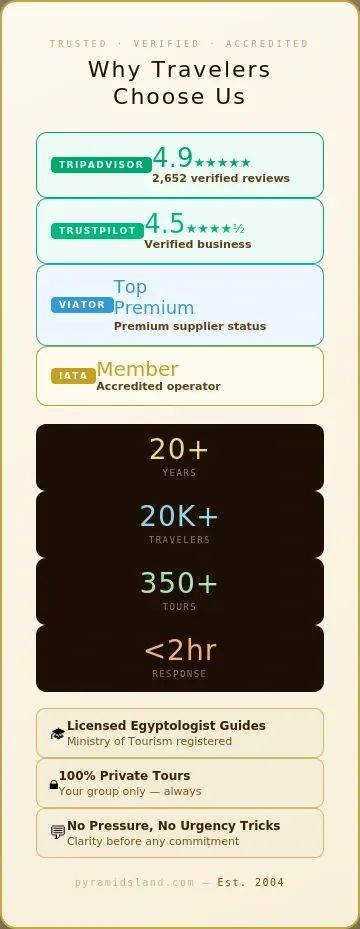
          Pyramids Land Tours trust signals — TripAdvisor 4.9 stars with 2,652 verified reviews, Trustpilot 4.5 Trusted Business

          What our clients say


          Gold ancient Egyptian Bennu bird on deep navy — Pyramids Land Tours.
          By Ashraf Fares August 2, 2026
          An Egyptologist explains the Bennu — Egypt's sacred heron: the creation myth, why the phoenix's fire is a Greek invention, and why NASA named an asteroid after it.
          Gold ancient Egyptian sistrum on deep navy — Pyramids Land Tours.
          By Ashraf Fares July 23, 2026
          An Egyptologist explains the sistrum — Hathor's sacred rattle: its two forms, the menat, why women played it, and the sound still heard in Coptic churches today.
          Ancient Egyptian gold uraeus cobra on deep navy — Pyramids Land Tours.
          By Ashraf Fares July 20, 2026
          An Egyptologist explains the uraeus — the rearing cobra on the pharaoh's crown: the goddess Wadjet, the Two Ladies, the Eye of Ra, and Tut's mask at the GEM.
          Pyramids skyline at dusk with gold sun — Egypt travel seasons guide
          By Ashraf Fares July 16, 2026
          The best time to visit Egypt is October–April; Feb–Mar and Oct–Nov are the sweet spots. Month-by-month weather, crowds & prices from a Cairo operator.
          Gold ancient Egyptian djed pillar on deep navy — Pyramids Land Tours.
          By Ashraf Fares July 13, 2026
          An Egyptologist explains the djed pillar: its meaning of stability, why it's the backbone of Osiris, the Raising of the Djed, and where to see it at Abydos.
          Gold ancient Egyptian crook and flail on deep navy — Pyramids Land Tours.
          By Ashraf Fares July 10, 2026
          An Egyptologist explains the crook and flail — the king as shepherd, why Osiris holds them, and where to see Tutankhamun's own pair at the GEM.
          Gold ancient Egyptian was scepter hieroglyph over a rising sun on a deep navy background
          By Ashraf Fares July 6, 2026
          An Egyptologist explains the was scepter — its meaning of power and dominion, the Set-animal head, the ankh-djed-was triad, and where to see it in Egypt.
          Gold ancient Egyptian cartouche name-ring hieroglyph over a rising sun on deep navy — Pyramids Land
          By Ashraf Fares July 4, 2026
          An Egyptologist explains the Egyptian cartouche: what it meant, the royal names inside, how it cracked hieroglyphs, and how to get your name in one.
          Gold ancient Egyptian scarab beetle hieroglyph over a rising sun on a deep navy background
          By Ashraf Fares July 2, 2026
          An Egyptologist explains the Egyptian scarab beetle — Khepri, the rising sun and rebirth, heart scarabs, and where to see the giant scarab at Karnak.
          Eye of Horus (wedjat) carved into weathered sandstone, traces of ancient blue and ochre pigment, lit
          By Ashraf Fares June 30, 2026
          The Eye of Horus explained: the wedjat myth, its meaning for healing and protection, how it differs from the Eye of Ra, and where to see it in Egypt.
          Show More