

Hurghada or Sharm El Sheikh? How to Choose the Right Red Sea Base
This is the most common Red Sea question we get, and the answer depends on three things: what you want from the water, how you are arriving, and how much you want to spend.
Both are excellent. Neither is wrong. But they are genuinely different places that suit different travelers — and choosing the wrong one means spending your beach days wishing you were somewhere else.
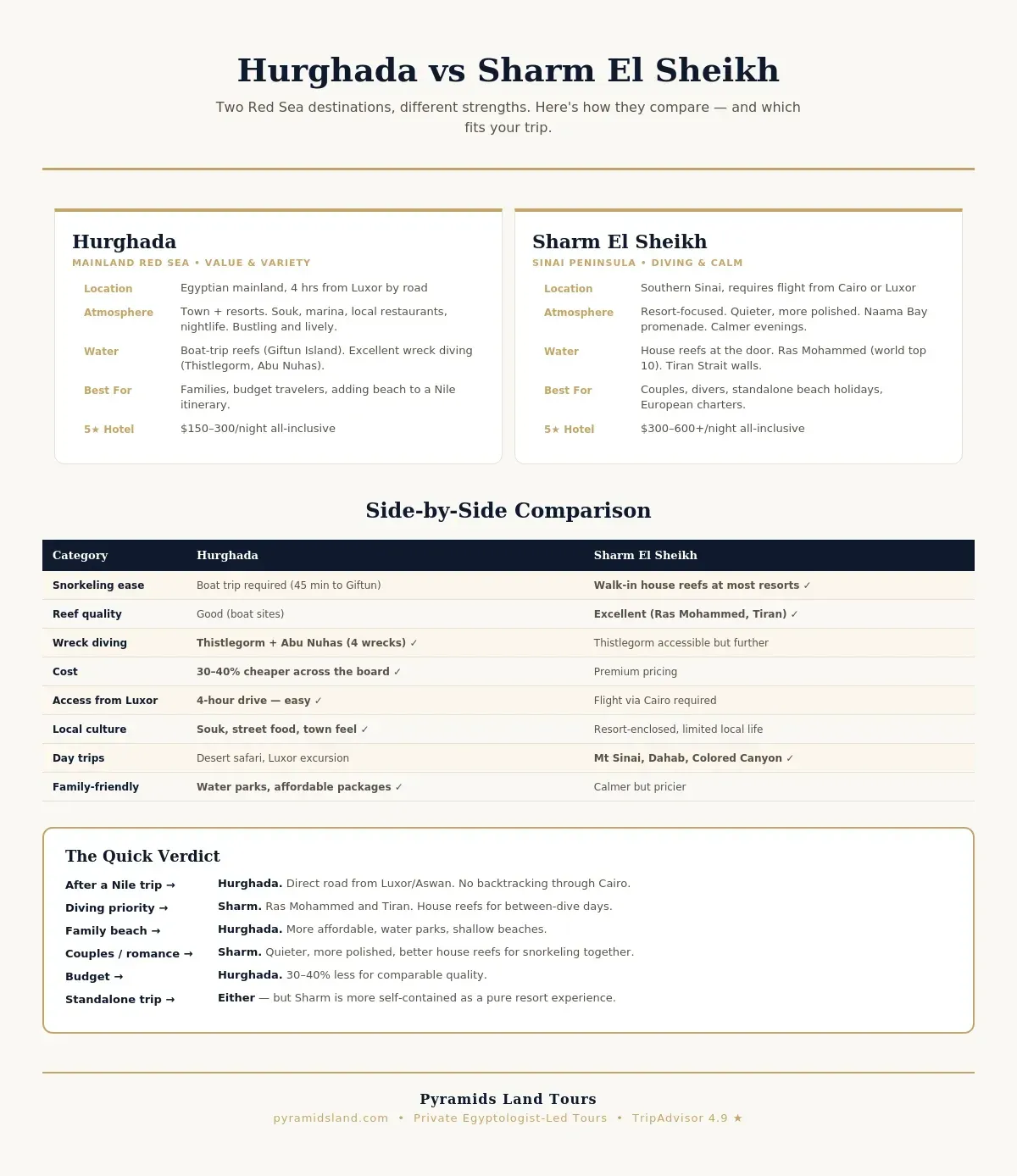
The Short Answer
Choose Hurghada if
you are coming from Luxor or Aswan (it is a 4-hour drive from Luxor, no flight needed), you want value, you are traveling with kids, or you want to mix resort time with a taste of local Egyptian life.
Choose Sharm El Sheikh if
diving quality is your top priority, you want a quieter and more polished resort atmosphere, you are arriving on a direct European charter flight, or you are a couple seeking a calm, upscale beach break.
Location and Access
This is where the practical difference starts.
Hurghada
sits on the Egyptian mainland, on the western shore of the Red Sea. It is 4–5 hours by road from Luxor and about 5–6 hours from Cairo. Domestic flights from Cairo take 1 hour. European charters fly direct from London, Manchester, Berlin, Warsaw, and other cities.
Sharm El Sheikh
sits on the southern tip of the Sinai Peninsula, the eastern side of the Red Sea. Getting there from Luxor requires flying via Cairo (no direct road connection). From Cairo, it is a 1-hour flight or a 6-hour drive through the Sinai desert.
What this means for your itinerary:
If your Egypt trip follows the standard Cairo → Luxor → Aswan route, Hurghada is the natural Red Sea add-on. You drive from Aswan or Luxor to Hurghada and fly home from HRG. Adding Sharm requires backtracking through Cairo, which costs a day.
If you are flying directly to the Red Sea from Europe for a standalone beach holiday — no pyramids, no Nile — Sharm is equally accessible and arguably a better pure-resort experience.
The Water
Both sit on the Red Sea with the same marine biodiversity — over 1,200 species of fish, 250 species of coral, and visibility regularly exceeding 30 metres. But the access to that marine life is different.
Sharm El Sheikh
has the edge for diving and snorkeling quality. Many resorts sit directly above healthy house reefs — you walk down a jetty, and you are snorkeling over coral within minutes. Ras Mohammed National Park, 20 minutes south of Sharm, is consistently ranked among the top 10 dive sites in the world. The Strait of Tiran offers wall dives and pelagic encounters. The water clarity in Sharm is noticeably better than in Hurghada.
Hurghada
requires a boat trip to reach the best reefs. Giftun Island (45 minutes by boat) is the main snorkeling destination. The house reefs at most Hurghada resorts are weaker than Sharm's. However, Hurghada offers excellent wreck diving — the SS Thistlegorm (a WWII British cargo ship, one of the world's top wreck dives) is accessible from Hurghada, and the Abu Nuhas reef has four wrecks on a single site.
Bottom line:
For snorkeling ease and reef quality, Sharm wins. For wreck-diving variety, Hurghada offers more options. For casual beachgoers who will snorkel once or twice, both are fine — but Sharm delivers the "wow" more effortlessly.
The Atmosphere
This is where preferences diverge most.
Hurghada
feels like a town with resorts attached. El Dahar (the old downtown) has a souk, street food stalls, local coffee shops, and a Bedouin-tourist-Egyptian mix that feels genuinely lived-in. Sekalla has a marina with restaurants. El Mamsha is the tourist promenade — polished, beachfront, international. Hurghada has nightlife, noise, and energy. It is bustling and occasionally chaotic.
Sharm El Sheikh
feels like resorts with a town attached. Naama Bay is the main tourist strip — restaurants, shops, cafes — but it is quieter and more contained than Hurghada. The Old Market offers a more local shopping experience, but Sharm overall is calmer, more manicured, and more controlled. Evenings are quieter. The resort-to-local ratio is higher.
If you want to eat at local restaurants, haggle in a souk, and feel the energy of an Egyptian town between beach days: Hurghada.
If you want to walk from your resort to the reef, have a quiet dinner with a sea view, and not be hassled: Sharm.
Costs
Hurghada is consistently cheaper across every category.
| Item | Hurghada | Sharm El Sheikh |
|---|---|---|
| 4-star all-inclusive (per night) | $80–140 | $150–250 |
| 5-star all-inclusive (per night) | $150–300 | $300–600+ |
| Snorkeling day trip | $30–50 | $40–70 |
| Two-dive day trip | $60–100 | $80–130 |
| Restaurant dinner (mid-range) | $10–20/person | $20–35/person |
| Taxi within town | $3–8 | $5–15 |
The gap widens at the luxury end. Sharm's top-tier properties (Four Seasons, Rixos, Savoy) are significantly more expensive than their equivalents in Hurghada.
Best For Each Type of Traveler
Families with children:
Hurghada. More affordable all-inclusive resorts, water parks (Jungle Aqua Park, Albatros Aqua Park), shallow beaches, and a wider range of family-priced activities.
Couples and honeymooners:
Sharm El Sheikh. Quieter, more romantic, better house reefs for snorkeling together, and more upscale dining options.
Divers:
Sharm for reef diving (Ras Mohammed, Tiran). Hurghada for wreck diving (Thistlegorm, Abu Nuhas). Serious divers often do both on separate trips.
Budget travelers:
Hurghada. Lower prices across the board, more budget hotel options, and cheaper local dining.
Travelers combining with a Nile trip:
Hurghada. Direct road access from Luxor/Aswan. Adding Sharm requires backtracking through Cairo.
Standalone beach holiday (no pyramids):
Either — but Sharm offers a more self-contained, polished resort experience.
Can You Visit Both?
A ferry runs between Hurghada and Sharm El Sheikh (approximately 90 minutes), but service is inconsistent and not recommended for tight itineraries. Most travelers choose one and commit.
If you have 14+ days in Egypt and want both the mainland Red Sea and the Sinai experience, it is possible to do 3 days in Hurghada + ferry or flight + 2 days in Sharm. But this is rare and usually only makes sense for dedicated divers.
The Honest Recommendation
For most Pyramids Land Tours travelers — people who have just completed a Cairo/Luxor/Aswan itinerary and want 2–3 days of beach before flying home — Hurghada is the right choice. It fits geographically, it is cost-effective, and it delivers exactly what you need after a week of temples: warm water, sun, and a pace change.
If you are building a standalone Red Sea trip, or if diving quality is your primary motivation, Sharm El Sheikh is worth the extra cost and logistics.
Neither is wrong. Both are the Red Sea. The difference is in the details.
→ How Hurghada fits into a wider Egypt itinerary → Sinai Peninsula Guide (includes Sharm) → Contact us to add Red Sea days to your trip

Ashraf Fares