
Cairo or Luxor First? The Answer Depends on One Thing
***Edited June 9, 2026
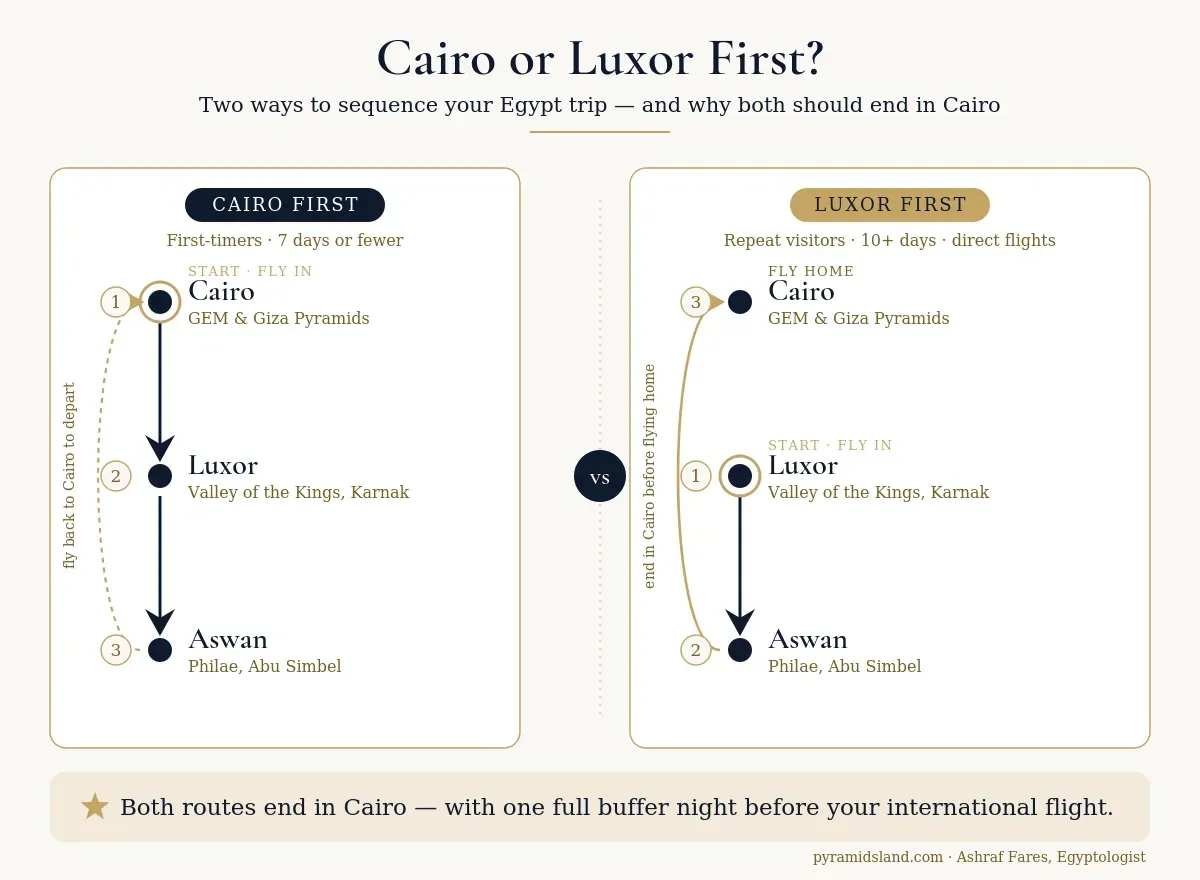
Short answer: start where your flights make it easy. For most first-time visitors on 7 days or fewer, that means Cairo first — the simplest routing, and you see Tutankhamun's treasures before his empty tomb. If you have been to Egypt before, have 10+ days, or can fly directly into Luxor, starting in Luxor gives you access to the most demanding sites when your energy is highest. Everything else follows from your flights.
That is the honest version. The longer version — and the one routing mistake that turns a smooth trip into a stressful one — is below.
Most Egypt itineraries start in Cairo. There is a practical reason: most international flights land at Cairo International Airport. And there is a psychological one — the Giza Pyramids are the image that brings people to Egypt, so starting there satisfies the central expectation before the trip builds outward.
But Cairo is not the only way, and for some travelers, starting in Luxor makes for a better trip. Here is the case for each, who should choose which, and how the rest of the itinerary shifts depending on where you begin.
The One Rule That Overrides Everything
Before you decide between Cairo and Luxor, decide this: do not take a domestic Egyptian flight and an international flight on the same day. Be in Cairo the night before you fly home.
This is the single most repeated piece of advice from experienced Egypt travelers, and it is not caution for its own sake. EgyptAir's domestic schedule shifts. Luxor–Cairo flights are postponed, consolidated, or canceled at short notice — often moved from morning to evening — and during busy periods the disruption gets worse, not better. A flight that lands you in Cairo three hours late is an inconvenience on Day 3. On the day of your transatlantic departure, it is a missed flight.
The fix is simple and shapes the whole itinerary: end your trip in Cairo with a buffer night before departure. Whether you start in Cairo or Luxor, the safest trips finish in Cairo.
If you would rather not fly the Cairo–Luxor leg at all, the overnight sleeper train is the alternative travelers ask about most. It is honest to set expectations: the sleeper carriages are dated and not to everyone's taste, and the train can run late too — but it removes the airport from the equation and turns transit into part of the trip. For some travelers, that trade is worth it.
ASHRAF FARES · Egyptologist
I once had a couple who landed in Cairo at 10 p.m. from Luxor and thought they could catch their 1:30 a.m. flight home the same night. Their domestic flight was 40 minutes late, they got stuck in passport control, and they ran through the terminal with their bags, sweating and panicked — only to watch the gate close in front of them. They slept on airport chairs and rebooked everything the next day. So now I'm very direct with every client: please, build in one full buffer night in Cairo at the end. Domestic flights here can shift, traffic can be brutal, and you will be tired. That one extra night saves so much stress — and it lets you actually enjoy your last day instead of racing.
Not sure how to sequence the flights so nothing goes wrong? Message us on WhatsApp — tell us your arrival and departure airports, and we'll map the safest order for your dates.
The Case for Cairo First
The standard sequence exists because it works
Cairo to Luxor roughly follows the chronological order of Egyptian history. The Old Kingdom pyramids at Giza and Saqqara came first (c. 2686–2181 BC). The New Kingdom temples of Luxor and Karnak came later (c. 1550–1069 BC). Seeing them in that order gives the history a direction — the development from pyramid to temple, from Memphis to Thebes, makes intuitive sense when you experience it in sequence.
→ 2 days in Cairo — what fits, and what to skip
The Grand Egyptian Museum is the context for everything else
The GEM holds objects from every period of Egyptian history, including the full Tutankhamun collection from the tomb found in the Valley of the Kings. Seeing his treasures in Cairo before you stand in his tomb in Luxor gives the Valley of the Kings a story that opens at one end of the trip and resolves at the other. Reverse it, and you stand in an empty tomb — historically significant, but quieter without the objects that filled it.
Cairo is the cleaner place to fly home from
Most international return flights depart Cairo. Start in Cairo and fly home from Cairo, and your routing is a straight line. Start in Luxor or Aswan, and you need a domestic flight or train back to Cairo for departure — which brings the one rule above back into play.
→ 5-Day Cairo, Luxor & Aswan Package → 7-Day Classic Egypt Tour Package
The Case for Luxor First
You reach the hardest sites with energy to spare
The Valley of the Kings is a full-morning site that rewards attention. Karnak is roughly 100 hectares and needs orientation before its scale becomes comprehensible. If you reach Luxor on Day 5 or 6 of a 7-day trip — after Cairo, after Saqqara, after the medieval city — you arrive at the most intensive set of sites on the itinerary with the least energy left.
Starting in Luxor reverses that. You see the Valley of the Kings and Karnak fresh, on Days 1–2, before fatigue accumulates. Cairo — where the Giza Plateau and the GEM each work as a focused half-day — becomes the easier way to end on tired legs.
→ 2 days in Luxor — the West Bank and East Bank, paced
Flying into Luxor is more practical than it sounds
Several European airlines fly direct to Luxor, and EgyptAir connects it to major hubs. If your international flight routes through Cairo but your first stop is Luxor, the practical move is a connecting domestic flight on a separate day — or the overnight train — rather than a tight same-day connection. Build the buffer in, and Luxor first is clean.
The cruise fits naturally either way
A Nile cruise visits the same temples — Esna, Edfu, Kom Ombo — regardless of direction. Cruise direction is set by your cruise booking, not by which city you start in. The common pattern: explore Luxor, sail south to Aswan, then fly from Aswan to Cairo for your departure (and your buffer night). If you start in Aswan instead, you sail north to Luxor. Both are valid; both end with you routing back to Cairo to fly home.
Cairo First vs Luxor First — At a Glance
| CAIRO FIRST | LUXOR FIRST | |
|---|---|---|
| Flight routing | Most international arrivals. Simplest departure routing. | May require domestic connection. Direct flights from select European cities. |
| Energy at major sites | Luxor reached mid-trip — some fatigue likely. | Luxor reached fresh on Days 1–2. |
| Historical sequence | Chronological: Old Kingdom first, New Kingdom second. | Reverse chronological — but Luxor stands alone well |
| GEM before Valley of Kings | Yes — see Tutankhamun's objects before the empty tomb. | No — tomb visited before the treasure. Less contextual depth. |
| Cruise fit | Luxor to Aswan (southbound, upstream). Standard route | Aswan to Luxor (northbound). Equally valid. |
| Departure safety | Ends in Cairo by default. | Repeat visPlan a buffer night in Cairo before flying home.itors, European direct-Luxor arrivals, 10+ day trips. |
| Best for | First-timers, 5–7 days, hub connections through Cairo. | Repeat visitors, direct-Luxor arrivals, 10+ day trips. |
The Answer
Start in Cairo if this is your first Egypt trip, you are flying in from a hub that connects through Cairo, and you have 7 days or fewer. The GEM-before-Valley-of-the-Kings sequencing is a real advantage, and the routing is simplest.
Start in Luxor if you have been to Cairo before, you can fly directly into Luxor, or you have 10+ days and a domestic connection on a separate day is not a problem. For a longer, more experienced itinerary, Luxor is the more interesting structure.
Either way, end in Cairo with a night in hand before your flight home. That one decision protects everything else.
→ First-time visitor guide to Egypt — what to understand before you go
ASHRAF FARES · Egyptologist You can see it so clearly at Karnak. On Day 1, clients arrive fresh, eyes wide, asking a million questions — "How many pharaohs built this?", "What does that symbol mean?" — standing tall, photographing everything. By Day 6 they move slower, shoulders rounded, quieter. They walk past the same enormous columns and barely look up. The questions become "How much longer until lunch?" and "Is there somewhere to sit?" The difference is night and day. That's why I fight so hard to put the biggest, most demanding sites early — while the energy and the curiosity are still high.
Common Questions (From the Forums)
Is it safe to fly Cairo–Luxor the same day as my international flight?
Not advisable. EgyptAir's domestic flights are frequently delayed, consolidated, or cancelled at short notice, and a delay on departure day can cost you your flight home. Fly the domestic leg on a separate day, and spend your last night in Cairo before your international departure.
Should I take the overnight train instead of flying between Cairo and Luxor?
You can, and many travellers do. The sleeper train removes airport uncertainty and turns the journey into part of the trip. Set expectations: the carriages are dated, it is roughly a 9–10 hour overnight run, and it can run late too. For travellers who dislike domestic flights, the trade is often worth it.
Cairo or Luxor first if I'm arriving from Jordan or Petra?
There are no direct flights from Jordan to Luxor, so you route through Cairo regardless. A common, comfortable plan is to fly into Cairo, connect to Luxor, work your way back north, and finish in Cairo before flying home — leaving the Pyramids and museums for the end, when they are still waiting for you.
Does starting in Luxor change which sightseeing pass I buy?
It can. The Cairo Pass and Luxor Pass are separate products, and the order you visit affects which makes sense and where any discount applies. Your guide can confirm current pricing and tell you whether a pass is worth it for your specific list of sites — the answer changes by itinerary.
Cairo or Luxor first for a first-time visitor?
Cairo, in most cases. The routing is simplest, and seeing the Grand Egyptian Museum before the Valley of the Kings gives the tombs their context. Luxor first is better suited to repeat visitors or longer trips.
Is Luxor or Aswan the better place to start in the south?
On a short trip, focus on Luxor — it is the densest concentration of ancient sites in Egypt and easily fills two to three days. Aswan and Abu Simbel involve more travel time and reward a longer itinerary or a return visit.
Plan the Order Around Your Flights, Not the Other Way Around
The Cairo-or-Luxor decision is really a flight decision wearing a sightseeing costume. Once your international arrival and departure are fixed, the right order usually becomes obvious — and the buffer night in Cairo keeps the whole trip from depending on a single on-time domestic flight.
Tell us your arrival and departure airports and your dates — message us on WhatsApp and we'll map the safest, best-paced order for your trip. No obligation.
Related reading
→ How many days in Egypt do you need? → Cairo airport arrival — what the first 30 minutes actually look like → Dahabiya vs Nile cruise — the honest comparison → Egypt for seniors and older travellers → See all Egypt tour packages — Cairo-first and Luxor-first sequences available

Ashraf Fares