
Egypt for Seniors and Older Travelers: The Honest Guide From a Cairo Operator
***Edited July 22, 2026
Can older travelers visit Egypt? Yes. Travelers in their 60s, 70s, and 80s do it every season — including travelers using canes, walkers, and wheelchairs. But Egypt is not accessible the way Western countries define the word: sites are built on sand, broken stone, and steep tomb corridors, and most have no ramps at all. What makes it work is structure — a private vehicle that reaches the viewpoints other visitors walk to, travel between October and March, two or three sites a day instead of five, and a guide who knows which routes avoid the worst ground. The Grand Egyptian Museum, NMEC, and the Nubian Museum in Aswan are fully step-free. Karnak works along its main axis. The Valley of the Kings and Philae Temple are the genuine limits — and both have alternatives.
Someone you love — maybe you — has wanted to see the Pyramids for thirty years. It has sat on the bucket list through career, children, grandchildren, and a body that no longer moves the way it used to. And now that the time and money are finally available, a different question has arrived: can I actually do this?
The travel forums are not reassuring. "Egypt is not mobility-friendly." "Uneven terrain everywhere." "No ramps." "My mother fell at Saqqara." These are real reports from real travelers. We have read hundreds of them.
They are also incomplete.
We are Pyramids Land Tours — Cairo-based, with 20+ years of operation, and we regularly guide travelers in their 60s, 70s, and 80s through Egypt. Some walk briskly. Some use canes. Some cannot stand for more than fifteen minutes. Everyone of them saw the Pyramids. Every one of them came home saying it was worth it.
Here is the honest guide — what is genuinely difficult, what is easier than you think, and exactly how we adapt every trip around what your body needs on that specific day.
The Truth About Egypt's Terrain
We are not going to pretend Egypt is accessible in the way Western countries define the word. It is not.
Sidewalks in Cairo and Luxor are broken, uneven, and interrupted by high curbs. Most pedestrians — including Egyptians — walk in the road. Archaeological sites are built on sand, rubble, and 3,000-year-old stone that has been weathered into irregular surfaces. Many tombs require descending steep, narrow corridors. Some temples have no ramps at all. Air conditioning is inconsistent outside of hotels and vehicles.
If someone tells you Egypt is "easy" for older travelers, they are either lying or they have never walked through the Valley of the Kings in July.
Now — here is the part those forum posts never include: every single one of these challenges has a specific, tested workaround that your guide has used dozens of times. The question is not whether Egypt is accessible by default. It is whether you have someone beside you who knows every shortcut, every alternative route, and every site where a car can drive that tourists normally walk.
That is what we do.
Three Travelers, Three Approaches
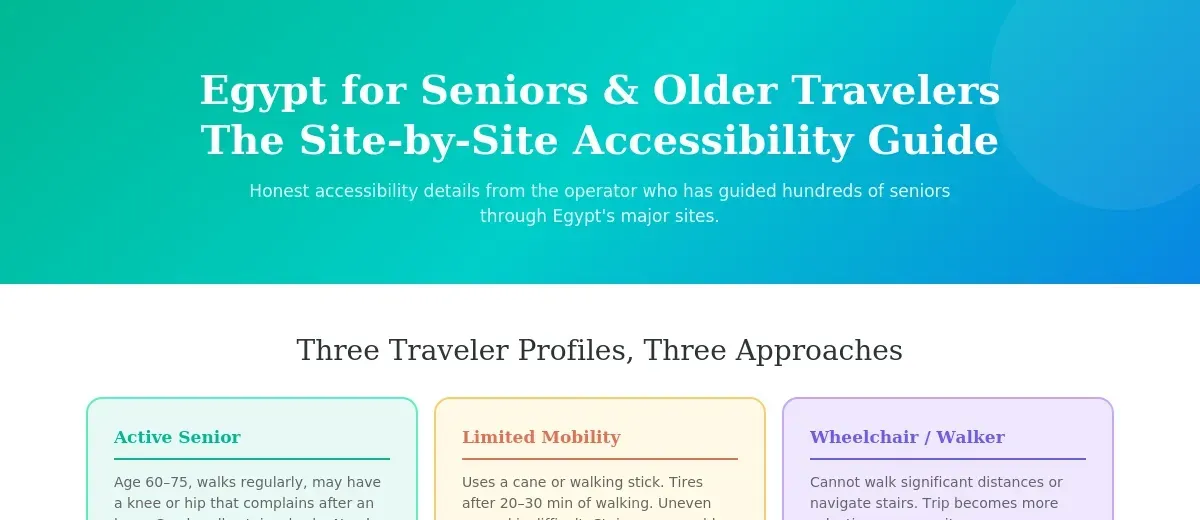
Not every senior traveler has the same body. We plan differently for each:
The Active Senior — You are 60 to 75, in good health, and walk regularly at home. You may have a knee or hip that complains after an hour, but you can handle stairs slowly and stand for reasonable periods. You can do 90% of what any younger traveler does — you just need the pace controlled, the heat managed, and the option to rest when you need it.
The Limited-Mobility Traveler — You use a cane or walking stick, tire after 20 to 30 minutes of walking, and find uneven ground difficult. Stairs are manageable with support, but not enjoyable. You can still see the major sites — with route modifications, vehicle positioning, and a guide who knows which entrances and paths avoid the worst terrain.
The Wheelchair or Walker User — You cannot walk significant distances or navigate stairs. Egypt becomes more selective at this level — some sites are genuinely inaccessible — but the Pyramids, the Grand Egyptian Museum, key temples, and the Nile are absolutely within reach. The trip is designed around what works, not around what does not.
Your guide plans your specific itinerary based on which of these profiles fits you — and adjusts in real time if a day is harder or easier than expected.
Site-by-Site: What You Can Actually Do
This is the section no other guide on the internet provides. We have walked every one of these sites with older travelers. Here is the honest breakdown.
The Pyramids of Giza
The reality: The ground is uneven — sand, loose gravel, and rough stone. Walking from the ticket office to the Great Pyramid and then to the Sphinx would take a fully mobile person 30 to 45 minutes in the sun.
What happened on your trip: Your private car drove directly onto the Giza plateau. Your driver took you to the panoramic viewpoint where all three pyramids align — you stepped out onto the paved road, took your photographs, and got back in the car. He then drove you down to the Sphinx and Valley Temple. Total walking: less than 200 meters, all on relatively flat ground. Your guide handled tickets in advance. You never stood in a line.
Going inside the Great Pyramid requires descending and then climbing a steep, low-ceilinged corridor. This is not recommended for anyone with mobility limitations, knee problems, claustrophobia, or breathing difficulties. Your guide will tell you this directly. The exterior experience — standing at the base, touching the original casing stones, seeing the scale up close — is what most people remember anyway.
For travelers who cannot walk on uneven ground at all, horse-drawn carts are available on the plateau and can take you between viewpoints.
The Grand Egyptian Museum (GEM)
The reality: This is the newest major museum in Egypt, and it was designed with full accessibility. Elevators, ramps, wide corridors, smooth floors, and climate-controlled throughout. This is the single most senior-friendly major attraction in the country.
What happened on your trip: You spent three hours moving through the galleries at your own pace, sitting whenever you needed to, with your Egyptologist guide narrating Tutankhamun's collection in a way that turned gold objects into a story about a teenager who became a god. You did not rush. You did not compete with a group schedule. You sat in front of the golden mask for as long as you wanted.
Karnak Temple (Luxor)
The reality: Karnak is enormous — the largest religious complex ever built. The main entrance now has a paved walkway with ramps. Once inside the Hypostyle Hall, the ground is ancient stone — uneven in places but largely flat. The full complex would take an hour of continuous walking.
What happened on your trip: Your guide took you directly to the Hypostyle Hall — the most spectacular section — through the accessible entrance. You spent 45 minutes among the 134 giant columns without needing to cover the entire complex. Your driver was parked within 100 meters of the exit. Ahmed knew the exact route that avoided the roughest sections and the longest distances.
Valley of the Kings (Luxor)
The reality: This is the most physically demanding major site in Egypt for anyone with mobility concerns. The valley floor is sand and gravel. The tombs require descending steep corridors, often with metal ramp rails, into underground chambers. Some tomb corridors are narrow and hot with limited ventilation.
What happened on your trip: An electric tram runs from the visitor center to the tomb entrances — you did not walk the valley floor. Your guide selected the two most accessible tombs with the widest corridors and most gradual descents. You took your time. You held the railing. Your guide walked beside you, never behind you. The tombs with the steepest stairs were skipped — and your guide showed you photographs of what was inside so you did not feel you missed the experience entirely.
For travelers who truly cannot manage the tomb descents, the replica tomb of Tutankhamun near Howard Carter's House was designed to be fully accessible — with a flat floor, a wide entrance, and a perfect reproduction of the original paintings. Your guide can include this as an alternative. Luxor day tours
Luxor Temple
The reality: Located in central Luxor, partially accessible with paved pathways and some ramps. The main avenue and inner court are accessible to travelers with limited mobility. Some sections have rough ground.
What happened on your trip: You visited at sunset — partly for the light, partly for the cooler temperature. Your guide walked you through the accessible sections and positioned you at the best viewpoints. You sat on a bench in the great court while the columns turned gold in the fading sun. You did not try to cover every corner. You covered the corners that mattered.
Hatshepsut's Temple (Deir el-Bahari)
The reality: The temple is built into a cliff face and accessed by a series of long, gradually inclined ramps connecting three terraced levels. The ramps are even and paved — but they are deceptively long, exposed to full sun, and there is no shade between levels. The distance from the visitor center to the temple entrance is also significant.
What happened on your trip: An electric tram took you from the visitor center to the temple base. Your guide assessed your energy and recommended visiting only the first and second terraces — where the famous Punt reliefs and the birth colonnade are located — rather than pushing to the top level. The ramps were manageable but slow. You rested at the top of each ramp before continuing. The key was going early, before the sun turned the ramps into a convection oven.
The Nile Cruise
The reality: Most standard Nile cruise ships have multiple decks connected by stairs. Elevators are not standard on all vessels. Gangplanks between the ship and the dock can be narrow and unsteady, especially when boats are moored side by side.
What happened on your trip: We booked you on a ship with an elevator — and confirmed this directly before your departure, not from a website. The crew assisted you on and off the gangplank. Your cabin was on the same deck as the dining room to minimize the need to use the stairs. During shore excursions, your private guide and driver met you at the dock — you were not part of the group bus system.
For travelers with significant mobility concerns, a private dahabiya (traditional sailing boat) is worth considering. These smaller vessels have fewer stairs, a more intimate layout, and stop at quieter sites with less crowded access points.
Philae Temple (Aswan)
The reality: Philae Temple sits on Agilika Island and is reached by a short motorboat ride from the dock. Getting on and off the motorboat requires stepping down into a rocking vessel and climbing out on the other side — this is the physical barrier, not the temple itself. Once on the island, the main temple courtyard is relatively flat with some ramps and short stairways. Aswan day tours
What happened on your trip: The boat crew assisted you on and off — one crew member held the boat steady while another offered his arm. Your guide had arranged a boat with a wider beam and lower sides for easier boarding. On the island, the main colonnade and inner courtyard were manageable at a moderate pace. Your guide skipped the steeper sections at the rear of the complex and focused on the most spectacular and accessible areas.
For travelers who cannot manage the boat transfer, your guide can show you detailed photographs and videos of the temple and direct you to the Nubian Museum in Aswan, which is fully wheelchair accessible, with free wheelchair rental available at the entrance.
Abu Simbel
The reality: The temples are reached by a short walk from the parking area — about 300 meters on a paved path. The interior of the Great Temple has a flat floor and wide chambers.
What happened on your trip: An electric golf cart took you from the bus to the temple entrance. The interior was flat and cool. You stood inside the sanctuary and watched the expression on your husband's face when he realized how far Ramesses II had moved these temples to save them from the rising lake. That moment did not require stairs.
Which Egyptian Sites Are Wheelchair Accessible?
Every site below, rated against the three traveler profiles above — assessed on the ground, not from a brochure.
| Site | Active Senior | Limited Mobility | Wheelchair / Walker | What we do |
|---|---|---|---|---|
| Grand Egyptian Museum | Yes | Yes | Yes | Lifts, ramps, smooth floors throughout. Complimentary wheelchairs at the welcome desk — but supply is limited and first-come. If you depend on wheels, bring your own folding chair or we carry a transport chair in the vehicle. We never gamble on museum inventory. |
| NMEC (Royal Mummies) | Yes | Yes | Yes | Fully lift-served. Complimentary chairs at the entrance on the same first-come basis — same rule applies. One of the easiest major experiences in Egypt. |
| Nubian Museum, Aswan | Yes | Yes | Yes | Free wheelchair rental at the entrance, ramps, wide galleries, climate control. Consistently overlooked in favour of the temples, and the single best fallback in Aswan. |
| Giza Plateau | Yes | Yes | From the vehicle | Your car drives onto the plateau and repositions at every viewpoint — under 200 metres of walking, all on paved ground. The Great Pyramid interior is a steep, low, bent-over corridor and is not recommended at any mobility level below fully active. |
| Abu Simbel | Yes | Yes | Yes | Electric cart from the parking area covers the 300-metre paved approach. The Great Temple interior is flat with wide chambers. Guides are not permitted inside and photography is prohibited indoors — your briefing happens outside, before you go in. |
| Colossi of Memnon | Yes | Yes | Yes | Roadside, flat, five minutes. The easiest win on the West Bank and a useful low-cost stop when the day needs to stay short. |
| Karnak Temple | Yes | Yes | With help — main axis only | The Avenue of Sphinxes, First Pylon, and Hypostyle Hall are hard-packed dirt and wide stone paths — a strong pusher moves through smoothly. Past the Hypostyle Hall, the Akh-menu and side chapels bring deep gravel, sunken stone sills, and sand traps. We stop at the Hall. Your driver waits within 100 metres of the exit. |
| Luxor Temple | Yes | Yes | Partly | Paved pathways and some ramps; the main avenue and inner court are manageable. Some sections stay rough. Compact enough to visit at sunset when Karnak's distance is too much for one day. |
| Hatshepsut's Temple | Yes | With rests | With help — lower terraces | An electric tram covers the long stretch from the visitor centre to the temple base. The ramps between terraces are paved and even but deceptively long with no shade. We take the first two terraces — where the Punt reliefs and birth colonnade are — and rest at the top of each ramp. Early morning only. |
| Valley of the Kings | Yes | With help | No — alternative below | The taf-taf tram drops at the central plaza near KV62 and KV9 only — it does not reach individual tomb doorways. From there every tomb means loose gravel, packed dirt, and sloping outdoor ramps, and tombs like KV34 add steep metal stairs. For wheelchair users we use the replica tomb of Tutankhamun near Carter's House: flat floor, wide entrance, exact reproduction of the paintings. |
| Dendera | Yes | With help | Main hall only | The approach and the great outer Hypostyle Hall are flat flagstones — and the ceiling, the reason to come, is fully visible from there. Every interior chamber beyond it is separated by raised stone thresholds 20 to 30 centimetres high. The roof stairs and underground crypts are impossible in a chair. |
| Philae Temple | Yes | Only if you can stand and step | No — alternative below | The honest one. Shellal marina means steep uneven stone stairs down to unstable wooden motorboats with high sides, then a rocky gangway onto the island. Unless you can stand, step over the boat's side, and walk short distances with two men supporting your arms, this is a no. Instead we take you to the high overlook near the Aswan Dam for the full island view, or pivot to Kalabsha. |
| Kalabsha Temple | Yes | Yes | Yes | The temple almost nobody offers, and the reason we can still give you a Nubian temple when Philae is out. Sitting by the dam on Lake Nasser, it is reached by a flat paved concrete gangway that takes a manual wheelchair safely. |
| Nile cruise ship | Yes | Vessel-dependent | Vessel-dependent | Many ships have no lift, and gangways can cross other moored boats. We confirm the lift with the vessel directly before booking — not from a website — and place your cabin on the dining-room deck. A private dahabiya has fewer stairs and is often the better answer. |
The Practical Details That Matter
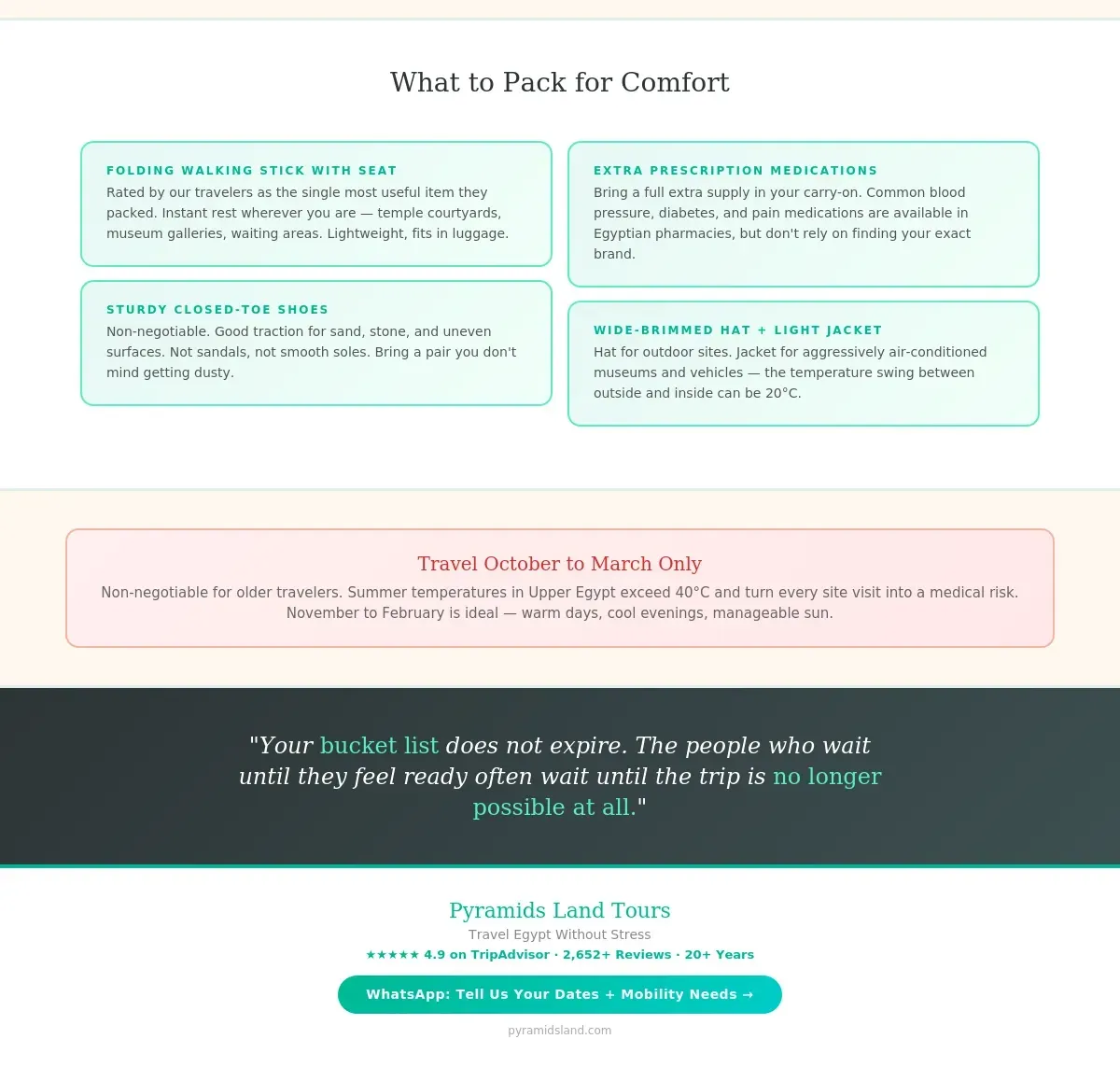
Season: Travel between October and March. This is non-negotiable for older travelers. Summer heat in Upper Egypt exceeds 40°C, making every site visit a medical risk. The best time to visit Egypt for seniors is November through February — warm days, cool evenings, manageable sun.
Pace: Your itinerary has fewer sites per day than a standard tour. We schedule one major site in the morning, rest through midday, and offer an optional lighter experience in the evening — a Nile-side dinner, a sound-and-light show, or simply free time. If you wake up tired, the day changes. A private tour bends to your energy, not a bus schedule.
Hydration and rest: Water is continuous. Your vehicle is always nearby and always air-conditioned. We build deliberate rest into every day — not as a concession, but as part of the design. The travelers who rest well see more clearly than the travelers who push through.
Bathrooms: Here is the practical detail nobody else puts in writing. Facilities at Egyptian sites range from modern at the GEM and the visitor centers to genuinely rough, and attendants expect a few pounds for a ration of paper. I never ask a group of seniors "does anyone need a bathroom?" — I build a mandatory ten-minute stop into the itinerary before we cross the threshold of any monument, scout the clean stalls ahead of you, and keep a pocket of 10-EGP notes so you never have to fumble for change with an attendant. It is a small thing. It is also the difference between a comfortable morning and a distracted one, and for anyone on blood-pressure or diuretic medication drinking water continuously in this heat, it is not a comfort issue at all. See our full guide to tipping in Egypt for what the small notes are actually for.
Medications: Bring more than you think you need. Pack a full extra supply in your carry-on in case checked luggage is delayed. Your guide knows the nearest pharmacies and which medications are available locally in Egypt. Common prescriptions for blood pressure, diabetes, and pain management are widely available over the counter.
Gear that helps: A lightweight folding walking stick with a built-in seat. Several of our travelers have called this the single most useful item they packed — instant rest wherever you are. Sturdy closed-toe shoes with good traction (not sandals, not smooth soles). A wide-brimmed hat. And a light, packable jacket for aggressively air-conditioned museums and vehicles.
Travel insurance: Essential. Not optional. Confirm that your policy covers pre-existing conditions, medical evacuation, and trip cancellation. Your guide cannot replace a doctor, but they can get you to one faster than you could on your own.
One specific Aswan highlight for limited-mobility travelers: the Nubian Museum offers free wheelchair rentals at the entrance and is entirely accessible — with ramps, wide galleries, and climate control. It is one of the best-curated museums in Egypt and is often overlooked in favor of the major temples.
Where You Sleep Is a Mobility Decision Too
Here is something the booking sites will not tell you: "wheelchair accessible" on a hotel listing can mean almost anything. Travelers on the accessibility forums describe arriving at hotels that were "totally accessible — except the bathroom." And Egypt's most romantic hotels are often the least forgiving ones: the grand properties of the golden age were built with ceremonial staircases, long garden paths, and bathtubs — not with an eighty-year-old knee in mind.
None of this means you must give up the romance. It means someone has to check the specifics before you pay — and someone has to be honest about the properties everyone else recommends on autopilot.
Start with the recommendation every other operator gets wrong. Every amateur agency assumes the Marriott Mena House is the default luxury option near the pyramids. But if you have limited mobility, that property is a beautiful, exhausting trap. It is built on a sweeping, historic incline where a wheelchair or a cane turns a simple trip to breakfast into a stressful logistical operation dependent on golf carts. For my mobility-challenged clients, I ditch Giza entirely and book the St. Regis or the Four Seasons First Residence on the Nile — where the footprint is completely flat, the elevators are flawless, and they can navigate wide marble hallways without fighting an uphill battle against antiquity. The pyramids are a private drive with your guide either way — timed around Cairo traffic, which we plan for and you never think about. The difference is that you arrive with your energy intact.
A working elevator, confirmed by phone. Not "the property has an elevator" on a booking page — a functioning lift that reaches your floor, confirmed with the hotel directly the week before arrival. In heritage buildings across Cairo and Luxor, elevators can be older than their guests: charming, and temperamental. This one question eliminates most of the pyramid-view guesthouses in Giza on its own.
A walk-in shower, not a bathtub. The single most common hotel obstacle for older travelers is a high tub wall in a marble bathroom. We request a shower room specifically, and we ask whether grab rails exist — in Egypt they often do not, and knowing that in advance changes which room we take.
The distance from the lobby to your room. In the grand hotels, a "garden wing" room can be a two-hundred-meter walk to breakfast. We ask for rooms near the elevator, on a low floor, and we ask how far the restaurant actually is — because a hotel is not senior-friendly if reaching dinner is the fourth site of the day.
And when a legendary hotel cannot deliver, we say so. Tour operators love to pull a shameless bait-and-switch at the Winter Palace in Luxor: booking clients into the cheaper Pavillon wing while bragging that they are staying at the legendary hotel. Let's be real — the Pavillon is a generic, modern annex tucked in the backyard. It shares the famous gardens, but the rooms have absolutely none of the high-ceilinged, Agatha Christie soul of the main building. My practice is unyielding transparency: if you cannot book the historic Palace wing — which is a challenge during its current Mandarin Oriental overhaul — we skip the property entirely rather than paying a premium just to sleep in a basic concrete block. In Aswan, by contrast, the Old Cataract was fully refurbished and handles older guests beautifully; there the legend and the knees can both have what they want.
Tell us your mobility level and we do this checking before you commit to anything — the same way we confirm the cruise ship's elevator before your departure, not from a website.
What We Tell Your Family When They Worry
If your children or grandchildren are reading this on your behalf — or if you are reading it for a parent — here is what we want you to know.
We do this regularly. We are not guessing. We have guided travelers with hip replacements, heart conditions, canes, walkers, and wheelchairs through sites that look impossible in photographs but that we have tested on the ground.
Your person will not be alone for a single moment at any site. They will have an Egyptologist guide who walks beside them, a driver who positions the vehicle as close as physically possible, and an itinerary designed specifically around what their body can do on that day.
The itinerary adjusts in real time. If the morning was harder than expected, the afternoon changes. If a site turns out to be easier than feared, we add something. Flexibility is not a feature — it is the fundamental architecture of a private tour.
One cultural difference to prepare for: Egyptians are extraordinarily generous with physical help. If you are struggling with a step, a ramp, or a boat transfer, bystanders — strangers — will reach out and physically support you. Sometimes this means lifting, pulling, or guiding without asking first. It comes from genuine kindness, not disrespect. But if you or your person is uncomfortable with uninvited physical contact, let your guide know in advance. Your guide will communicate your preferences in Arabic before each situation, ensuring help is offered on your terms.
Egypt is not an easy destination for anyone. But difficulty and impossibility are not the same thing. And the people who wait until they feel "ready" often wait until the trip is no longer possible.
The Moment That Makes It Worth It
You stood at the base of the Great Pyramid and put your hand on the stone. It was warm from the sun — the same sun that has been warming it for four and a half thousand years. Your guide stood quietly beside you and let the moment happen without narrating it.
Then your granddaughter, watching the video you sent her that evening, said: "Grandma, you actually did it."
That is what we are protecting. Not a checklist of sites. Not a photo album. The proof — to yourself and to the people who love you — that the dream on the list was not too late.
Frequently Asked Questions
Can seniors visit Egypt?
Yes. Travelers in their 60s, 70s, and 80s visit Egypt successfully every season — including travelers with canes, walkers, hip replacements, and heart conditions. The determining factor is not age but structure: private transport, controlled pacing, October–March travel, and a guide who knows the accessible routes at each site.
s Egypt wheelchair accessible?
Partially. The Grand Egyptian Museum, NMEC, and the Nubian Museum in Aswan are fully accessible with elevators and ramps. Major sites like the Giza plateau and Abu Simbel can be managed with vehicle positioning and electric carts. Some tombs and temple interiors are genuinely inaccessible — a well-designed itinerary is built around what works.
What is the best time for seniors to visit Egypt?
October through March. November to February is ideal — warm days, cool evenings, manageable sun. Summer heat in Upper Egypt exceeds 40°C and turns every outdoor site into a medical risk for older travelers.
Do Nile cruise ships have elevators?
Some do, many do not — and websites are unreliable on this point. We confirm the elevator directly with the ship before booking and place your cabin on the same deck as the dining room. For significant mobility concerns, a private dahabiya with fewer stairs is often the better vessel.
Which hotels in Egypt are best for older travelers?
Not always the famous ones. Historic properties built on inclines or entered up grand staircases can be exhausting for limited mobility, however beautiful — a flat, modern Nile-side hotel in Cairo often serves an older traveler far better than a legendary name in Giza. We confirm a working elevator, a walk-in shower, and a room near the lift by phone before booking, and we tell you honestly when a famous hotel is the wrong choice for your body.
Is Egypt safe for elderly travelers?
Yes. Major tourist areas have heavy security presence, and Egyptians are exceptionally helpful toward older visitors. With a private guide beside you at every site, solo seniors and older couples consistently describe feeling secure throughout.
Start With One Message
Tell us your travel dates, who is traveling, and any mobility or health considerations. We will design a specific itinerary around what your body can do — not a generic "senior tour," but your trip, at your pace, with your priorities.
No brochure. No pressure. Just the plan, the guide who will lead it, and the price.
WhatsApp: +20 122 362 4703 — Tell Us Your Dates and We'll Design Your Trip →
Or if you are in the US: +1 (928) 923-2598
About Pyramids Land Tours
Cairo-based. Egyptian-owned. 20+ years guiding travelers through Egypt — including hundreds of seniors who were told the trip might not be possible. Every tour is private, led by a licensed Egyptologist, and built around one principle: your bucket list does not expire.
★★★★★ 4.9 on TripAdvisor · 2,700+ Reviews · pyramidsland.com
Ashraf Fares