
Grand Egyptian Museum: The Complete Visitor Guide
***Edited April 1, 2026
The Grand Egyptian Museum is the single most important new attraction in Egypt. It opened fully in late 2025 after more than 20 years of construction, fundamentally changing the Cairo experience. The Tutankhamun collection, the Tutankhamun gallery alone, justifies 2 hours. The GEM also houses the Khufu Solar Boat, colossal royal statues, and 12 themed galleries spanning 7,000 years. For the Royal Mummies — Ramesses II, Seti I, Hatshepsut — visit the National Museum of Egyptian Civilization (NMEC) in Old Cairo, a separate half-day trip. — over 5,000 objects from the boy king's intact tomb — are displayed together for the first time in history. The Grand Staircase lines your ascent with colossal statues spanning 3,000 years of Egyptian history. And the building itself, sitting on the edge of the Giza Plateau with pyramid views from the upper galleries, is designed to be the largest archaeological museum in the world dedicated to a single civilization.
If you visit one museum in Egypt, this is it. If you visit one museum this year, anywhere, this is a strong contender.
Location
The GEM sits at El Remayah Square on the Cairo–Alexandria Desert Road, adjacent to the Giza Plateau. It is a 10-minute drive from the Pyramids, so you can combine them in a single day. From central Cairo (downtown or Garden City), the drive takes 30–45 minutes depending on traffic. From Giza-area hotels, it is 10–20 minutes.
This proximity to Giza is by design. The museum was built here specifically so that visitors experience the Pyramids and the GEM as a single cultural unit rather than separate attractions on opposite sides of Cairo.
Tickets
All tickets must be purchased online in advance. The GEM does not sell tickets at the door for foreign visitors.
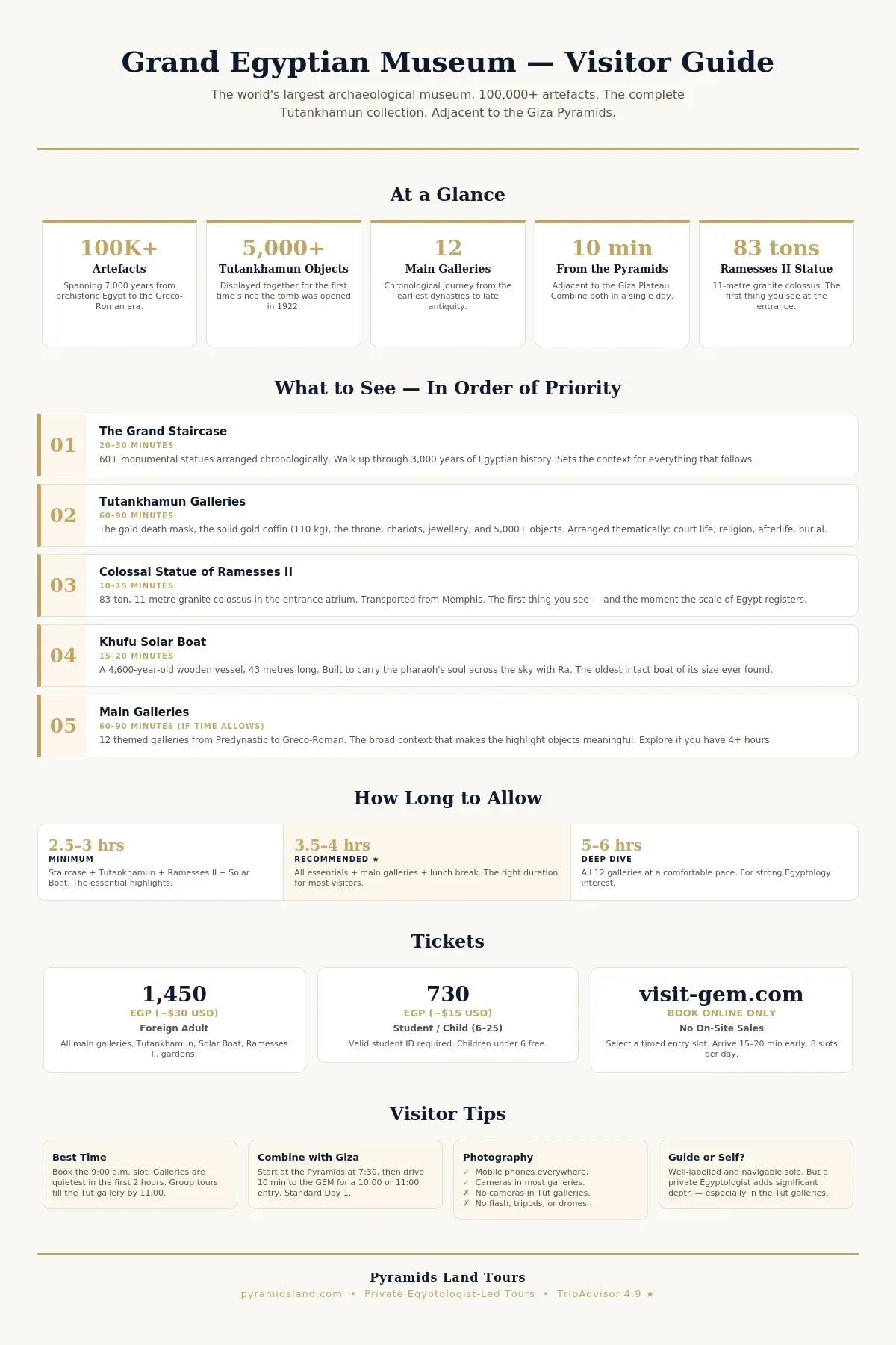
Book at the official site: visit-gem.com — this is the only authorized platform. Tickets from third-party sites may not be accepted.
Ticket prices (2026, foreign visitors):
- Adult: 1,450 EGP (~$30 USD)
- Student/child (6–25 with ID): 730 EGP (~$15 USD)
- Under 6: Free
Timed entry: When booking, you select a specific entry time slot. The museum operates 8 slots per day. Arrive 15–20 minutes before your slot. There is sometimes limited flexibility (up to 1–2 hours late), but this is not guaranteed on busy days.
What the ticket includes: All main galleries, the Tutankhamun collection, the Grand Staircase, the Khufu Solar Boat Hall, exterior gardens, and the commercial area.
What it does not include: Guided tours (available separately in English and Arabic, ~90 minutes), the Children's Museum (separate ticket for ages 6–12), and any temporary exhibitions.
Our recommendation: Book your ticket for 9:00 a.m. and arrive as the galleries open. The museum is quietest in the first two hours. By 11:00 a.m., group tours begin filling the Tutankhamun gallery.
What to See
The GEM contains over 100,000 artifacts spanning more than 7,000 years of Egyptian history. You cannot see everything in one visit. Here is what matters most and in what order.
The Colossal Statue of Ramesses II
You see it before you enter. An 83-ton, 11-meter granite statue of Ramesses II stands in the entrance atrium. It was transported here from Memphis and is the first thing that establishes the scale of what you are about to experience. This statue alone would be a national treasure in any other country. Here, it is the welcome mat.
The Grand Staircase
The main atrium features a dramatic ascending staircase lined with over 60 monumental statues, and artifacts arranged chronologically — from the earliest dynasties at the bottom to the Greco-Roman period at the top. Walking up the staircase is walking through 3,000 years of Egyptian history in physical form. Allow 20–30 minutes to ascend slowly and read the labels.
The Tutankhamun Galleries
The centerpiece of the museum. Over 5,000 objects from the intact tomb of the boy king are displayed together for the first time since Howard Carter opened the burial chamber in 1922. The gold death mask, the innermost coffin of solid gold (110 kg), the gilded shrine, the throne, the chariots, the canopic chest, the shabtis, the jewelry, the sandals, the childhood toys — everything.
The galleries are arranged thematically: court life, religion, the afterlife, and the burial itself. The layout tells a story rather than simply displaying objects. A guide adds enormous value here — not because the labels are insufficient, but because the connections between objects reveal how Tutankhamun lived, ruled, and was prepared for eternity.
Note: Mobile phone photography is permitted in the Tutankhamun Galleries. Cameras are not. No flash anywhere.
The Khufu Solar Boat
A 4,600-year-old wooden boat was discovered buried beside the Great Pyramid. Originally built to carry the pharaoh's soul alongside Ra across the sky. The boat has been painstakingly restored and is displayed in a purpose-built hall. At 43 meters long, it is the oldest intact vessel of its size ever found.
The Main Galleries
Twelve themed galleries covering the Predynastic period through the Greco-Roman era. These galleries provide the broad context that makes the highlighted objects meaningful. If you have 4+ hours, explore them. If you have 3 hours, prioritize the staircase, Tutankhamun, the Mummies, and the Solar Boat.
How Long to Allow
Minimum: 2.5–3 hours. This covers the Grand Staircase, the Tutankhamun galleries, and the Solar Boat — the four essential experiences.
Recommended: 3.5–4 hours. This adds time for the main galleries and a lunch break at one of the museum's restaurants (several quality options, open during museum hours).
Deep dive: 5–6 hours. For visitors with a strong interest in Egyptology who want to explore all 12 main galleries at a comfortable pace.
Two visits: Only necessary for people with a PhD-level interest. For most travelers, a well-planned 3–4-hour visit is sufficient.
Practical Tips
Combine with Giza. The GEM is 10 minutes from the Pyramids. Start at Giza at 7:30 a.m. (2 hours on the plateau), then drive to the GEM for a 10:00 or 11:00 a.m. entry. This is the standard Day 1 structure in our Cairo itineraries.
Wear comfortable shoes. The museum covers a vast area. You will walk more than you expect.
Photography. Allowed in all areas except where specifically restricted. Mobile phones are only allowed in the Tutankhamun Galleries. No flash, tripods, selfie sticks, or drones anywhere.
Bag check. Large bags must be checked. Bring a small crossbody or nothing.
Food and water. Restaurants and cafes inside the museum complex. Outside food and drinks are not permitted in the galleries.
Guided tour vs self-guided. The museum is well-labeled and navigable, self-guided. However, a private Egyptologist guide adds significant depth — especially in the Tutankhamun galleries, where the connections between objects tell a story that labels alone do not convey. If you are on one of our tours, your guide accompanies you inside.
→ Private Pyramids, Sphinx & Grand Egyptian Museum Tour → Private GEM Guided Tour
The GEM is only 10 minutes from the Pyramids — if you have a Cairo layover, both can fit in a single morning
Opening Hours
Standard: Complex grounds 8:30 a.m. – 7:00 p.m. Galleries 9:00 a.m. – 6:00 p.m. Extended until 9:00 p.m. on Wednesdays and Saturdays.
Ramadan: Complex 8:30 a.m. – 5:00 p.m. Galleries 9:00 a.m. – 4:00 p.m.
Closed: Check the official site for any closure days. As of 2026, the museum is open daily — verify before your visit, as this schedule may change.
Ashraf Fares