
Ramesses II: Complete Guide to Egypt's Greatest Pharaoh
***Edited April 29, 2026
Contents
2. Military Campaigns — 15 Fronts and the One He Nearly Lost
3. What Did Ramesses II Build? The Monuments You Can Still See
- Abu Simbel — Ancient Engineering and a Modern Rescue
- The Ramesseum, Western Thebes
- Luxor Temple
- Karnak — The Great Hypostyle Hall
4. The Heb-Sed Festival: Renewing Divine Authority
5. Nefertari, Khaemwaset, and the Family of a Dynasty
6. The Mummy — What Science Revealed (and Where to See It in 2026)
7. Was Ramesses II the Pharaoh of the Exodus?
8. How to See Ramesses II's Egypt: Private Tour Guide
9. FAQ
This guide covers the life, campaigns, buildings, and legacy of Ramesses II — and, critically, where you can stand in front of his work today. It is updated for 2026 and corrects a mummy-location error that persists across most competitor guides.
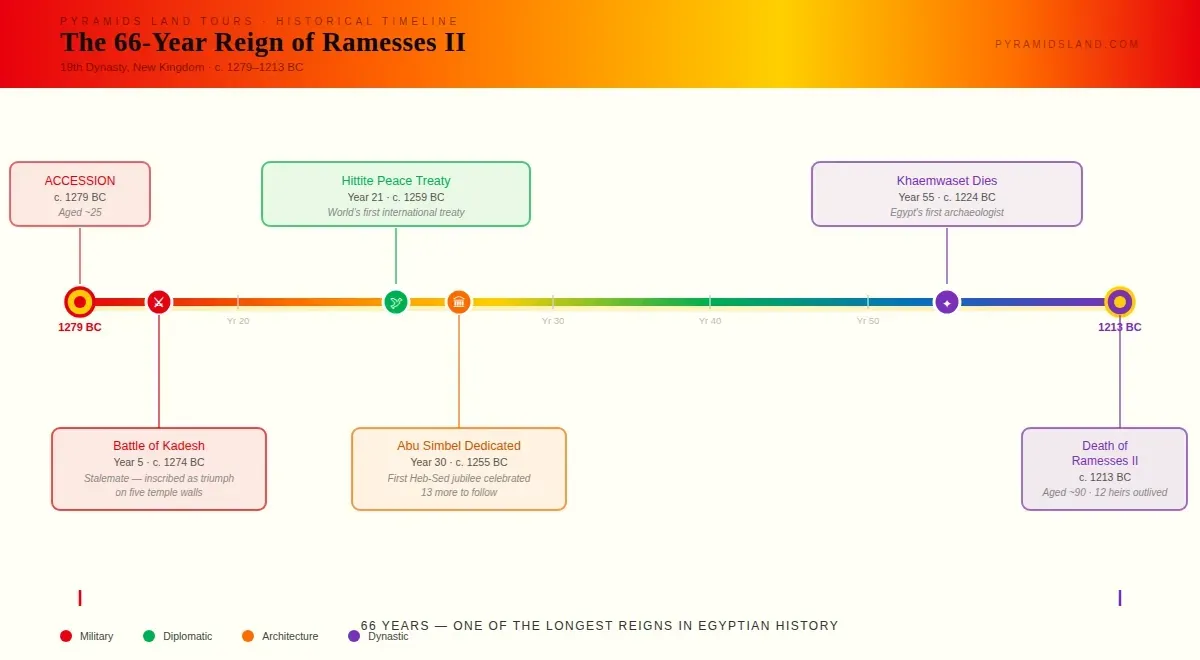
He stood at Kadesh in 1274 BC, cut off from his own army, surrounded by Hittite chariots, with no obvious path to survival. He survived. Then he had the entire episode inscribed on five temple walls — as the greatest military triumph in Egyptian history.
That is Ramesses II in miniature: a man of genuine ability who turned every event, including his near-defeats, into monuments of personal glory. He ruled Egypt for approximately 66 years (sources cite between 66 and 67 depending on chronology; the most precise figure is 66 years, 2 months and 14 days), outlived most of his own children, conducted at least 15 military campaigns, built more temples than any pharaoh before or after him, and constructed an entirely new capital city from scratch in the eastern Delta. His throne name — Usermaatra, corrupted to Ozymandias by the Greeks — inspired Shelley's most famous poem. The irony is that Ramesses would have been entirely unbothered by that poem's conclusion. His monuments are still standing.
1. Who Was Ramesses II?
Ramesses II was born around 1303 BC into the 19th Dynasty — a relatively young royal family by Egyptian standards. His grandfather, Ramesses I, had been a soldier-vizier who founded the dynasty; there was no ancient royal blood. His father, Seti I, was one of Egypt's most capable rulers, responsible for restoring stability after the religious upheaval of the Amarna Period under Akhenaten.
From childhood, Ramesses was prepared for kingship through deliberate public ritual: depicted alongside his father, lassoing a sacred bull, and joining Nubian military campaigns at around fourteen. By his early to mid-twenties, he was on the throne — and would remain there for approximately 66 years, one of the longest reigns in Egyptian history.
His throne name, Usermaatra Setepenre — "The justice of Ra is powerful, Chosen of Ra" — tells you everything about his self-image. So does his birth name, Ramesses Meryamun: "Born of Ra, Beloved of Amun." He was not a man given to understatement.
Quick reference:
- Reign: c. 1279–1213 BC (approximately 66 years; chronologies vary)
- Dynasty: 19th Dynasty, New Kingdom
- Capital: Pi-Ramesse (eastern Delta); also Thebes and Memphis
- Principal wives: Nefertari (Great Royal Wife); Isetnofret; Hittite princess Maathorneferure
- Children: over 100 known; some sources name up to 96 by name, with many more unnamed
- Successor: 13th son Merenptah — already in his sixties at accession
- Death: c. 1213 BC, aged approximately 90, standing over 1.8 meters tall
2. Military Campaigns — 15 Fronts and the One He Nearly Lost
Ramesses II conducted at least 15 documented military campaigns over his reign, operating on three main fronts. In Syria-Palestine, punitive expeditions into Canaan, Edom, Moab, and the Negev reasserted Egyptian suzerainty over the city-states that had been testing Egyptian control since the Amarna Period. In Nubia, he consolidated control over the gold mines that funded his building program. Against the Libyan tribal confederations pressing Egypt's western frontier, he enrolled captured Sherden fighters as mercenaries — the same men who would form part of his bodyguard at Kadesh.
Of those 15 campaigns, one stands apart — not because it was his greatest victory, but because it was nearly his greatest defeat.
The Battle of Kadesh (Year 5, c. 1274 BC)
In Year 5 of his reign, Ramesses marched four divisions of the Egyptian army north to retake the city of Kadesh on the Orontes River in modern Syria, held by Hittite king Muwatalli II. Kadesh was strategically critical: whoever held it controlled the land routes between Egypt and the Near East.
What followed was nearly a catastrophe for Egypt.
Two Hittite spies, captured and interrogated by the Egyptians, told Ramesses the Hittite army was still far to the north. In fact, Muwatalli had concealed roughly 3,500 chariots behind the walls of Kadesh. When the Egyptian Re division came up the road, the Hittites swept around and routed it. Ramesses found himself nearly surrounded, cut off with only his immediate guard and the Amun division.
By his own account — inscribed on at least five temple walls — he then charged the Hittite chariots alone, invoked Amun, and turned the battle. A relief force from the coast helped repel the attack. The battle ended in a stalemate: neither side achieved a decisive victory. Both withdrew.
Ramesses transformed this into the greatest propaganda triumph of his reign. The Kadesh Poem — the oldest known epic narrative text, and the most widely reproduced text from ancient Egypt — presents it as a spectacular personal triumph. It was carved at Luxor, the Ramesseum, Abydos, Abu Simbel, and Karnak.
Ashraf Fares · Egyptologist
I have stood in front of the Kadesh battle reliefs on the north wall of Luxor Temple's great court with clients hundreds of times over twenty years. [REPLACE WITH YOUR OWN WORDS — TripAdvisor research shows visitors use the word 'propaganda' unprompted when a guide explains the context. Specific prompts: Which tower do you point to first — the west (Ramesses with his generals) or the east (chariot over the fallen enemies)? What is the detail that makes clients stop and really see it? What question do they ask most often at this exact spot? Two or three sentences from you here are the paragraph no other operator can produce.]
The World's First Known Peace Treaty (Year 21, c. 1259 BC)
After sixteen years of the Cold War and low-level skirmishing, a shift in the balance of power forced both sides to negotiate. The rising Assyrian empire was threatening the Hittites from the east, making continued confrontation with Egypt strategically untenable. The new Hittite king, Hattusili III, sent envoys to Per-Ramesses.
The result was the world's earliest known international peace treaty — mutual non-aggression, mutual defense obligations (each side would aid the other if attacked by a third party), and an extradition clause for political refugees. The Hittites inscribed it in cuneiform on a silver tablet; Ramesses had the Egyptian version carved on the walls of Karnak. The treaty was sealed by a royal marriage: a Hittite princess who took the Egyptian name Maathorneferure became one of Ramesses's queens.
A replica of the Hittite version now hangs in the United Nations headquarters in New York. The Egyptian version is still on the wall at Karnak. You can read it there — if you know where to look. That is exactly the kind of thing a private Egyptologist is for.
3. What Did Ramesses II Build? The Monuments You Can Still See
More standing monuments bear the cartouche of Ramesses II than of any other pharaoh in history. His building strategy had two components: construct on an enormous scale, and carve his name so deeply into stonework that it could never be removed. He also re-carved the names of earlier pharaohs on existing monuments with his own — so systematically that later scholars initially overcredited him as builder of structures he had merely appropriated.
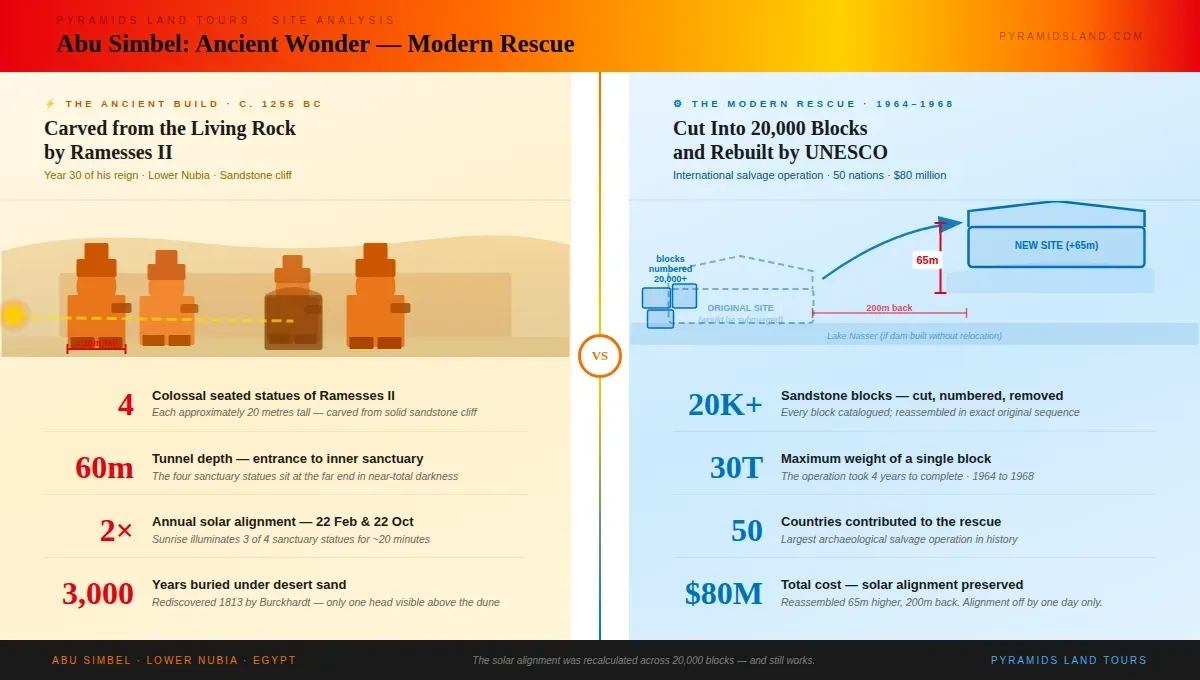
Abu Simbel — Ancient Engineering and a Modern Rescue
The twin rock-cut temples at Abu Simbel are the apex of Ramesses II's building program — and the site of one of the most remarkable feats of modern and ancient engineering.
The temples were carved from a sandstone cliff in Lower Nubia around Year 30 of Ramesses's reign. The Great Temple's facade carries four colossal seated statues of Ramesses, each around 20 meters tall. Inside, the sanctuary holds four statues: Ra-Horakhty, Amun, Ptah, and Ramesses himself — placed as a fourth deity among Egypt's greatest gods. On approximately 22 February and 22 October each year, the rising sun penetrates 60 meters into the temple and illuminates three of the four statues (including Ramesses), while Ptah, the god of the underworld, remains in permanent darkness. This was engineered into the cliff with astronomical precision, a feat that took modern scientists years to fully document.
The temples remained unknown to the outside world until 1813, when Swiss explorer Johann Ludwig Burckhardt found them almost entirely buried under sand — only the top of one colossal head was visible above the dune. They had been hidden for over 3,000 years.
Then, in 1964, they nearly disappeared again. The construction of the Aswan High Dam would have submerged Abu Simbel under Lake Nasser. UNESCO launched one of the largest archaeological salvage operations in history: the entire temple complex was cut into more than 20,000 numbered sandstone blocks, many weighing up to 30 tonnes, and reassembled on an artificial hillside 65 meters above and 200 meters behind the original site. Engineers from over 50 countries participated. The operation cost approximately $80 million and was completed in 1968. The solar alignment was preserved to within one or two days of the original.
Some visitors arrive knowing the temples were moved and wonder if that changes what they experience. The answer is in the engineering: the solar alignment was recalculated following a relocation of 65 meters up and 200 meters back, completed in 1968, and it still works — with a one-day variance from the original, across 20,000 hand-numbered sandstone blocks. The 'authenticity' debate dissolves the moment the light enters the corridor.
The smaller temple was dedicated to Nefertari as an incarnation of the goddess Hathor — an extraordinary honor for a royal consort. [LINK: Abu Simbel complete guide]
Private tour clients reach Abu Simbel ahead of the Aswan convoy coaches — arriving when the site is quiet, with no fixed departure time and no group schedule to match. The difference between a shared tour bus and a private car on this route is not just comfort: it is 45 minutes more inside the temple before the crowds arrive.
Ashraf Fares · Egyptologist
The solar alignment at Abu Simbel on 22 February is one of the experiences I bring clients to every year. [REPLACE WITH YOUR OWN WORDS — TripAdvisor research: visitors describe going silent, mouths open, saying 'none of the photos prepared me.' You have watched this from the guide's side hundreds of times. Specific prompts: What do you observe in the clients — not the statues, the people watching the light? What do you say, or choose not to say, during those 20–25 minutes? What changes in the room as the light moves? Two or three sentences from you that no competitor can replicate.]
▶ The Ramesses II Trail: Cairo, Luxor & Abu Simbel — 8-Day Private Tour →
Solar alignment dates: 22 February & 22 October. Places on these dates fill months in advance.
The Ramesseum, Western Thebes
Ramesses's mortuary temple on the west bank at Luxor covered over 11.5 acres. Its storerooms and granaries could hold 350 boatloads of grain — functioning as Upper Egypt's economic reserve. The temple complex also housed one of the ancient world's great repositories of knowledge: a library of approximately 10,000 papyrus scrolls, the largest archive of recorded texts in the Nile Valley at the time.
The fallen granite colossus in its forecourt — the statue whose throne name, Usermaatra, the Greeks corrupted to Ozymandias — still lies in fragments exactly where it fell — an estimated 1,000 tonnes of granite, transported 220 kilometers from the Aswan quarry — which is precisely why the fragments are still there. Shelley never visited Egypt; he wrote the poem from a description given to him by the traveler Giovanni Belzoni. But the image was accurate enough.
Ashraf Fares · Egyptologist
The fallen colossus is the detail that makes Shelley's poem make sense in your body rather than just your head. [REPLACE WITH YOUR OWN WORDS — TripAdvisor research: the Ramesseum is consistently 'surprisingly quiet' — visitors notice the silence after Karnak. Specific prompts: Do you read the Ozymandias inscription at the colossus's feet? What do clients say when you do? What specific fragment — the hand, the face, the scale of the ankle — do you always point to first? Does the quietness of this site change what you say here? Two or three sentences.] [LINK: Luxor West Bank guide]
Luxor Temple
Ramesses added an entirely new court and gateway to the earlier Amenhotep III temple at Luxor, decorating it with Kadesh battle reliefs and installing colossal statues of himself plus two towering obelisks. One obelisk still stands in Luxor. The other was given to France in 1829 and stands today in the Place de la Concorde in Paris — making Ramesses II a permanent presence in central Paris as well as Upper Egypt. [LINK: Luxor Temple guide]
One practical note from 20 years of bringing clients here: if your schedule allows, Luxor Temple after dark is one of the most atmospheric experiences in Egypt. The temple is floodlit from dusk until 10 PM, and the Kadesh reliefs on the pylon read entirely differently in artificial light — the battle scenes flatten in full sun, but the shadows thrown by floodlighting reveal the depth of the carving in a way daytime visits simply do not.
Karnak — The Great Hypostyle Hall
Begun by Seti I and completed under Ramesses II, the Great Hypostyle Hall contains 134 massive columns, the largest of which are 21 meters tall and 10 meters in circumference. The Hittite peace treaty inscription is on the outer wall. Ramesses's cartouches are on virtually every surface. The hall remains the largest religious building ever constructed. Karnak Temple guide
4. The Heb-Sed Festival: How a Pharaoh Renewed His Power for 66 Years
Egyptian kingship carried a biological problem: pharaohs were considered divine, but they aged. The Heb-Sed festival — a royal jubilee celebrated after 30 years on the throne, then every three years thereafter — was the ritual solution. Through a series of ceremonies, the pharaoh symbolically died and was reborn, his vitality renewed, his legitimacy reconfirmed by the gods.
Ramesses II, with a 66-year reign, would have celebrated at least 13 Heb-Sed festivals — more than any other pharaoh on record. Each festival required elaborate ceremonies, the construction of a dedicated court, and — crucially — a demonstration of the pharaoh's physical fitness, including a ritual run between boundary markers. For a king who lived to approximately 90 while suffering from severe arthritis in his final decades, this last requirement became increasingly ceremonial. But it continued. The ritual fiction of the eternal, vigorous king was maintained to the end.
The Heb-Sed is also why Ramesses's propaganda machinery was so relentless: with each three-year cycle, the court needed fresh demonstrations of divine vitality. New monuments, new battle narratives, new colossal statues. The building program was not vanity for its own sake — it was the liturgical requirement of a system of power that ran on the myth of an undying king.
5. Nefertari, Khaemwaset, and the Family of a Dynasty
Ramesses II had at least two principal wives and over 100 known children. Three are worth understanding in depth.
Nefertari — The Great Royal Wife
Nefertari Merymut was Ramesses's first and most beloved Great Royal Wife — elevated from the very beginning of his reign. She appears unusually prominently throughout his monuments: the smaller temple at Abu Simbel was officially dedicated to her as an incarnation of the goddess Hathor, a rare honor for a royal consort. Her tomb in the Valley of the Queens (QV66) is widely considered the finest tomb painting in all of Egypt — more vivid and better preserved than anything in the Valley of the Kings. She appears to have predeceased Ramesses, dying sometime after Year 24 of his reign. [LINK: Valley of the Queens guide]
Prince Khaemwaset — The World's First Archaeologist
Son of Isetnofret, Ramesses's second principal wife. As High Priest of Ptah at Memphis, Khaemwaset conducted systematic restoration projects of Old Kingdom monuments across the Memphite region — inspecting crumbling temples and pyramids, reinscribing their original builders' names (alongside his and his father's), and recording what he found. He has been called, with genuine justification, the world's first archaeologist. He died around Year 55 of Ramesses's reign, before his father, predeceasing the man he had expected to outlive. He is buried at Saqqara.
Merenptah — The Successor Who Almost Wasn't
Ramesses's thirteenth son, and eventual successor, was only because twelve older sons died before him. Merenptah was likely already in his sixties when he inherited the throne. His own legacy includes the Merneptah Stele — the earliest external reference to Israel as a people outside the biblical text itself.
6. The Mummy of Ramesses II — What Science Revealed (and Where to See It in 2026)
⚠ Many guides still send visitors to the Egyptian Museum on Tahrir Square. The mummy of Ramesses II has been at the National Museum of Egyptian Civilization (NMEC) in Fustat, Old Cairo, since April 2021. These are different buildings in different parts of the city.
In April 2021, Egypt conducted the Pharaohs' Golden Parade — a nationally televised ceremony in which 22 royal mummies were transported in convoy to their permanent new home at the NMEC. Ramesses II was among them. The mummy of Ramesses II is now in the Royal Mummies Hall at the NMEC, Fustat, Old Cairo.
The mummy was originally discovered in 1881 in a royal cache at Deir el-Bahri, where priests had moved it during the Third Intermediate Period to protect it from tomb robbers. His actual tomb — KV7 in the Valley of the Kings — had been stripped in antiquity.
Physical examination has confirmed what the historical record implies. Ramesses died at approximately 90 years of age. He stood over 1.8 meters tall — notably tall for the ancient world. He suffered from severe arthritis, atherosclerosis, and advanced dental disease consistent with extreme old age. He was red-haired, consistent with the Ramesside family's probable northern heritage.
I
n 1976, the Egyptian government sent the mummy to Paris for scientific examination and conservation. For the journey, the Egyptian authorities issued Ramesses II an Egyptian passport — occupation listed as "King (deceased)." He was received at Paris-Le Bourget Airport with full military honors.
7. Was Ramesses II the Pharaoh of the Exodus?
This is the question every visitor to Egypt eventually asks, and it has no clean answer.
The evidence connecting Ramesses II to the biblical Exodus is circumstantial but not trivial. Exodus 1:11 refers to Hebrew laborers building store-cities "Pithom and Raamses" — and Per-Ramesses, Ramesses II's vast Delta capital, is the most plausible candidate for the latter. Egyptian sources also confirm the use of Habiru — a term that overlaps partially with "Hebrew" in scholarly debate — as a labor class in the New Kingdom.
However, no Egyptian source mentions the Exodus, the ten plagues, or Moses by name. Scholars hold three main positions: (1) the Exodus occurred under Ramesses II, with the Delta capital providing the backdrop; (2) it occurred under his successor Merenptah, whose Stele already references Israel as a people; or (3) there was no single historical Exodus event, and the narrative is a composite of migration and memory spread across generations. The third position is held by a significant number of academic Egyptologists.
What can be said: the Egypt of Ramesses II — the construction projects, the Delta capital, the multi-ethnic conscripted workforce — fits the general backdrop of the Exodus narrative better than any other period. Whether that makes Ramesses the pharaoh of the story is a theological and historical question that remains genuinely open. [LINK: Exodus FAQ article — add when published]
8. How to See Ramesses II's Egypt: A Private Tour Guide
The monuments of Ramesses II span the length of Egypt. A well-structured private tour connects most of them in a single trip. Here is how I plan it:
Cairo — 1 day
The National Museum of Egyptian Civilization (NMEC), Fustat, Old Cairo — not the Egyptian Museum on Tahrir Square. The Royal Mummies Hall at the NMEC is where you will see Ramesses II in person. Allow a full morning. The museum also gives essential context on New Kingdom Egypt before you travel south.
Luxor — 3 to 4 days
The greatest concentration of Ramesses II's work outside Nubia. West bank: the Ramesseum (fallen colossus, grain stores, papyrus library site) and the Valley of the Queens for Nefertari's tomb QV66 by special permit. East bank: Luxor Temple (the Kadesh reliefs and obelisk) and the Great Hypostyle Hall at Karnak. This is the heart of the itinerary.
Abu Simbel — day trip or overnight from Aswan
280 kilometers south of Aswan by road, or 45 minutes by flight. The solar alignment on approximately 22 February and 22 October draws visitors from around the world — book months in advance for these dates. On any other day, the temples are extraordinary, and the crowds are manageable.
I have been taking clients to these sites for over 20 years. The difference a private tour makes at Abu Simbel is not logistics — it is context. The solar alignment means nothing without understanding Ramesses's theology of self-deification. The Kadesh reliefs at Luxor Temple are decorative rather than depicting the real story of what happened in the battle. The Ramesseum is a field of ruins until you understand what it once contained. That is what I am there for.
The Ramesseum is one of the sites in Egypt where a guide makes the greatest difference. It is poorly labeled, requires interpretation, and is almost always quiet enough for a real conversation, which is exactly what the Valley of the Kings and Karnak are not. Most visitors without a guide walk through in 20 minutes and leave having seen almost nothing of what is actually there.
▶ The Ramesses II Trail: Cairo, Luxor & Abu Simbel — 8-Day Private Tour →
Private, fully customisable. Led by Ashraf Fares, Egyptologist and his team
FAQ: Ramesses II
What was Ramesses II's throne name?
Usermaatra Setepenre — "The justice of Ra is powerful, Chosen of Ra." The Greeks corrupted this to Ozymandias, which Shelley used in his 1818 poem about the vanity of power.
How long did Ramesses II reign?
Approximately 66 years, from around 1279 BC to 1213 BC. The most precise figure in the sources is 66 years, 2 months and 14 days. Some chronologies give 67 years depending on how the accession year is counted.
Where is the mummy of Ramesses II in 2026?
At the National Museum of Egyptian Civilization (NMEC) in Fustat, Old Cairo. The mummy moved there from the Egyptian Museum in April 2021 during the Pharaohs' Golden Parade. Many online guides still cite the Egyptian Museum — that information is outdated.
Did Ramesses II win the Battle of Kadesh?
No. The battle ended in a stalemate. Neither Egypt nor the Hittites achieved a decisive victory; both withdrew. Ramesses's own account, inscribed on multiple temple walls, presents it as a personal triumph — but this was propaganda. The Hittites retained Kadesh.
Is Abu Simbel worth visiting?
Yes — Abu Simbel is one of the most impressive surviving monuments from the ancient world. The solar alignment on approximately 22 February and 22 October, when the rising sun illuminates the sanctuary statues, is among the most carefully engineered phenomena in ancient architecture. The UNESCO relocation story — the temple was cut into 20,000+ blocks and rebuilt in the 1960s to save it from Lake Nasser — adds a second extraordinary layer to any visit.
What is the world's first peace treaty?
The Hittite-Egyptian peace treaty of c. 1259 BC, concluded between Ramesses II and Hittite king Hattusili III. A replica hangs in the United Nations headquarters in New York. The Egyptian version is inscribed on the outer wall of Karnak Temple.
How many children did Ramesses II have?
Over 100 known children. Some sources name up to 96 by name; many more are unnamed. He had over 200 wives and concubines. He outlived most of his children — his eventual successor, Merenptah, was his 13th son.
Ashraf Fares