
How to Plan Your Egypt Trip: A Step-by-Step Guide From Someone Who Lives Here
***Edited June 22, 2026
Most people spend weeks planning a trip to Egypt and still arrive feeling underprepared. The country is enormous, the logistics feel unfamiliar, and every travel forum gives different advice.
This guide cuts through the noise. After 25 years of running private tours from Cairo and watching thousands of travelers arrive — some brilliantly prepared, others completely blindsided — I know exactly which planning steps matter and which ones people skip to their regret.
Here is how to plan a trip to Egypt that actually works.
Decide How Many Days You Need
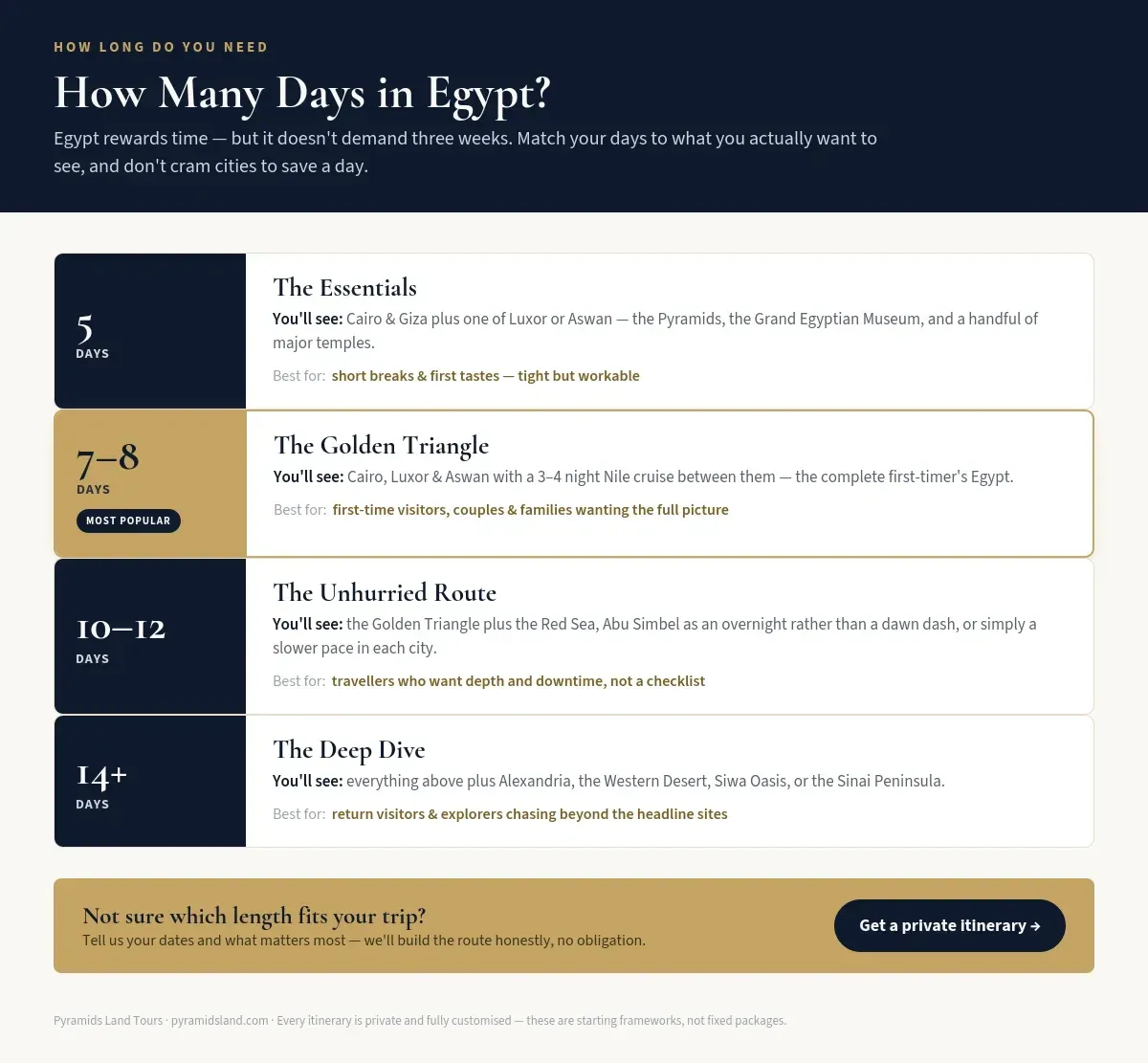
Egypt rewards time. But it does not require three weeks to see the essential sites.
5 days cover Cairo and one of either Luxor or Aswan. You will see the Pyramids, the Grand Egyptian Museum, and a handful of major temples. It works, but it is tight.
7–8 days is the most popular window. This is enough for the "Golden Triangle" route: Cairo, Luxor, and Aswan, often with a 3- or 4-night Nile cruise between Luxor and Aswan. Most first-time visitors choose this duration.
10–12 days opens space for the Red Sea (Hurghada or Marsa Alam), Abu Simbel as an overnight rather than a dawn flight, or a slower pace with more time in each city.
14+ days allow additions such as Alexandria, the Western Desert, Siwa Oasis, or the Sinai Peninsula.
The mistake most travelers make is cramming too many cities into too few days. Egypt's distances are real — Cairo to Luxor is a 1-hour flight or a 9-hour train ride. Build in travel time, not just sightseeing time.
For a detailed breakdown, see
How Many Days in Egypt?
Choose the Right Time of Year
Egypt's climate is simple: hot and hotter.
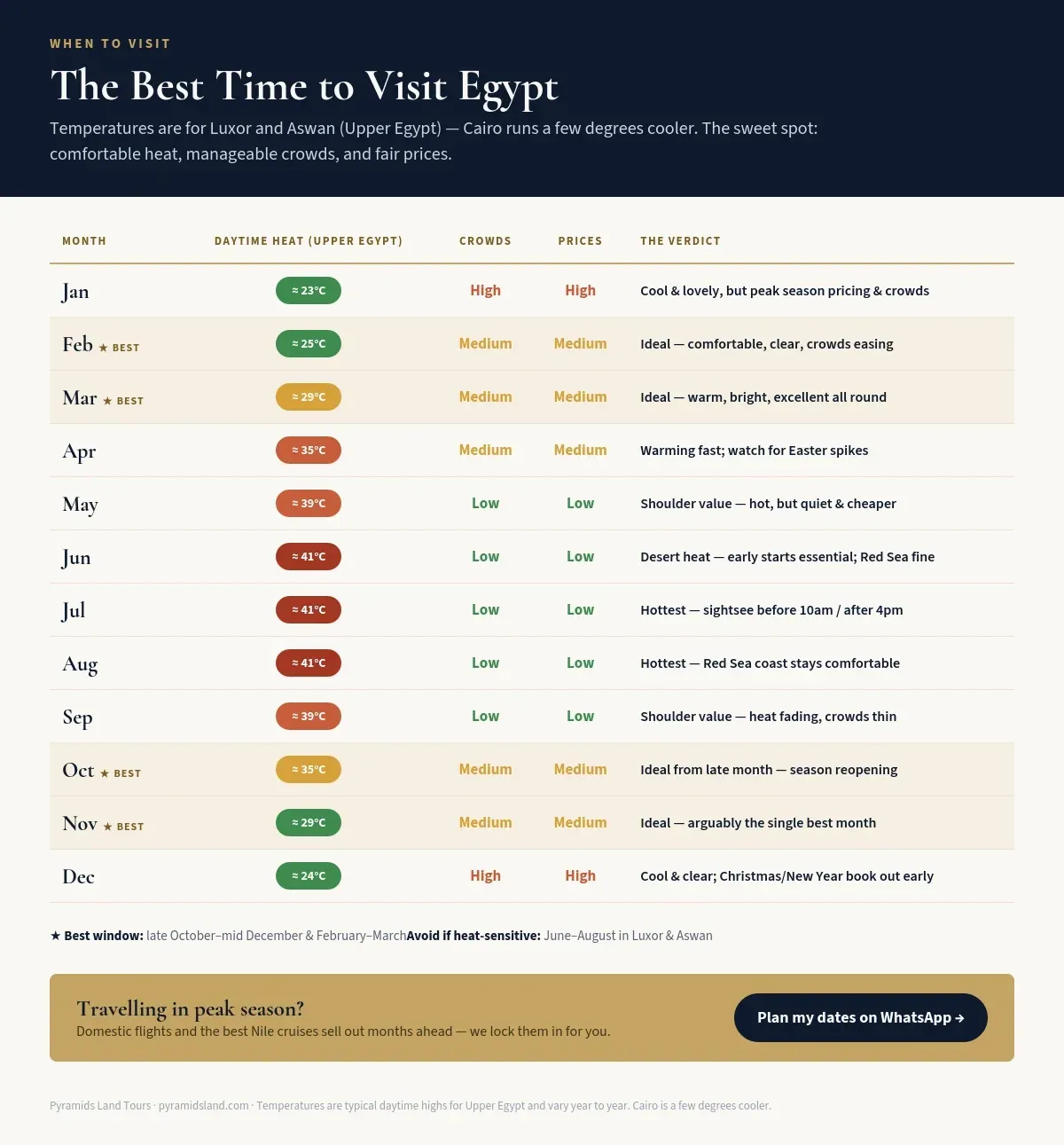
October to April is the main travel season. Daytime temperatures in Cairo and Luxor hover between 20–28°C (68–82°F). Evenings can be cool, especially in the desert. This is peak season — expect higher prices and busier sites, particularly around Christmas, New Year, and Easter.
May and September are shoulder months. Heat is rising or fading, but crowds drop noticeably. Prices soften. If you tolerate warmth, these months offer excellent value. One spring caveat: the khamsin season (roughly March–May) brings occasional hot, dusty winds that can reduce visibility for a day or two. They pass quickly and rarely disrupt a trip — but they're worth knowing about.
June to August brings genuine desert heat — 40°C+ (104°F+) in Upper Egypt. Sightseeing before 10 a.m. and after 4 p.m. becomes essential. The Red Sea coast remains comfortable year-round and is busiest during European summer holidays.
The single best window for most travelers: Late October through mid-December, or February through March. Comfortable weather, manageable crowds, and competitive pricing. Read Best Time to Visit Egypt guide.
A note on Ramadan: Ramadan dates shift annually (following the lunar calendar). During Ramadan, most restaurants outside hotels are closed during daylight hours. Some site opening hours have changed. The pace of daily life slows noticeably. Egypt is still very much open for tourism — and the evening iftars (breaking of the fast) are a cultural experience worth seeing — but if your trip overlaps with Ramadan, your guide adjusts the schedule accordingly: earlier starts, longer midday breaks, and evening dining at hotels or restaurants that serve during fasting hours. Check the dates before you book.
Sort Your Visa Before You Fly
Most nationalities — including U.S., UK, EU, Canadian, and Australian passport holders — can obtain an Egypt visa in one of two ways:
E-visa (recommended): Apply online at visa2egypt.gov.eg at least 7 days before travel. Single-entry costs $25 USD. Multiple-entry costs $60 USD. Valid for 30 days from arrival.
Visa on arrival: Available at Cairo, Hurghada, Luxor, and Sharm El Sheikh airports. Single-entry costs $30 USD — note this is slightly more than the $25 e-visa, and the rate rose from $25 in March 2026. Lines can be long after several flights land at once. You pay in USD cash at a bank window before passport control. Have exact change — the bank windows do not always have small bills.
Your passport must be valid for at least 6 months beyond your entry date. Keep your entry slip — you will need it when you leave.
For a full breakdown including special cases, see Egypt Entry Requirements.
Book Flights Into Cairo (Usually)
Cairo International Airport (CAI) is the primary gateway. Direct flights operate from most major hubs: New York, London, Frankfurt, Dubai, Istanbul, and others.
Some travelers fly directly into Luxor (LXR) or Hurghada (HRG), particularly on European charter routes. This makes sense if your itinerary starts in Upper Egypt or at the Red Sea — but for most first-timers, Cairo is the logical starting point because it is home to the Pyramids of Giza, the Grand Egyptian Museum, and the infrastructure to begin a wider tour.
Booking tip: Flights to Cairo are cheapest when booked 2–4 months in advance. Prices spike during December–January and around Ramadan.
For the question of whether to begin in Cairo or Luxor, see Cairo or Luxor First?
Build Your Route in Geographic Order
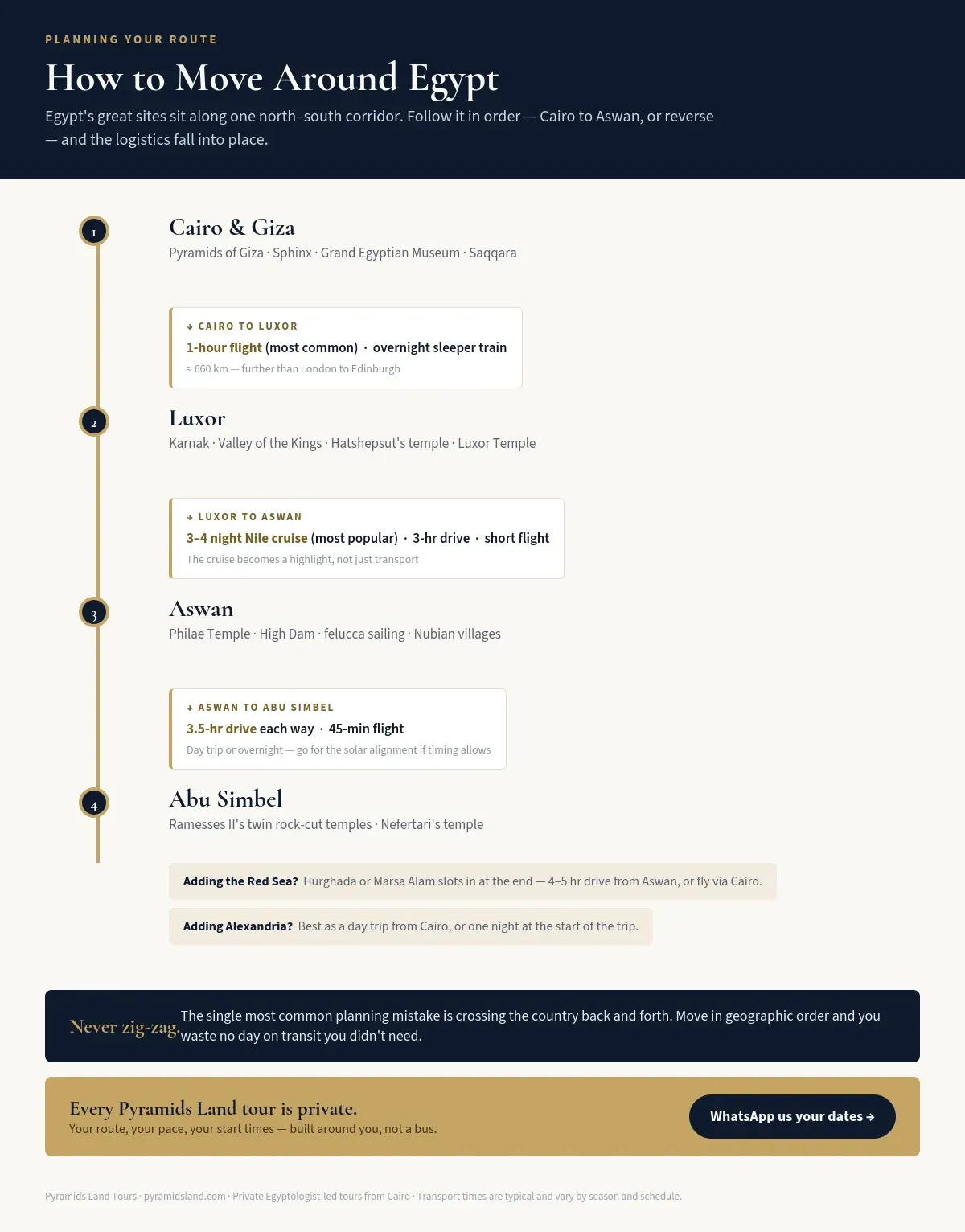
A common mistake is zig-zagging across the country. Egypt's key destinations fall along a natural north-to-south corridor:
Cairo → Luxor → Aswan (the Golden Triangle). Most 7–10 day itineraries follow this flow, with a Nile cruise between Luxor and Aswan. Some travelers reverse the route — flying into Aswan and working northward — which works equally well. Dahabiya vs Nile Cruise
If you are adding the Red Sea, it typically slots in at the end: Aswan → Hurghada or Marsa Alam → fly home. If you want Alexandria, it works best as a day trip from Cairo or a one-night addition at the start of your trip.
| Route | Options | Time |
|---|---|---|
| Cairo → Luxor | Flight (most common) · overnight sleeper train · private car | 1 hr flight |
| Luxor → Aswan | Nile cruise (most popular) · drive · short flight | 3–4 night cruise |
| Aswan → Abu Simbel | Drive each way · or flight | 3.5 hr drive / 45 min flight |
| Aswan → Hurghada | Drive via Eastern Desert · or fly via Cairo | 4–5 hr drive |
Decide Between Independent Travel and a Private Tour
This is the single biggest planning decision you will make, and it affects everything downstream.
Independent travel is possible in Egypt. Trains run between Cairo, Luxor, and Aswan. Hotels can arrange airport transfers. Uber works in Cairo. But the reality is that navigating site logistics, managing touts, negotiating transport, and making sense of temples without a guide is genuinely difficult — especially on a first visit.
A private tour means a licensed Egyptologist guide, a private vehicle with a driver, pre-arranged accommodation, and someone handling the logistics so you do not have to. You still choose what you see and how fast you move, but the friction disappears.
Both approaches work. Independent travel is genuinely doable — trains run, Uber works in Cairo, and hotels arrange transfers. The honest trade-off is energy: on a first visit, the logistics and the constant low-level selling at major sites pull attention away from the experience itself. That is the real thing to weigh — not whether you can do it alone, but what you want your days to feel like.
At Pyramids Land Tours, every tour is private and Egyptologist-led. No group buses, no fixed schedules, no single supplements. The guide works for you, not a busload of strangers. See how our tours work
ndependent travel works well for the relaxed parts of a trip — Dahab, a Red Sea resort, the cafés of Zamalek. Where a private guide earns its place is the dense, high-pressure sites: the Giza Plateau, Karnak, the Valley of the Kings.
Tell us your dates and we'll tell you honestly what's realistic — a private Egyptologist, your pace, no group bus, no commission shops.
Set a Realistic Budget
Egypt offers strong value compared to most international destinations. A general framework per person, excluding international flights:
Budget (backpacker): $50–80/day. Basic hotels, street food, public transport, and self-guided sightseeing.
Mid-range (most travelers): $150–250/day. 4-star hotels, private transport, licensed guide, restaurant meals, and site entries are included.
Luxury: $400–800+/day. 5-star hotels, dahabiya Nile cruise, premium Egyptologist guides, fine dining, VIP access where available.
Costs that surprise first-timers: Site entry fees add up. The Pyramids of Giza cost 540 EGP (~$11 USD). The Valley of the Kings costs 600 EGP (~$12 USD) for three tombs. The Grand Egyptian Museum is 1,450 EGP (~$30 USD) — and for foreign visitors, GEM tickets must be booked online in advance through the official GEM portal; there are no on-site sales. On a guided tour, your guide handles this for you." A full day of sightseeing in Luxor can cost $40–60 in entry fees alone.
Tipping (baksheesh): Tipping is part of daily life in Egypt — for guides, drivers, hotel and restaurant staff, and site attendants. Rather than a percentage of your trip cost, it's easier to budget set amounts per service per day. Our Tipping in Egypt guide gives specific 2026 figures for each.
Pack for the Climate and the Culture
Egypt is a Muslim-majority country. You do not need to cover head to toe, but modest clothing goes a long way — particularly at mosques, in rural areas, and in Upper Egypt.
For women: Shoulders and knees should be covered in cities and at historical sites. Lightweight linen or cotton trousers, loose shirts, and a scarf (useful for sun, mosques, and dusty sites). Swimwear is fine at hotel pools and Red Sea resorts.
For men: Shorts are acceptable at resorts but draw attention in Cairo and Upper Egypt. Long trousers or chinos with breathable shirts are a better default.
Footwear: Closed-toe walking shoes with good grip. You will be on uneven stone, sand, and ramps. Sandals for evenings and pools.
Essentials: High-SPF sunscreen, a hat with a brim, a refillable water bottle, a power adapter (Type C, 220V), basic medications (anti-diarrheal, rehydration salts, antihistamine), and a portable battery pack — charging points inside tombs and temples do not exist.
For more details, see What to Pack for Egypt
Handle Money and Connectivity
Currency: Egyptian Pound (EGP). The pound has been volatile — check a live converter before you travel; as a rough 2026 guide, expect roughly 48–50 EGP to 1 USD.. ATMs are widely available in tourist areas. One 2026 change worth knowing: major sites are shifting to card- and advance-online ticketing — the Grand Egyptian Museum is online-only, and the Giza Plateau has moved to card- and online-only entry. Bring at least one card with international transactions enabled. (Your visa fee on arrival, by contrast, is still paid in USD cash at the bank window — keep some for that.)
Exchanging money: Airport exchange desks offer fair rates. Avoid exchanging large amounts at hotels. Withdraw from ATMs in increments — Egyptian ATMs often have daily limits of 5,000–10,000 EGP per transaction.
SIM cards: Buy a local SIM at the airport. Vodafone and Orange both sell tourist SIM packages with data (around $10–15 USD for a month of 10–20 GB). Coverage is strong in cities, decent along the Nile, and patchy in the desert. For more details, see our Egypt SIM Card Guide
Safety: The Question Everyone Asks First
Egypt is safe for tourists. The main tourist corridor — Cairo, Luxor, Aswan, the Red Sea — is well-monitored, heavily policed, and traveled by millions of visitors every year. Tourist police are stationed at every major site, hotel zone, and transport hub.
The areas that appear in travel advisories — parts of the northern Sinai Peninsula, the Libyan border region — are not on any standard tourist itinerary and are far from the places you will visit. The tourist Egypt and the Egypt in security briefings are essentially different geographies.
Common sense applies, as it does anywhere: keep valuables secure, be aware of your surroundings in crowded places, and don't wander alone in unfamiliar neighborhoods at night. But the honest truth is that most visitors find Egypt safer-feeling than they expected. The tourism infrastructure is mature, the security presence is visible, and Egyptians are genuinely hospitable to guests.
A private guide adds a practical layer of security: someone who speaks the language, knows the logistics, handles the transport, and can resolve any situation that arises before it becomes a problem.
You won't be navigating Egypt alone.
Your guide handles the language, the transport, and anything that comes up — it's the reason travellers in our reviews describe Egypt as feeling “safe.”
Health and Vaccinations
Egypt does not require any mandatory vaccinations for most travelers. However, the CDC recommends:
Hepatitis A — recommended for all travelers (transmitted through food and water).
Typhoid — recommended if you plan to eat outside major hotels and restaurants.
Routine vaccinations (MMR, Tdap, flu) should be up to date.
COVID-19 — no restrictions as of 2026, but check current requirements before travel.
The stomach: This is the health issue most travelers actually face. Egyptian food is outstanding, but the water supply and unfamiliar bacteria can cause digestive upset during the first 2–3 days. Drink only bottled or filtered water. Avoid ice in drinks at smaller establishments. Skip raw salads at street stalls for the first few days. Let your system adjust. Carry oral rehydration salts, anti-diarrheal medication, and an antihistamine. Pharmacies are widely available in Egyptian cities, and many medications can be purchased without a prescription.
Sun and heat: The risk most travelers underestimate. Dehydration and heat exhaustion are real, especially in Upper Egypt (Luxor, Aswan) between March and October. Drink water constantly. Wear a hat. Apply sunscreen every 2 hours at outdoor sites. Your guide will pace the day around the heat — but you need to manage your own hydration.
Travel insurance: Strongly recommended. Ensure your policy covers medical evacuation. Egypt has good private hospitals in Cairo and major cities, but treatment standards outside urban areas are variable.
Navigating Touts and Hassles
This is the reality that TripAdvisor forums talk about, and most travel guides gloss over.
At major tourist sites — particularly the Pyramids, Khan El Khalili, and Luxor — you will encounter people offering unsolicited help, trying to sell you things, or steering you toward specific shops. This is not dangerous. It is persistent. And for first-time visitors, it can be exhausting.
The most effective response is a polite, firm "La', shukran" (no, thank you) — and keep walking. Do not engage in conversation with someone who approaches you uninvited at a tourist site, even if they seem friendly. The longer the conversation, the harder the sell.
A private guide eliminates most of this entirely. Touts generally do not approach travelers who are visibly accompanied by a guide because they know the guide will deflect them. This is one of the least-discussed but most appreciated benefits of guided travel in Egypt.
For more specific advice, see our How to Avoid Tourist Scams in Egypt.
Skip the hassle entirely.
Touts rarely approach travellers who are visibly with a guide. A private tour removes the friction so you can simply enjoy the sites.
Learn Five Arabic Phrases
You do not need to speak Arabic to travel in Egypt. English is widely understood in hotels, tourist sites, and restaurants. But a few words in Egyptian Arabic will change how people respond to you:
Salaam aleikum — Hello (literally "peace be upon you"). The universal greeting.
Shukran — Thank you.
La', shukran — No, thank you. Essential in bazaars.
Bikam da? — How much is this?
Insha'Allah — God willing. You will hear it constantly. Use it back and watch people smile.
Book Early for Peak Season, Stay Flexible for Shoulder Season
If you are traveling between October and April — particularly over Christmas, New Year, or Easter — book flights, hotels, and Nile cruises 3–6 months ahead. The best cabins and best-located hotels sell out.
For travel in May, September, and the summer, you have more flexibility. Last-minute deals exist, but a 6–8 week lead time still helps secure your first-choice accommodation. Read
What Most People Get Wrong
After 25 years, the same mistakes repeat:
Underestimating distances. Egypt is not small. Cairo to Aswan is further than London to Edinburgh.
Overpacking the itinerary. Three temples a day sounds reasonable until you are standing in 35°C heat at the third one. Build in downtime.
Skipping a guide at major sites. The Pyramids, Karnak, the Valley of the Kings — these places are exponentially more powerful with someone who can explain what you are looking at. A guide does not just narrate. They navigate, handle logistics, and protect your time.
Ignoring the stomach. Drink bottled water. Skip salads at street stalls during your first few days. Let your stomach adjust. Egyptian food is outstanding — give yourself the best chance to enjoy it. See our Egypt Food Guide for specific recommendations.
Worrying too much about safety. Egypt is safe for tourists. The government invests heavily in tourism security. Common sense applies — as it does anywhere — but fear should not be a reason to stay home.
Start with a conversation, not a booking.
Tell us how many days you have and what matters most. We'll tell you what's realistic, what to prioritise, and what to skip. No deposit. No obligation.
Frequently Asked Questions
How much does an Egypt trip cost?
Excluding international flights: budget travelers spend $50–80/day (basic hotels, self-guided). Mid-range travelers spend $150–250/day (4-star hotels, private guide, transport, meals included). Luxury travelers spend $400–800+/day (5-star, dahabiya, premium access). Site entry fees add $40–60/day in Luxor. Budget a set daily amount for tips — see our Tipping in Egypt guide for specifics.
Is Egypt safe for tourists?
Yes. The main tourist corridor (Cairo, Luxor, Aswan, Red Sea) is heavily policed, well-monitored, and traveled by millions annually. Tourist police are at every major site. Areas in travel advisories are far from standard tourist routes. A private guide adds a practical layer of local knowledge and logistics.
Do I need a visa for Egypt?
Most nationalities (US, UK, EU, Canada, Australia) can get an e-visa online ($25 single entry) or a visa on arrival at the airport. Apply the e-visa at least 7 days before travel. Your passport must be valid for 6+ months beyond entry.
What is the best month to visit Egypt?
Late October through mid-December, or February through March. Comfortable temperatures, manageable crowds, and competitive pricing. Avoid June–August unless you tolerate 40°C+ heat or are heading to the Red Sea coast.
Should I book a guided tour or travel independently?
Both are possible. Independent travel works but requires navigating logistics, touts, transport, and sites without explanatory context. Many first-time visitors who travel independently say the logistics took more energy than expected. Both are possible — a private tour simply removes that load. A private tour means a licensed Egyptologist, private vehicle, pre-arranged hotels, and someone handling everything so you don't have to.
What should I wear in Egypt?
Lightweight, breathable clothing that covers shoulders and knees in cities and at historical sites. Women should carry a scarf (useful for mosques, sun, and dusty sites). Swimwear is fine at hotel pools and Red Sea resorts. Closed-toe walking shoes are essential — you will be on uneven stone, sand, and ramps all day.
Can I travel Egypt during Ramadan?
Yes. Egypt remains open for tourism during Ramadan. Some restaurant hours change, the social pace slows during daylight, and evening iftars are a cultural experience worth seeing. A guide adjusts the daily schedule to account for Ramadan rhythms. Check dates before you book.
What You'll See With a Guide
These guides explain what your Egyptologist shows you at each site — the stories that make the stones meaningful:
→ Ancient Egyptian Religion — the belief system behind every monument → The Eye of Ra — the symbol on every pharaoh's forehead → Queen Hatshepsut — her reign, her temple, and her erasure → Karnak Temple Guide — the largest religious complex ever built → Valley of the Kings Guide — the afterlife painted on tomb walls → Grand Egyptian Museum Guide — Tutankhamun and 100,000 artefacts → Best Egypt Tours 2026 — how to choose the right tour
Ashraf Fares