
Cairo Airport to Your Hotel: What the First 30 Minutes of Egypt Actually Look Like
The flight lands. You stand up. You step into a corridor that smells like disinfectant and jet fuel. And somewhere between the airplane door and the arrivals hall, a question forms that no amount of research fully prepared you for: what exactly do I do now?
The honest answer depends entirely on whether someone is waiting for you.
We are Pyramids Land Tours — Cairo-based, with 25+ years of operation. We meet travelers at Cairo International Airport multiple times a week. We know every terminal, every visa queue, every exit gate, and every shortcut through the process. We also know exactly what happens to travelers who arrive without a plan — because we hear about it from the ones who book with us for the second half of their trip, after the airport broke their confidence on day one.
Here is what actually happens when you land in Cairo — step by step, with nothing left out.
Step 1: The Walk From the Plane
You deplane and follow the corridor toward immigration. The signs are in Arabic and English. The walkway is long, with escalators, moving walkways, and sometimes just concrete corridors. Several flights often land within the same window, so the corridor can feel crowded and fast-moving, or nearly empty. There is nothing to worry about yet. Follow the flow. Cairo Airport is not the disaster zone some forums describe — it is a functioning international airport with clear bilingual signage, standard procedures, and a process that millions of travelers navigate every year without incident. The challenge is not the airport. It is the transition from the airport to the city.
What happened on your trip: This part was identical. You walked the same corridor. The difference was that you already had a WhatsApp message from your guide telling you exactly what to expect at each step: "When you reach the visa kiosks, go to the bank window on the left. I'll be waiting just past passport control."
Step 2: The Visa on Arrival
Before you reach passport control, you need to buy a visa sticker. For most nationalities — US, UK, EU, Canada, Australia — this is a $30 USD sticker purchased at a small bank kiosk in the arrivals hall, just before the immigration desks. You can also pay in euros or British pounds. Several kiosks now accept bank card payments as well — though not all do, and there is no signage indicating which. If you plan to pay by card, check two or three kiosks until you find one that accepts it. One reassurance: unlike some Red Sea resort airports, there are no rogue visa sellers at Cairo Airport. Every kiosk is a legitimate bank counter. You will not be overcharged at the visa stage — the price is fixed at $30 USD regardless of which kiosk you use. If you plan to pay cash, the crisp-bills rule below still applies.
No passport photograph is required — you are simply buying a sticker, not filling out an application.
The detail nobody mentions until you are standing there: Your bills must be crisp, clean, and untorn. Scribbled-on notes, creased bills, or anything that looks worn will be rejected. This catches more travelers off guard than the visa process itself. Bring fresh bills from your home bank.
If you are paying in British pounds, only Bank of England notes are accepted. Bank of Scotland and Bank of Northern Ireland notes will be rejected — this catches UK travelers off guard more than any other detail at the visa kiosk. Carry Bank of England notes or pay in USD instead.
The queue at the bank kiosk is usually short — five minutes or less. You peel the visa sticker and stick it in your passport, then walk to the immigration desk. The officer stamps you in. Total time if there is no queue: under ten minutes.
What happened on your trip: Your guide had already purchased the visa sticker before you arrived at the kiosk. He met you in the arrivals hall with the sticker ready, placed it in your passport, and walked you directly to the immigration desk. You did not stand in any line. You did not need to have crisp dollars. Total time: under three minutes.
Alternatively, you can apply for an e-visa before you travel. This eliminates the kiosk step entirely — you show the printed approval at immigration and go straight through.
The $50 trick: Pay for your $30 visa with a $50 USD bill and ask for change in small Egyptian pound notes. The bank teller will hand you a mix of 10s, 20s, and 50s — exactly the denominations you need for tipping over your first two days. One transaction solves two problems: visa done, tipping cash sorted.
Step 3: Passport Control
A uniformed officer checks your passport and visa. This is standard — the same process at any international airport. You will also need a completed landing card, which you should receive on your incoming flight. If you did not get one on the plane, blank cards are available near the immigration desks. Fill it out before you reach the queue: name, passport number, hotel name, flight number. Have a pen ready — they are not always provided. The officer may ask where you are staying. Have your hotel name ready. The line can be long when multiple flights land simultaneously, or empty.
What happened on your trip: Same line, same officer, same stamp. Your guide waited in the arrivals hall just beyond the immigration desks — the first face you saw after the officer stamped your passport. You saw him as you stepped through — holding a sign with your name. That moment, after a long flight into an unfamiliar country, is the moment most of our travelers later describe as the point where the anxiety dissolved.
Step 4: Baggage Claim
Your bags come through on the carousel. Keep your passport accessible after immigration — you will need to show it at one or two additional checkpoints between passport control and the baggage hall. Do not bury it in your bag yet. Trolleys are available. All incoming luggage is X-rayed upon exit — an additional security scan that surprises many visitors. It is routine and quick.
The warning from every forum post we have read: Men in plain clothes may approach you in the baggage area and offer to carry your bags or help you find the exit. They look helpful. They are not airport staff. They will carry your bag 20 meters and then demand a large tip — sometimes aggressively. Decline firmly. Say "la, shukran" (no, thank you). Do not hand your bag to anyone who is not wearing an official airport uniform.
What happened on your trip: Your guide was already beside you at the carousel. He helped with the bags, loaded them onto a trolley, and walked you through the exit scan. Nobody approached you, because you were clearly accompanied. The plain-clothes helpers target solo, confused-looking travelers — not people walking confidently with a local.
Step 5: The Exit — Where the Real Test Begins
This is the moment that defines the Cairo airport experience for most travelers. You walk out of the arrivals hall and into a wall of noise, heat, and people.
Without a pre-arranged transfer, here is what you face:
Taxi drivers will shout from every direction. "Taxi, friend!" "Where you go?" "Good price!" Some approach inside the terminal. Some follow you outside. Many quote prices four to five times the actual fare. Some wear unofficial badges or claim to represent your hotel. One common scam: a driver agrees on a price, then claims the fare is "per person" when you arrive. Another: you hand over a 200 EGP note, and the driver quickly swaps it for a 20 EGP note, insisting you short-changed him.
For reference: a fair taxi fare from Cairo Airport to central Cairo (Downtown, Zamalek, Garden City) is roughly 150–250 EGP depending on traffic and time of day. To Giza and the Pyramids area, expect 250–400 EGP. Any quote above these ranges is inflated. Uber and Careem typically show similar or slightly lower prices — but do not request your ride until you have passed through the final exit doors, or the driver will not be able to locate you.
This is not dangerous. It is exhausting. After a long flight, possibly arriving late at night, into a country you have never visited, the last thing your brain can handle is a negotiation with someone who does this for a living.
What happened on your trip: You walked out of the arrivals hall, and your driver was already at the curb — air-conditioned car running, your name on his phone screen, cold water bottles in the back seat. Your guide put the bags in the trunk. You sat down. The door closed. The noise stopped. Egypt's first impression was not a negotiation. It was a cold bottle of water and a quiet car.
"After 14 hours of flying, I walked out of the terminal and there was Ahmed — calm, smiling, holding a sign with my name. The car was cool, the water was cold, and by the time we reached the hotel I had already stopped being nervous about Egypt." — Jennifer M., Austin, USA
Step 6: The Drive to Your Hotel
The drive from Cairo Airport to central Cairo or Giza takes between 30 and 90 minutes, depending on traffic and your hotel location. If you are staying near the Pyramids, expect closer to 60 minutes. Downtown Cairo is closer — 30 to 45 minutes.
And now, the part nobody tells you is actually an experience: the drive itself.
Cairo traffic has no visible logic from the passenger seat. Lanes are suggestions. Horns are constant — not angry, communicative. Cars, microbuses, motorcycles, and occasionally donkey carts share the same road. Your first instinct will be to grip the seat. Your second, about ten minutes later, will be to realize that it somehow works. Nobody hits anyone. The chaos has a rhythm.
What happened on your trip: Your guide sat in the front seat and narrated the drive. He pointed out the Citadel lit up on the skyline. He explained why the traffic moves the way it does — a system built on eye contact and horn language, not lane markings. He told you what neighborhood you were passing through, what the street food vendors on the median were selling, and why the call to prayer was echoing from four different mosques at slightly different times.
The drive was not dead time between the airport and your hotel. It was your first experience of Egypt. And because someone was translating it in real time, it arrived as fascination instead of panic.
Step 7: The Hotel
You checked in. You put your bag down. You stood at the window and looked at Cairo at night — a city of 22 million people, still fully awake, still fully in motion.
The anxiety you carried from the gate to the curb was gone. Not because Egypt changed. Because the surrounding structure made it readable.
Your guide's last message that night: "Rest well. I'll meet you in the lobby at 8:30. Tomorrow we start at the Pyramids."
The Practical Details You Need Before You Land
Screenshot your hotel address in both English and Arabic before you leave home. If anything goes wrong with your transfer, you can show this to any driver.
Carry $30 USD in crisp, clean bills for the visa on arrival. Alternatively, apply for an e-visa online before you travel.
Download Uber and Careem (the Middle Eastern ride-hailing app) before you land. They work in Cairo and are a reliable backup for airport transfers — though availability varies by time of day and terminal.
Do not expect reliable airport WiFi. Cairo Airport offers free WiFi, but it requires an SMS verification code that frequently does not arrive. Buy a SIM card at the airport instead — locations vary by terminal: in Terminal 3, the Orange shop is in the baggage claim area near carousel 4 and is generally open 24 hours; in Terminal 2, the SIM shops are in the arrivals hall after the X-ray exit. Ask the staff to activate the card and confirm it is working before you leave the counter. Alternatively, arrange an
eSIM before you travel — more expensive but ready the moment you land. One caveat about eSIMs: Some travelers report that they interfere with banking app verification codes that rely on SMS. If your bank uses text-message authentication, a physical SIM may be the safer choice.
Bring your own tissue and hand sanitizer for airport restrooms. Supplies in the terminal bathrooms are inconsistent — a small detail that forum travelers repeatedly mention.
If your flight is delayed, your operator should know. We track every incoming flight. If you land two hours late at midnight, your driver is still at the curb. This is not a special service — it is the minimum standard for any operator meeting you at the airport.
Arriving late at night? Everything still works. Visa kiosks are open for all international flights, regardless of the hour — bank tellers are present whenever planes are landing. SIM card shops at Terminal 3 are generally open 24 hours. Traffic at midnight is dramatically lighter than during the day: the drive to Giza can take 20 minutes at 1 AM versus 75 minutes at 3 PM. A late-night arrival is not a problem. In some ways, it is easier than a daytime one.
Have a longer layover? You can see the Pyramids — here is exactly how much time you need
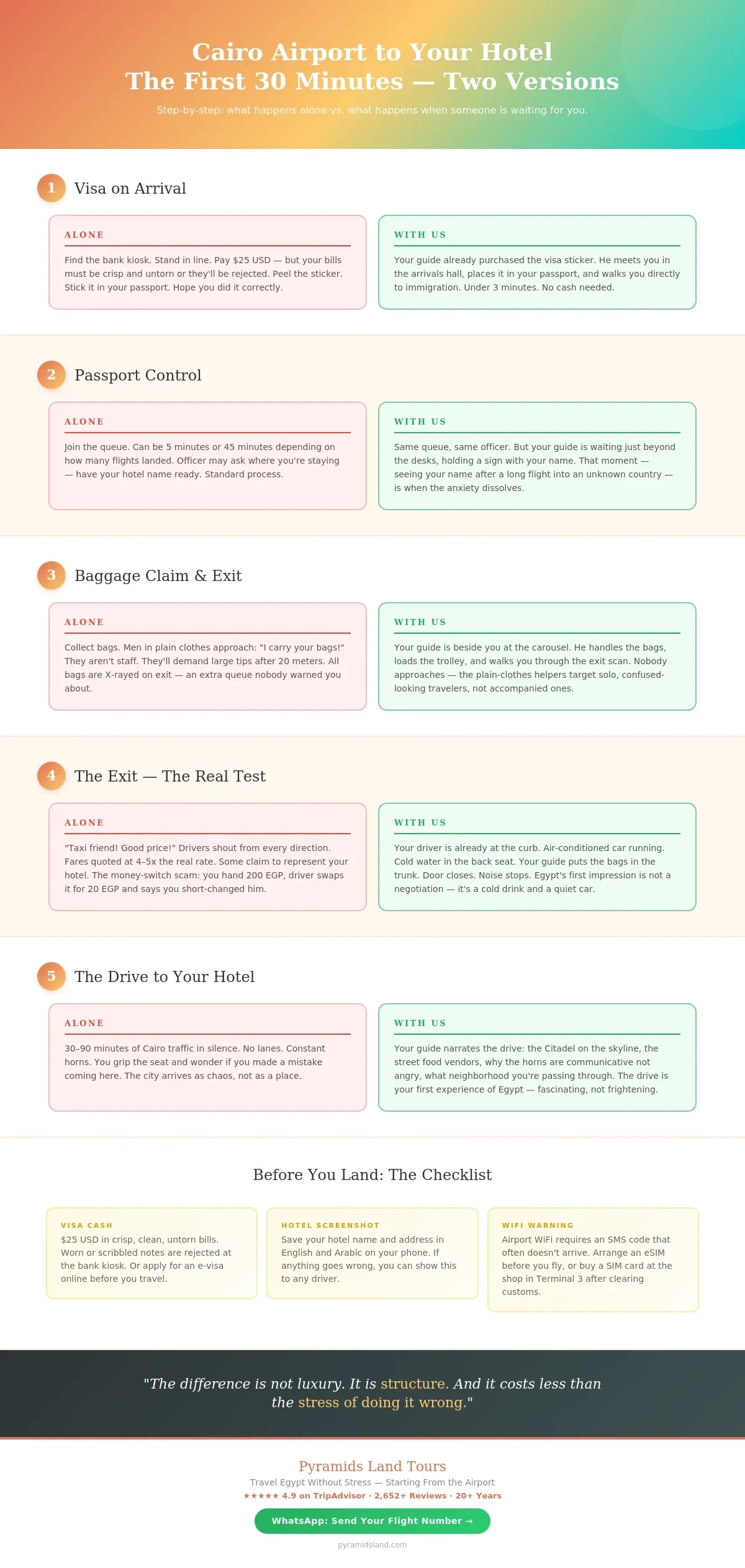
The Two Versions of Your First 30 Minutes
Without a transfer: You navigate the visa kiosk alone, stand in the passport line alone, defend your bags from unofficial helpers alone, walk into the taxi gauntlet alone, negotiate a price you have no way of evaluating alone, and ride through Cairo traffic in silence, gripping the seat, wondering if you made a mistake coming here.
With us: Your guide meets you before passport control. Your visa is ready. Your car is at the curb. Your bags are in the trunk. Your first experience of Cairo is narrated, explained, and fascinating. You arrive at your hotel rested, oriented, and ready for tomorrow.
The difference is not luxury. It is structured. And it costs less than the stress of doing it wrong.
Your Transfer Starts Before You Land
Send us your flight number, your arrival date, and which terminal you are landing at. We will confirm your guide's name, his phone number, and exactly where he will be standing when you step out of the arrivals hall.
WhatsApp: +20 122 362 4703 — Send Your Flight Details →
Or if you are in the US: +1 (928) 923-2598
About Pyramids Land Tours
Cairo-based. Egyptian-owned. 25+ years meeting travelers at Cairo International Airport and turning the most stressful 30 minutes of their trip into the first chapter of the story. Every tour is private, led by a licensed Egyptologist, and starts the moment you land.
★★★★★ 4.9 on TripAdvisor · 2,700+ Reviews · pyramidsland.com
Ashraf Fares