
Hot Air Balloon Over Luxor: What to Know Before You Book
At 5:15 AM, the West Bank of the Nile is dark. Your motorboat crosses the river in silence. On the far shore, a field of deflated balloons lies spread across the ground, crews working by headlamp to inflate them. Then the burners ignite — one by one — and the fabric begins to rise.
Not five. Not ten. On a busy morning, fifty or more balloons fill simultaneously — each one lit from inside like an enormous lantern against the pre-dawn sky. The entire West Bank becomes a field of glowing color rising slowly into the dark. No photograph you have seen has captured the scale of this. It is the single most visually extraordinary moment in Egyptian tourism.
It is also one of the most misunderstood — surrounded by inflated pricing, safety anxiety, scam operators, and logistics that most travel blogs gloss over with a "totally worth it!"
We are Pyramids Land Tours. We integrate balloon flights into our Luxor itineraries multiple times a month. We know which operators to trust, which to avoid, what the experience actually delivers, and what can go wrong. Here is the honest guide.
What You Actually See
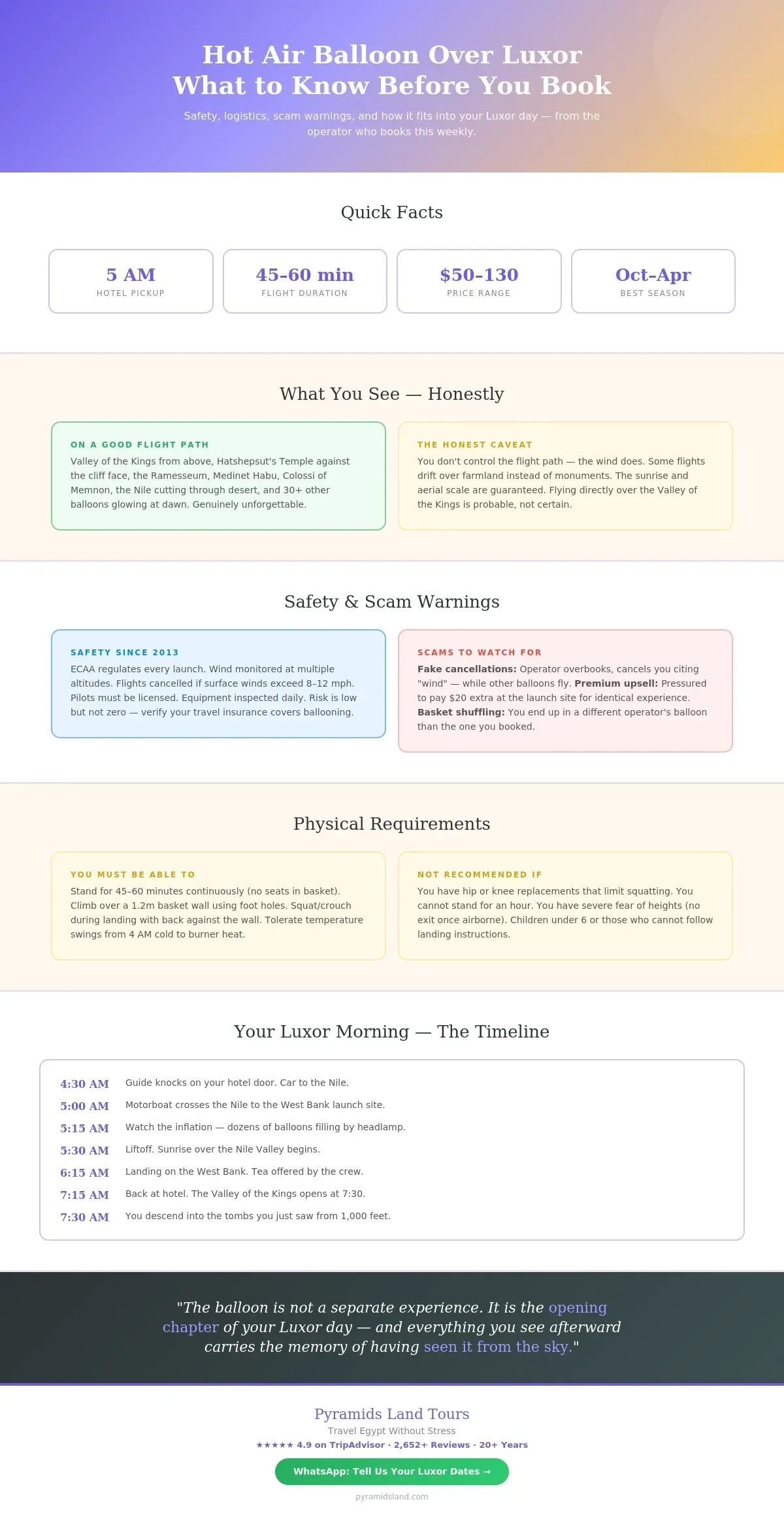
The balloon lifts off from the West Bank just before sunrise. Over the next 45 to 60 minutes — depending on wind conditions — you drift across the landscape at altitudes between 300 and 1,500 feet.
Below you: the Nile, the green ribbon of farmland along its banks, the desert beginning abruptly at the edge of cultivation, and scattered across the terrain — the temples and tombs that make Luxor the largest open-air museum on earth. On a good flight path, you pass directly over or alongside the Valley of the Kings, Hatshepsut's Temple at Deir el-Bahari, the Ramesseum, Medinet Habu, and the Colossi of Memnon.
The honest caveat: You do not control the flight path. The pilot navigates by adjusting altitude to catch different wind currents, but the exact route depends on the morning's conditions. Some flights drift directly over the Valley of the Kings at 500 feet in perfect still air. Others stay over farmland and the Nile. One TripAdvisor reviewer reported seeing farmland only, while other balloons that same morning flew over the major sites. This is the nature of ballooning — the wind decides.
Some mornings are transcendent. Some mornings are pleasant but unremarkable. You cannot book the transcendent version — you can only put yourself in a position where it is possible.
What is guaranteed regardless of path: the sunrise over the Nile Valley, the scale of the landscape visible only from altitude, and the sight of dozens of other balloons glowing against the dawn sky. Even on a flight that does not pass directly over the major monuments, the experience is extraordinary. But if you are booking specifically to photograph the Valley of the Kings from above, understand that this is probable, not certain.
Why We Schedule It First — Not Last
This is the section that changes how you think about the balloon.
Most travelers treat the balloon as a standalone bucket-list item — an activity you check off independently from the rest of your Luxor experience. We treat it as the opening chapter of your Luxor day, and the difference matters.
What happened on your trip: Your guide knocked on your hotel door at 4:30 AM. You were groggy and briefly wondered why you agreed to this. By 4:45, you were in the car. By 5:00, you were on the motorboat, crossing the Nile in the dark. On the far shore, a convoy of minivans was waiting — this part is chaotic, and your guide had warned you the night before: a dozen vehicles racing through dark village roads to reach the launch field. It lasts five minutes. It is jarring. Then it is over, and you are standing in a field watching fifty balloons inflate.
By 5:30, you were airborne, and the regret had been replaced by something you could not name — not excitement exactly, but a quiet awe at the scale of what was below you.
The Nile, green on both sides, cuts through the desert that stretches to every horizon. The tiny rectangles of tombs in the Valley of the Kings. Hatshepsut's Temple, a white line against the cliff face. And beside you and behind you and in front of you, thirty other balloons, each carrying their own basket of people having the same thought you were having: this is real.
You landed at 6:20 AM in a field on the West Bank. The crew offered tea. You tipped the ground crew 50-100 EGP — they had been chasing the balloon in a truck and were now packing the envelope in the heat. You were back at your hotel by 7:15.
And then — and this is the part that makes the balloon worth scheduling first — you went to the Valley of the Kings at 7:30 AM. You descended into the tombs you had just seen from 1,000 feet. The aerial perspective gave the ground-level visit a dimension it would not otherwise have had. You understood the geography — where the valley sits in relation to the river, how the ancient builders chose this location, and why the tombs face the way they do.
"The balloon changed how I saw everything afterward. Standing inside the Valley of the Kings, I kept thinking — I was just above this. I could see the whole layout. It made the tombs feel like they belonged to a plan, not just a list of stops." — Caroline D., Lyon, France
The balloon is not a separate experience. It is the opening chapter of your Luxor day. We schedule it first, specifically so that everything you see afterward carries the memory of having seen it from the sky.
Safety: The Honest Assessment
The 2013 Luxor balloon crash killed 19 people. It remains the deadliest hot air balloon accident in history. That event is the reason safety dominates every conversation about this experience, and it should.
Since 2013, Egypt's Civil Aviation Authority has imposed significantly stricter regulations. Every morning before dawn, ECAA officials monitor wind speeds at multiple altitudes. If surface winds exceed 8 to 12 mph, or if upper-altitude winds exceed 20 to 25 knots, flights are canceled for the entire morning. Pilots must hold a specific license. Equipment inspection is required before every flight. Airport permission must be granted daily.
Our honest position: Ballooning anywhere in the world carries inherent risk. You are in a wicker basket suspended beneath a fabric envelope heated by an open flame. There is no steering mechanism — only altitude control. Accidents, while rare since 2013, have occurred, including injuries from hard landings and a temporary ban in 2022 after two passengers were hurt.
We do not tell our travelers, "It is completely safe." We tell them: the risk is low, the regulations have improved substantially, and thousands of passengers fly safely every month. But it is a decision each person should make with clear information, not reassurance.
There is also an inverse risk the article needs to name: some operators fly when they should not. A TripAdvisor forum post describes a reputable operator canceling for safety reasons while three balloons from a cheaper company flew that same morning — "drifting really badly." The cheapest flight on a windy morning might be the one that should not be in the air at all. This is the strongest argument for booking through an operator who vets the balloon company, not just the price.
Check your travel insurance. Some policies classify hot air ballooning as a "risky activity" and exclude coverage. Verify this before you fly. If your policy does not cover it, consider purchasing supplementary adventure sports coverage.
Which Operators to Trust — and Which to Avoid
There are over a dozen balloon operators in Luxor. Quality varies enormously. The cheapest options are often the most problematic — not because every budget operator is dangerous, but because cost-cutting tends to show up in crew experience, equipment maintenance, and customer handling.
The operators we recommend have been flying for 15 to 25 years, have documented safety records, maintain their equipment to international standards, and communicate clearly before, during, and after the experience. Hod Hod Soliman (established 1993) and Sindbad Balloons are consistently the highest-rated across TripAdvisor, Viator, and GetYourGuide — with thousands of reviews each.
The scams to watch for:
Fake weather cancellations. Some operators overbook, then cancel your flight, claiming "high winds" — while other companies fly that same morning without issue. One TripAdvisor reviewer wrote: "They cited high winds and safety as the reason, but they actually just booked too many people for that morning. Several other guests from my hotel who booked with other companies were able to go ahead without any problems." If your operator cancels but you can still see balloons in the sky, you were not canceled due to weather. You were canceled because they sold too many tickets.
The premium upsell. You arrive at the launch site and are pressured to pay extra for a "premium" experience that is identical to the standard flight. A recent reviewer described being repeatedly asked to upgrade the night before — and when they refused, their booking was canceled and reassigned to a group willing to pay more. If you refuse, some operators threaten to cancel your booking entirely.
Basket shuffling. Regardless of which company you book with, groups are sometimes shuffled at the launch site. You may end up in a different operator's basket than the one you paid for. Reputable companies do not do this. Budget operators frequently do.
When your guide books the balloon as part of your Pyramids Land itinerary, these problems disappear. We book directly with vetted operators, confirm your specific flight the evening before, and your guide accompanies you to the launch site. If something goes wrong — a weather cancellation, a scheduling conflict — your guide resolves it on the ground in Arabic before it becomes your problem.
What Happens if Your Flight Is Canceled
This deserves its own section because it is the #1 source of frustration in every balloon forum thread.
Legitimate weather cancellations happen — sometimes for multiple consecutive days during windy periods, particularly in spring (March-April) when khamsin winds blow from the desert. When the ECAA cancels flights, no operator flies. This is not a scam — this is safety. You should expect a full refund or a free reschedule for the following morning.
Fake cancellations (overbooking disguised as weather) are a different matter. Demand a full refund immediately. Do not accept a partial refund. Do not accept vague promises of rescheduling "later this week." A reputable operator will refund the full amount the same day.
If your guide booked the balloon: Your guide will know within minutes whether the cancellation is real (all balloons grounded) or fake (other balloons flying). If it is real, your guide adjusts the morning — you go directly to the Valley of the Kings early instead, and the balloon is rescheduled for the following morning if your itinerary allows. If it is fake, your guide escalates with the operator in Arabic and secures your flight or your refund. You do not lose a morning either way.
The Physical Requirements Nobody Mentions
You must be able to:
Stand for 45 to 60 minutes continuously. There are no seats inside the basket. You stand for the entire flight, leaning against the padded basket wall. If standing for an hour is difficult for you, this experience will be physically challenging rather than enjoyable.
Board and exit a motorboat in the dark. The Nile crossing happens before dawn in a small motorboat. You step down into the boat from the dock and climb out on the far shore. For anyone with balance issues or mobility concerns, this is the first physical barrier — and one the article almost never mentions. Your guide and the boat crew will assist, but the movement is yours.
Climb into and out of the basket. The basket wall is approximately 1.2 meters high. You step into foot holes and swing your leg over the edge. There is no door. Crew members assist, but the physical movement is yours. For anyone with hip or knee replacements, this is often the limiting factor.
Adopt the landing position. Before landing, the pilot instructs all passengers to crouch down with their backs against the basket wall, holding the rope handles. This squat position absorbs the impact of landing. Landings range from gentle touchdowns to bumpy drag-and-stops across farmland — the basket may tip, scrape, and drag for several meters before coming to rest. One forum poster described landing "in a field on the edge of town between buildings and full of crops that had sharp needles — big mistake to wear shorts that morning." The squat position exists because rough landings are the norm, not the exception. If you cannot squat or crouch, discuss this with your operator in advance.
Tolerate significant temperature swings. The pickup at 4 AM in winter can be 8-12°C. The motorboat crossing adds wind chill. Once airborne, the burner directly above you pushes temperatures past 100°C at the envelope opening — you feel waves of heat from above while cold air surrounds you at altitude. Dress in removable layers: a warm jacket over a t-shirt is the proven combination.
There is no age restriction for children over 6, but they must be tall enough to see over the basket wall and able to follow the landing instructions independently. For seniors, assess honestly whether the standing, climbing, boarding a boat, and crouching requirements match your physical reality.
Getting the Best Photographs
The golden light window lasts approximately 15-20 minutes from first light to full sunrise. After that, the light flattens and the magic shifts from visual to experiential.
Have your camera ready before liftoff. The inflation and early ascent — balloons glowing from inside against a dark sky — produce the most dramatic images. If you are still fumbling with your phone settings during liftoff, you will miss them.
Look down, not across. Every first-timer photographs the other balloons. The images that last are the ones pointing straight down — the patchwork of farmland, the desert edge, the temple outlines, the shadow of your own balloon on the ground below.
Shoot through the burner flame. When the pilot fires the burner, the blast of flame frames whatever is behind it — other balloons, the sunrise, the landscape. Hold your camera just below the burner opening and shoot upward through the fire. This produces dramatic images that look professional with no skill required.
Phone cameras struggle with contrast. The interior of the basket is dark. The sky is bright. Your phone's auto-exposure will fight between the two. Tap on the sky or the landscape to lock exposure there — the basket will go dark, but the scene you came to photograph will be properly exposed.
Request an edge compartment. Standard balloons have 16-24 passengers divided into 4-6 compartments. Edge compartments have unobstructed views on one or two sides. Center compartments are surrounded by other passengers. If you arrive early or ask politely, you can often be placed in an edge position. Your guide can request this when confirming the booking.
The Practical Details
When: Every morning at sunrise, year-round. Best conditions: October through April (stable winds, comfortable temperatures). Summer flights are possible but less reliable due to thermal winds.
Pickup time: Varies by season and operator — anywhere from 3:15 AM to 4:45 AM. Summer sunrise is earlier, so pickup is earlier; winter sunrise is later. Your operator confirms the exact time the evening before. Do not panic if you are told 3:30 AM when you expected 4:30 — it means your flight is in a different season than the one in the blog post you read.
The journey to the launch site: Hotel pickup → drive to the Nile pier (typically near the Sofitel Winter Palace on the East Bank) → motorboat crossing (10 minutes) → minivan convoy to the launch field (5 minutes, chaotic but brief) → inflation and liftoff.
Duration: 45 to 60 minutes in the air. Total experience, including pickup, motorboat, inflation, flight, and return: approximately 3 hours.
Basket size: 16 to 24 passengers in most standard flights, divided into compartments. Private flights (your group only, typically 4-8 passengers) are available at a premium — roughly 2-3x the standard price.
Price: $50 to $130 per person through reputable operators, depending on the season, booking platform, and whether you book a standard or private tour. Prices booked locally in Luxor are typically lower than on international platforms like Viator or GetYourGuide. When booked as part of your Pyramids Land itinerary, we secure the best available rate with a vetted operator.
What to wear: Layers — warm jacket over a light top for the 8°C-to-burner swing. Sneakers or closed shoes, not sandals (landing fields can be rough, thorny, or muddy). Long trousers for climbing into the basket and protecting your legs during landing. Sunglasses for after sunrise. A hat if you burn easily — once the sun is up, there is no shade in the basket.
What to bring: Fully charged phone or camera. The sunrise light lasts about 20 minutes — have your camera ready before liftoff, not after. A small bag or pocket to secure your phone during the landing crouch — you do not want it in your hand when the basket tips.
After landing: The ground crew will assist you out of the basket. They have been chasing the balloon in a truck and are now packing the enormous envelope in the heat. A tip of 50-100 EGP for the ground crew is customary and appreciated. Some operators provide a flight certificate as a souvenir — a nice keepsake that some travelers frame.
Is It Worth It?
Multiple travelers on TripAdvisor and other review platforms describe the Luxor balloon as the single highlight of their entire trip to Egypt. One reviewer wrote that it surpassed the Pyramids, the temples, and everything else they saw. Another called it "absolutely breathtaking — an experience not to be missed." Others describe it as pleasant but unremarkable, usually when the wind pushed them over farmland rather than monuments.
The difference, consistently, is the flight path and the operator. A good flight over the monuments at sunrise is genuinely unforgettable. A mediocre flight over sugarcane fields with 24 people crammed in a basket while a discount operator cuts the flight short is forgettable.
Our job is to make sure you get the first version. We cannot control the wind. We can control which operator you fly with, which pilot is in your basket, and how the balloon experience integrates into the rest of your Luxor day so that even if the wind is ordinary, the day is not.
Book It as Part of Your Itinerary
The balloon is not a standalone booking. It is a chapter in your Luxor day — scheduled first, integrated with the sites you visit afterward, and handled by your guide from the 4:30 AM knock to the 7:15 AM return.
Tell us your Luxor dates, and we will build the balloon into your itinerary with a vetted operator, confirmed the evening before.
WhatsApp: +20 122 362 4703 — Tell Us Your Luxor Dates →
Or if you are in the US: +1 (928) 923-2598
About Pyramids Land Tours
Cairo-based. Egyptian-owned. 25+ years integrating the best experiences in Egypt into private itineraries — including the one that starts before dawn and ends with you understanding why the ancients chose this valley.
★★★★★ 4.9 on TripAdvisor · 2,700+ Reviews · pyramidsland.com

Ashraf Fares