
The Bennu Bird: Egypt's Phoenix and the Symbol of Rebirth
The short answer: The Bennu was ancient Egypt's sacred heron — a symbol of the sun, creation, and rebirth. It was believed to have flown over the waters of the beginning and set creation in motion, and it renewed itself endlessly like the rising sun. The Greek phoenix is widely regarded as deriving from it.
Long before the phoenix rose from its ashes in Greek and Roman tales, Egypt had its own bird of rebirth: the Bennu, a grey heron crowned with two long feathers. It did not burn and die to be reborn — the Egyptian version is quieter and, in a way, grander. The Bennu was the bird that started the world, and rose anew with the sun every single morning.
At a glance
Key Facts
- What it is: Egypt’s sacred heron (pronounced BEN-noo )
- Symbol of: the sun, creation, and rebirth
- Its name: from weben — “to rise,” “to shine”
- Its great moment: it landed on the benben, the first mound of creation, and gave the first cry
- The soul of a god: the ba of Ra, and bound to Osiris — sunrise and resurrection in one bird
- The phoenix: descends from the Bennu — but the fire and ashes are a later Greek and Roman addition
- Modern legacy: NASA named an asteroid Bennu, sampled by the OSIRIS-REx mission
- See its home: the obelisk of Senusret I at Heliopolis (Matariya), Cairo
What is the Bennu bird?
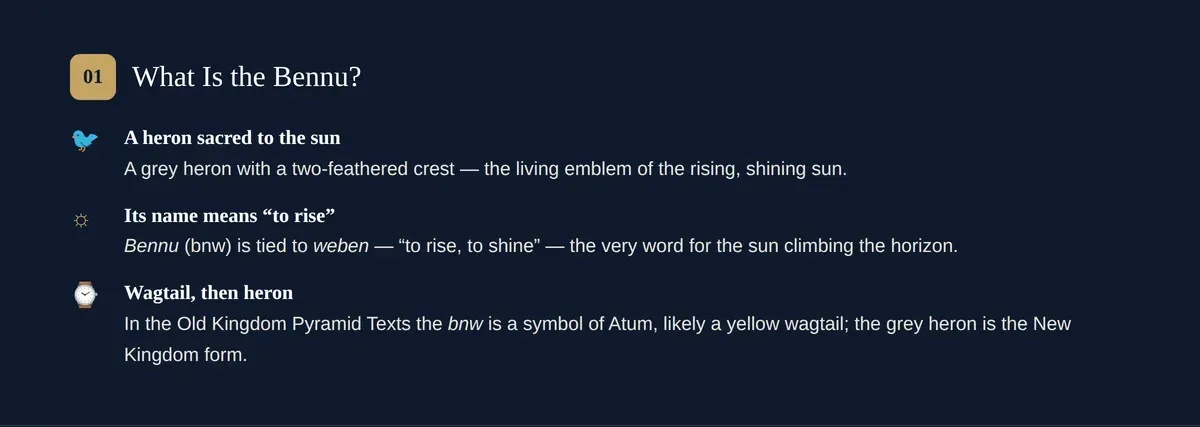
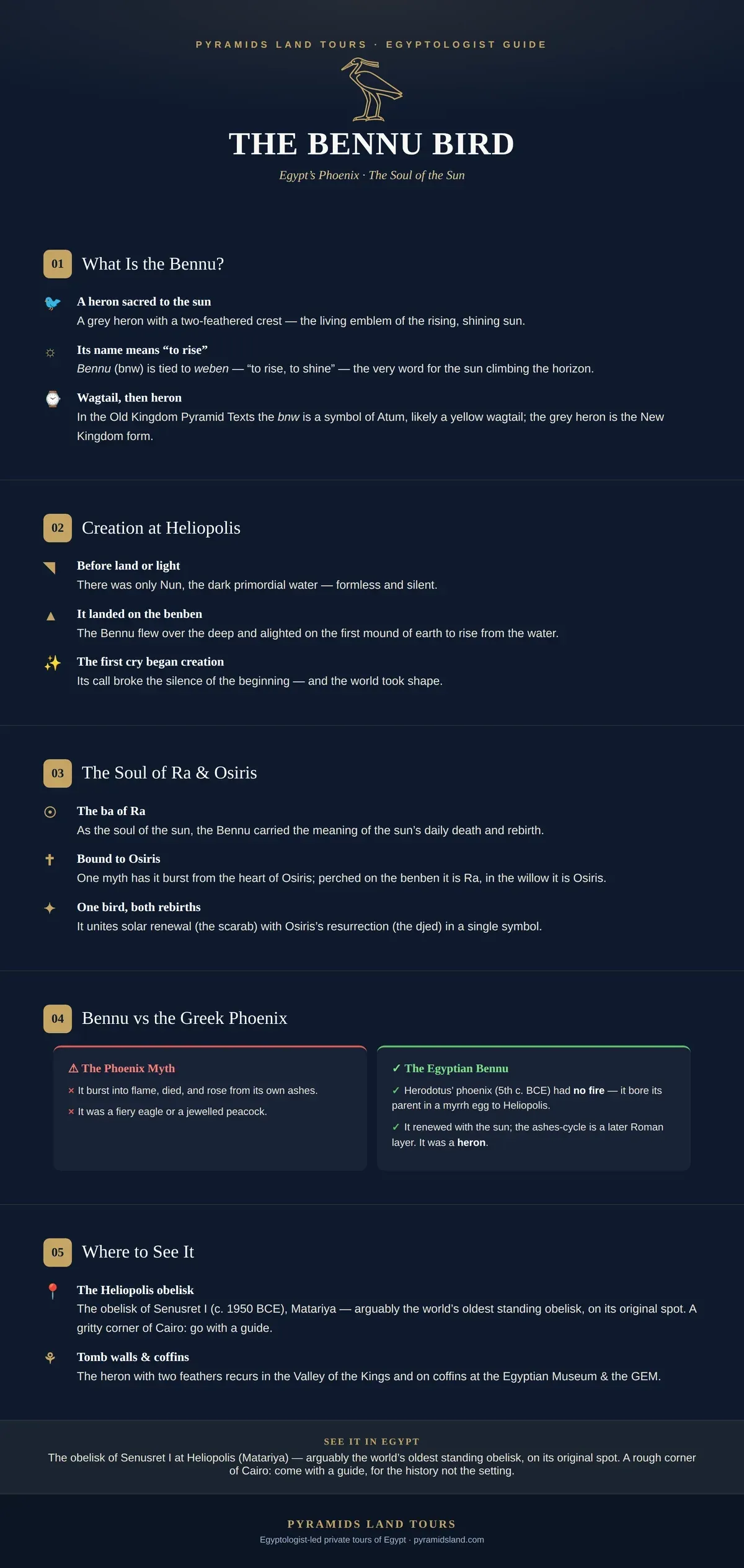
The Bennu (pronounced BEN-noo) was a heron, sacred to the sun and to the daily miracle of the sun's return. Its name, bennu (bnw), is linked to the verb weben — "to rise," "to shine" — the same word used for the sun climbing over the horizon. To the Egyptians, the connection was obvious: here was a tall, still bird that stood at the water's edge at dawn, and here was the sun rising behind it. The bird became the living emblem of rising, shining, and beginning again. The Egyptologist Barry Kemp has suggested the whole cluster of ideas may rest on a chain of wordplay: the sun rises (weben), throwing its light onto the benben stone, on which the bennu perches — three words, one dawn.
It is one of Egypt's older sacred symbols, tied to the sun cult of Heliopolis and to its creator god Atum (later Atum-Ra). The bird changed shape over time: in the Old Kingdom Pyramid Texts, the bnw is a symbol of Atum, and on the usual reading, it was first depicted as a small yellow wagtail — though that identification is an interpretation, not a settled fact. The tall grey heron we now think of as the Bennu is the New Kingdom form. In that later art it appears as a heron with a two-feathered crest, sometimes wearing the atef crown or the sun disk, and often perched on a mound or a sacred tree. Whether the wagtail of the Pyramid Texts and the heron of the New Kingdom were ever really understood as the same creature is still argued over — one of those places where the honest answer is that Egyptologists do not fully agree.
How to spot the Bennu in seconds
- A tall wading bird — long legs, long straight beak.
- Modeled on the grey heron.
- Two long feathers trailing from the back of the head.
- Often crowned with the atef crown of Osiris or a sun disk.
- Frequently shown perched on the benben stone or a sacred tree.
Is the Bennu bird a phoenix?
Yes — the Greek phoenix descends directly from the Bennu. When Greek writers encountered Egypt's sun-bird at Heliopolis, they matched it to their own myth of a fabulous bird of renewal, and the two merged in the Western imagination.
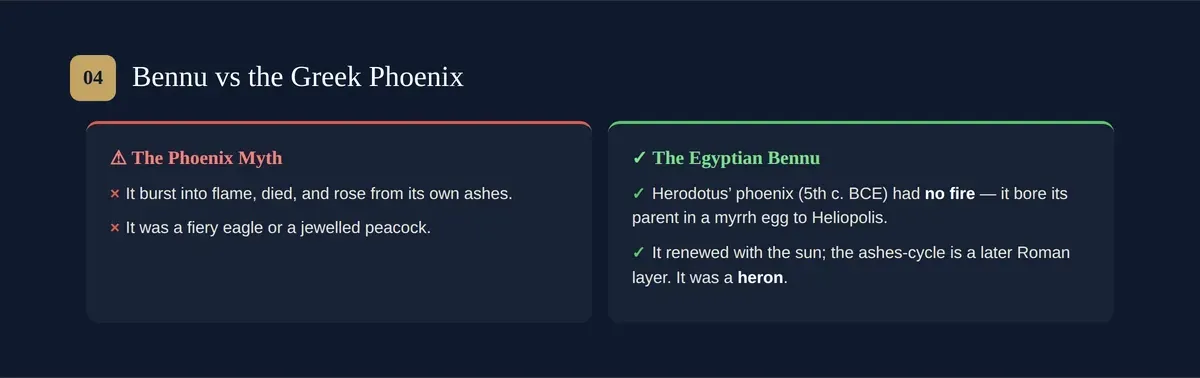
But here is the correction worth making, because it gets it backward everywhere: the famous self-cremation — the bird bursting into flame, dying, and rising from its own ashes — is a later layer, not the Egyptian original. The earliest Greek account, from Herodotus in the fifth century BCE, has no fire at all: his phoenix lived some 500 years and carried its dead parent, encased in an egg of myrrh, to Heliopolis for burial. The blazing death-and-ashes cycle only develops later, in Roman and late-antique retellings.
One honest nuance, since it trips people up: fire is not entirely absent from the Egyptian side — one tradition has the Bennu self-create from a flame on the sacred persea tree at Heliopolis. But that is a fire of creation, not the phoenix's cyclical fire of death and rebirth. A bird that makes itself is no accident here: it is Heliopolitan theology given feathers. In that city's doctrine, the creator Atum generated himself, alone on the primeval mound, needing no parents — and the Bennu carries the same idea in its own titles, "He Who Came Into Being by Himself" and "Lord of Jubilees." At heart, the Egyptian Bennu renewed the way the sun renews — rising fresh each dawn and marking the great cycles of time — a calmer idea than the pyre the Romans gave it.
At a glance
Bennu vs phoenix
| The Egyptian Bennu | The Greek & Roman phoenix | |
|---|---|---|
| The bird | A grey heron | An eagle-like bird of red and gold |
| How it renews | Rises fresh with the sun, each dawn | Burns on a pyre and rises from its ashes |
| Does it die? | No death in the Egyptian sources | Death by fire is the whole point |
| What it means | Creation, the sun, the soul reborn | The immortality of the individual |
| Where it lives | On the benben stone at Heliopolis | In Arabia, returning to Heliopolis to die |
The Bennu and the creation of the world
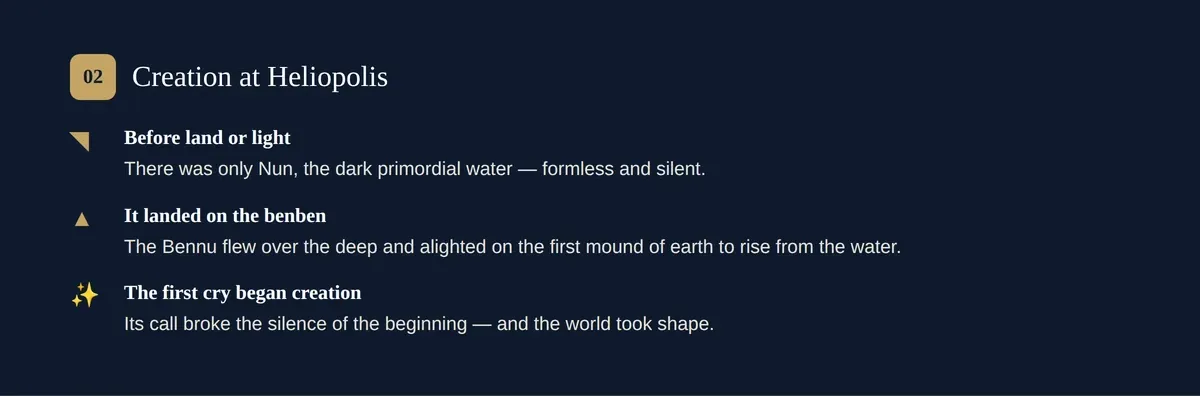
The Bennu's greatest role was at the very beginning. In the creation story told at Heliopolis, before there was land or light, there was only Nun, the dark primordial water. The Bennu flew over that formless deep and alighted on the benben — the first mound of earth to rise from the water, the primeval hill. There it gave the first cry, and that cry is said to have broken the silence of the beginning and set the shape of what would be created and what would not.
And the benben was not only a story. At Heliopolis it was a real object — an upright stone with a rounded top, kept in its own sanctuary, the hwt-benben, "the House of the Benben." It was the holiest thing the sun cult owned, and the Bennu was said to live on it (or in the branches of the sacred willow beside it). The original stone vanished long ago, but its shape did not: it is the ancestor of the pyramidion that caps every obelisk and pyramid in Egypt. Other sun-temples raised benben stones of their own, and centuries later Akhenaten built his open-air temple to the Aten around one. The Bennu, standing on it at the dawn of everything, was creation's first witness and its herald.
Why the Bennu means rebirth: the ba of Ra and Osiris
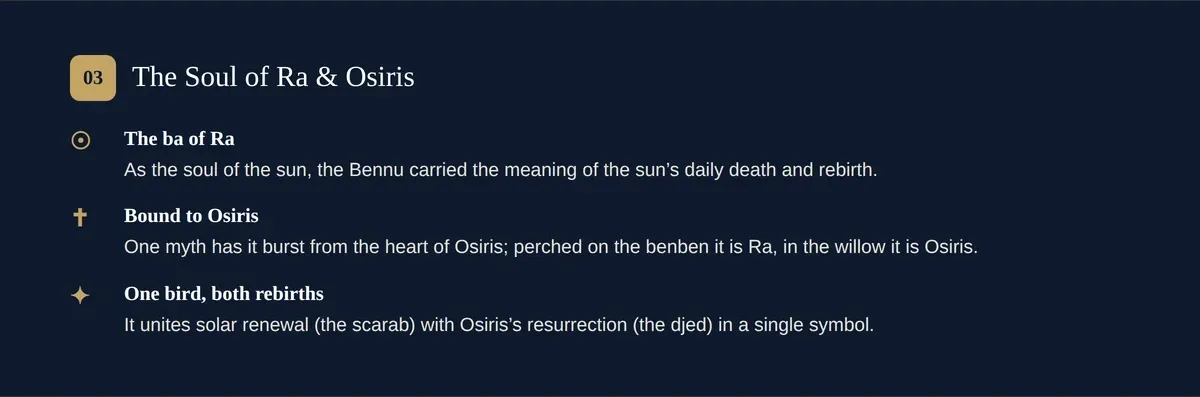
Here is the theological heart of it. The Bennu was understood as a ba — a soul — and specifically as the ba of Ra, the sun, so it carried all the meaning of the sun's daily death and rebirth. It was also bound to Osiris, god of the dead and resurrected: one myth has the Bennu bursting from the very heart of Osiris, and in art the bird perched on the benben stone stands for Ra while the bird in the willow tree stands for Osiris — which is why it can wear Osiris's atef crown. Solar rebirth and afterlife resurrection meet in one bird. The Egyptians even hung the bird in the sky: one funerary text has the deceased declare that he comes forth like the Bennu, the Morning Star of Ra — the planet we call Venus, the light that outshines the dawn and announces the sun.
That double link is why the Bennu sits so powerfully among the ancient Egyptian symbols of rebirth. It unites the two great engines of Egyptian renewal — the solar rebirth embodied in the scarab and the resurrection of Osiris embodied in the djed pillar — in a single bird. The Book of the Dead even offered the deceased a spell — Spell 83 — to take the form of the Bennu, becoming a creature of pure renewal to make the passage into the afterlife.
Myth-check
A few corrections worth having. The Bennu did not burn itself alive — as above, that is the Greek phoenix's addition, not the Egyptian bird's story. Nor was it, above all, the eagle or the jewel-coloured peacock the phoenix became in European art — the Egyptian Bennu was, first and foremost, a heron (though the odd Egyptian image does show it as a red-and-gold eagle or a wagtail). The real bird behind it may even have been a giant heron species, since named Ardea bennuides, that once lived around the Arabian Peninsula and later died out — the honest answer to the popular question of why the "Bennu heron" is gone.
And a modern footnote that delights people: when NASA needed a name for the near-Earth asteroid its OSIRIS-REx mission would sample and bring home, it chose Bennu. The fit is better than a pun. The mission's whole purpose was to bring back material left over from the birth of the solar system — dust older than the Earth, carrying the raw ingredients of worlds and possibly of life. So the samples that came home in 2023 are, quite literally, matter from the beginning of everything, in a capsule named after the bird that stood on the first mound and gave the first cry. Even the spacecraft's name nods to Osiris, the god of resurrection the Bennu was bound to. Egypt's bird of creation now has a rock from creation named after it.
Where to see the Bennu in Egypt
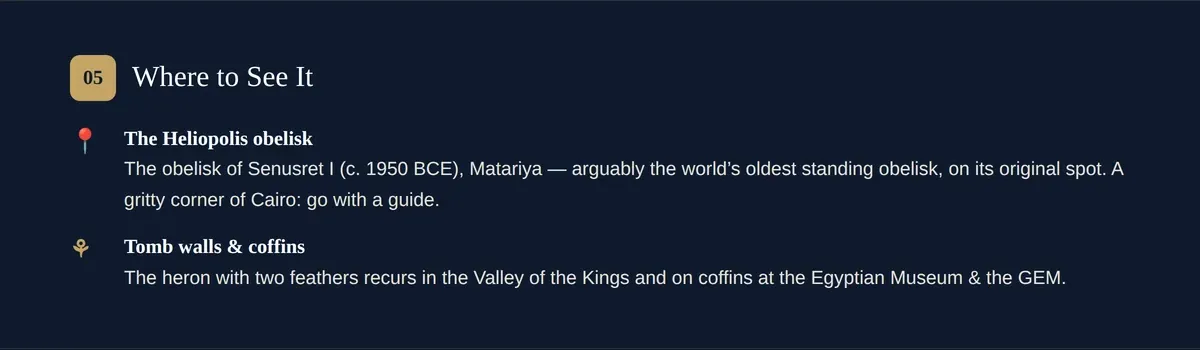
The Bennu is a symbol to hunt for rather than a single monument to visit, but its home has a surviving marker. The sun cult that raised it stood at Heliopolis, now the Cairo district of Matariya — and the obelisk of Senusret I (12th Dynasty, around 1950 BCE) still rises there on its original spot — the oldest obelisk in the world still standing where it was raised, and the last upright relic of the temple where the Bennu and the benben were worshipped.
Know what you are standing in, though. Three and a half thousand years ago this was Iunu — the Bible's On, the Greeks' Heliopolis, "the City of the Sun": the principal cult center of the sun god in all Egypt, where Atum was said to have begun creation and where the priests worked out the Ennead, the nine-god family at the root of Egypt's oldest theology. It was one of the greatest sanctuaries in the ancient world. Senusret's lone obelisk is the last upright splinter of it.
A candid word, because I would rather you hear it from me: this is one for the truly Egypt-obsessed, not a polished attraction. The obelisk stands in a crowded, run-down corner of Cairo, hemmed in by apartment blocks, and the immediate surroundings can be rough — worth going with a guide and driver rather than wandering in alone. Come for the thrill of standing beside 4,000-year-old granite where the sun-cult began, not for the setting.
For the bird itself, look to the painted walls of the royal tombs in the Valley of the Kings and to the coffins and papyri in the Egyptian Museum and the Grand Egyptian Museum, where the Bennu appears again and again as the emblem of the soul reborn. Once a guide points it out, the heron with its two feathers turns up everywhere the Egyptians thought about rising again.
And that is the quiet grandeur of this bird. Every sunrise over Egypt repeats its oldest promise: that an ending is never the whole story, and that the light always comes back.
Did you know?
- The Bennu is older than the phoenix — the Greeks met Egypt's sun-bird and remade it as their own.
- Herodotus's phoenix never burns. The fire and ashes are a later Roman invention.
- The Bennu's own titles were "He Who Came Into Being by Himself" and "Lord of Jubilees."
- NASA named an asteroid after it — a rock from the birth of the solar system, named for the bird of creation.
Frequently Asked Questions
What is the Bennu bird?
Ancient Egypt's sacred heron, a symbol of the sun, creation and rebirth. Its name, bennu, is linked to the verb weben, "to rise" or "to shine" — the same word used for the sun climbing over the horizon.
Is the Bennu the same as the phoenix?
The Greek phoenix descends directly from the Bennu, but the famous self-cremation — bursting into flame and rising from its ashes — is a later Greek and Roman addition. The earliest Greek account, from Herodotus, has no fire at all. The Egyptian Bennu renewed the way the sun renews: fresh each dawn.
Why does the Bennu symbolize rebirth?
It was understood as a ba (soul) — specifically the soul of Ra, the sun, and also bound to Osiris, god of resurrection. Solar rebirth and afterlife resurrection meet in one bird, which is why the Book of the Dead offered a spell (Spell 83) to take the Bennu's form.
What is the Bennu's role in creation?
In the Heliopolitan creation story, the Bennu flew over Nun, the primordial water, and landed on the benben, the first mound of earth to rise from the deep. Its first cry broke the silence of the beginning. That benben mound is the ancestor of the pyramidion that caps every obelisk and pyramid.
What kind of bird was the Bennu?
A heron — a grey heron in New Kingdom art, though the Old Kingdom pictured it as a small yellow wagtail. The real bird behind it may have been a now-extinct giant heron, since named Ardea bennuides, that once lived around the Arabian Peninsula.
Was the Bennu a real bird?
No — the Bennu was a deity, not a species. But it was clearly modelled on a real bird: the grey heron that stands motionless at the water's edge at dawn. Some scholars have gone further and suggested the inspiration was a now-extinct giant heron, since named Ardea bennuides — though that rests on very slight remains and is best treated as a possibility, not a fact.
Why is it called the Bennu?
Its name is linked to the Egyptian verb weben — "to rise," "to shine" — the same word used of the sun climbing the horizon. Barry Kemp has suggested the whole idea may rest on wordplay: the sun rises (weben) onto the benben stone, where the bennu perches.
Where can I see the Bennu in Egypt?
Its home survives as the obelisk of Senusret I at Heliopolis (now the Cairo district of Matariya) — the oldest standing obelisk in the world, though it sits in a rough, run-down neighbourhood best visited with a guide and driver, not alone. For the bird itself, look to the painted walls of the royal tombs in the Valley of the Kings and to the coffins and papyri in the Egyptian Museum and the Grand Egyptian Museum.
Title or Question
Describe the item or answer the question so that site visitors who are interested get more information. You can emphasize this text with bullets, italics or bold, and add links.
Want an Egyptologist to point out the Bennu on a tomb wall and tell you the whole creation story on the spot? Every Pyramids Land tour is private and guide-led, shaped around exactly what you want to see. Plan your private tour on WhatsApp →
Written and verified by Ashraf Fares, Egyptologist Guide & General Manager, Pyramids Land Tours.

Ashraf Fares