

Hurghada Travel Guide: What to Do, Where to Stay, and Whether It Belongs in Your Egypt Trip
***Edited March 26, 2026
Most people come to Egypt for the pharaohs, the temples, and the Nile. Hurghada is a different proposition entirely. Sitting on the western shore of the Red Sea, roughly 450 km southeast of Cairo, it is Egypt's largest and most accessible beach resort town — a place built for sun, sea, and marine life rather than ancient monuments.
Whether Hurghada belongs in your Egypt itinerary depends on what you want. If you need a few days of decompression after a week of temples, it delivers. If your time is limited and every day matters, you may want to spend those days elsewhere.
Here is what Hurghada actually offers, what it costs, and how to decide.
What Hurghada Is (and Is Not)
Hurghada is a resort town. It stretches over 40 km along the Red Sea coast, divided roughly into three zones:
El Dahar (Downtown)
is the older, more local part of town. Budget hotels, street food, fruit markets, and the main souk. It is the least polished area but also the most authentically Egyptian. If you want to eat where locals eat and pay local prices, this is where to go.
Sekalla
is the mid-range district. Wider streets, more tourist infrastructure, a mix of mid-tier hotels, coffee shops, and restaurants. The main marina is here.
El Mamsha (The Village Road / New Hurghada)
is the tourist promenade. This is where the all-inclusive resorts, high-end restaurants, and beachfront boardwalk live. Most international visitors spend their time here. It feels closer to Sharm El Sheikh or Antalya than to Cairo or Luxor.
Hurghada is not a cultural destination. There is no significant ancient site within the city. If you are looking for history, Luxor is 4–5 hours by road (or a 45-minute flight) away, and many visitors take a day trip to Luxor from Hurghada. 1 day in Luxor — though we generally recommend against trying to compress Luxor into a single day.
The Best Things to Do in Hurghada
Snorkeling and Diving
This is the primary reason people come. The Red Sea hosts some of the most biodiverse marine environments on earth — over 1,200 species of fish, 250 species of coral, and visibility that regularly exceeds 30 meters.
For snorkelers:
The best accessible reefs are at Giftun Island (a national park, reachable by boat in about 45 minutes), Mahmya Beach (a protected island with a more upmarket setup), and directly off the coast at some of the better resort house reefs. Entry fees for Giftun Island run around $25–35 USD including the boat trip.
For certified divers:
Hurghada offers everything from beginner reef dives to advanced wreck and drift diving. Key dive sites include the SS Thistlegorm (a World War II-era British cargo ship sunk in the Strait of Gubal — one of the top wreck dives in the world), Abu Nuhas (four wrecks on a single reef), and the Careless Reef wall. A two-dive day trip typically costs $60–100 USD, depending on the operator and location.
For non-swimmers:
Glass-bottom boats and semi-submarine tours offer a window into the reef without getting wet. The Sinbad Submarine operates a genuine submarine that descends 22 meters — one of only a handful of tourist submarines in the world. Tickets run $50–70 USD.
Desert Excursions
The Eastern Desert behind Hurghada is vast and dramatic — red mountains, dry wadis, and Bedouin settlements that feel a world away from the resort strip.
Quad bike safaris
are the most popular options: 1–2 hours riding through the desert with a stop at a Bedouin camp for tea and (optionally) a camel ride. Expect to pay $30–50 USD. Quality varies widely among operators — ask your hotel for a recommendation rather than booking through a beach tout.
Jeep safaris
cover more ground and reach more remote terrain, including wadi systems with acacia trees and occasional wildlife (ibex, desert foxes). Half-day trips run $50–80 USD per person.
Stargazing tours
are worth considering if you are in Hurghada during a new moon period. The Eastern Desert has minimal light pollution, and the night sky is genuinely spectacular.
Boat Trips and Island Beaches
Beyond snorkeling, boat trips to the Giftun Islands and Mahmya are popular as pure beach days — crystal water, white sand, and a bar. Full-day trips, including lunch and snorkeling equipment, cost $30–50 USD.
Orange Bay
is a newer, more upscale island beach option — better facilities, fewer crowds, higher price point (~$60–80 USD).
Old Town and the Marina
El Dahar's souk is smaller than Cairo's Khan El Khalili, but it is less touristy, and prices are lower. Look for spices, dried hibiscus (for karkade tea), leather goods, and alabaster.
The New Marina in Sekalla is pleasant for an evening walk — restaurants, cafes, and a view of the moored yachts. Food quality is mixed; the seafood restaurants closest to the water tend to be better.
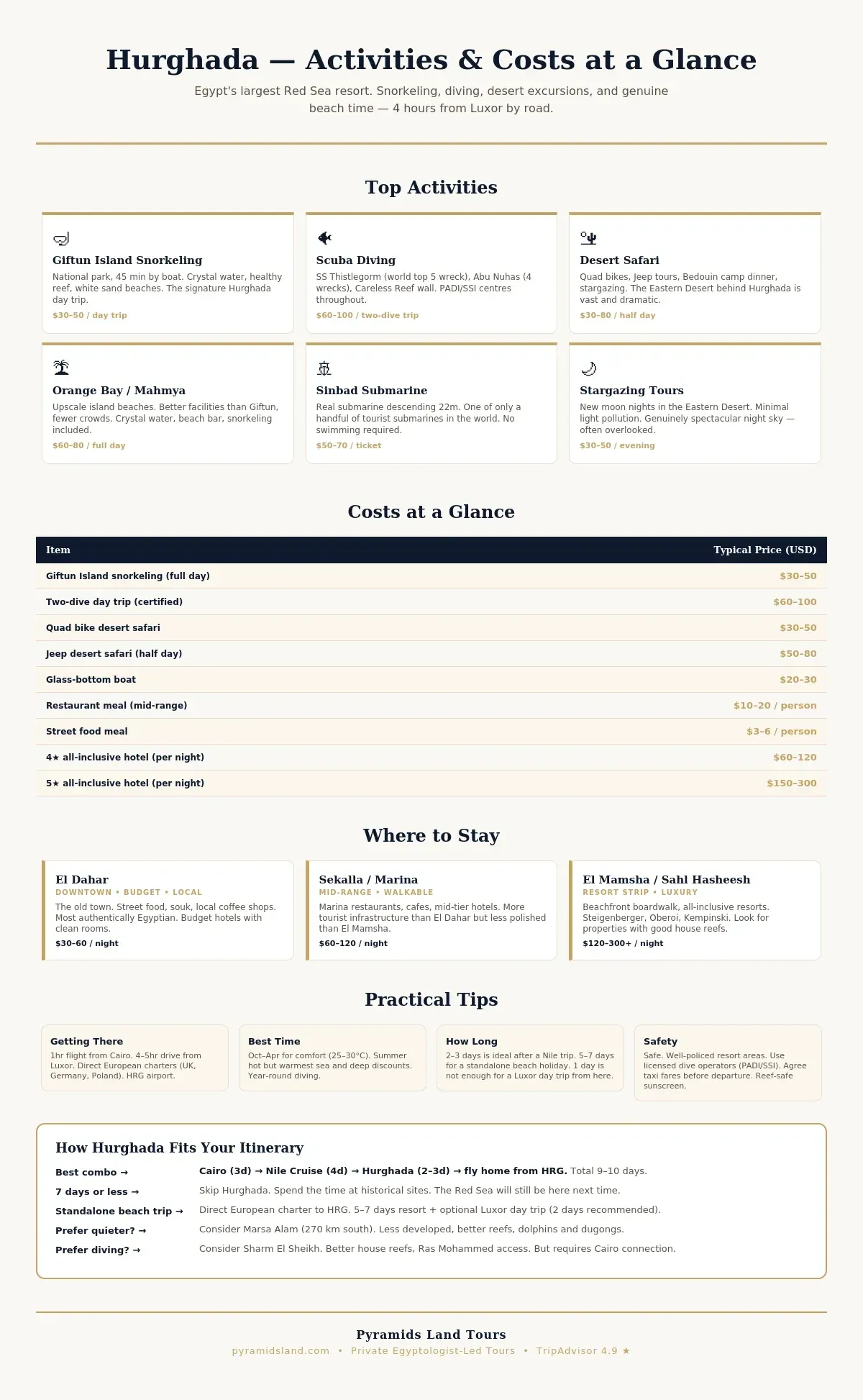
Where to Stay
Budget ($30–60/night)
El Dahar and Sekalla have solid budget options. Expect clean rooms, air conditioning, and rooftop or small pool areas, but limited beach access. Many budget hotels are a short taxi or tuk-tuk ride from the beach.
Mid-Range ($60–120/night)
Resorts with private beaches, pools, and half-board or all-inclusive options. The southern stretch of El Mamsha has the highest concentration. Look for properties with a good house reef if you plan to snorkel daily — it saves money and time compared to daily boat trips.
Luxury ($150–300+/night)
Steigenberger, Oberoi Sahl Hasheesh, Kempinski Soma Bay, and the Jaz and Premier Le Rêve properties anchor the luxury end. Soma Bay (30 minutes south of central Hurghada) and Sahl Hasheesh (20 minutes south) are quieter, more polished alternatives to the main Hurghada strip.
A practical note:
All-inclusive resorts dominate Hurghada. If you enjoy trying local restaurants and street food, avoid all-inclusive — you will overpay for food you do not eat at the resort. If you prefer to never think about meal logistics, all-inclusive works well.
Getting There and Away
From Cairo:
EgyptAir, Air Cairo, and Nile Air fly Cairo–Hurghada daily (1 hour, $50–100 USD one way). The road drive takes approximately 5–6 hours via the Red Sea highway — scenic but long.
From Luxor:
A 4–5 hour drive through the Eastern Desert. Some travelers add Hurghada as a final stop after completing a Luxor–Aswan Nile cruise, then fly home from Hurghada airport.
From Aswan:
About 5–6 hours by road. Less commonly done, but possible.
Hurghada International Airport (HRG)
receives direct charter flights from many European cities (London, Manchester, Berlin, Munich, Warsaw, and others), making it possible to fly directly to the Red Sea without transiting through Cairo.
How Hurghada Fits Into a Wider Egypt Itinerary
The most natural pairing is:
Cairo (3 days) → Luxor & Aswan via Nile Cruise (4 days) → Hurghada (2–3 days) → fly home from HRG
This gives you the historical core of Egypt, followed by genuine downtime at the beach. Total duration: 9–10 days.
Alternatively, budget-focused travelers on European charters sometimes fly into Hurghada, spend 5–7 days at a resort, and do a single-day trip to Luxor. This works if the beach is your priority, but a one-day Luxor trip is genuinely exhausting and barely scratches the surface. Luxor deserves at least two days.
For travelers with only 7 days in Egypt, we generally recommend skipping Hurghada to spend more time at the historical sites. You can always return to the Red Sea on a future trip.
Costs at a Glance
| Item | Typical Price (USD) |
|---|---|
| Giftun Island snorkeling day trip | $30–50 |
| Two-dive day trip (certified) | $60–100 |
| Sinbad Submarine | $50–70 |
| Quad bike desert safari | $30–50 |
| Jeep desert safari (half day) | $50–80 |
| Glass-bottom boat | $20–30 |
| Restaurant meal (mid-range) | $10–20 per person |
| Street food meal | $3–6 per person |
| Taxi within Hurghada | $3–8 |
Safety and Practical Notes
Hurghada is safe. It is one of Egypt's most heavily touristed cities, and the resort areas are well-policed and well-lit. Standard travel precautions apply: keep valuables secure at the beach, agree on taxi fares before departure, and avoid unlicensed excursion operators who approach you on the beach.
Water sports safety:
Choose diving operators affiliated with PADI or SSI. Check that the equipment looks maintained. Hurghada's dive scene is mature and well-regulated, but the cheapest operators sometimes cut corners on gear maintenance.
Sun exposure:
The Red Sea coast is hotter than people expect. Apply reef-safe sunscreen generously and reapply after swimming. Sunstroke is a genuine risk — not just discomfort — if you spend a full day on a boat without shade and hydration.
The Honest Answer: Is Hurghada Worth It?
If you love diving, snorkeling, or simply need a few days of sea and sun after an intensive week of temples, yes. Hurghada delivers exactly what it promises: warm water, abundant marine life, and a pace that feels nothing like the rest of Egypt.
If your time in Egypt is limited (7 days or fewer), the Red Sea is a trade-off. Every day at the beach is a day not spent at a site you cannot see anywhere else in the world. The Pyramids, the Valley of the Kings, and Abu Simbel have no equivalent. The Red Sea is extraordinary, but it will still be there next time.
Related Guides
- Red Sea & Hurghada Resort Guide
- How Many Days in Egypt?
- Egypt for First-Time Visitors
- Sinai Peninsula Guide
Hurghada Travel Packages
Ashraf Fares