Luxor One-Day Tour From Aswan By Car

A private experience shaped around your time and interests.


★ 4.9 · 2,678 reviews on TripAdvisor · Licensed since 2001 · Free Cancellation
8-Hour Private Tour of the Pyramids, Sphinx, Grand Egyptian Museum

12 hours

Moderate


Luxor Tour from Aswan

Enjoy a full day to Luxor from Aswan. Early in the morning you will meet our expert tour guided in the lobby of your hotel and start your drive to Luxor    (about 3 hours each way)  with Aswan day tours  where you enjoy exploring the Karnak Temple, Valley of the Kings, Temple of Hatshepsut and Colossi of Memnon.

Karnak Temple

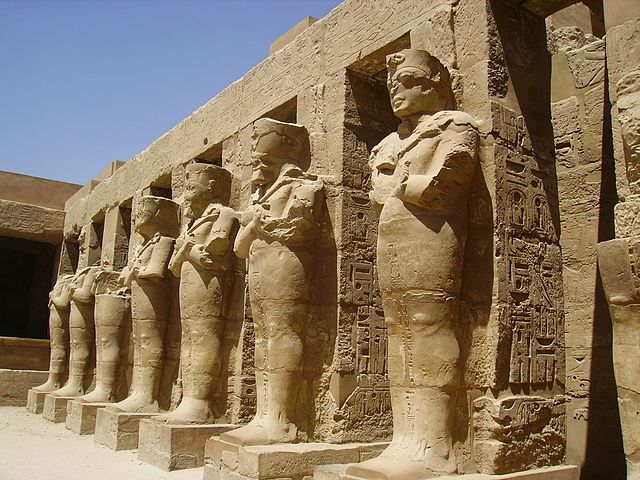
The Karnak Temple complex, one of the largest ancient religious sites in the world and the second most visited historical site in all of Egypt after the Giza Pyramids is a sight to behold. It's also one of the most remarkable places you'll ever see. Within its huge compound lies a vast mixture of ruined temples, chapels and other buildings from Egypt's distant past.

Luxor Temple

Situated on the eastern bank of the Nile river, Luxor Temple is one of the most beautiful temples in Egypt. It was built by Amenhotep III of the 18th Dynasty who ruled between 1390-53 BC . The temple was dedicated to Amun-Re, Ptah and Re-Horakhty, which are important deities in ancient Egyptian mythology. When Amenhotep III passed away, his successor Akhenaten abandoned it at first due to radical changes he introduced in Egyptian religion. However, after he died also , Tutankhamen came back to restore some old worships again. Finally Ramses II initiated a restoration process that continued during the rest of New Kingdom period . Nowadays its

Valley of the Kings

Valley of the Kings that still keeps the Pharaohs' tombs like: Ramses VI , Tutankhamun, Ramses IX and Ramses II . It is situated on the West Bank of the Nile. The length of the valley is about 64 km and its maximum width is 16 km. Most tombs were cut into the limestone cliffs as deep as 70 meters below ground level.

Some features of those tombs are still unknown for us , such as: two unopened royal tombs, which one belongs to Alexander The Great and another one to Queen Hatshepsut (one of the few female pharaohs in ancient Egypt). Also we don't know how their treasures look like because we didn't find them yet . However, many Tombs were raided over time by robbers who entered through cracks or holes found in the ceilings or upper walls where they had dug tunnels connected with small passageways

Temple of Hatshepsut

Temple of Hatshepsut in Luxor is a mortuary temple of this great female Pharaoh in Luxor. It was built by Senmout who served both Hatshepsut and her successor, Tuthmosis III . The temple is situated on a terrace overlooking the flood plain of the Nile River in western Thebes with an impressive view of the nearby town of Karnak and Luxor Temple  , which lies across the river from it.

Hatshepsut's Mortuary Temple originally was very small and it occupied only a small area at the back of the temple. The temple consisted of only one colonnaded structure that led into a walled forecourt. The colonnade had six square pillars which were decorated with beautiful carvings of Osiris figures while their architrave.

Colossi of Memnon

Colossi of Memnon are located on the West Bank of the Nile at Thebes near the Mortuary Temple of Amenhotep III . The two 80 ton statues (originally 24 tons) depict Amenhotep III as a seated brick figure wearing the striped nemes-headdress and their feet are damaged. They were said to have been cut from stone quarried at Aswan specifically for this purpose.

At the end of the tour you will be transferred back to your hotel.


What's included?

    Transfer services from your Aswan hotel and return

    All transfers are made by an air-conditioned private vehicle

    Mineral water is available onboard the vehicle during the tour

    Lunch at a local restaurant

    Luxor Shopping Tours

    All service charges and taxes

    Exclusions
      • Recommendations: Gratuities
      • Additional items not included in the itinerary
      Please note

        Pickup & Timing: Your guide contacts you the evening before your tour via WhatsApp to reconfirm the exact pickup time and your hotel details. Pickup is from the lobby of any hotel in Cairo or Giza (Luxor or Aswan for southern tours). If you're staying in an Airbnb or non-hotel accommodation, share your location pin when booking so your driver can find you easily.

        What You'll Pay On-Site: All entry fees listed in the itinerary are included. If you choose optional upgrades during the tour — such as entering the Tutankhamun tomb, the Seti I tomb, or the Great Pyramid interior — these are paid on-site by credit or debit card. Your guide will advise whether each upgrade is worthwhile before you decide. Cash is no longer accepted at most major archaeological sites in Egypt.

        Weather & Sun Egypt is hot and dry for most of the year. From October to March, daytime temperatures in Cairo are comfortable (18–25°C / 65–77°F), but mornings can be cool. From April to September, expect 35–45°C (95–113°F) at open-air sites. The Giza Plateau, Valley of the Kings, and Karnak have almost no shade. Your guide schedules site visits to avoid the worst midday heat, but sun protection is essential regardless of season.

        Dress Code: Dress comfortably and modestly. At mosques (Al-Hussein, Al-Azhar, Alabaster Mosque), shoulders and knees must be covered — this applies to all genders. At archaeological sites, there is no dress code, but lightweight long sleeves protect against the sun better than sunscreen alone. Comfortable closed-toe shoes with grip are essential — sites involve walking on sand, uneven stone, and rough terrain.

        Photography: Photography is permitted at most outdoor archaeological sites. Inside tombs (Valley of the Kings), photography is generally prohibited unless you purchase a separate photography ticket. Inside the Grand Egyptian Museum, photography rules vary by gallery — your guide advises on the day. Drone photography at all archaeological sites requires permits that are extremely difficult to obtain. Do not fly a drone without confirmed authorization.

        Payments & Currency Egypt's currency is the Egyptian Pound (EGP). Most tourist-facing businesses accept credit/debit cards and USD. Your guide and driver accept tips in EGP, USD, or EUR. ATMs are widely available in Cairo, Luxor, and Aswan. Recommended tipping: $5–10 per person for your guide on a half-day tour, $10–15 on a full day. $3–5 for your driver.

        Health & Safety: Drink only bottled water (provided on your tour). Tap water in Egypt is not safe for tourists. Carry any personal medications you need — pharmacies are available but may not stock specific brands. Apply sunscreen before departure, not on-site — you'll be in the sun within minutes of arriving at most sites. Travel insurance is required for all tours and is not provided by Pyramids Land.

        Cultural Notes: Egyptians are genuinely welcoming. "Shukran" (thank you) and "Salaam alaikum" (peace be upon you) go a long way. At tourist sites, you may be approached by local vendors or people offering unsolicited help (leading you to a viewpoint, taking your photo). A polite "la, shukran" (no, thank you) works. Your guide manages these interactions so you don't have to.

        What to bring
          • Comfortable closed-toe shoes with grip (sand, uneven stone, rough terrain at all sites)
          • Hat with a brim — essential at Giza, Saqqara, Valley of the Kings, Karnak, and all open-air sites
          • Sunscreen (apply before departure — you'll be in the sun immediately on arrival)
          • Sunglasses
          • Camera or smartphone (charged — there are no charging points at sites)
          • A light scarf or shawl for mosque visits (shoulders and knees covered)
          • Small daypack for water, camera, and sun protection
          • Any personal medications you need during the day

          We provide bottled water throughout the tour. You do not need to bring your own.

          Explore the tours above. Read the details. Ask questions if needed. Book only when it feels right.

          How pricing works

          Prices are based on:

          • Group size
          • Duration
          • Inclusions listed on the tour page

          You will always know what is included before booking. There are no surprise additions.
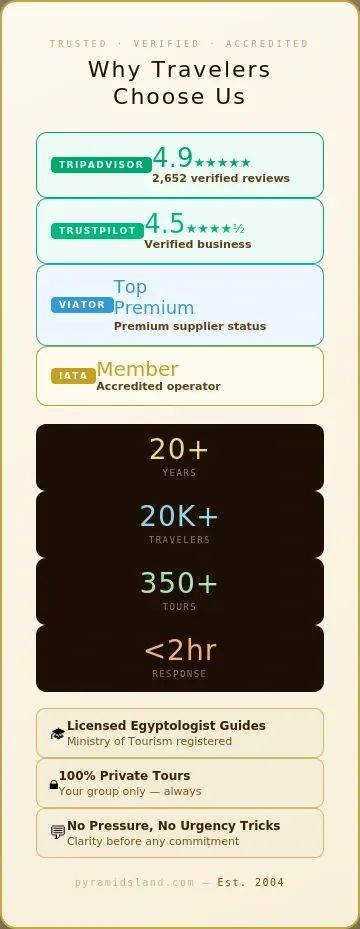
          Pyramids Land Tours trust signals — TripAdvisor 4.9 stars with 2,652 verified reviews, Trustpilot 4.5 Trusted Business

          What our clients say


          100 Ancient Egyptian Symbols and Their Meanings, Explained
          By Ashraf Fares August 3, 2026
          An Egyptologist's illustrated guide to 100 ancient Egyptian symbols and their meanings — protection, power, rebirth — and where to see each one in Egypt today.
          Gold ancient Egyptian Bennu bird on deep navy — Pyramids Land Tours.
          By Ashraf Fares August 2, 2026
          An Egyptologist explains the Bennu — Egypt's sacred heron: the creation myth, why the phoenix's fire is a Greek invention, and why NASA named an asteroid after it.
          Gold ancient Egyptian sistrum on deep navy — Pyramids Land Tours.
          By Ashraf Fares July 23, 2026
          An Egyptologist explains the sistrum — Hathor's sacred rattle: its two forms, the menat, why women played it, and the sound still heard in Coptic churches today.
          Ancient Egyptian gold uraeus cobra on deep navy — Pyramids Land Tours.
          By Ashraf Fares July 20, 2026
          An Egyptologist explains the uraeus — the rearing cobra on the pharaoh's crown: the goddess Wadjet, the Two Ladies, the Eye of Ra, and Tut's mask at the GEM.
          Pyramids skyline at dusk with gold sun — Egypt travel seasons guide
          By Ashraf Fares July 16, 2026
          The best time to visit Egypt is October–April; Feb–Mar and Oct–Nov are the sweet spots. Month-by-month weather, crowds & prices from a Cairo operator.
          Gold ancient Egyptian djed pillar on deep navy — Pyramids Land Tours.
          By Ashraf Fares July 13, 2026
          An Egyptologist explains the djed pillar: its meaning of stability, why it's the backbone of Osiris, the Raising of the Djed, and where to see it at Abydos.
          Gold ancient Egyptian crook and flail on deep navy — Pyramids Land Tours.
          By Ashraf Fares July 10, 2026
          An Egyptologist explains the crook and flail — the king as shepherd, why Osiris holds them, and where to see Tutankhamun's own pair at the GEM.
          Gold ancient Egyptian was scepter hieroglyph over a rising sun on a deep navy background
          By Ashraf Fares July 6, 2026
          An Egyptologist explains the was scepter — its meaning of power and dominion, the Set-animal head, the ankh-djed-was triad, and where to see it in Egypt.
          Gold ancient Egyptian cartouche name-ring hieroglyph over a rising sun on deep navy — Pyramids Land
          By Ashraf Fares July 4, 2026
          An Egyptologist explains the Egyptian cartouche: what it meant, the royal names inside, how it cracked hieroglyphs, and how to get your name in one.
          Gold ancient Egyptian scarab beetle hieroglyph over a rising sun on a deep navy background
          By Ashraf Fares July 2, 2026
          An Egyptologist explains the Egyptian scarab beetle — Khepri, the rising sun and rebirth, heart scarabs, and where to see the giant scarab at Karnak.
          Show More