
Egypt Rewards Structure More Than Any Country in the World
***Edited May 31, 2026
What Egypt Does That Nowhere Else Can
The moment I wait for with every single group — the one that still hits me the same after twenty years — is the second we step into the Great Hypostyle Hall at Karnak at 7:00 am, when the low morning light cuts through the clerestory windows, and suddenly those 134 columns become a stone forest. Everything goes quiet. People stop talking mid-sentence. You hear only footsteps and the occasional soft "oh my god." That collective intake of breath when the scale finally lands on them — that is the moment I live for. It never gets old.
Egypt does this to people. It is the only destination I know that routinely makes experienced travelers go quiet. Not because Egypt is the biggest or the oldest, though it is often both. Because it is the most present. The stones are still warm from the sun. The paintings in the tombs are still vivid. The columns still hold up the sky. Five thousand years have not dulled this place. They have deepened it.
This is what every article on this page is about. Not planning for its own sake — but planning as the means to an experience that changes how you think about human history, about beauty, about what people are capable of building. Egypt demands preparation because what it offers in return is worth preparing for.
Why Egypt Is Different
I have guided travelers through Egypt for more than twenty years. In that time, one observation has held without exception: the travelers who describe Egypt as the best trip of their life and those who describe it as overwhelming are not different kinds of people. They made different planning decisions.
Egypt IS challenging. It is hot, dense, loud, and socially unfamiliar to most Western travelers. Multiple experienced travelers describe Egypt as the most difficult AND the most amazing destination they have visited. Both are true. What determines which feeling dominates is the structure behind the trip.
In Luxor during summer, the temperature at the Valley of the Kings sits at 26–28°C when we arrive at 6:30 am. By 11:00 am, it is 38–40°C in the shade and feels closer to 44°C on the exposed paths between tombs. Cruise ship buses start rolling in between 8:45 and 10:00 am, with the real flood hitting around 9:30–10:30 am. That is why we depart from Luxor hotels at 5:00–5:30 am and arrive at the ticket office right at opening. By the time the bus wave arrives, we are finishing our second or third tomb.
Cairo to Luxor is 660 kilometers — the distance from London to Edinburgh. Within Cairo, from Giza to downtown, it can take 30 minutes or 90 minutes depending on traffic. At the Giza Pyramids, the Sphinx, Khan El Khalili, and every major site, visitors encounter more direct human interaction than in most destinations. When I walk through the Giza Plateau with travelers, vendors give a quick nod or "welcome" and move on. Without a guide, the same vendors swarm and the hard sell starts immediately — not because the vendors are hostile, but because the social signal that this person is accompanied changes the interaction entirely.
What Structure Actually Means
Structure means timing decisions — arriving at sites when the light, the temperature, and the crowds align in your favor. Karnak's clerestory light at its most magical between 7:00 and 8:30 am. The Giza panoramic viewpoint is quietest before 9 am and again from about 3:00–4:30 pm when the golden light returns. The Valley of the Kings before the cruise ship flood.
Structure means pacing — two to three major sites per day with rest windows between them. Early starts, early finishes. The afternoon free. Not because there is nothing to see, but because a rested traveler, at dinner, remembering what they saw at Karnak that morning, is worth more than an exhausted traveler checking off a fourth site they will not remember.
Structure means a guide who interprets, not just narrates. In Egypt, "Egyptologist guide" is a professional credential regulated by the Ministry of Tourism and Antiquities — a university degree and a government examination, not a marketing label. Structure means logistical coordination — entrance tickets, meal timing, vehicle positioning, backup plans. And structure means arrival planning, because the first 24 hours set the emotional baseline for everything that follows.
What Happens Without It
The pattern is predictable. Day one: excitement mixed with confusion. Day two: the micro-decisions compound — how much should this taxi cost, is this the right entrance, should I respond to this vendor? Day three: fatigue becomes defensiveness. Every vendor interaction is filtered through accumulated frustration. Day five: resentment or resignation. The sites that should have been extraordinary became items on an overwhelming list. The traveler blames Egypt. In most cases, the schedule was the problem.
If that day-five spiral is the trip you are trying to avoid, it is exactly what we plan against. Tell us your dates and your biggest concern → and we'll show you what the alternative looks like.
What Happens With It
You stood at the entrance to Karnak at 6:50 a.m. Mahmoud was already inside, checking something with the site manager. When you walked in, the hall was empty — just columns and light and silence. He waited until you had looked around for a full minute before saying anything. Then he began. The construction history. The clerestory engineering. The erased cartouches. The political rivalries are carved into stone. Ninety minutes later, you left Karnak understanding something about human ambition that you had never understood before. The cruise ship groups were arriving as you drove away.
By day three, you had found your rhythm. You stopped clutching bags tightly, started smiling back at vendors, and by day four, you were the one accepting tea invitations and chatting with shopkeepers. Egypt became warm rather than threatening — not because Egypt changed, but because your framework changed. The structure did not constrain you. It prepared you.
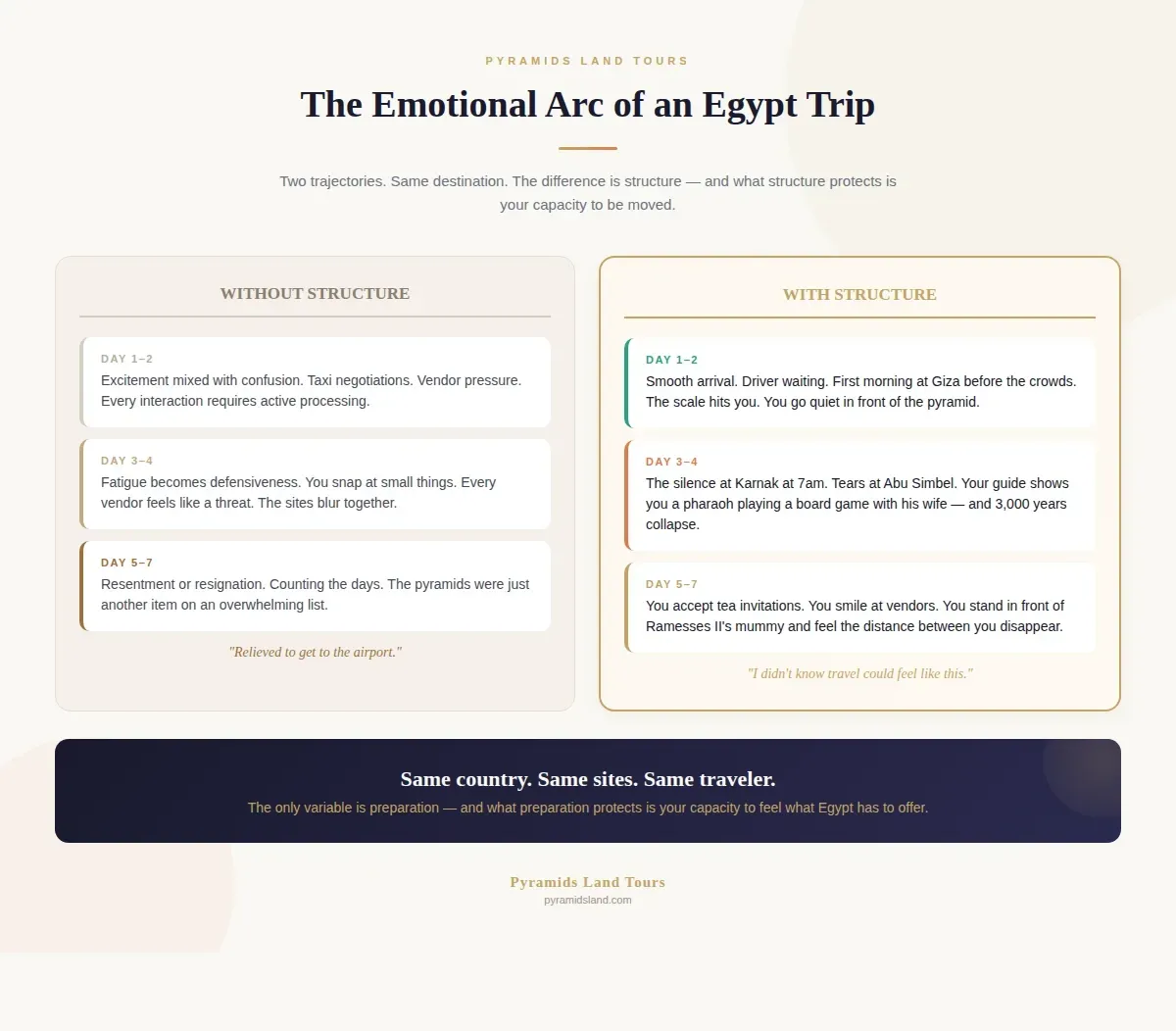
The structured day (top) holds its energy from the 7am pickup through to an evening that still has something left in it. The improvised day (bottom) starts with a taxi negotiation and burns out by mid-afternoon. Same sites, same city — different framework.
What Structure Protects
Egypt rewards structure more than any country I know. But I want to be precise about what "reward" means.
It does not mean a smooth itinerary. It does not mean air-conditioned comfort. It means standing inside a tomb that was sealed three thousand years ago and understanding — not just knowing, but feeling — that the person buried here believed they would live forever, and that the paintings on these walls were their map to eternity. It means watching the sun enter Abu Simbel's sanctuary and realizing that someone calculated this alignment thirty-two centuries before you were born. It means sitting on the Nile at dusk, hearing nothing but water, wind, and the call to prayer from a village minaret.
That is what structure protects. Not your schedule. Your capacity to be moved.
Egypt has been here for five thousand years. It will be here when you are ready. When you come, bring structure — because what Egypt offers in return is worth every hour of preparation.
Tell us your dates and your biggest concern, and we'll answer honestly — no obligation. Message us on WhatsApp and tell us your dates and your biggest concern →, or browse our Egypt tour packages.
Ashraf Fares