
The Hidden Cost of Cheap Egypt Tours
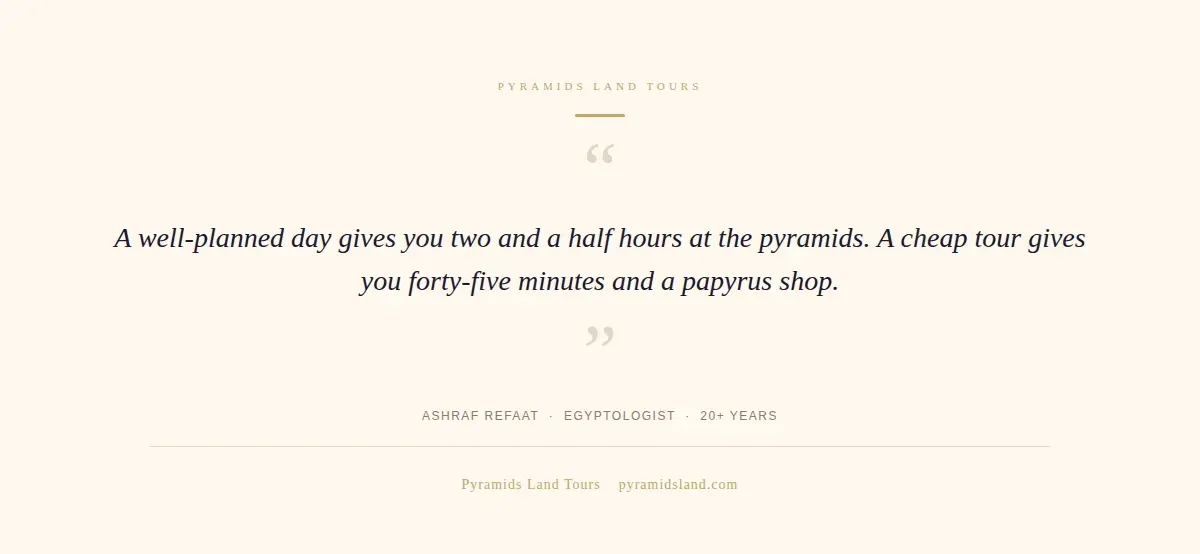
A well-planned day at the Giza Pyramids gives you this: two and a half hours walking the full complex in morning light, with a guide who explains the engineering, the mythology, and the politics behind each structure. You leave with an understanding of how and why these monuments exist — and with the memory of standing inside something that has stood for forty-six centuries.
A cheap group tour gives you this: forty-five minutes at the same pyramids, followed by thirty minutes at a papyrus shop.
The price difference between these two days is real. The experience difference is immeasurable.
A Disclosure Before We Begin
I have a financial interest in travelers choosing well-priced direct tours over cheap platform bookings. Pyramids Land Tours is a private tour operator. We charge more for our direct-booking tours than the cheapest platform options. This article explains why the cheapest options are cheap — and I benefit commercially if you find the argument persuasive.
I am telling you this because the operators who benefit from the commission-based model described below will never disclose how their economics work. And because I am about to tell you something about our own platform listings that most operators would never admit.
How Cheap Tours Make Their Money
The economics of a $45 full-day Cairo tour do not work on tour fees alone. A private vehicle, a licensed guide, fuel, entrance fees, and insurance cost more than $45 to provide. The gap is closed by commission from mandatory shopping stops — papyrus factories, perfume shops, alabaster workshops, jewelry stores — where the operator receives 20–40% of whatever you spend.
This is not speculation. It is the economic structure of budget tourism in Egypt, and it has been for decades. A TripAdvisor Destination Expert with over 28,000 posts on the Egypt forum has noted explicitly that there is no government requirement to visit an alabaster factory or papyrus museum — despite what some guides tell travelers. The tours that include these stops are designed to deliver you to retail environments where the operator earns a margin, not to maximize your time at historical sites.
Reviews of the Egypt Papyrus Institute on TripAdvisor describe the pattern clearly: a three-minute papyrus demonstration followed by a sales pitch, overpriced goods, and the understanding that the guide receives a percentage of your purchases. One reviewer wrote that the pictures they were told would "glow in the dark" did not glow when they got home. Another described being taken to a papyrus shop in Giza, then to a second papyrus shop in Luxor, by a different guide — the same commission structure operating at both ends of the country.
What You Actually Lose
The cost is not measured in money. It is measured in time, energy, and the quality of the experience you flew to Egypt for.
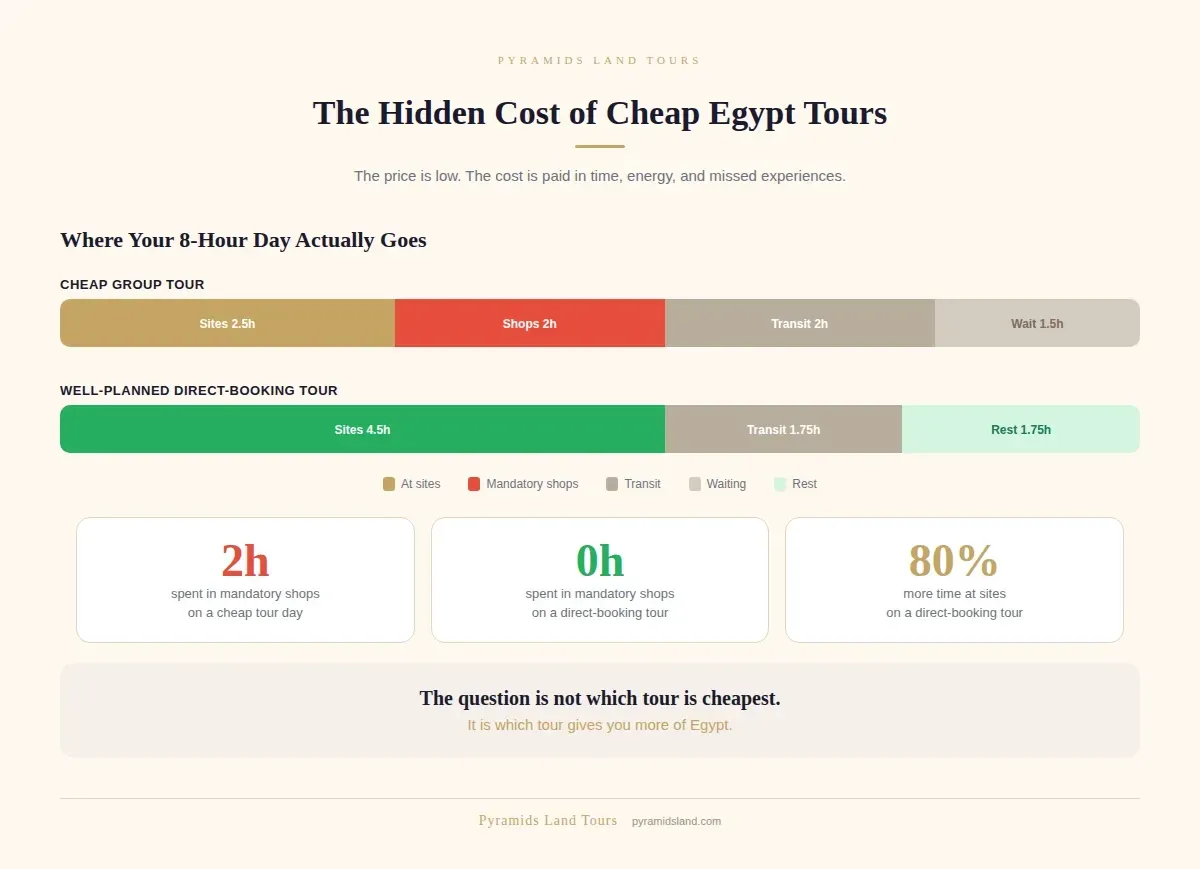
I have spoken with travelers who describe their "full day Cairo tour" schedule: forty-five minutes at the Giza Pyramids and Sphinx combined, thirty minutes at a papyrus shop, forty-five minutes at a perfume factory, one hour at the Egyptian Museum, thirty minutes at an alabaster shop, and lunch at a tourist-price restaurant where the operator receives a kickback. The sites received less than two hours of their eight-hour day. The shops received more than an hour.
On a well-planned day with no mandatory shopping, the same eight hours look entirely different: two and a half hours at the Giza Plateau with time to walk the full complex and enter a pyramid, a transition with a cold drink, two hours at the Grand Egyptian Museum with detailed guide interpretation, a genuine local lunch, and still time left for Khan El Khalili or rest. Four to five hours at sites, zero at mandatory shops.
The gap compounds across a multi-day trip. Three days of commission-heavy touring can consume four to six hours in shops — time that could have been spent inside Karnak when the light was right, or at the Valley of the Kings before the cruise ship buses arrived, or sitting on the Nile with nothing to do but watch the feluccas drift past.
Guide quality suffers too. On a commission-based tour, the guide's income depends partly on what you buy. This creates an incentive structure that is impossible to ignore regardless of how professional the individual. When Mahmoud takes you through the Giza Plateau on a direct-booking tour, his daily rate is fixed. He has no financial relationship with any shop. The advice he gives — where to stand for the best photograph, which pyramid interior is worth entering, how to avoid the camel operators — is clean. He is working for you, not for a shopkeeper.
Trust erodes gradually. When your tour includes mandatory shopping, every subsequent interaction feels transactional. The guide recommends a restaurant — is it genuine, or is it a kickback? The driver suggests a detour — is it interesting, or is it another shop? Trust collapses not because Egypt is untrustworthy, but because the economic structure of that specific tour was designed around commission. Multiple travelers in negative Egypt reviews describe this exact progression: one unexpected shop visit was tolerable, but by the third, they had mentally checked out of the entire experience.
Energy drains faster. Egypt is physically demanding. In Luxor during summer, the temperature at the Valley of the Kings swings from 26°C at dawn to 40°C by late morning — and feels closer to 44°C on the open paths between tombs. Every mandatory shopping stop drains energy that could have gone toward the experience you flew to Egypt for. You have a limited reservoir of physical and mental energy each day. Commission stops do not refill it. They deplete it — and they displace the site visits that would have made the day meaningful.
What I Am Going to Tell You That No Other Operator Will
Here is the part most operators will never say publicly.
When you book a Cairo day tour through a platform like Viator or TripAdvisor — including ours — the listed price is lower. The economics of tours on these platforms require shopping stops. The papyrus gallery, the perfume demonstration — they are part of the structure. This is true for virtually every operator selling day tours on these platforms in Egypt, including our Viator listings.
When you contact us directly — through WhatsApp or through our website — the economics change entirely. The price reflects the actual cost of a dedicated Egyptologist guide, a private vehicle, entrance fees, and meals. No commission stops. No papyrus factories. No perfumeries. Your time at sites is not compressed. The guide works on a fixed daily rate with zero financial relationship to any shop.
This is not a trick. It is two different products with two different economic structures. The platform version costs less and includes shops. The direct version costs more and includes only what you came to Egypt to see.
I am telling you this because the choice should be yours — and it should be an informed choice, not one made because you did not understand how the pricing worked.
What Well-Priced Direct Booking Actually Costs
For concrete context: a full-day private tour booked directly with Pyramids Land in Cairo — including an Egyptologist guide, a private vehicle, all entrance fees, and lunch — falls in the range of $180–$280 per person for two travelers sharing. A similar tour booked through Viator typically costs $45–$85 per person — but it includes shopping stops that cut into your time at historical sites.
A seven-day private package covering Cairo, Luxor, and Aswan — hotels, domestic flights, all guided tours, most meals — typically ranges from $1,450–$2,250 per person when booked directly, depending on hotel level and season.
The difference in price is real. What it buys: a dedicated guide who works for you, not for a shop. A vehicle that goes where you need, not where the operator earns commission. Realistic pacing — two to three sites per day, not five. Timing that puts you at the Valley of the Kings at the 6:00 am opening, before the cruise ship buses that arrive around 8:45 am. And zero mandatory shopping stops — because the price already covers the full cost of the experience.
You stood at the base of the Great Pyramid at 7:20 a.m. The plateau was quiet — the gate had opened twenty minutes ago, and the tour buses were still forty-five minutes away. Mahmoud was explaining how the limestone casing stones that once made the pyramid gleam white in the sun were stripped over centuries for Cairo's mosques and palaces. He answered your specific question about the internal chambers without checking a phone or reciting a script. A family walked past, looking frustrated, checking their watches, their group leader waving them toward the bus. Their forty-five minutes were up. Your morning had just begun.
That is the difference the price pays for. Not luxury. Time.
When Platform Tours Are the Right Choice
I am not going to pretend that direct-booking private tours are always the answer.
If your budget is genuinely constrained and the alternative is not visiting Egypt at all, a platform tour gets you to the sites. At forty-five minutes per site, Egypt is still Egypt. The pyramids are still extraordinary even with a compressed schedule. The shopping stops, while time-consuming, sometimes include genuinely interesting demonstrations — watching papyrus being made is a real craft process, even if the prices in the attached shop are inflated.
If you are a repeat visitor who has already seen the major sites in depth and want a relaxed, low-decision day, a platform tour is a perfectly adequate way to revisit favorites.
And if you are testing whether Egypt appeals to you before committing to a longer, more expensive trip, a platform day tour is a reasonable trial run. Several of our longest-term repeat clients started with a Viator booking and later contacted us directly for their full multi-day itinerary.
Where platform tours consistently fail is with first-time visitors who want to absorb what they are seeing, have limited time, and will not return for years — if ever. For those travelers, the compressed schedule and commission stops represent a genuine loss of the experience they came for.
The One Question That Reveals Everything
If you are comparing tour operators and want to cut through the marketing language, ask one question: "Are there mandatory shopping stops on the itinerary?"
If the answer is yes, the tour is subsidized by commission. Your time at historical sites will be compressed. The guide may be excellent — many commission-based guides are genuinely knowledgeable and warm — but the day's structure is designed around revenue rather than your experience.
If the answer is no — or if the operator can explain exactly how they price without commission — you are talking to a different kind of operation.
And if the operator does not answer the question directly, that tells you everything you need to know.
The Honest Summary
Every tour operator in Egypt — including Pyramids Land — operates within the same industry economics. Platform-sold tours subsidize their prices through shopping commissions. Directly booked tours charge what the experience actually costs.
The question is not "which tour is cheapest?" It is "what am I paying for — and what am I paying with?" On a cheap tour, you pay for sites and shops. On a direct-booking tour, you pay more money and receive only sites. In both cases, the currency that matters most is time — and time at Karnak at 7:00 am is worth more than time at a papyrus factory at 11:00 am.
That is not a sales pitch. It is an observation from twenty years of watching both models produce different experiences in the same country.
Tell us what matters most to you, and we will send a transparent, all-inclusive quote. No shopping stops. No hidden costs. The number we quote is the number you pay.
WhatsApp: wa.me/201223624703 · Browse direct-booking Egypt tour packages
Ashraf Fares