
The 5 Mistakes First-Time Egypt Travelers Repeat
***Edited June 3, 2026
Egypt is the kind of destination that produces the most emphatic superlatives in travel. "The most extraordinary place I have ever been." "Nothing else compares." "I cried, and I don't cry at things."
It also produces the most emphatic negatives. "Exhausting." "Never again." "Relieved to leave."
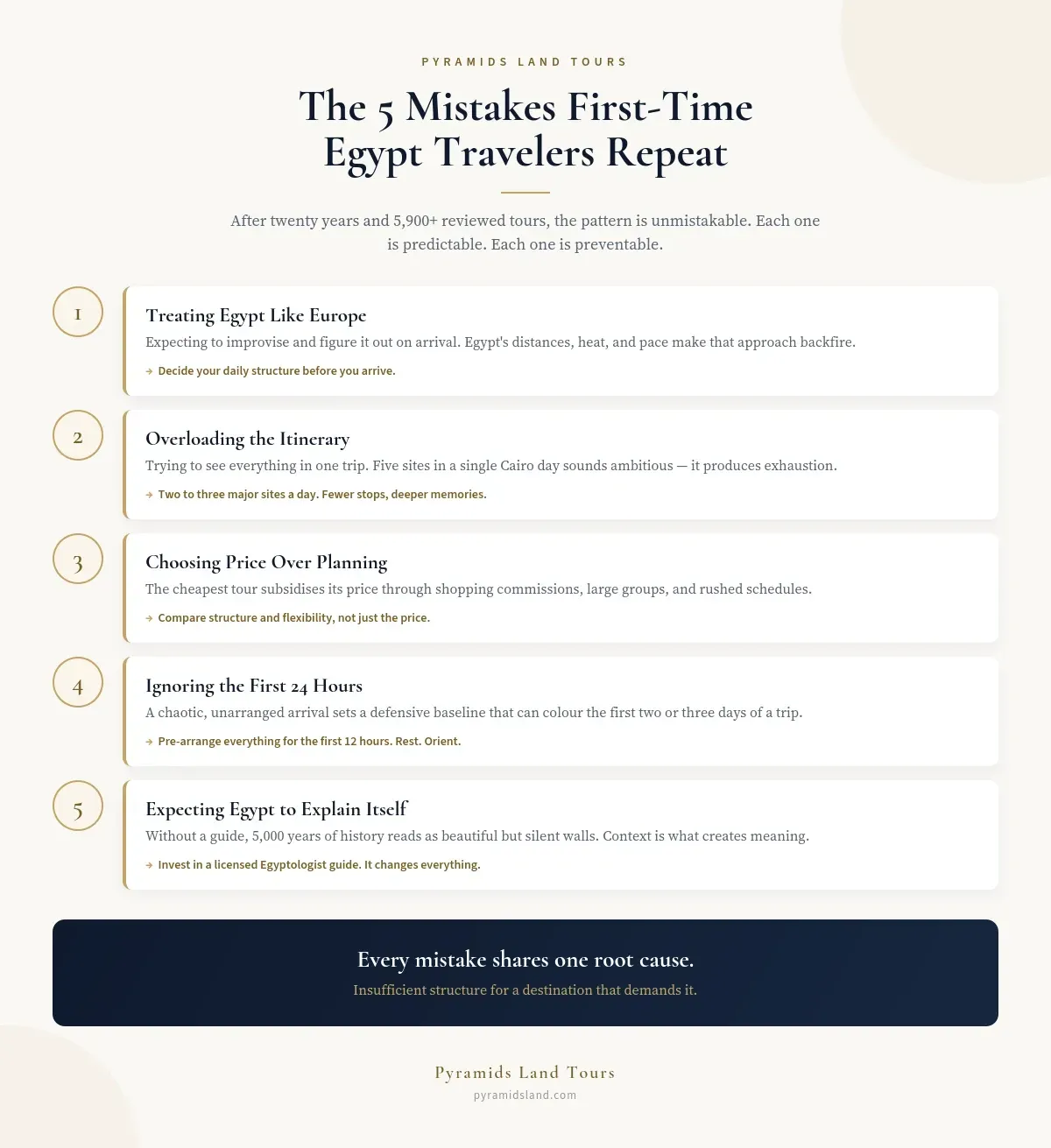
Both groups visited the same country. The difference between them is not personality, not budget, not luck. It is five specific decisions — each one predictable, each one preventable — that separate the first experience from the second.
Other lists of Egypt mistakes focus on practical tips — what to wear, what to pack, which scams to avoid. Those details matter, and you will find them in our planning checklist. This article is about the five structural mistakes that cause the most damage — the ones I watch repeat, trip after trip, after twenty years of meeting travelers at the point where the damage is already done.
Treating Egypt Like a Flexible, Improvise-Friendly Destination
It happens almost every trip. A common line I hear on Day 1: "We thought we could just grab a taxi and figure it out… but after 20 minutes at the Pyramids with vendors surrounding us, we realized we needed help." By the afternoon, they are asking if we can add more guided days. A Rick Steves forum member with military experience living in the Middle East put it bluntly: they strongly recommend a tour over trying to do Egypt independently.
The pattern is so consistent that even Egypt's critics arrive at the same advice. In one widely read account titled around the reasons its author would not return, the conclusion was not "avoid Egypt" — it was: book a reputable guided tour, and negotiate everything in advance. Another seasoned independent traveler, the kind who prizes freedom above all else, described abandoning the idea of a guide-free trip only after days of frustrated research, defeated less by danger than by how hard it was to arrange anything reliably. The friction starts before you even land: travelers regularly describe being overwhelmed at the booking stage by contradictory advice and a near-total lack of price transparency.
Egypt does not reward improvisation — not because it is hostile, but because it is dense. The distances are longer than they appear on maps (the drive from Cairo airport to Giza can take 30–50 minutes at night or 75–120 minutes in heavy daytime traffic). The heat at exposed sites in summer swings from 26°C at 6:30 am to 40°C by 11 am. The cultural dynamics surrounding tourism differ from those most Western travelers are used to. The fix is not to over-plan every hour — it is to decide your daily structure, your transfers, and your guide before you arrive, not after. Spontaneity is a luxury Egypt grants you only once the scaffolding is already in place.
Overloading the Itinerary
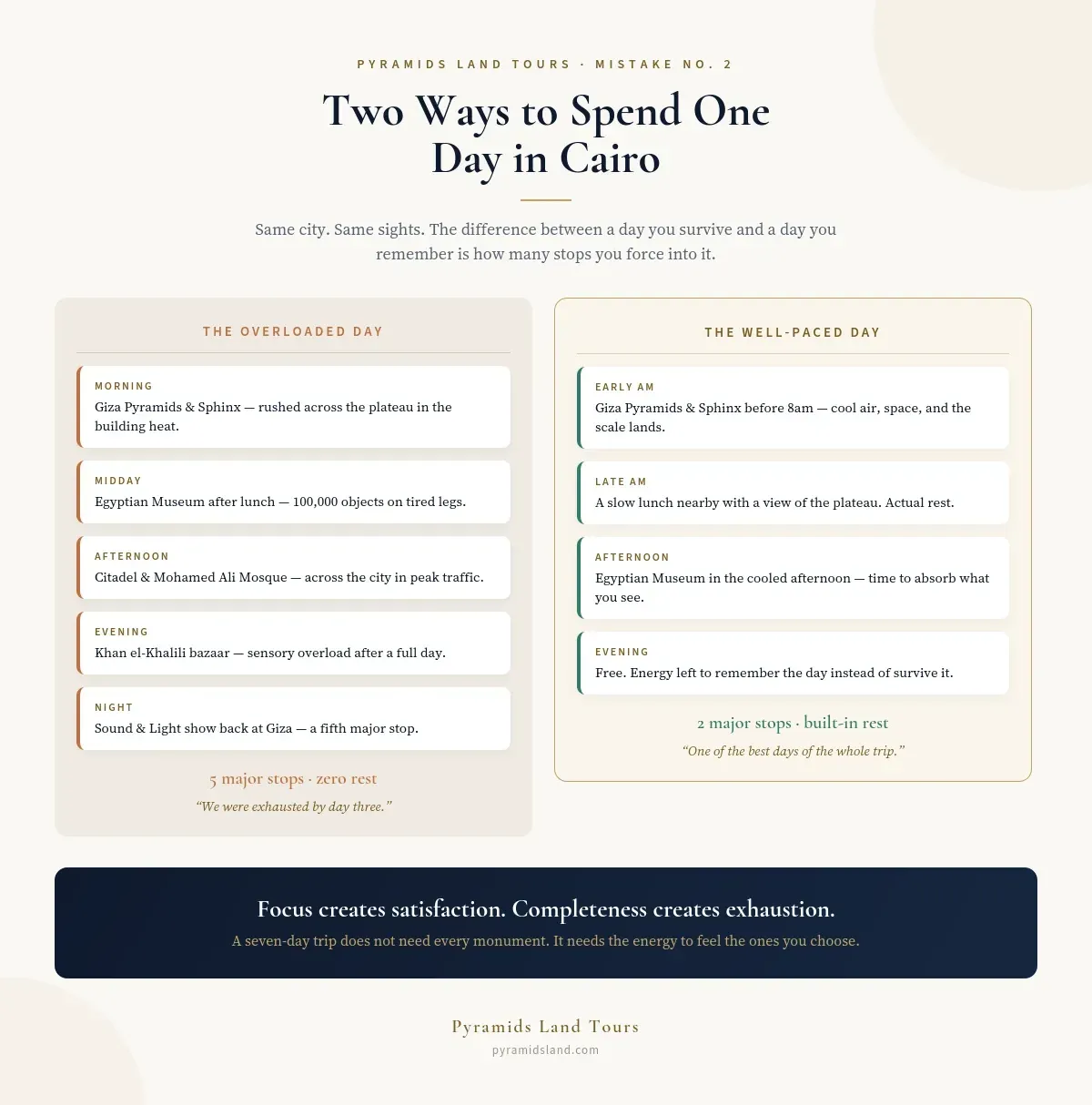
Giza Pyramids and Sphinx in the morning. Grand Egyptian Museum after lunch. Citadel in the afternoon. Khan El Khalili in the evening. Sound and Light Show at night. Five major stops plus Cairo traffic between each one. It looks impressive on paper and collapses in practice.
This is the mistake even careful planners make, because the map lies to them. Egyptian sites are not compact. The Giza Plateau takes two to three hours to see properly. Karnak covers more than 200 acres. The Valley of the Kings spreads multiple tombs across an exposed limestone valley. Experienced travelers on the forums say the same thing to every first-timer who posts an ambitious seven-day plan: there is too much to see, so focus. One traveler, reviewing a tour itinerary that crammed a flight, a temple at Dendera, and Karnak into a single day, did the math out loud and realized they would simply "plan to be completely exhausted for a couple of days." Another described Luxor — one of the largest archaeological sites on earth — as a place that requires ruthless triage rather than completeness.
Here is the realistic version. Two full days minimum in Cairo, two in Luxor, two to three major sites per day — never five. A well-paced Cairo day: Giza shortly after the 7:00 am opening, ahead of the 8:45 tour-bus convoys, then the GEM in the cooled afternoon. A well-paced Luxor day: the Valley of the Kings before 7 am, a rest in the shade, Karnak by 9:30, finished by 11, the afternoon free. Travelers who follow this pace describe deeper enjoyment, clearer memories, and the energy to feel the next day rather than endure it. Focus creates satisfaction. Completeness creates exhaustion — and an exhausted traveler does not remember the fourth site; they only remember being tired in front of it.
Choosing Price Over Planning
Forum travelers regularly post tour quotes and ask the community a single question: is this fair? It is the right instinct aimed at the wrong number. A full-day private Cairo tour with a dedicated Egyptologist guide, transport, and entrance fees typically ranges from $180–$280 per person. A budget group tour advertises $45–$85 — and recovers the difference somewhere you do not see on the invoice.
That somewhere is the mandatory shopping stop. The perfume "factory," the papyrus "institute," the alabaster workshop — each one pays the operator a commission on whatever you buy, and each one eats a slice of the day you came to spend at temples. On a typical cheap eight-hour tour, travelers report two to two and a half hours at actual sites and well over an hour parked in shops. The sites receive less time than the showrooms. You did not save money; you traded the experience you paid for. The lesson is not "spend more" — it is to compare tours by structure: how many hours at sites, how many mandatory stops, how the guide is paid. A guide on a fixed daily rate has no reason to steer you in any particular direction. A guide on commission has every reason. The cheapest sticker price is rarely the cheapest trip once you count the hours and the pressure.
Ignoring the First 24 Hours
Most flights arrive at Cairo airport between 10 pm and 2 am. What happens next — a smooth transfer or a midnight negotiation — sets the emotional baseline for the entire trip. A forum poster described Cairo airport as "a trip, in more ways than one" and said they would not have wanted to do it alone.
You landed at Terminal 3 at 11:40 pm. The visa line took twenty minutes. You walked into the arrivals hall and saw the sign: "Pyramids Land Tours." Mahmoud was already there. You were in the car in ten minutes. Cairo through the window at midnight — lit minarets, the Nile, a city that does not sleep. You barely spoke. You did not need to. By the time you reached the hotel, the tension you had been carrying since boarding the flight had dissolved. The next morning, you met Zenab in the lobby, and the trip began with curiosity instead of anxiety.
That is what a planned arrival does. The clearest proof is our layover travelers — people with as little as seven hours in Cairo between connecting flights, who consistently report complete, satisfying tours because every logistical detail was arranged before they landed. If the infrastructure works under the tightest possible constraint, it works for everyone. Treat arrival day as the single most important planning element of the trip. Pre-arrange everything for the first twelve hours. Rest. Orient. Begin the real sightseeing on Day 2, when you are a person again rather than a passenger.
If the arrival is the part that worries you most, you are not alone — it is the single most common concern travelers raise. Tell us your dates and your biggest concern → and we'll walk you through exactly how the first night works.
Expecting Egypt to Explain Itself
Egyptian history spans more than five thousand years. The monuments carry layers of meaning — religious, political, astronomical, architectural — that are invisible without context. And Egypt, unlike a European museum, very rarely explains itself to you.
A visitor to the Egyptian Museum captured the mistake perfectly: they decided they did not need a guide to get in, and they were right — but afterward they wrote that they wished they had done far more research, because most exhibits are not labeled, and time after time they had no idea what they were looking at. That is the trap. The sites are open to anyone; their meaning is not. Standing in the Hypostyle Hall at Karnak, you are surrounded by 134 columns. Without a guide, it is impressive and empty. With Mahmoud explaining that the hall was built over more than a century by three pharaohs, that the twelve central columns are taller to create a clerestory for light and ritual effect, and that the carvings record specific stories about specific gods — the experience turns from sightseeing into understanding.
The guide is the single highest-impact investment in any Egypt trip. In Egypt, "Egyptologist guide" is a professional credential regulated by the Ministry of Tourism and Antiquities — a university degree and a government examination, not a marketing phrase. Verify your operator at etaa-egypt.org. The difference between a guided and an unguided day is not access. It is whether you leave understanding what you came five thousand years to see, or whether you leave with photographs of things you could not name.
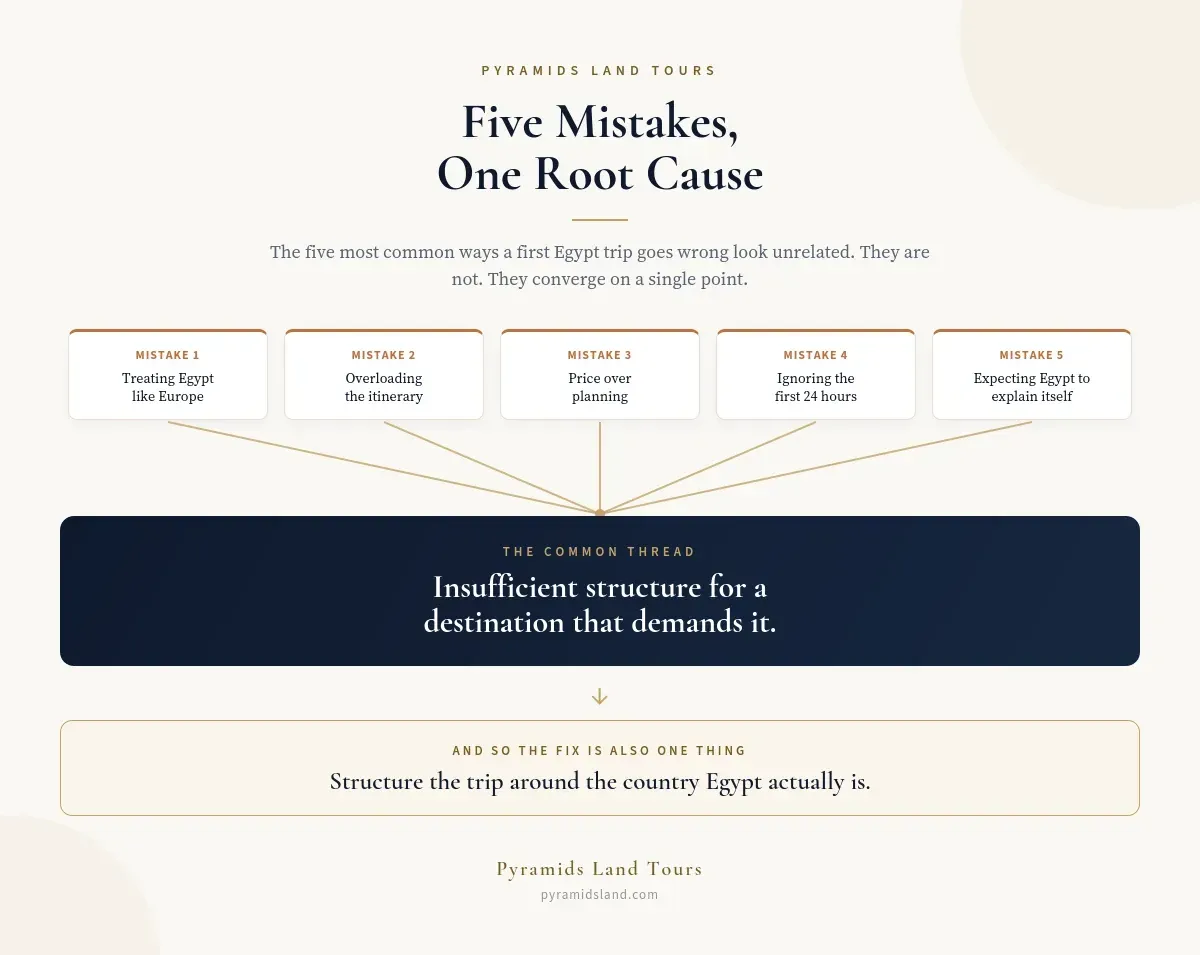
Every mistake on this list shares one root cause: approaching Egypt with the assumptions that work elsewhere. Egypt is not a country where flexibility, completeness, and bargain-hunting produce the best outcomes. Recognizing that is the first step toward the kind of trip that changes how you think about travel — rather than the kind you are relieved to end.
Tell us your dates and your biggest concern, and we'll answer honestly — no obligation. Message us on WhatsApp and tell us your dates and your biggest concern →, or browse our Egypt tour packages.
Ashraf Fares