
10-Day Complete Egypt Tour with Hurghada
A private experience shaped around your time and interests.
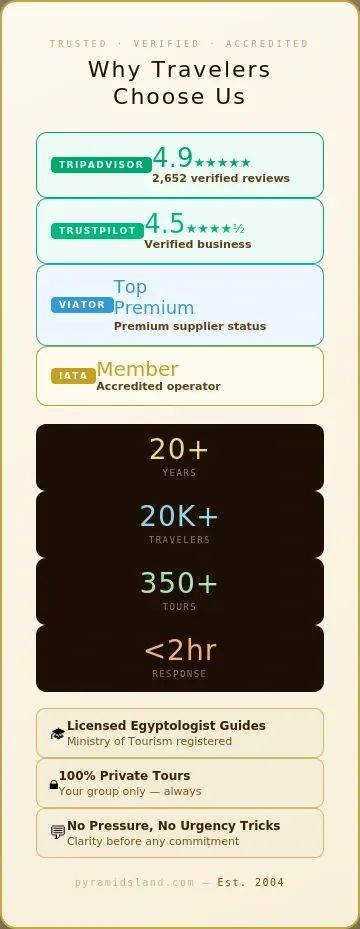
★ 4.9 · 2,678 reviews on TripAdvisor · Licensed since 2001 · Free Cancellation

Overview
This 10-day private tour is the most thorough Egypt itinerary available in this duration: three days in Cairo covering the Giza Plateau, Saqqara, and both the Egyptian Museum and the Grand Egyptian Museum, a complete 4-night Nile cruise between Luxor and Aswan, a full day in Aswan with the option to add Abu Simbel, and two nights in Hurghada to end the journey at the Red Sea. Every site is covered without rushing. Private Egyptologist guides are with you throughout.
Tour Highlights
◆ Three days in Cairo: Giza, GEM, Saqqara, Memphis & Khan el-Khalili
◆ 4-night Nile cruise from Luxor to Aswan — full-board included
◆ Valley of the Kings with 2 royal tomb entries
◆ Five temple stops on the cruise: Karnak, Luxor, Edfu, Kom Ombo, Philae
◆ Aswan full day — High Dam, Philae, Unfinished Obelisk & felucca sail
◆ Optional Abu Simbel add-on from Aswan
◆ Two nights in Hurghada: Giftun Island snorkelling & glass-bottom boat
◆ Eastern Desert scenic drive: Aswan to Hurghada (~6 hours)
Who This Tour Is For
- First-time visitors who want the complete Egypt experience in 10 days — Cairo, the Nile, Aswan, and the Red Sea — without compressing any section. This itinerary was structured so that nothing is rushed: three full days in Cairo, a proper 4-night cruise, a full day in Aswan, and two nights in Hurghada.
- Those who want the Nile cruise as a genuine centerpiece, not a 2-night transit. The 4-night structure gives the cruise time to reach Edfu and Kom Ombo properly, with Aswan arriving unhurried on Day 7.
- Travelers who want the Red Sea ending — Hurghada provides a genuine decompression after seven days of monuments. Giftun Island snorkelling and two free mornings at the resort are a different experience from anything in the pharaonic south.
- Those who've been told 7 or 8 days is enough and know they want more. Ten days is where the pace shifts from efficient to comfortable. Every destination on this itinerary has adequate time.
- Couples, families, and small groups — the fully private model means the schedule and pace are yours throughout.
What Makes This Tour Different
- Saqqara and Memphis on their own day — Day 3 is dedicated entirely to Saqqara and Memphis, not compressed with Giza. The Step Pyramid of Djoser, the Pyramid of Teti, and the painted mastaba tombs of the Old Kingdom viziers are among the most historically dense sites in Egypt. Memphis adds the colossal statue of Ramesses II and the alabaster Sphinx. Most 10-day Egypt tours give these sites a rushed afternoon after Giza; this tour gives them the morning they deserve.
- The Egyptian Museum and the Grand Egyptian Museum on separate days — Day 2 includes the GEM's full Tutankhamun collection in the morning and Giza in the afternoon. The older Egyptian Museum (now largely a secondary collection since the GEM opened) is included in Day 3's Cairo circuit for those who want it. Both collections, without compression.
- The Aswan-to-Hurghada drive, as a structural feature, is a 6-hour private vehicle journey that crosses the Eastern Desert and the Safaga road. It is a genuine landscape transition: from the Nile valley to the open desert to the Red Sea coast. The drive is included in the itinerary as Day 8, not treated as a logistics problem. For travelers choosing Abu Simbel, an early 05:30 departure still allows return before the transfer.
- Abu Simbel is an honest option — transparently listed as an add-on (USD 120 per person) and not buried in a footnote. We confirm the logistics at booking: early departure, both temples with your Egyptologist, return before midday, then the Hurghada transfer. It's feasible and the most common addition to this itinerary.
A Note on Itinerary Sequencing
Nile cruise ships operate on fixed embarkation and disembarkation schedules that are set by the cruise company and may change depending on your travel dates. This means the sequence of days shown above — specifically, which site is visited on which cruise day — may be adjusted to align with the ship's sailing schedule when we book your departure.
What does not change: all sites listed are covered. Every temple, every guided visit, and every day of the cruise is included, regardless of the sequence your particular departure follows. Your Egyptologist remains with you for every site visit, in whatever order the cruise runs
In practice, the common sequencing variations are:
- Southbound (Luxor to Aswan): West Bank → Edfu → Kom Ombo → Aswan. This is the most common direction.
- Northbound (Aswan to Luxor): Aswan → Kom Ombo → Edfu → West Bank. Less common but operated by some cruise lines.
We confirm the exact daily sequence with you before departure, once the cruise departure dates are set. If the direction or sequencing matters to you specifically, tell us when you enquire and we will match you to the right cruise departure.
Day-by-Day Itinerary
Day 1: Arrive in Cairo
Private VIP airport transfer. Hotel check-in. Itinerary briefing with your Egyptologist. Overnight: Cairo (4-star+, Kempinski Nile Hotel or similar).
Day 2 Cairo — Giza Plateau & Grand Egyptian Museum Giza Plateau:
Great Pyramid of Khufu (exterior), Pyramid of Khafre, Pyramid of Menkaure, Great Sphinx, Valley Temple. Afternoon: Grand Egyptian Museum (GEM), Giza — Tutankhamun Galleries, Royal Mummies Hall, Ramesses Corridor. Overnight: Cairo.
Day 3 Cairo — Saqqara, Memphis & Khan el-Khalili
Morning: Saqqara Necropolis — Step Pyramid of Djoser (the world's oldest monumental stone structure), Pyramid of Teti, Mastaba of Ti. Afternoon: Memphis, the ancient capital — colossal statue of Ramesses II, Alabaster Sphinx. Evening: Khan el-Khalili bazaar at leisure. Overnight: Cairo.
Day 4: Fly to Luxor — Valley of the Kings & Board Cruise
Morning flight Cairo → Luxor (1 hr). West Bank: Valley of the Kings (2 tombs), Temple of Hatshepsut at Deir el-Bahari, Colossi of Memnon. Board the Nile cruise. Welcome lunch on board. Overnight: cruise ship, moored in Luxor.
Day 5 Luxor — Karnak & Luxor Temple
East Bank: Karnak Temple Complex (Great Hypostyle Hall, Sacred Lake). Afternoon: Luxor Temple at dusk — best light of the day. Cruise sails south overnight. Overnight: cruise ship (underway).
Day 6 Edfu & Kom Ombo
Morning: Edfu Temple of Horus — horse carriage from the Nile bank to the entrance. Afternoon: Kom Ombo double temple overlooking the river. Continue sailing south to Aswan. Overnight: cruise ship.
Day 7 Aswan — High Dam, Philae & Felucca
Aswan High Dam — engineering overview and Lake Nasser views. Philae Temple of Isis — reached by motorboat to Agilkia Island. Unfinished Obelisk — reveals ancient quarrying technique. Afternoon: felucca sails around Elephantine Island. Optional Nubian village (extra). Overnight: cruise ship.
Day 8 Aswan → Hurghada Transfer
Disembarkthe cruise. Optional early departure (05:30) for Abu Simbel day trip (+USD 120 pp) — return before midday for transfer. Private vehicle Aswan → Hurghada (~6 hours via Luxor and Safaga road). Arrive in Hurghada late afternoon. Check in at the beach resort. Overnight: Hurghada (4-star+).
Day 9 Hurghada — Red Sea Day
Full-day snorkelling trip to Giftun Island Marine Protected Area. Glass-bottom boat section. Option (own cost): jeep safari at sunset into the Eastern Desert with Bedouin tea ceremony. Overnight: Hurghada.
Day 10 Hurghada → Departure
Morning at leisure. Transfer to Hurghada Airport. Fly Cairo. International departure. Day room available in Cairo on request.
Best Time to Visit: October to April is optimal. November–February is peak season for the Red Sea and monument sites combined. Book 6–8 weeks ahead during peak periods.
Note: If Abu Simbel is selected, the Day 8 departure from Aswan is at 05:30. Abu Simbel adds approximately 4 hours to the day and is entirely feasible before the Hurghada transfer. Recommend confirming this at booking.
Frequently Asked Questions
Is Abu Simbel worth adding to this itinerary?
Yes, without reservation. The two rock-cut temples of Ramesses II at Abu Simbel — the Great Temple with its four 20-metre colossi and the Temple of Nefertari — are among the most extraordinary monuments in Egypt. They require an early start from Aswan (05:30 departure), three to four hours at the site with your Egyptologist, and a return to Aswan by late morning. The Hurghada transfer then departs from Aswan in the afternoon. The day is long but entirely manageable. The add-on cost is approximately USD 120 per person (vehicle option). A charter aircraft option (45 minutes each way, USD 150–280 per person) is also available for a later start. Confirm at booking, and we will arrange whichever works for your group.
How long is the drive from Aswan to Hurghada?
Approximately 5.5–6.5 hours, depending on traffic and the specific route. The journey runs along the Nile Valley road through Luxor, then across the Eastern Desert via the Safaga road to the Red Sea coast. The road is well-maintained, and the scenery changes significantly en route — from the agricultural Nile valley, through open desert plateau, to the Red Sea mountains above Hurghada. Your private air-conditioned vehicle makes the drive comfortable. There is a rest stop mid-route.
Can we do this tour in reverse — starting in Hurghada and ending in Cairo?
Yes, with some restructuring. The reverse routing would be: fly Cairo → Hurghada, 2 nights in the Red Sea, then drive Hurghada → Aswan, board the cruise southbound or northbound depending on availability, disembark in Luxor, fly Luxor → Cairo for Cairo days, and depart internationally. The cruise direction becomes more important in this variant. If the reverse order appeals — beach first, then monuments — tell us at enquiry, and we will build the alternative routing.
What is Giftun Island, and how is the snorkelling?
Giftun Island is a national marine protected area approximately 7 kilometres off the Hurghada coast. The reef around the island has consistent coral coverage, clear water (typically 15–25 metres visibility), and a range of marine life, including sea turtles, reef fish, and parrotfish. The private boat takes your group directly to the island. Snorkelling equipment is provided, and a guide is in the water with you. No prior experience is required. The glass-bottom boat section is available for those who prefer not to snorkel — you see the reef from the boat's glass panels rather than in the water. Both options are on the same private boat departure.
The itinerary mentions Khan el-Khalili on Day 3 evening — is this guided or free?
Khan el-Khalili on the evening of Day 3 is at leisure — your Egyptologist is not with you for the bazaar walk. The recommendation is to spend the evening independently: the bazaar is within walking distance of most Cairo hotels, the main street (Muizz Street) is a 10-minute walk from the market entrance, and the area is well frequented by international visitors in the evening. If you'd prefer a guided introduction to the bazaar and the surrounding Fatimid quarter, we can arrange it — just confirm at the time of booking.
Explore the tours above. Read the details. Ask questions if needed. Book only when it feels right.
How pricing works
Prices are based on:
- Group size
- Duration
- Inclusions listed on the tour page
You will always know what is included before booking. There are no surprise additions.