
11-Day Luxury Egypt Tour | Cairo, Nile Cruise, Upper Egypt & Red Sea
A private experience shaped around your time and interests.
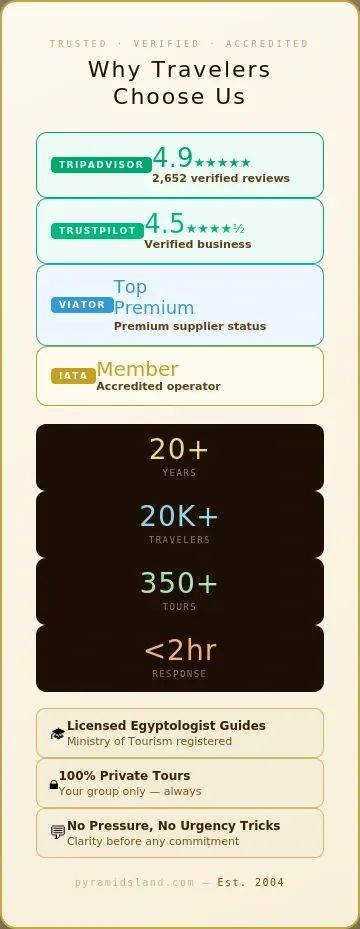
★ 4.9 · 2,678 reviews on TripAdvisor · Licensed since 2001 · Free Cancellation
Eleven days. The history, the river, and the sea.
The 11-day itinerary is for travelers who want Egypt's full arc — ancient history, river, and coast — without having to plan two separate trips. Days 1 through 9 follow the same structure as the 9-Day Elite itinerary. Days 10 and 11 add the Red Sea at Hurghada.
Most travelers returning from Hurghada say the same thing: they didn't expect to need it, but the contrast turned out to be the right ending. Nine days of monuments and history is immersive — which is exactly what makes a decompression day matter.
This itinerary is typically based at the following properties: Marriott Mena House or Four Seasons Cairo (Cairo) · Sofitel Winter Palace Luxor · 5-star deluxe Nile cruise ship · Sofitel Legend Old Cataract (Aswan) · Kempinski Soma Bay or equivalent (Hurghada). Specific properties are confirmed at booking and may be adjusted based on availability — all replacements are at equivalent or superior standard.
Highlights
- Grand Egyptian Museum, Giza, Saqqara, and Old Cairo — the full Cairo circuit
- Valley of the Kings and the Luxor West Bank in full
- Nile cruise from Luxor to Aswan — Edfu, Kom Ombo, Philae
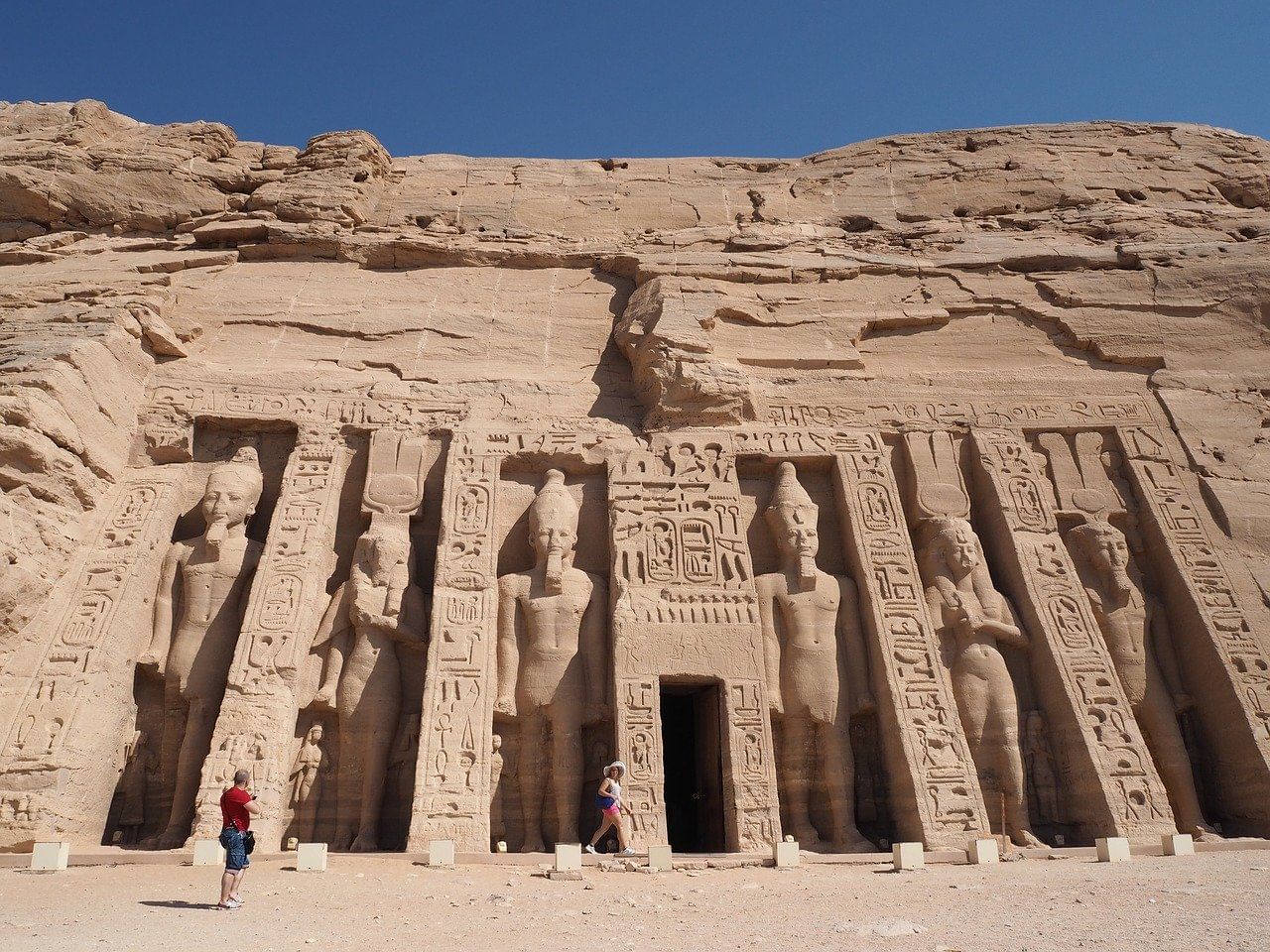
- Abu Simbel day trip from Aswan — two rock-cut Nubian temples, early morning
- Two days at a 5-star Red Sea resort in Hurghada — snorkelling, beach, no schedule
- Private Egyptologist for all nine archaeological days
- The complete Egypt experience in one itinerary
Who This Tour Is For
- Travelers who want Egypt's complete experience — ancient sites, Nile, and coast — in a single trip
- Those who dive or snorkel and want to combine what would otherwise be two separate journeys
- Anyone for whom rest and contrast at the end of an intensive trip is as important as the itinerary itself
What Makes This Tour Different
- The Red Sea is positioned as decompression, not more sightseeing — two full days at the resort with no guide, no schedule, no obligations. Egypt's ancient sites are demanding; the contrast is intentional.
- Divers get two separate trips in one — the historical Egypt experience and the Red Sea in a single itinerary, rather than planning two journeys.
- Days 1–9 are unchanged from the 9-Day Elite — Abu Simbel, full West Bank, Cairo with Saqqara. Nothing is borrowed from the Red Sea extension to accommodate the longer duration.
- Hurghada is a 30-minute flight from Aswan — the transition from ancient Egypt to Red Sea resort takes less time than most people expect.
A Note on Itinerary Sequencing
Nile cruise ships operate on fixed embarkation and disembarkation schedules that are set by the cruise company and may change depending on your travel dates. This means the sequence of days shown above — specifically, which site is visited on which cruise day — may be adjusted to align with the ship's sailing schedule when we book your departure.
What does not change: all sites listed are covered. Every temple, every guided visit, and every day of the cruise is included, regardless of the sequence your particular departure follows. Your Egyptologist remains with you for every site visit, in whatever order the cruise runs
In practice, the common sequencing variations are:
- Southbound (Luxor to Aswan): West Bank → Edfu → Kom Ombo → Aswan. This is the most common direction.
- Northbound (Aswan to Luxor): Aswan → Kom Ombo → Edfu → West Bank. Less common but operated by some cruise lines.
We confirm the exact daily sequence with you before departure, once the cruise departure dates are set. If the direction or sequencing matters to you specifically, tell us when you enquire, and we will match you to the right cruise departure.
What You'll Experience
Day 1 — Arrive in Cairo · Afternoon: Old Cairo
Private airport transfer to your 5-star hotel. After settling in, your Egyptologist meets you in the afternoon for a walk through Old Cairo — the Hanging Church, Ben Ezra Synagogue, and the Roman fort foundations of Babylon. Two thousand years of history in one walkable neighbourhood, at a pace that doesn't demand anything from you yet. Your guide orients you to what the next nine days will cover, answers early questions, and recommends where to eat this evening. Evening at leisure.
Day 2 — Grand Egyptian Museum
The Grand Egyptian Museum occupies the full morning. Your Egyptologist builds the session around the Tutankhamun collection — four thousand objects from a single tomb, displayed in their own wing of the world's largest archaeological museum. The golden death mask, the gilded shrine, the canopic chest with its four alabaster jars, the model boats for the journey to the afterlife. The collection is dense enough that three to four hours is the working minimum; your guide calibrates the pace and depth of your responses. This is the historical context you'll carry for the rest of the trip — every site you visit from here will connect back to objects and names you first encountered this morning.
Day 3 — Giza Plateau & Saqqara
Giza in the morning, early. The Great Pyramid of Khufu, the Pyramid of Khafre with its intact casing stones at the apex, and the smaller Pyramid of Menkaure. The Sphinx from the south side — the angle most visitors never reach. Your Egyptologist explains the construction not as a mystery to be speculated about but as a logistics and engineering problem to be understood: how a workforce of 20,000 quarried, transported, and placed approximately 2.3 million stones in twenty years. The Solar Boat Museum, if you want it. Saqqara in the afternoon. The Step Pyramid of Djoser — the world's oldest monumental stone structure, completed around 2650 BCE, predating Giza by several decades. The complex around it: the mortuary temple, the Heb-Sed court, and the serdab where the statue of Djoser stands facing north. Then the painted mastaba tombs of the Old Kingdom viziers — Mereruka, Ti, Kagemni — where the wall reliefs record daily life with a specificity and warmth that the royal tombs rarely match. Saqqara is the site that most repeat visitors to Egypt say they wish they'd given more time the first time.
Day 4 — Fly to Luxor · East Bank Temples
Morning domestic flight to Luxor. Private transfer to your hotel. Karnak Temple in the afternoon with your Egyptologist: the largest religious complex ever built, added to by thirty successive pharaohs over 2,000 years. Your guide explains the construction sequence, turning what might otherwise be an overwhelming accumulation of pylons and columns into a legible political document — each addition a statement of power, each new court a pharaoh's claim on the city. The hypostyle hall, 5,000 square meters of 134 columns, the tallest 23 meters high, is the single most visually overwhelming interior space in ancient Egypt. Luxor Temple at dusk: the sandstone goes amber in the evening light. Built primarily by Amenhotep III and expanded by Ramesses II, it served as the setting for the annual Feast of Opet. The avenue of sphinxes leading north toward Karnak, reopened in 2021 after decades of excavation, is visible from the entrance. Dinner recommendation provided.
Day 5 — Luxor: West Bank in Full ·
Embark Cruise The full West Bank. Valley of the Kings in the morning — three tombs selected by your Egyptologist based on what engaged you at the GEM the day before yesterday. If the Amarna period caught your attention, there are tombs here that follow that thread directly. The chamber paintings in KV9 and KV11 are the most expansive; KV62 (Tutankhamun's tomb) is smaller than expected but historically extraordinary as the only intact royal burial ever found. Your guide explains why each tomb's iconography works the way it does. Hatshepsut's Temple at Deir el-Bahari: the three-tiered colonnaded terrace cut into the cliff face, dedicated to the female pharaoh who ruled Egypt for twenty years before her successor systematically removed her cartouches from every surface. Your Egyptologist explains who did it, why, and why it ultimately failed to erase her. The Colossi of Memnon on the return — the two seated quartzite statues of Amenhotep III that once guarded the entrance to the largest mortuary temple in Thebes, now standing in open farmland. Return to the Luxor docks in the late afternoon and board your 5-star Nile cruise ship. Dinner on board as the boat clears the dock and begins moving south. The Nile cruise begins.
Day 6 — Sailing South · Edfu Temple
The boat docked overnight near Edfu. Morning visit to the Temple of Horus by horse-drawn carriage from the riverside — the best-preserved temple in Egypt, completed during the Ptolemaic period in a style that deliberately reproduces ancient Egyptian architectural forms as an act of continuity and legitimacy. Your Egyptologist reads the reliefs on the inner walls of the sanctuary: the full mythological cycle of Horus and Set, the sacred drama of their conflict, and Horus's ultimate kingship, carved in extraordinary detail at eye level. The hypostyle hall with its 18 columns is the antechamber to a sanctuary that has stood almost completely intact for over 2,000 years. Return to the boat and sail south through the afternoon. The Nile narrows as you move further into Upper Egypt — the desert comes closer to the water, the agriculture thins, the light changes. Upper deck time; the river at its own pace.
Day 7 — Kom Ombo · Sail to Aswan
Continue to South Kom Ombo Temple in the morning, which can be reached directly from the boat. The dual temple dedicated simultaneously to Sobek, the crocodile god, and Horus the elder — two deities, two sanctuaries, two sets of priests, two complete ritual systems housed in a single symmetrical structure. The building's architectural logic is unusual and worth your guide's explanation: every element on the left is mirrored on the right, each serving a different god. The small museum attached to the temple holds a collection of crocodile mummies — actual mummified crocodiles, discovered in a cache near the site — which gives the worship of Sobek a physical specificity that most temple descriptions fail to convey. Continue south toward Aswan through the afternoon. The first granite outcrops of the Aswan region appear in and around the river — the landscape changes more dramatically on this section of the cruise than on any other. Dinner on board.
Day 8 — Aswan from cruise: Philae + High Dam + felucca
The cruise docks in Aswan this morning. Philae Temple by motorboat from the dock — the island sanctuary of Isis, relocated stone by stone to its current position before the Aswan reservoir rose. One of the most quietly beautiful sites in Egypt: a human scale, a water setting, and the unusual completeness of a temple that was moved intact rather than partially excavated. The High Dam in the afternoon: your Egyptologist explains the engineering, the Soviet technical assistance after the West withdrew funding, the construction schedule, and the reservoir that submerged the original sites of Abu Simbel and Philae. The UNESCO rescue operation that saved both 50 countries, four years, and the precise dissection of both temples into over a thousand blocks each, lifted 60 metres uphill and reassembled. A felucca on the Nile cataract in the late afternoon — the Aswan section of the river, wide and granite-lined, is the most beautiful stretch in Egypt. Return to the cruise for the final night on board, docked in Aswan.
Day 9 — Abu Simbel early morning · Disembark after return to Aswan · Transfer to airport
Early morning flight to Abu Simbel. The two rock-cut temples of Ramesses II were carved into a sandstone cliff at the edge of ancient Nubia in 1264 BCE. The Great Temple is fronted by four seated colossi of Ramesses II, each 20 meters high. The inner sanctuary, 65 meters into the cliff, contains four seated statues — three gods and Ramesses II himself, deified in his own lifetime — aligned so that twice a year, sunlight penetrates the full length of the corridor and illuminates the sanctuary. The Temple of Nefertari stands to the north: one of the very few Egyptian temples dedicated to a queen, its façade depicting Nefertari at the same scale as her husband. Your Egyptologist is with you at the site and provides what the setting alone cannot: why Ramesses built these temples here, at the edge of his empire; what the astronomical alignment meant and how it was encoded; and what the 1968 UNESCO operation required to save them — 50 countries, $80 million, 4 years, and the precise cutting of both temples into 1,036 blocks averaging 20 tonnes each, moved 60 metres uphill and reassembled on higher ground. The engineers reproduced the astronomical alignment with an error of one day. Return flight to Aswan. Private transfer to your hotel. Afternoon at leisure.
Day 10 — Fly to Hurghada · Red Sea Resort
Morning domestic flight from Aswan to Hurghada. Private transfer to your 5-star Red Sea resort. Check in. The archaeological portion of the trip is complete — nine days of monuments, temples, tombs, and the river. What follows is genuinely different: the Red Sea has no historical context to absorb, no sites to pace through, no schedule. The afternoon is yours entirely. The Red Sea reefs around Hurghada have some of the best accessible snorkeling and diving in the world — warm, clear water with good visibility and a functioning coral ecosystem. Most resorts have gear available and can arrange guided snorkel trips to the better reef sections. Giftun Island, a marine protected area 10 kilometers offshore, is the premium option — accessible by permit and worth arranging before arrival if snorkeling is a priority. Dinner at the resort.
Day 11 — Hurghada at leisure · Departure
Full day at the resort. Snorkeling, diving, the beach, the pool — or nothing in particular. This day is a genuine blank: no guide, no transfer to arrange, no sites that require your attention. Most travelers describe Day 11 as the day they finally stopped moving, which turns out to be exactly what nine days of ancient Egypt requires before a long international flight. Late afternoon or evening: private transfer to Hurghada Airport for your international departure, or your Hurghada–Cairo domestic flight for onward international connections from Cairo.
Frequently Asked Questions
Is the Red Sea ending necessary, or is it optional?
It is included in the standard 11-day itinerary. If you would rather end in Cairo or Aswan, we can adjust. The Red Sea ending works because by Day 9, even the most enthusiastic travelers benefit from two days without a schedule or a guide. It is not a tourism experience — it is a decompression. Most travelers who take this package say the Hurghada days felt earned.
Is Abu Simbel included?
Yes. The 11-day tour includes a Day 9 trip to Abu Simbel from Aswan, using the same early-morning flight schedule as the 9-day package. Both temples, with your Egyptologist, will return to Aswan by midday.
What is the difference between the 9-day and 11-day packages?
The 11-day adds two Red Sea days in Hurghada at the end. Everything else — Cairo, Luxor, Nile cruise, Aswan, Abu Simbel — is structurally identical. The 11-day tour is for travelers who want both the complete Egyptian archaeological experience and a proper rest before flying home.
What is Hurghada actually like for snorkeling?
The Red Sea reef off Hurghada has clear, warm water and accessible coral within a short boat trip of the resort hotels. It is not the Maldives — the reef has seen pressure from tourism over the decades — but for travelers arriving from nine days of ancient Egypt, it is genuinely excellent: easy conditions, good visibility, and manageable for beginners. Your resort will have gear available and can arrange guided reef trips.
Explore the tours above. Read the details. Ask questions if needed. Book only when it feels right.
How pricing works
Prices are based on:
- Group size
- Duration
- Inclusions listed on the tour page
You will always know what is included before booking. There are no surprise additions.