Private Giza Pyramids & Sphinx Half-Day Tour from Cairo

A private experience shaped around your time and interests.


★ 4.9 · 2,678 reviews on TripAdvisor · Licensed since 2001 · Free Cancellation

8-Hour Private Tour of the Pyramids, Sphinx, Grand Egyptian Museum

4 hours

Moderate

Minimum age: 1


Four hours is the right amount of time to see the Giza Plateau well.

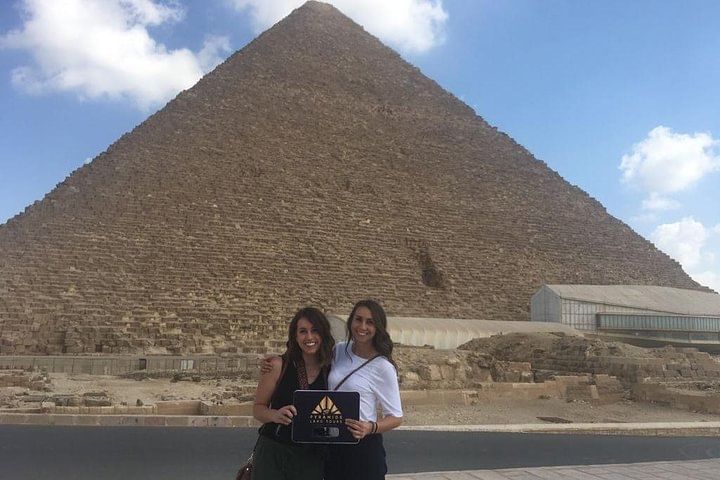
Not rushed — there is time to stand at the base of the Great Pyramid and let the scale register, time to approach the Sphinx from the right angle, time to reach the panoramic viewpoint that most visitors miss entirely.

Not exhausted — you return to your hotel with the afternoon free. Many travelers follow this tour with an independent afternoon in Cairo or use the rest for genuine recovery after a long flight.

This tour does one thing and does it properly.

Who This Tour Is For

  • Travelers who want to focus on the Pyramids and the Sphinx without extending into other sites
  • Those who prefer morning excursions and want the afternoon free
  • Visitors with a full Egypt itinerary who are allocating specific time windows to specific sites
  • First-time visitors who want an orientation before committing to longer tours

How the Morning Flows

Pickup from your hotel, typically between 7:00 and 8:00 am — early enough to reach the plateau before tour groups arrive in volume.

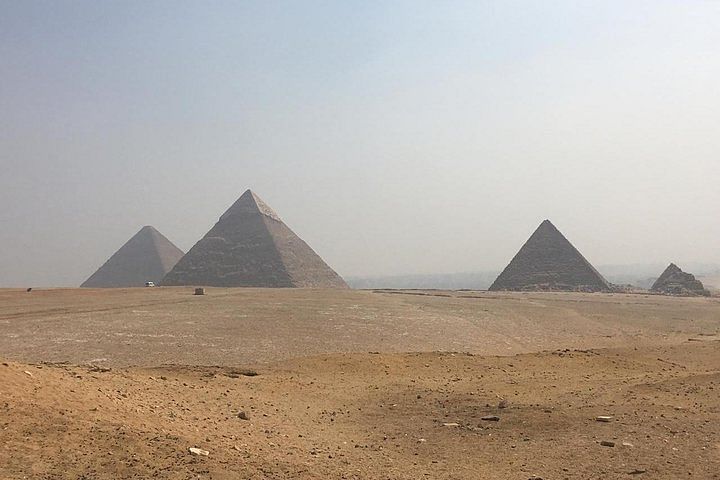
Your Egyptologist guide begins with context: the three pyramids and how they relate to each other, why Giza was chosen, what the plateau tells us about Old Kingdom Egypt, and its organizational power. This takes about ten minutes and changes everything that follows.

You then move through the site in a deliberate sequence: the Great Pyramid, the Pyramid of Khafre, the panoramic viewpoint, the Sphinx, and the Valley Temple. Your guide adjusts based on where you want more time.

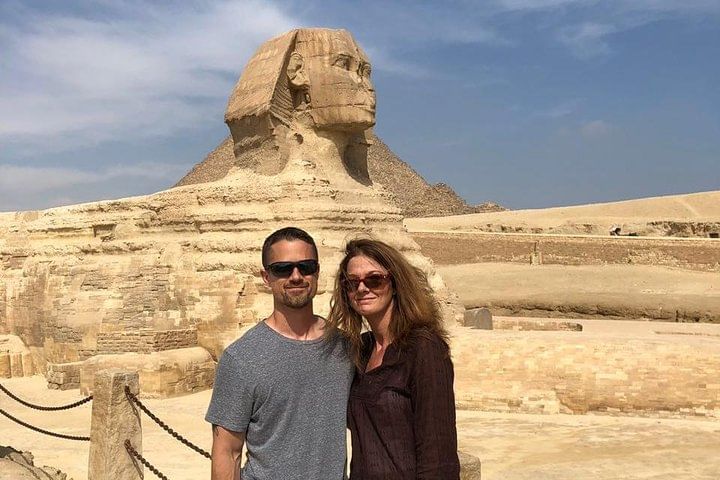
✦ The Sphinx faces east — toward the rising sun. Most visitors photograph it from the south. Your guide will position you correctly in front of it so you can understand what the ancient Egyptians intended you to see.

Sites You Will Visit

  • The Great Pyramid of Khufu
  • The Pyramid of Khafre
  • The Pyramid of Menkaure
  • The Great Sphinx and Valley Temple
  • Panoramic viewpoint across the plateau

Our Guide Note

After 20 years of standing at the Giza plateau, the thing that still surprises first-time visitors is the silence. Not silence exactly — Cairo is never silent — but the way sound seems to stop at the edge of the plateau. We always arrive before 8 am, before the tour buses from the cruise ships. That first hour, when the light is still orange and low, and the shadows of the pyramids stretch toward you, is when most of my guests say they finally understand why they came to Egypt. The Sphinx is smaller than you expect from photographs — but standing ten meters from its paw, looking up at the weathered face, you feel the scale shift completely. I always stop there and explain what Khafre was actually communicating when he built it. That context changes everything.

Common First-Time Questions

Can I extend this tour to include Saqqara or the  Grand Egyptian Museum?

Yes — speak to us before booking. Saqqara, 30 minutes from Giza, adds significant historical depth. The Grand Egyptian Museum is 15 minutes from Giza. Either addition converts this into a full-day tour.

Will I be pressured to buy anything?

No. This is a private tour. We do not include commission-based stops, and your guide will not redirect the itinerary for shopping.

Can the pacing or order be adjusted?

Yes. This is private — the schedule adapts to you. If you want to spend longer at one site or skip something, tell your guide.

Is this suitable for travelers arriving from a long flight?

We recommend scheduling your first full tour after at least one night of sleep in Egypt. If you are booking for the arrival day, we can discuss a gentler start time.


What's included?
    • Private hotel pickup and drop-off in Cairo or Giza
    • Private, air-conditioned vehicle throughout
    • Licensed Egyptologist guide, full tour
    • Entrance fees to all listed sites
    • Lunch at a good quality restaurant
    • 30 minutes camel ride around the Giza pyramids (if option selected)
    • Bottled water
    Exclusions
    • Tip or gratuity
    • Extra entrance fees (interior of the pyramids)
    • Tips
    • Remote pickup locations or airport require extra charge
    Please note

      Pickup & Timing: Your guide contacts you the evening before your tour via WhatsApp to reconfirm the exact pickup time and your hotel details. Pickup is from the lobby of any hotel in Cairo or Giza (Luxor or Aswan for southern tours). If you're staying in an Airbnb or non-hotel accommodation, share your location pin when booking so your driver can find you easily.

      What You'll Pay On-Site: All entry fees listed in the itinerary are included. If you choose optional upgrades during the tour — such as entering the Tutankhamun tomb, the Seti I tomb, or the Great Pyramid interior — these are paid on-site by credit or debit card. Your guide will advise whether each upgrade is worthwhile before you decide. Cash is no longer accepted at most major archaeological sites in Egypt.

      Weather & Sun Egypt is hot and dry for most of the year. From October to March, daytime temperatures in Cairo are comfortable (18–25°C / 65–77°F), but mornings can be cool. From April to September, expect 35–45°C (95–113°F) at open-air sites. The Giza Plateau, Valley of the Kings, and Karnak have almost no shade. Your guide schedules site visits to avoid the worst midday heat, but sun protection is essential regardless of season.

      Dress Code: Dress comfortably and modestly. At mosques (Al-Hussein, Al-Azhar, Alabaster Mosque), shoulders and knees must be covered — this applies to all genders. At archaeological sites, there is no dress code, but lightweight long sleeves protect against the sun better than sunscreen alone. Comfortable closed-toe shoes with grip are essential — sites involve walking on sand, uneven stone, and rough terrain.

      Photography: Photography is permitted at most outdoor archaeological sites. Inside tombs (Valley of the Kings), photography is generally prohibited unless you purchase a separate photography ticket. Inside the Grand Egyptian Museum, photography rules vary by gallery — your guide advises on the day. Drone photography at all archaeological sites requires permits that are extremely difficult to obtain. Do not fly a drone without confirmed authorization.

      Payments & Currency Egypt's currency is the Egyptian Pound (EGP). Most tourist-facing businesses accept credit/debit cards and USD. Your guide and driver accept tips in EGP, USD, or EUR. ATMs are widely available in Cairo, Luxor, and Aswan. Recommended tipping: $5–10 per person for your guide on a half-day tour, $10–15 on a full day. $3–5 for your driver.

      Health & Safety: Drink only bottled water (provided on your tour). Tap water in Egypt is not safe for tourists. Carry any personal medications you need — pharmacies are available but may not stock specific brands. Apply sunscreen before departure, not on-site — you'll be in the sun within minutes of arriving at most sites. Travel insurance is required for all tours and is not provided by Pyramids Land.

      Cultural Notes: Egyptians are genuinely welcoming. "Shukran" (thank you) and "Salaam alaikum" (peace be upon you) go a long way. At tourist sites, you may be approached by local vendors or people offering unsolicited help (leading you to a viewpoint, taking your photo). A polite "la, shukran" (no, thank you) works. Your guide manages these interactions so you don't have to.

      What to bring
        • Comfortable closed-toe shoes with grip (sand, uneven stone, rough terrain at all sites)
        • Hat with a brim — essential at Giza, Saqqara, Valley of the Kings, Karnak, and all open-air sites
        • Sunscreen (apply before departure — you'll be in the sun immediately on arrival)
        • Sunglasses
        • Camera or smartphone (charged — there are no charging points at sites)
        • A light scarf or shawl for mosque visits (shoulders and knees covered)
        • Small daypack for water, camera, and sun protection
        • Any personal medications you need during the day

        We provide bottled water throughout the tour. You do not need to bring your own.

        Explore the tours above. Read the details. Ask questions if needed. Book only when it feels right.

        How pricing works

        Prices are based on:

        • Group size
        • Duration
        • Inclusions listed on the tour page

        You will always know what is included before booking. There are no surprise additions.
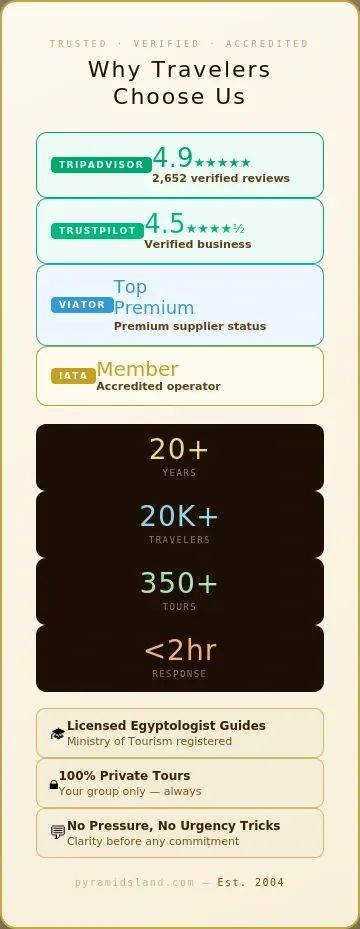
        Pyramids Land Tours trust signals — TripAdvisor 4.9 stars with 2,652 verified reviews, Trustpilot 4.5 Trusted Business

        What our clients say


        Gold ancient Egyptian crook and flail on deep navy — Pyramids Land Tours.
        By Ashraf Fares July 10, 2026
        An Egyptologist explains the crook and flail — the king as shepherd, why Osiris holds them, and where to see Tutankhamun's own pair at the GEM.
        Gold ancient Egyptian was scepter hieroglyph over a rising sun on a deep navy background
        By Ashraf Fares July 6, 2026
        An Egyptologist explains the was scepter — its meaning of power and dominion, the Set-animal head, the ankh-djed-was triad, and where to see it in Egypt.
        Gold ancient Egyptian cartouche name-ring hieroglyph over a rising sun on deep navy — Pyramids Land
        By Ashraf Fares July 4, 2026
        An Egyptologist explains the Egyptian cartouche: what it meant, the royal names inside, how it cracked hieroglyphs, and how to get your name in one.
        Gold ancient Egyptian scarab beetle hieroglyph over a rising sun on a deep navy background
        By Ashraf Fares July 2, 2026
        An Egyptologist explains the Egyptian scarab beetle — Khepri, the rising sun and rebirth, heart scarabs, and where to see the giant scarab at Karnak.
        Eye of Horus (wedjat) carved into weathered sandstone, traces of ancient blue and ochre pigment, lit
        By Ashraf Fares June 30, 2026
        The Eye of Horus explained: the wedjat myth, its meaning for healing and protection, how it differs from the Eye of Ra, and where to see it in Egypt.
        Sunrise from the summit of Mount Sinai in Egypt with travelers watching golden light strike the gran
        By Ashraf Fares June 21, 2026
        Three zones most guides treat as one. Red Sea diving, Bedouin desert camps, Mount Sinai at dawn. Costs, free visa stamp, and how Sinai fits your Egypt trip.
        Golden morning light falling through the carved stone columns of an ancient Egyptian temple hall
        By Ashraf Fares June 15, 2026
        Which Egyptian temples are worth visiting, and how to avoid "temple fatigue"? An Egyptologist ranks the major temples by what you care about — and says what to skip.
        Dimly lit ancient Egyptian royal burial chamber with a stone sarcophagus in warm golden light, evoki
        By Ashraf Fares June 11, 2026
        Tutankhamun's full story — Amarna family, 1922 discovery, the real cause of death, what's inside KV62, and where to see everything in Egypt in 2026
        A child's hand touching a limestone block at the base of the Great Pyramid in morning light.
        By Ashraf Fares June 5, 2026
        The silence at Karnak. The tears at Abu Simbel. The moment Egypt stops being a destination and becomes something you carry home.
        Ancient Alexandria harbor at golden hour — a woman in 
Ptolemaic court dress on a marble terrace, th
        By Ashraf Fares May 27, 2026
        Who was Cleopatra really? Strategist, linguist, last pharaoh. Her history, her Egypt, and where to see it today. Private Egyptologist-led tours.
        Show More