
Package of Honeymoon in Egypt
A private experience shaped around your time and interests.
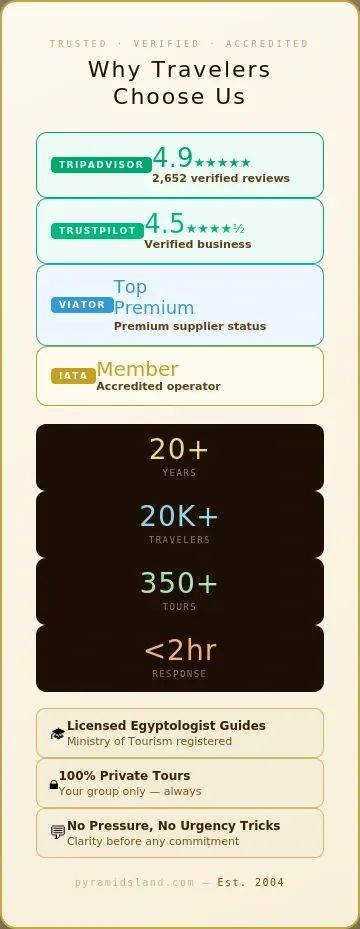
★ 4.9 · 2,678 reviews on TripAdvisor · Licensed since 2001 · Free Cancellation

For couples who want Egypt's full experience — and a quiet ending.
Egypt in full. The monuments, the river, the sea — and a farewell lunch on the Nile before the trip changes tone.
This itinerary does something the others don't: it ends differently. After seven days of ancient Egypt — the museums, the temples, the history — it finishes with two days at the Red Sea. No schedule. No guide. No sites to absorb.
That contrast turns out to matter. Couples who do this itinerary consistently say that the Red Sea ending is what made the whole trip feel complete rather than just finished.
Highlights
- Grand Egyptian Museum & Giza Plateau — two full Cairo days with a private Egyptologist, starting at first light
- Optional Saqqara — the Step Pyramid of Djoser and the painted Old Kingdom mastaba tombs, quieter and older than Giza
- Three nights on a 5-star Nile cruise ship — Luxor to Aswan, full board, private excursions at every port
- Temple of Horus at Edfu — the best-preserved temple in Egypt, reached before the day tour coaches arrive
- Philae Temple on its island — the relocated sanctuary of Isis, approached by motorboat across the Aswan reservoir
- Private farewell lunch in Aswan — arranged at a Nile-view terrace restaurant before the transition to the Red Sea; the last meal on the river
- 2 nights at a 5-star Red Sea resort in Hurghada — warm water, accessible reef, full resort amenities — and no schedule
- Exclusively private throughout — licensed Egyptologist and private vehicle for all archaeological days
Who This Tour Is For
- Couples who want Egypt's full arc — history, river, and sea — in one honeymoon trip
- Anyone for whom nine days is the right length: enough time for everything without leaving them exhausted
- Those who have always wanted to see Egypt but also want the Red Sea — this itinerary doesn't ask you to choose
- Couples returning to celebrate an anniversary who want the definitive Egypt experience
What Makes This Tour Different
- The Red Sea ending changes the shape of the trip — two days in Hurghada after the ancient sites aren't a holiday afterthought; they're a decompression that makes the entire journey feel complete. The Nile and the sea together are what the nine-day honeymoon does that shorter itineraries can't.
- Nothing is rushed to fit in nine days — Cairo gets two full days, the cruise gets three nights, Aswan gets a real day, and Hurghada gets two nights. The itinerary doesn't borrow from itself
- Private farewell dinner in Aswan — arranged on Day 7, before the transition to the Red Sea. A last evening on the Nile, before the tone of the trip changes entirely.
- Hurghada is 30 minutes from Aswan by air — the transition from ancient Egypt to beach resort takes less time than most people expect, which means you lose none of the history to travel.
Why This Itinerary Has a Quiet Ending
Nine days gives this honeymoon something the shorter packages don't have: a genuine close. After seven days of ancient Egypt — the museums, the temples, the history accumulating in layers — the trip finishes with two days at the Red Sea. No schedule. No guide. No sites to absorb. Just warm water, a good resort, and the particular quality of doing nothing after eight extraordinary days.
The Hurghada ending turns out to matter more than most couples expect. The contrast is the thing — the jump from the Nile Valley to the coast, from ancient stone to clear water, from context-rich touring to genuinely empty time. Couples who take this itinerary consistently describe the Red Sea days as the ones they didn't know they needed until they were in them.
The rest of the trip is built to earn that ending. Two days in Cairo. The Luxor-to-Aswan cruise lasts three nights. A private farewell lunch in Aswan on the last day before the flight to Hurghada, at a Nile-view terrace restaurant — the last meal on the river before the tone of the trip changes entirely.
What You Will Experience
Day 1 — Arrival in Cairo
Private airport transfer to your hotel. Check in and settle in. Your Egyptologist contacts you this evening to confirm the Day 2 start time. Dinner recommendation provided — nothing scheduled tonight. The trip begins gently.
Day 2 — Grand Egyptian Museum
The Grand Egyptian Museum occupies the full morning. Your private Egyptologist structures the session around the Tutankhamun collection: four thousand objects from a single tomb, displayed in their own dedicated wing. The golden death mask. The gilded shrine. The canopic chest with its four alabaster jars. The miniature coffins that held the king's organs. The shabtis — thousands of small servant figures buried to work on the king's behalf in the afterlife. Three to four hours, calibrated to your response. This is the context you carry for the rest of the trip: every site from here connects back to objects and names you first encountered this morning. Afternoon at leisure.
Day 3 — Giza Plateau · Optional Saqqara
Early start at Giza. The three pyramid complexes and the Sphinx, before the midday heat and before the largest groups assemble. The Great Pyramid of Khufu, Khafre, with its intact casing stones at the summit, and the smaller Pyramid of Menkaure. The Sphinx from the south angle — the view most visitors never reach. Your Egyptologist explains the logistics of construction: how 20,000 people quarried, transported, and placed two million stones in twenty years. Not as a mystery, but as a solvable engineering problem that the evidence supports. Saqqara in the afternoon if energy allows — the Step Pyramid of Djoser, the world's oldest monumental stone structure, and the painted mastaba tombs of the Old Kingdom viziers. Saqqara is a different kind of site from Giza: older, quieter, more immediately human, and worth the extra half-day if you have it.
Day 4 — Fly to Luxor · East Bank Temples
Morning domestic flight to Luxor. Karnak Temple in the afternoon with your Egyptologist: the largest religious complex ever built, added to by thirty pharaohs over 2,000 years. Your guide explains the construction sequence — which pharaoh built what section and why — turning the accumulation of pylons, obelisks, and halls into a legible political document rather than a bewildering collection of stones. The hypostyle hall, 134 columns, the tallest reaching 23 metres, is the single most visually overwhelming interior in ancient Egypt. Luxor Temple at dusk: the sandstone turns amber in the evening light, and the scale becomes more intimate. Dinner by the Nile — the Luxor waterfront at this hour is one of the most atmospheric settings in Egypt.
Day 5 — Luxor: West Bank · Embark Cruise
The full West Bank in the morning. Valley of the Kings — three tombs chosen by your Egyptologist based on what engaged you at the GEM three days ago. If the Amarna period caught your interest, there are tombs here that follow it directly. Hatshepsut's Temple at Deir el-Bahari: the three-tiered colonnaded terrace cut into the cliff face, dedicated to the female pharaoh who ruled Egypt for twenty years before her successor systematically chiselled her cartouches from every surface. Your guide explains who did it and why — and why it ultimately failed. The Colossi of Memnon on the return: the two seated quartzite statues of Amenhotep III that once guarded the entrance to the largest mortuary temple in Thebes. Board your 5-star Nile cruise ship in the afternoon. Your cabin, the sundeck, and dinner on the river as the boat begins to move south. The Nile cruise begins.
Day 6 — Sailing South · Edfu Temple '
The boat docked overnight near Edfu. Morning visit to the Temple of Horus by horse-drawn carriage from the riverside — the best-preserved temple in Egypt, its walls carrying the full mythological cycle of Horus and Set in extraordinary carved detail. Your Egyptologist reads the sanctuary reliefs in sequence: the conflict, the resolution, the coronation of Horus as rightful king. The hypostyle hall with its 18 columns is the antechamber to a sanctuary that has stood almost completely intact for over 2,000 years. Return to the boat and sail south through the afternoon. The Nile opens out as you move further into Upper Egypt — the desert draws closer to the water, and the farmland thins. Afternoon on the upper deck. The river at its own pace.
Day 7 — Kom Ombo · Sail to Aswan
Kom Ombo Temple in the morning, approached directly from the river. The dual temple dedicated simultaneously to Sobek, the crocodile god, and Horus, the elder, two deities, two sanctuaries, two complete ritual systems inside a single symmetrical building. Every element on the left is mirrored on the right, each side serving its own god with its own priesthood. The crocodile mummy museum attached to the temple holds actual mummified crocodiles — physical evidence of a cult that the temple's art otherwise makes feel abstract. Continue south toward Aswan through the afternoon. The first granite outcrops of the Aswan region appear in the river — grey and warm-toned, the Nile narrowing and quickening around them. Dinner on board as the boat approaches Aswan.
Day 8 — Aswan: Philae Temple · Private Farewell Lunch · Fly to Hurghada
Disembarkation in Aswan. Philae Temple by motorboat — the island sanctuary of Isis, relocated stone by stone to its current position before the Aswan reservoir rose. One of the most quietly beautiful sites in Egypt: human scale, a water setting, and an unusual completeness. Your Egyptologist provides the UNESCO relocation context: the same campaign that saved Abu Simbel. Private farewell lunch in Aswan — arranged at a Nile-view terrace restaurant, a last meal on the river before the trip changes tone. Afternoon domestic flight to Hurghada. Check in to your 5-star Red Sea resort. The ancient Egypt portion of the trip ends here. First evening at the resort, at leisure.
Day 9 — Hurghada · Red Sea · Departure
A full day at the Red Sea resort. No guide, no schedule, no sites. Snorkeling over the coral reef — the Red Sea off Hurghada has clear, warm water and accessible reef within a short boat trip of the resort hotels. Diving available through the hotel if you're certified or want an introductory lesson. Or simply the beach and the pool, and the particular quality of doing nothing after eight days of extraordinary things. Late transfer to Hurghada Airport for your international departure.
Romantic Additions Available on Request
- Private Nile felucca at sunset in Aswan (Day 7 late afternoon, before disembarkation)
- In-room welcome amenity on arrival in Cairo
- Private snorkeling boat charter in Hurghada (Day 9 morning)
- Nile dinner cruise in Cairo (Day 2 evening) with a private table. Frequently Asked Questions
Frequently Asked Questions
Why does this itinerary end at the Red Sea rather than Aswan or Cairo?
By Day 8, most couples on this itinerary have absorbed eight days of ancient Egypt: two days in Cairo, Luxor East and West Banks, three nights on the Nile, and Aswan. The Red Sea ending works because it is genuinely different from everything that came before — warm water, no historical context required, no Egyptologist, no schedule. The contrast is the point. Couples who take the 9- day consistently describe the Hurghada day as the one they didn't know they needed until they were in it. If you'd rather end in Aswan or Cairo, we can adjust the routing — contact us.
Is one day in Hurghada enough?
For the purpose of this itinerary — decompression, beach, the Red Sea — one full day is the right amount. This isn't a resort holiday; it's the ending of an Egyptian honeymoon. If you want two or three days at the Red Sea, we can extend the itinerary. The 11-day luxury tour includes Hurghada as a 2- night addition and may be the better option if the beach is as important as the history.
Can we upgrade to a different Red Sea location — Sharm El Sheikh instead of Hurghada?
Yes. Sharm el-Sheikh is accessible by flight from Aswan via Cairo and is a valid alternative. The reef quality around the Sinai is comparable to Hurghada; the setting is slightly different — Sharm is more sheltered, with a quieter atmosphere. The flight routing takes slightly longer. Let us know your preference when you enquire, and we'll confirm the connection options.
Is the private farewell lunch in Aswan included or optional?
The private farewell lunch in Aswan on Day 8 is included in the itinerary — it's the meal before the airport transfer to Hurghada, at a Nile-view restaurant arranged by your Egyptologist. It is the last structured meal of the ancient Egypt portion of the trip. The Hurghada resort meals are arranged by the hotel at your own expense.
Explore the tours above. Read the details. Ask questions if needed. Book only when it feels right.
How pricing works
Prices are based on:
- Group size
- Duration
- Inclusions listed on the tour page
You will always know what is included before booking. There are no surprise additions.