
Visiting the Giza Pyramids in 2026: Tickets, the New Entrance & What to See
***Edited June 10, 2026
Short answer: The Giza Pyramids sit about 13–15 km (30–45 minutes) from central Cairo, right beside the Grand Egyptian Museum. As of 2025–2026, the plateau works differently: the main entrance moved to a new gate on the Fayoum Highway, private cars and tour buses are no longer allowed inside, and visitors ride electric shuttle buses between stops. Tickets are sold online, and your entry is single-entry. You can go inside the Great Pyramid on a separate ticket — a steep, bare climb that's worth it for the curious. Go early, and know how the camel sellers work before you arrive.
The Pyramids of Giza are the one site almost everyone comes to Egypt to see — and the practical reality of visiting them has changed more in the last year than in the previous fifty. This guide is the current version: how you get in now, what to buy, what's actually worth your time on the plateau, and how to handle the parts that catch first-timers out.
What You're Looking At
Three pyramids dominate the plateau. The Great Pyramid of Khufu is the largest and oldest, built around 2560 BC, and the last surviving wonder of the ancient world. Khafre's pyramid looks taller because it stands on higher ground and still keeps a cap of its original limestone casing near the summit. Menkaure's is the smallest of the three. Below them sits the Great Sphinx, carved from a single ridge of bedrock, facing the sunrise. All of it belongs to the Old Kingdom, roughly 2600–2500 BC — the Pyramid Age.
That's the orientation you need on the ground. For the deeper history — how they were built, why, and what the chambers mean — those are their own stories:
→ Ancient Egyptian Pyramids — why they were built and how they evolved → The Great Pyramid of Khufu → The Great Sphinx of Giza
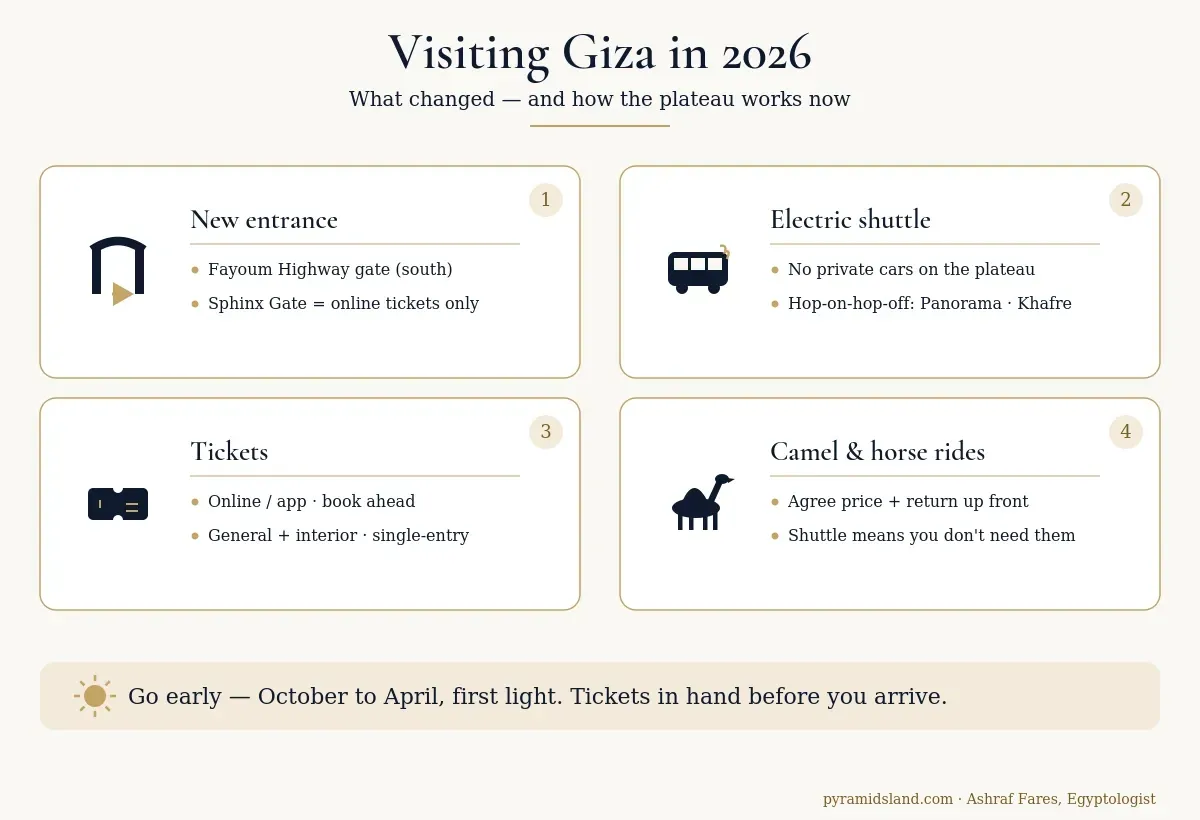
How to Visit in 2026: The New Entrance and Shuttle
This is the part most older guides still get wrong, so read it before you go. The Giza Plateau is midway through a major redevelopment, and the way you enter and move around has changed.
The main entrance moved from the historic gate near the Marriott Mena House to a new visitor center on the Fayoum Highway, on the south side of the plateau — built to ease the traffic and crowding at the old gate. The Sphinx Gate on the east side is still in use, but it has no ticket office, so you can only enter there with a ticket already bought online.
Private cars and tour buses are no longer allowed onto the plateau itself. Instead, visitors ride electric shuttle buses — a hop-on, hop-off loop that runs at short intervals and stops at the main points: the Panorama Viewpoint (the classic all-three-pyramids photo), Menkaure, and Khafre. It's included, it's air-conditioned, and it removes the old need to negotiate with a camel handler just to cross the site.
A few practical things that trip people up: tickets are sold online/by app, the official portal has had genuine glitches (payments going through without a working confirmation), so it's worth booking ahead or letting an operator handle it; and your entry ticket is single-entry — leave the plateau, and you have to buy again to return. From central Cairo, it's a 30–45-minute drive depending on traffic; if you're going independently, an Uber to the gate is the simplest option.
There are a few exceptions to the no-vehicles rule, and all of them have to be arranged in advance rather than sorted at the gate. Private electric golf carts can be booked in advance for travelers who would rather not wait for the shuttle or walk the distance — comfortable and flexible, but at a premium. Large groups (roughly 25 or more) can arrange to bring their own coach onto the site. And travelers using a wheelchair or with limited mobility can be accommodated with private vehicle access to the interior road; the shuttle buses themselves are also wheelchair-accessible, and visitors with a disability pay a reduced entry fee (roughly half price). If any of these apply to you, set them up beforehand — they are not things you can request on arrival.
Tickets: What to Buy
There isn't one ticket — there are layers. General admission gets you onto the plateau, around all three pyramids, and to the Sphinx. If you want to go inside a pyramid, that's a separate, and Menkaure is cheaper again. Photography is generally fine; drones are not allowed.
One correction worth flagging, because many guides still list it: the old Solar Boat Museum on the plateau has closed — Khufu's restored boat was moved to the Grand Egyptian Museum next door. Don't plan your Giza visit around seeing it here.
(Ticket prices change frequently in Egypt; treat any figure you read online as approximate and confirm current rates close to your trip.)
Can You Go Inside the Pyramids? (And Is It Worth It?)
Yes — you can go inside, on the separate interior ticket. Whether it's worth it depends entirely on you.
Here's the honest version. The climb into the Great Pyramid is a steep, low, hot scramble up a cramped wooden ramp, bent double in places, into a bare granite chamber that holds nothing but an empty sarcophagus. There are no decorations, no hieroglyphs, no treasure — those are at the museums. What you're paying for is the experience of standing inside the largest pyramid ever built, and for many people, that's reason enough. If you are at all claustrophobic, have knee or back trouble, or struggle in heat, skip it without regret — the outside is the real spectacle. And if you do want the inside experience for less money and fewer people, Khafre's interior offers a very similar climb with a fraction of the crowd.
The Camel and Horse Rides: The Honest Truth
The number one complaint travelers bring home from Giza has nothing to do with the pyramids — it's the camel and horse sellers. The classic version goes like this: a friendly offer of a cheap or "free" ride, and then, once you're up on the animal and out on the sand, a demand for a much larger sum to bring you back down. The pressure can be persistent, and it has soured many first visits.
Two things have changed, and both are worth knowing. First, the new shuttle system means you no longer need a camel or horse to get around — that was always the leverage, and it's largely gone. Second, the animal handlers have been relocated to designated zones, partly in response to serious animal-welfare concerns (organizations including PETA have documented mistreatment), and a growing number of travelers now skip the rides on ethical grounds alone. If you still want a short photo-ride for the experience, agree the full price and the return trip in writing before you get on, and don't hand over anything until you're back where you started.
The Best Time to Visit
The best months are October to April, when the desert heat is manageable. For time of day, early morning wins: it's cooler, the light on the stone is soft, and you reach the Panorama Viewpoint before the day's crowds and the strongest sun. Late afternoon offers good light too, with the sun lower on the pyramids. Avoid the middle of a summer day — by midday in July, the plateau is punishing — and, if you can, the Egyptian school holidays, when the site is busiest.
Getting In Ahead of the Crowds
Here's the part the "go early" advice never explains: under the new system, arriving early isn't enough on its own. The crowd you're trying to beat arrives in waves — the cruise and coach groups funnel through the same gates and onto the same shuttles within a tight window mid-morning, and once that wave starts, the Panorama Viewpoint, the Sphinx, and the interior queues fill within minutes. Getting genuinely ahead of it depends on three things most independent visitors only work out afterward: which gate to use, having a first-slot timed ticket already in hand before the booking portal wakes up, and knowing the order to take the stops in so you're at each one before the buses reach it.
For travelers who want more than a head start, private after-hours access can be arranged — the plateau outside public visiting hours, when the site is quiet, and the light is at its best. It's a special arrangement rather than a standard ticket, so it has to be set up well in advance, but it's the closest thing there is to having the Pyramids to yourself. Short of that, a private early-entry morning does the next best thing: we hold the early entry, enter at the right gate, and run the plateau in reverse of the crowd — so the photographs everyone else takes over other people's heads, you take with the site to yourselves. Either way, it's knowing the new system well enough to stay a step in front of it — which is exactly what the online portal and a first visit can't give you.
Want the Pyramids quiet — private after-hours access, or an early-entry morning timed to land at each stop before the crowds? Message us on WhatsApp and we'll arrange it.
Giza and the Grand Egyptian Museum, Together
The Grand Egyptian Museum now stands right beside the plateau, and the two make for a natural Giza day: the monuments outside, the artifacts that came from them — including Khufu's solar boat and the full Tutankhamun collection — all within a short distance. The museum is vast; give it half a day, and note that GEM tickets are booked online only in advance at the official site, visit-gem.com. Most people do the pyramids early, then the museum, or split them across two mornings.
→ Plan the wider city: Cairo Travel Guide → Getting around: Egypt Transportation Guide
Want the new gate, the shuttle, the tickets, and the camel sellers all handled — and an Egyptologist who turns the stones into the story? Message us on WhatsApp and we'll plan your Giza day. No obligation.
Common Questions
Can you go inside the Giza pyramids?
Yes, on a separate interior ticket (the Great Pyramid of Khufu is the most expensive; Khafre is the cheaper, quieter option). Inside is a steep, hot, cramped climb to a bare granite chamber with no decoration — worth it for the experience of being inside, skippable if you're claustrophobic or have mobility issues.
How much are tickets to the Giza Pyramids?
There's a general admission ticket for the plateau and the Sphinx area, plus separate, limited tickets to go inside a pyramid. Prices change often, so confirm current rates close to your trip — and note interior tickets can sell out by mid-morning.
Do you have to book Giza tickets online now?
Increasingly, yes. Tickets are sold online and by app, and the Sphinx Gate has no ticket office at all — you can only enter there with a ticket bought in advance. The official portal has had glitches, so book ahead or have an operator handle it.
How do you get to the pyramids from Cairo?
The plateau is about 13–15 km (30–45 minutes) from central Cairo, depending on traffic. An Uber to the entrance is the simplest independent option. Private cars and tour buses can no longer drive onto the plateau itself — once inside, you move around on the electric shuttle buses. The exceptions, all arranged in advance, are private golf carts (at a premium), coaches for large groups of around 25+, and private vehicle access for wheelchair users and travellers with limited mobility.
Are the camel and horse rides at Giza a scam?
Not always, but they're the most common complaint at Giza — typically a cheap offer to get on, then a much larger demand to get down or return. The new shuttle means you no longer need them to get around, and there are real animal-welfare concerns. If you do want a photo-ride, agree the full price and the return in writing before getting on.
What's the best time to visit the Giza Pyramids?
October to April for comfortable temperatures, and early morning for the best light, the smallest crowds, and the gentlest heat. Avoid the middle of a summer day and Egyptian school holidays.
How long do you need at the pyramids?
Two to three hours covers the plateau comfortably — the viewpoints, the Sphinx, and time inside one pyramid if you choose. Pair it with the Grand Egyptian Museum next door for a full day.
Is there still a Solar Boat Museum at Giza?
No. The museum on the plateau has closed and Khufu's restored solar boat moved to the Grand Egyptian Museum next door, where you can see it now.
What's the best way to beat the crowds at the Giza Pyramids?
Arrive at opening, but know that "early" alone isn't enough under the new system — the coach and cruise groups funnel through the same gates and shuttles in a tight mid-morning window. Getting genuinely ahead means the right gate, a first-slot ticket already booked, and taking the shuttle stops in an order that keeps you ahead of the buses. For the quietest possible visit, private after-hours access (the plateau outside public hours) can be arranged in advance; short of that, a private early-entry morning is the reliable way to have the viewpoints to yourself.
See the Pyramids Properly
The pyramids reward the travelers who arrive with the practical details sorted — the right gate, a ticket already in hand, an early start, and a plan for the sellers — because it frees you to actually stand there and take in the only ancient wonder still standing. That's the whole difference between a stressful morning and one you remember.
Tell us your dates and we'll build your Giza day — early start, tickets and shuttle handled, the museum next door, no hassle. Message us on WhatsApp.
Ashraf Fares