
Solo Female Travel in Egypt: The Honest Guide From the Women Who Guide You
***Edited May 5, 2026
You have been researching this for weeks. You have read the blog posts — the ones by women who went solo and loved it, and the ones by women who went solo and swore never to return. You have read the Reddit threads, the TripAdvisor forums, and the Instagram comments. You have heard "Egypt is amazing but..." so many times that the "but" has become louder than the "amazing."
You are still here. That means some part of you already knows this trip matters enough to push through the noise.
This guide is not written by a travel blogger who visited once. It is written in partnership with the women who guide solo female travelers through Egypt every week — Zenab, Nour, Fatma, and Manar, Egyptologist guides at Pyramids Land Tours. Between them, they have walked beside hundreds of solo women through Cairo's bazaars, Luxor's temples, and Aswan's Nile-side villages. They know what happens at 8 AM at the Pyramids and what happens at 10 PM on a Cairo side street. They know what solo women fear before arrival and what they actually experience on the ground.
Here is their honest guide.
The Emotional Truth Nobody Writes About
Let's name the thing every other article dances around.
You are afraid of feeling vulnerable. Not of violence — the statistics on tourist violence in Egypt are low, and you have probably already read that. You are afraid of the feeling: being stared at by men you do not know, in a language you do not speak, in a culture where the social rules are different from everything you have learned. You are afraid of feeling like a target instead of a traveler.
That fear is rational. It is based on real reports from real women. Street harassment exists in Egypt — catcalling, persistent comments, staring, the occasional man who follows you for a block, men who appoint themselves your "Egyptian boyfriend" and trail you between shops, and — increasingly — men who find you on Instagram and message you requesting meetings. It exists in Cairo more than in Luxor, in bazaars more than in temples, in the evening more than in the morning. It is not violent in the vast majority of cases. It is not universal. And it is exhausting in a way that no male-authored travel guide can fully convey.
Nour puts it this way: "The women who arrive prepared handle it well. The women who arrive expecting it not to exist have a harder time. My job is not to pretend Egypt is something it is not. My job is to stand between you and the friction — so you experience the country, not the hassle."
A Note Before We Continue
Many women travel to Egypt solo without a guide and have extraordinary trips. Experienced solo travelers who are comfortable in intense environments — women who have navigated India, Morocco, or Southeast Asia alone — can absolutely explore Egypt independently. If that is you, this article still has practical value in the safety, transport, and clothing sections.
This guide is written for women who want the structure — not because Egypt requires it, but because it changes what you experience when your energy goes to the temples rather than to logistics and social management. If you are deciding between independent and guided, the solo itinerary page shows what a guided week looks like day by day.
What Actually Happens With a Female Guide
This is the section no competitor can write — because no competitor employs the guide.
What happened on your trip: You landed at Cairo Airport. Zenab met you before passport control. She handled the visa, walked you through baggage, and had the driver at the curb. The taxi touts at the exit did not approach — they saw you were accompanied by someone who belonged.
At the Pyramids the next morning, you noticed something immediately. The touts — the camel handlers, the "free gift" sellers, the men who attach themselves to unaccompanied women — looked at Zenab, read the situation, and moved on. Not because she said anything. Because her presence changed the social equation. You were no longer a solo foreign woman. You were a woman walking with another woman who was clearly Egyptian, clearly professional, and clearly not interested in their pitch.
In Khan El Khalili, Zenab navigated you through the narrowest alleys without a single shopkeeper following. When you stopped to admire a brass lamp, she stepped in before the vendor could begin his routine. She negotiated in Arabic, told you the fair price, and let you decide. You bought the lamp for a third of what you would have paid alone.
That evening, you walked through Zamalek after dinner. Zenab had told you which streets were busy with families after dark (safe, lively, full of ice cream shops) and which ones to avoid. You walked alone — deliberately. Because the point of having a guide is not to never be alone. It is to know exactly when and where being alone is comfortable.
This is the rhythm of every day on a guided solo trip: structure in the morning (guide, driver, sites, narration), independence in the evening (your choice — walk, eat, rest, explore). Your guide sends a WhatsApp message at 7 PM to confirm the next morning's plan and answer any questions about where to eat or walk tonight. By day three, you have a mental map of the city built from Zenab's briefings, and the evenings feel like yours — not the guide's, not the operator's, yours.
"Zenab was super friendly from the start — she greeted me and gave me helpful tips about avoiding scams before we started our tour. She showed me markets and vendors that I could actually trust. She made sure we got to the pyramids early before anyone else did so I got some amazing solo shots. She let it be my day and I got to choose what I wanted to see." — TripAdvisor review, Pyramids Land Tours
"From the moment we settled into the car, the history lesson began and the sites came alive through Manar's guidance. She was incredibly passionate about Egyptian history and by far the most knowledgeable guide we had." — TripAdvisor review, Pyramids Land Tours
The Specific Things That Change With a Guide
This is not a generic "guides are helpful" list. These are specific dynamics that solo women report, and what happens to each one when Zenab or Nour is beside you.
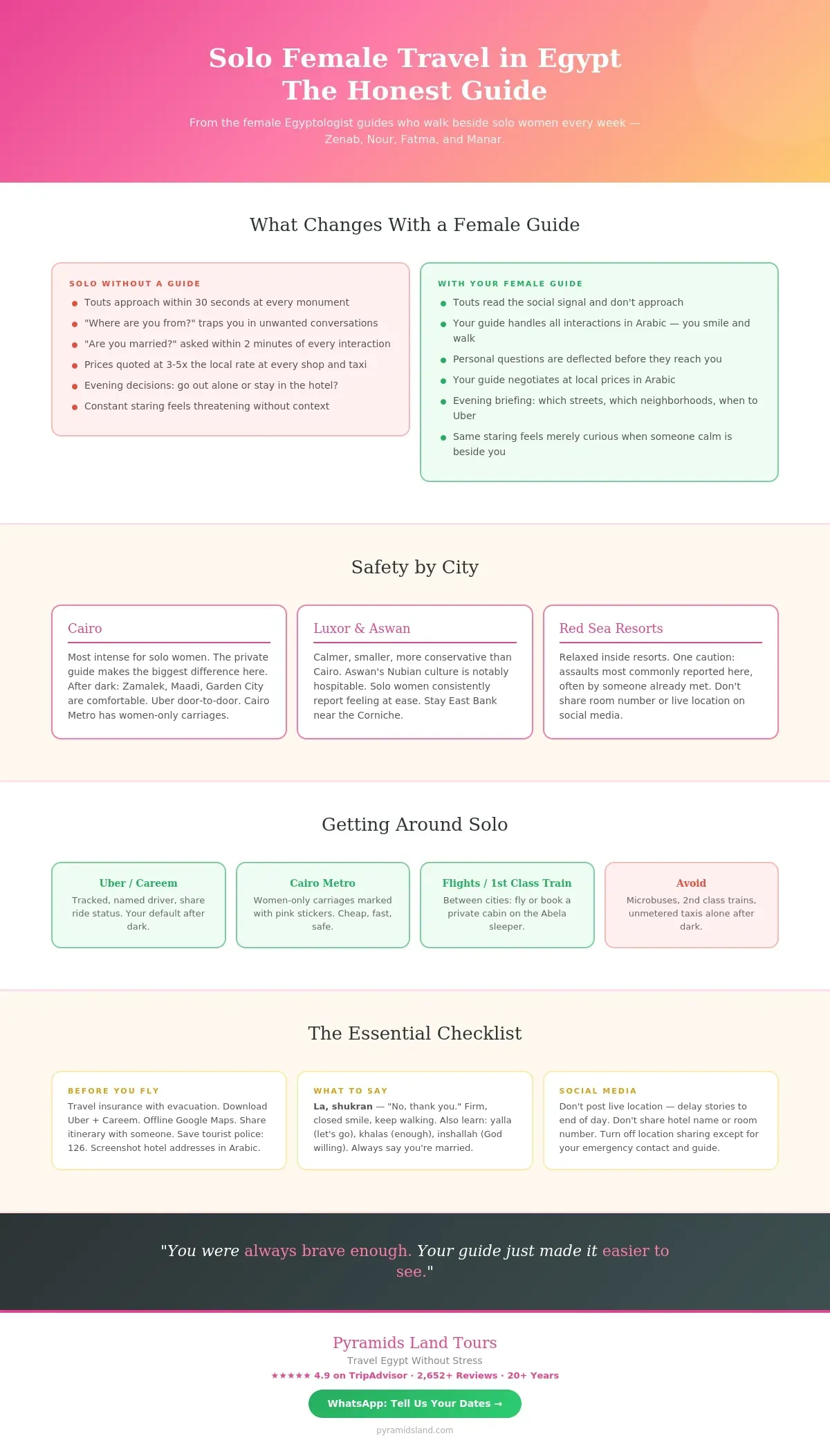
The staring. It does not stop — but its effect on you changes. Zenab explains: "Egyptian men stare. It is cultural, not personal. When I am walking with you, your brain processes the staring differently — because you have someone next to you who is unbothered by it. My calm becomes your calm." Multiple solo travelers have confirmed this: the same staring that felt threatening alone felt merely curious when accompanied. To be clear: your guide does not make the attention disappear. A man shouting from across the street cannot be prevented by anyone. What changes is that the attention never escalates beyond words — and you have someone beside you who has heard it a thousand times and is genuinely unbothered.
The "where are you from?" question. Solo, this is a trap. Once you engage — even politely, even with a smile — the conversation does not end. "My friendliness was misunderstood as flirtation," one forum poster wrote. With a guide, you do not need to decide whether to engage. Your guide handles the interaction in Arabic. You smile and keep walking. The social burden lifts.
The marriage question. "Are you married?" will be asked within the first two minutes of almost every interaction with a man — taxi drivers, shopkeepers, restaurant staff, random passersby. The universal advice from every solo female traveler who has been to Egypt: always say yes. "My husband is meeting me at the hotel," ends conversations that "no" does not. Some women wear a fake wedding ring for the same reason. With your guide beside you, this question is asked less often — and when it is, your guide deflects it in Arabic before you need to answer.
The pricing. Solo foreign women pay the highest prices in Egypt — at bazaars, at taxis, at restaurants without menus. This is not speculation; it is the consistent report of every forum poster and travel blogger. Your guide negotiates in Arabic at local prices. You pay what the item is worth, not what your foreignness commands.
The evening question. Every solo female traveler faces the same decision at 7 PM: go out or stay in? Walk to that restaurant alone? Take an Uber? The guide resolves this — not by accompanying you everywhere, but by briefing you on exactly which neighborhoods, streets, and modes of transport are comfortable after dark. Nour tells every solo traveler: "Uber door-to-door after sunset. Stay where families are walking. And share your location with me on WhatsApp — I am always available."
The mosque barrier. Solo women entering mosques can feel conspicuous. Your guide ensures you have the right coverage (the scarf you are already carrying), handles shoe removal, and walks you through the interior with the confidence of someone who enters mosques weekly. You experience the architecture, not the anxiety.
What to Wear — The 30-Second Version
We wrote a full clothing guide with location-specific advice for Cairo, Luxor, temples, mosques, cruises, and resorts. For solo women, the essential points:
Covered and loose. Shoulders covered. Knees covered. Fabric that does not cling. No visible cleavage — V-necks that feel modest at home read very differently in Cairo. Three-quarter sleeves reduce staring more than short sleeves. This is not about your rights. It is about reducing friction so your energy goes to the temples, not the social management.
Sunglasses are your best accessory. Dark, non-transparent sunglasses reduce the weariness of constant eye contact. Several of our guides call them the #1 accessory for solo women. They let you observe markets and streets without inviting interaction.
Dress to disappear. Branded clothing raises prices. Revealing clothing increases attention. Plain, unbranded, covered-and-loose clothing makes you socially invisible — which is the opposite of what it sounds like. Invisibility to hassle means visibility to the experience.
The "I'm Not Comfortable Being Alone With a Guide" Concern
This appears in Rick Steves forums, TripAdvisor threads, and our own WhatsApp inquiries. It is a legitimate concern, and we take it seriously.
Some women worry about being alone with any guide — male or female — in an unfamiliar country. The power dynamic feels uneven. What if the guide is not who they claim to be? What if you are uncomfortable and cannot leave?
Our response is structural, not just verbal:
You choose your guide's gender. Female Egyptologist guides — Zenab, Nour — are available on every itinerary, every day, no supplement. This is not a special request. It is a standard option on every booking.
Your guide is a licensed professional. Egyptian Ministry of Tourism licensed, university-trained in Egyptology, and employed by Pyramids Land for years. These are not freelancers assigned the morning of your tour.
Your driver is a separate person. You are never alone with one individual. Your guide and your driver are two different people, present at all times.
You have direct WhatsApp contact with Ashraf (the owner) throughout your trip. If anything feels wrong — anything at all — you message the owner directly. This is not a corporate complaint line. It is the phone number of the person whose name is on the company.
You can verify us before you arrive. 2,700+ TripAdvisor reviews. 4.9 rating. 20+ years of operation. IATA certified. Read the reviews from solo women specifically — they describe exactly what we are describing here.
"I came to Egypt, alone, and wanted to see as much as I could. My time with Fatma did not disappoint! She was so full of knowledge about everything and has a fun personality to go with her wisdom. I couldn't have asked for a better solo trip." — TripAdvisor review, Pyramids Land Tours
Safety by City — The Honest Breakdown
Cairo
The most intense city for solo women. The density, the traffic, the sheer number of people — it is sensory overload for everyone, and it is more charged for a woman alone. But Cairo is also where the private guide makes the biggest difference. With Zenab or Nour, Cairo is navigable, fascinating, and safe.
After dark: Several Cairo neighborhoods — including those recommended in the accommodation section below — are comfortable to walk in, with families out late. Avoid poorly lit side streets and do not walk alone in areas your guide has not briefed you on. See the transport section below for specifics on Uber, the Metro, and safe travel.
Luxor and Aswan
Calmer, smaller, more tourism-oriented — but more conservative than Cairo in social norms. The West Bank in Luxor (where the tombs are) has its own vendor culture, but it is less intense than Cairo's bazaars. Aswan is genuinely warm and welcoming — the Nubian culture is notably hospitable, and solo women consistently report feeling at ease.
Nile Cruise
One of the most comfortable ways for a solo woman to experience Upper Egypt. The ship is a controlled environment. You have your own cabin. The crew is professional. Shore excursions are with your guide. Many solo women describe the cruise as the part of the trip where they can fully relax.
For the most private experience, consider a dahabiya — a traditional sailing boat with 8-20 passengers, an intimate atmosphere, and stops at sites the large ships cannot reach.
Red Sea Resorts
Inside resorts, the atmosphere is relaxed and international. Hurghada and Sharm El Sheikh operate on different social norms from the Nile Valley. Swimwear at the pool and beach is normal.
One specific caution: The British Embassy and multiple travel sources note that sexual assaults in Egypt are most commonly reported at Red Sea resorts, often involving someone the victim had already met. Do not accept invitations from staff or locals met at the hotel. Do not share your room number. Do not post your live location on social media. Be cautious with social media connections — several solo travelers report that men find them on Instagram and request meetings.
Social Media Safety
This section exists because it did not exist five years ago, and now it matters.
Do not post Instagram stories with your live location. Post them at the end of the day, after you have left the area. Multiple solo female travelers report being found on Instagram by men who recognized them from the tourist sites.
Do not share your hotel name or room number with anyone you have met casually — not hotel staff outside your direct service team, not tour bus companions, not shopkeepers who ask "where are you staying?"
Turn off location sharing on your social profiles for the duration of your trip. Turn it on only for your emergency contact and your guide.
Getting Around Solo
Transport is where the difference between prepared and unprepared solo female travel is sharpest.
In Cairo: Uber is your default. It is tracked, the driver's name and plate are visible before you get in, and you can share your ride status with someone in real time. One critical detail: some travelers report that Uber doesn't work without an Egyptian SIM card — download the app and test it immediately after activating your SIM at the airport. Careem is the backup. Do not use unmetered street taxis alone after dark.
The Cairo Metro is clean, cheap (10-25 EGP), and faster than any Uber during rush hour. It has women-only carriages — look for the cars where only women are waiting on the platform, typically marked with pink stickers in the middle of the train. You can ride in mixed carriages, but the women-only option is available specifically for your comfort during crowded peak hours. Avoid microbuses entirely — they are cramped, routes are unmarked, and the crowded conditions create groping opportunities that are difficult to address in the moment.
Between cities: Fly or take the first-class sleeper train. Domestic flights between Cairo, Luxor, and Aswan are roughly the same price as a first-class train ticket and take one hour instead of ten. If you prefer the train for the experience, book a private cabin on the Abela sleeper — your guide can arrange this. Do not take second-class trains or long-distance buses as a solo woman.
On a Pyramids Land tour: You are in a private vehicle with a dedicated driver at all times. You never need to navigate Cairo traffic, negotiate a fare, or wonder whether a taxi is safe. This is the single largest practical advantage of a private tour for solo women — transport stress drops to zero from the moment you land.
Where to Stay
Your choice of hotel affects your solo experience more than most women expect.
Choose larger, internationally branded properties — not because they are luxurious, but because their staff is trained to interact professionally with foreign women. A TripAdvisor poster who visits Egypt solo three to four times a year explained it this way: "Staying at nicer accommodations means I don't have to venture outside the hotel alone at night to get something to eat. The staff are accustomed to foreigners and don't ask inappropriate questions."
In Cairo: Zamalek is the top neighborhood for solo women — tree-lined, walkable, with families out late, international restaurants, and a safe atmosphere after dark. Garden City is similarly comfortable and closer to central sites. Downtown Cairo is lively and well-located, but more intense. Avoid budget hotels in unfamiliar neighborhoods where you would be the only foreign guest.
In Luxor and Aswan: Stay on the East Bank near the Corniche. West Bank accommodation in Luxor can be isolated after dark.
Everywhere: Check the door lock before accepting the room. Request the upper floors rather than the ground floor. Do not open the door to unexpected visitors — call reception to confirm.
The Practical Checklist
Before your trip: Get travel insurance — confirm it covers emergency evacuation. Arrange your airport pickup. Download Uber (Cairo) and Careem. Save offline Google Maps for Cairo, Luxor, and Aswan. Share your full itinerary with someone at home. Screenshot your hotel addresses in English and Arabic. Save the tourist police number in your phone: 126. Read our tipping guide — knowing the amounts in advance reduces one more source of anxiety. Confirm your visa requirements.
During your trip: Dress covered and loose in cities and at sites. Use Uber door-to-door after dark. Do not engage with "where are you from?" from strangers — smile and keep walking. Keep your phone charged. Carry your hotel's business card in your pocket — if you are ever lost and your Arabic is not enough, show the card to any taxi driver. Carry your guide's WhatsApp number and Ashraf's direct number at all times. Trust your instincts — if something feels wrong, leave. Your safety matters more than politeness.
The phrase that changes everything: La, shukran — "No, thank you." Said firmly, with a closed smile, without breaking stride. Your guide teaches you this and several more on your first morning — yalla (let's go), khalas (enough/finished), inshallah (God willing), mashallah (a compliment shield). They transform every interaction that follows.
When to Visit as a Solo Woman
October, November, and February are the best months. Warm, manageable crowds, fair prices. Avoid summer — the heat adds a physical burden on top of the social one.
Ramadan (dates shift annually) changes the daily rhythm, but is not a reason to cancel. Sites have shorter hours, but the iftar atmosphere after sunset is vibrant and welcoming. Read our Ramadan guide for details.
What You Came Home With
You walked through a 3,000-year-old temple with a woman who had spent her career learning to tell its story. You rode a felucca on the Nile at sunset with the same woman who had navigated you through Khan El Khalili that morning without a single tout approaching.
In Luxor, Nour walked you through the Valley of the Kings at 7:30 AM — before the buses, before the heat. Inside the tomb of Seti I, she stood beside you in a corridor painted 3,200 years ago and told you the story of a pharaoh who built this for eternity. No one else was in the tomb. The colors on the ceiling — blues and golds that had never seen sunlight — glowed under the soft lighting as if they had been painted last month. You stood there for five minutes without speaking. Nour did not rush you. She understood that some moments in Egypt are not about information. They are about standing still in a place that was built for exactly that.
You sat on the deck of a Nile cruise reading a book while the landscape of Upper Egypt unfolded on both banks — and you felt, for the first time in a week of travel, completely at peace.
You were not naive about Egypt. You knew the challenges. You read the forums. You packed the right clothes. You learned "la, shukran." And then you landed and discovered that the structure around you — the guide, the driver, the itinerary, the briefings — dissolved every fear into something manageable. Not invisible. Manageable. Egypt was still Egypt. It was still intense, unfamiliar, and occasionally uncomfortable. But you were never alone in the discomfort. And that changed everything.
On the flight home, you messaged Zenab: "Thank you for making me feel brave enough to be there." She replied, "You were always brave enough. I just made it easier to see."
Your Trip Starts With One Message
Tell us your dates, whether you would like a female guide, and what your biggest concern is. We will send you the specific itinerary, the guide who will lead it, and the price.
No brochure. No pressure. Just the plan.
WhatsApp: +20 122 362 4703 — Tell Us Your Dates →
Or if you are in the US: +1 (928) 923-2598
Browse All Solo Egypt Tours → — 6, 8, and 10-day private itineraries. No single supplement. A female Egyptologist guide is available on every package.
About Pyramids Land Tours
Cairo-based. Egyptian-owned. 20+ years guiding travelers through Egypt — including hundreds of solo women who were told the trip might not be possible. Every tour is private, led by a licensed Egyptologist, and built around one principle: you should remember Egypt for what you experienced, not for what you feared.
★★★★★ 4.9 on TripAdvisor · 2,652+ Reviews · pyramidsland.com
Ashraf Fares